


Saudi Energy Minister Says OPEC+ Meeting's Outcome a 'Turning Point'

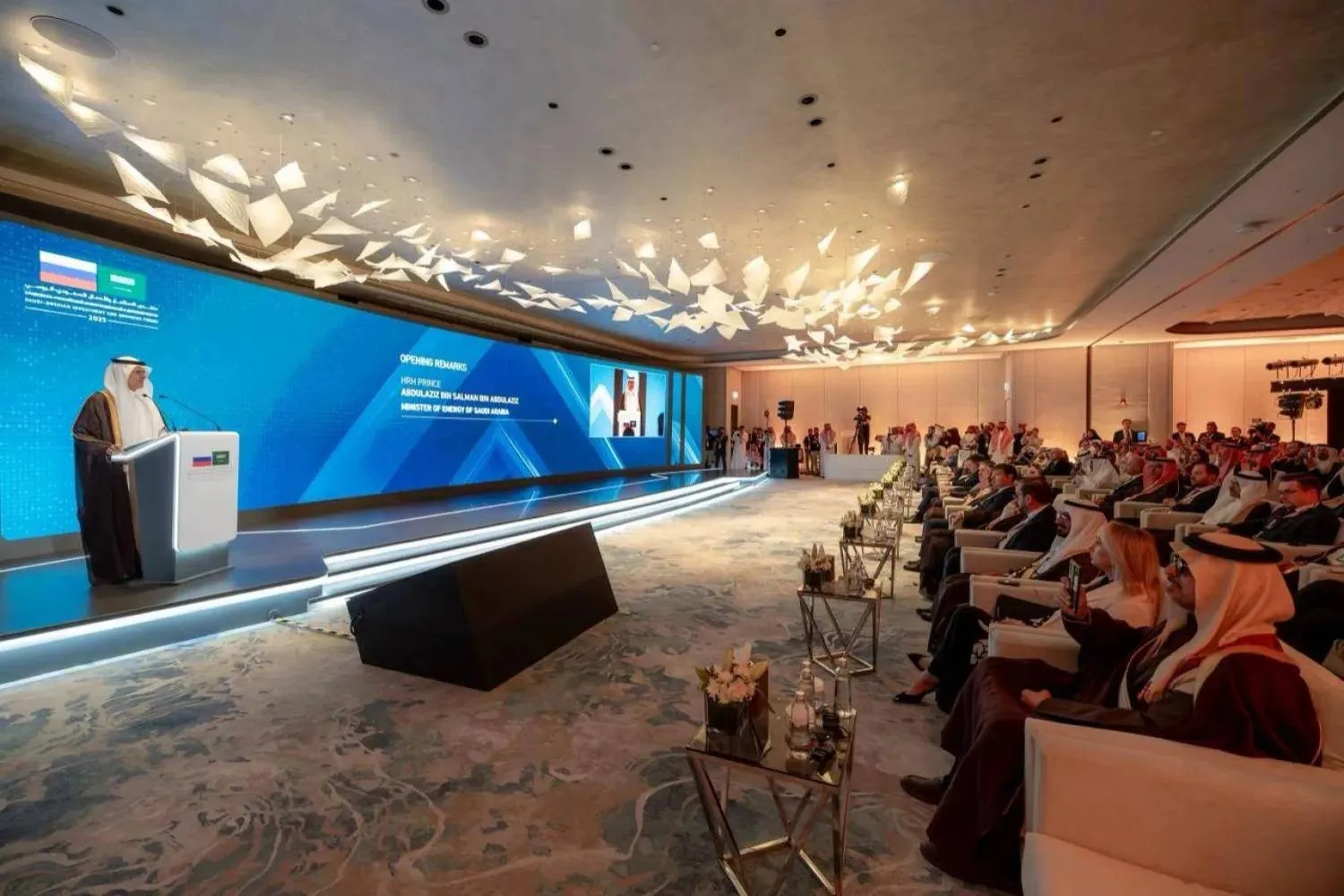
Saudi Arabia's Energy Minister speaks at the opening of the Saudi-Russian Investment and Business Forum 2025 (X).
TT

Saudi Energy Minister Says OPEC+ Meeting's Outcome a 'Turning Point'

Saudi Arabia's Energy Minister speaks at the opening of the Saudi-Russian Investment and Business Forum 2025 (X).

Saudi Energy Minister Prince Abdulaziz bin Salman said the agreement reached during Sunday’s OPEC+ meetings marks “a turning point and one of the most successful days of my career,” following the adoption of a transparent mechanism for setting production levels.

The minister, who also co-chairs the Saudi-Russian Joint Committee, made the remarks at the opening of the Saudi-Russian Business Forum 2025, organized by the Ministries of Energy and Investment.

The event was attended by Russia’s Deputy Prime Minister and committee co-chair Alexander Novak, as well as Saudi Foreign Minister Prince Faisal bin Farhan.

The Saudi minister noted that the agreement “will reward those who invest and those who believe in demand growth, placing us in a leading position among producers.”

“We will be there when the world realizes that its earlier narratives about energy will give way to consumption realities,” pointing out that those calling for abandoning hydrocarbons “are currently using every molecule of it, and asking for more.”

OPEC said the OPEC+ group had approved a mechanism to assess members' maximum production capacity to be used for setting output baselines from 2027, against which their output targets are set.

Prince Abdulaziz said the mechanism to be adopted is the 'most important and most transparent' decision for determining production levels.

The evaluation of members’ maximum production capacity is scheduled to take place between January and September 2026, according to sources following the meetings, allowing for 2027 output quotas to be set.

Bilateral Relations

Prince Abdulaziz revealed that on Monday Saudi Arabia and Russia will sign a cooperation agreement on environmental and climate-change issues. He also announced a second agreement that will allow visa-free travel between the two countries, a step that underscores the deepening partnership between Riyadh and Moscow.



Amazon Confirms Drone Strikes Hit Data Centers in the Gulf

An Amazon office in Ireland in October 2025 (Reuters)
TT

Amazon Confirms Drone Strikes Hit Data Centers in the Gulf

An Amazon office in Ireland in October 2025 (Reuters)

Amazon said Monday that two of its data centers in the United Arab Emirates were hit by drones, while a drone strike near one of its facilities in Bahrain “caused physical impacts to our infrastructure.”

The tech giant said on its website that the strikes have caused structural damage and gotten in the way of power getting to infrastructure.

“We are working to restore full service availability as quickly as possible, though we expect recovery to be prolonged given the nature of the physical damage involved,” Amazon said.

Iran has hit many countries in the Mideast in retaliation for the US and Israeli strikes.


Strait of Hormuz Under Siege: A Double Shock to Global Energy Markets

People visit Hormuz Island in the Strait of Hormuz off the Iranian city of Bandar Abbas (File photo – AFP)
TT

Strait of Hormuz Under Siege: A Double Shock to Global Energy Markets

People visit Hormuz Island in the Strait of Hormuz off the Iranian city of Bandar Abbas (File photo – AFP)

Global energy markets are on maximum alert following the military escalation in the Middle East. The outbreak of direct confrontation between the United States and Israel on one side and Iran on the other has effectively paralyzed shipping through the Strait of Hormuz - the vital artery that carries more than 20 percent of the world’s oil and gas supplies - fueling fears of a major supply shock.

How quickly oil tanker traffic resumes normal operations through the strait is now critical. Roughly one-fifth of global oil production and a similar share of liquefied natural gas transit the narrow waterway.

Estimates from JPMorgan suggest that a 25-day halt in tanker traffic would fill storage tanks in producing countries to capacity, forcing them to cut output.

On Monday, in the first trading session since Saturday’s attack, oil prices surged sharply. Brent crude, the international benchmark, jumped as much as 13 percent to trade above $82 a barrel, its highest level since January 2025.

At the same time, insurers announced the cancellation of some policies covering vessels operating in the region. Meanwhile, S&P Global Platts, a leading provider of oil price assessments, suspended bids and offers for Middle Eastern refined product benchmarks that pass through the Strait of Hormuz, citing shipping disruptions linked to the US-Iran conflict. The agency added that it is reviewing its pricing methodology for Middle Eastern crude.

Gas Crisis Deepens

The turmoil has not been limited to oil. Natural gas markets have also been jolted, with European prices jumping more than 30 percent after QatarEnergy announced a suspension of production and exports.

Qatar’s Ministry of Defense said an Iranian drone targeted an onshore gas processing facility in Ras Laffan Industrial City, forcing operations to halt.

The impact is particularly severe for Europe, which relies on Qatar as a strategic alternative to Russian gas. Ole Hvalbye, a commodities analyst at SEB, said disruption to flows through Hormuz, which account for about 20 percent of global LNG supplies, would spark fierce competition between Asian and European buyers for US cargoes, driving prices sharply higher across the Atlantic basin.

The direction of prices now depends largely on how long the conflict persists. Analysts say the base-case scenario hinges on political developments in Tehran, where the international community hopes for either a significant leadership shift or US diplomatic intervention to de-escalate tensions within one to two weeks.

However, if prices remain elevated for a prolonged period, the risk of a renewed global inflation surge looms, placing central banks in a historic bind between curbing inflation and supporting economic growth.

Asia at the Epicenter

Asia - widely regarded as the engine of global growth - now finds itself at the heart of the crisis. The region is the most exposed to the fallout from the Middle East conflict due to its heavy dependence on Gulf oil and gas supplies. This is not merely a trade disruption; it is a direct challenge to energy security across Asian capitals.

Countries such as Japan, South Korea and India rely heavily on Middle Eastern shipping lanes to secure their energy needs. In Japan, around 70 percent of imported oil passes through the Strait of Hormuz, leaving the country highly vulnerable to geopolitical tensions in the corridor. China, despite diversifying its suppliers, remains the largest buyer of Iranian crude and Qatari LNG, making the security of these flows critical to its industrial economy.

Asian governments are now scrambling to reassess their strategic reserves.

If the conflict turns into a prolonged war of attrition, countries such as Japan and South Korea could face an unenviable choice: draw down reserves that may prove difficult to replenish quickly, or accept soaring spot market prices.

With Qatari LNG supplies disrupted, Asia has already entered into intense competition with Europe for US and Australian cargoes. The scramble for alternative supplies is tightening global availability and sharply increasing energy costs across emerging Asian economies.

For India and several Southeast Asian nations, higher prices mean an immediate rise in import bills, placing heavy pressure on balance-of-payments positions and fueling imported inflation that could undermine growth targets for the year.

The strain extends beyond crude oil. Asia’s refineries - the largest in the world - depend heavily on medium and heavy Middle Eastern grades. A sustained disruption in these supplies could force refiners to cut processing rates, leading to shortages of diesel, gasoline and jet fuel within the region itself, with knock-on effects for transportation and logistics.


Demand Remained Strong in Saudi Arabia's Non-oil Business in February, PMI Shows

A general view of the city of Riyadh (AFP)
TT

Demand Remained Strong in Saudi Arabia's Non-oil Business in February, PMI Shows

A general view of the city of Riyadh (AFP)

Growth in Saudi Arabia's non-oil private sector slowed slightly in February, a survey showed on Tuesday, although demand remained strong.

The seasonally adjusted Riyad Bank Saudi Arabia Purchasing Managers' Index (PMI) slipped to a reading of 56.1 in February from January's 56.3, but remained well above the 50.0 threshold that separates growth from contraction.

"This performance was driven by ⁠robust domestic demand ⁠and a steady flow of new project approvals," said Naif Al-Ghaith, Riyad Bank's chief economist.

In February's PMI survey, the new orders sub-index remained steady at 61.8, similar to the previous month, indicating strong demand with businesses continuing to report strong output growth and a sharp rise in employment.

The rate of ⁠employment ⁠growth accelerated to a four-month high, driven by increased sales and a build-up of backlogs, according to the survey. However, the rate of staff cost inflation hit its highest since the survey began in August 2009.