



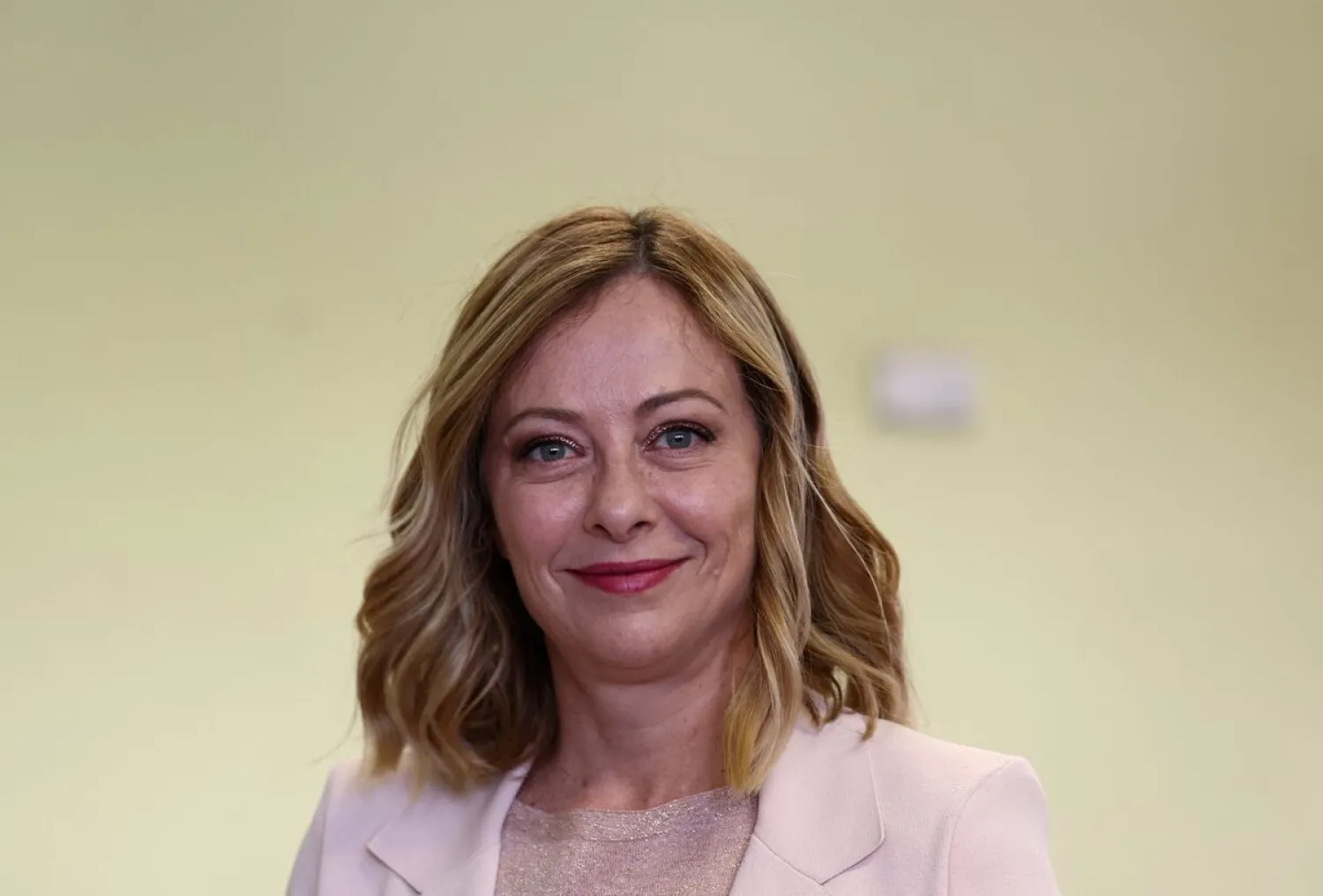

Italian Prime Minister Giorgia Meloni is expected to participate on Wednesday in the 46th session of the Gulf Cooperation Council (GCC), following an invitation from Bahrain’s King Hamad bin Isa Al Khalifa.
The Manama Summit comes amid regional security shifts and economic pressures, and the strategic importance of maritime corridors.
These conditions, analysts say, underscore the need for deeper political coordination on Gaza, Syria, Iran, and Ukraine, and for expanding cooperation in trade and investment.
Daniele Ruvinetti, senior adviser at the Italian Med-Or Foundation, described Meloni’s participation as “a remarkable diplomatic achievement for Rome.”
Speaking to Asharq Al-Awsat, he said King Hamad’s invitation is “uncommon and signals that Italy is now viewed as a reliable and pragmatic actor across the broader Euro-Mediterranean space.”
Ruvinetti noted that Meloni’s attendance reflects a phase in which Gulf states are diversifying partnerships and increasingly regard Italy as a stable counterpart capable of sustained dialogue and cooperation.
Previous GCC summits have hosted leaders including Turkish President Recep Tayyip Erdogan, Chinese President Xi Jinping, former British Prime Minister Theresa May, ex-French President François Hollande, and former Iranian President Mahmoud Ahmadinejad.
For Italy, participation in the summit supports a long-term strategy centered on economic integration, energy diplomacy, security cooperation, and reviving the political channel between the European Union and the GCC.
According to Ruvinetti, Meloni’s presence highlights three broad themes. The first is a push to intensify political coordination on key regional crises, particularly in Gaza, Syria, Iran, and Ukraine. The second is the expansion of commercial opportunities for Italian companies in sectors such as energy, infrastructure, and technology. The third is growing Gulf interest in investing in Italy, especially in projects linked to the Mattei Plan and the India–Middle East–Europe Economic Corridor.
Bahrain, which hosted in November the 19th meeting of GCC parliamentary speakers on artificial-intelligence governance and political integration, continues to position itself as a hub for dialogue with Europe and Latin America.
Ruvinetti added that Meloni’s expected bilateral meeting with King Hamad aligns with the recently launched “Strategic Investment and Partnership Framework,” and reflects Italy’s broader engagement across the region, from Saudi Arabia to the UAE and Qatar.
Gulf-Italian economic ties have strengthened steadily. Italian exports to the region reached 13.3 billion euros in 2024, a 14.2 percent increase over the previous year. In late November, Riyadh hosted the Saudi-Italian Business Forum, which brought together more than 430 Italian companies and nearly 600 Saudi firms. The event resulted in the signing of 22 bilateral agreements in infrastructure, energy, technology, healthcare, cultural industries, and agrifood.


