
Iraq on Thursday stunned observers by abruptly adding Hezbollah and Yemen’s Houthi movement to a terrorism list that triggers immediate asset freezes, only to retract the move within hours by claiming the two names had appeared in an “unedited list” slated for correction.
The whiplash decision set off confusion and disbelief in Baghdad.
The Official Gazette, which is run by the Ministry of Justice, had published last month and formally announced on Thursday a list of entities subject to asset freezes that included Hezbollah and the Houthis.
Observers said the step was expected to win praise from Washington and tighten pressure on Tehran before the government withdrew it.
The paper said a government committee had decided to freeze the assets of individuals and entities linked to the Houthis and Hezbollah, and that the Iraqi announcement, later deleted, covered more than one hundred entities and individuals worldwide.
It said the terrorism list update came in accordance with resolutions of the committee tasked with freezing funds for identifying entities and individuals subject to counter terrorism and counter terrorism financing measures.
The developments came a day after s, urged Iraqi partners to undermine Iranian militias and prevent them from threatening Iraqis and Americans.
Asset freeze for terrorists
The text in the Official Gazette shows that the Anti-Money Laundering and Counter Terrorism Financing Committee had submitted in March 2025 a list of terrorist individuals and entities for asset freezes before the Committee for Freezing Terrorists’ Funds endorsed it in October 2025.
The Ministry of Justice website published the edition that carried the decision before deleting it following a wave of outrage among pro Iran circles in Iraq.
Hossein Moanes, the head of Kataib Hezbollah affiliate group Harakat Hoquq (The Rights Movement), attacked the government as lacking dignity.
Ali Al-Asadi, head of the political council of the Harakat al-Nujaba movement, said listing Hezbollah and Ansar Allah, the Houthis, as terrorists was an act of treason, adding that the government does not represent the Iraqi people.
A confidential letter from the Central Bank of Iraq said the publication of the two names was an oversight, and that pursuant to Committee for Freezing Terrorists’ Funds Decision 61 of 2025, paragraphs 18 and 19 should be deleted because the committee did not approve them.
The bank requested that an official amendment be issued in the Official Gazette.
Iraqi bloggers reposted paragraphs from the law governing publication in the Official Gazette, which states that ignorance of what is published in the Official Gazette does not excuse its content.
However, legal experts said rescinding what is published in the Official Gazette is possible and permissible from a legal standpoint, noting that the publication law allows corrections through a statement issued by the authority that produced the decision.
Iraq’s state news agency said Baghdad would fix the list after Hezbollah and the Iran backed Houthis were added.
The asset freeze committee said the publication dated November 17 applied solely to individuals and entities linked to ISIS and Al-Qaeda, in line with a Malaysian request and with United Nations Security Council Resolution 1373. It said adding other groups occurred before the final review was completed and would be deleted in a corrected version.
Iraqi regulations state that the only way to amend or cancel what is published in the Official Gazette is through a new law that repeals or modifies the earlier one, and until then anything published is considered an official and binding announcement.
A technical step
Legal expert Ali Al-Tamimi said the Committee for Freezing Funds of Terrorist Groups is attached to the General Secretariat of the Council of Ministers and chaired by the central bank governor, with members from counter terrorism and counter narcotics agencies, the interior and communications ministries, and the Integrity Commission.
It was established under the 2012 Anti Money Laundering Law.
He told Asharq al-Awsat that the committee’s mandate is to implement Security Council decisions and that the measure is financial and economic rather than political, noting that Security Council Resolution 2140 of 2025 calls for freezing the funds of Hezbollah and the Houthis.
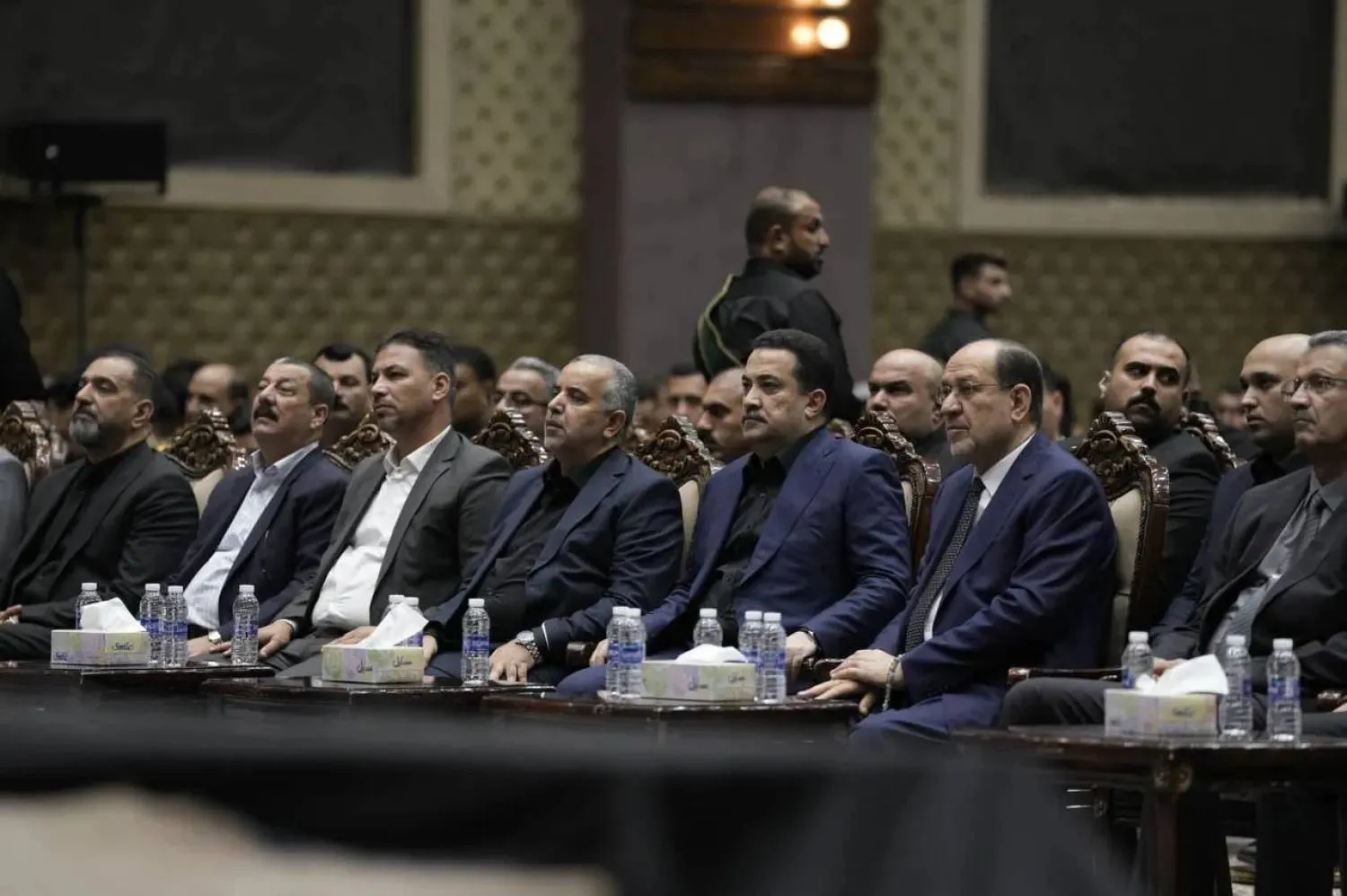
The controversy quickly fed into political jockeying over whether Prime Minister Mohammed Shia al-Sudani should serve a second term. Yasser Al-Maliki, secretary general of the Al Bashaer Movement, wrote on X that respect for the dead requires their burial, in a remark widely interpreted as a declaration that Sudani’s term had ended.
Yasser Al-Maliki is close to Nouri Al-Maliki, leader of the State of Law coalition and a prominent opponent of Sudani remaining in office.
Government probe
The government responded with a statement saying Sudani had ordered an urgent investigation, identification of those responsible and accountability for the negligence related to the committee’s decision.
It said Iraq’s political and humanitarian positions toward the aggression against its people in Lebanon and Palestine are principled and not subject to political point scoring.
Arab media outlets quoted what they described as informed sources as saying Hezbollah in Lebanon was displeased by the uproar in Iraq over its appearance on the terrorism list.
They said a senior Hezbollah figure contacted Baghdad to clarify the mistake and urged Iraqi authorities to hold those responsible to account.
Washington has for years sought to curb Iran’s influence in Iraq and other parts of the Middle East, where Tehran aligned factions operate under what is known as the axis of resistance, which has come under heavy Israeli strikes since the Gaza war erupted in 2023.
Iran, a neighbor and key economic lifeline for Iraq under sanctions, is vital to Baghdad, which continues to balance its partnership with Washington against its complex ties with Tehran at a time when Iran’s regional sway has ebbed after a string of Israeli attacks on its allies over the past year.