


Zelenskyy Refuses to Cede Land to Russia as He Rallies European Support 

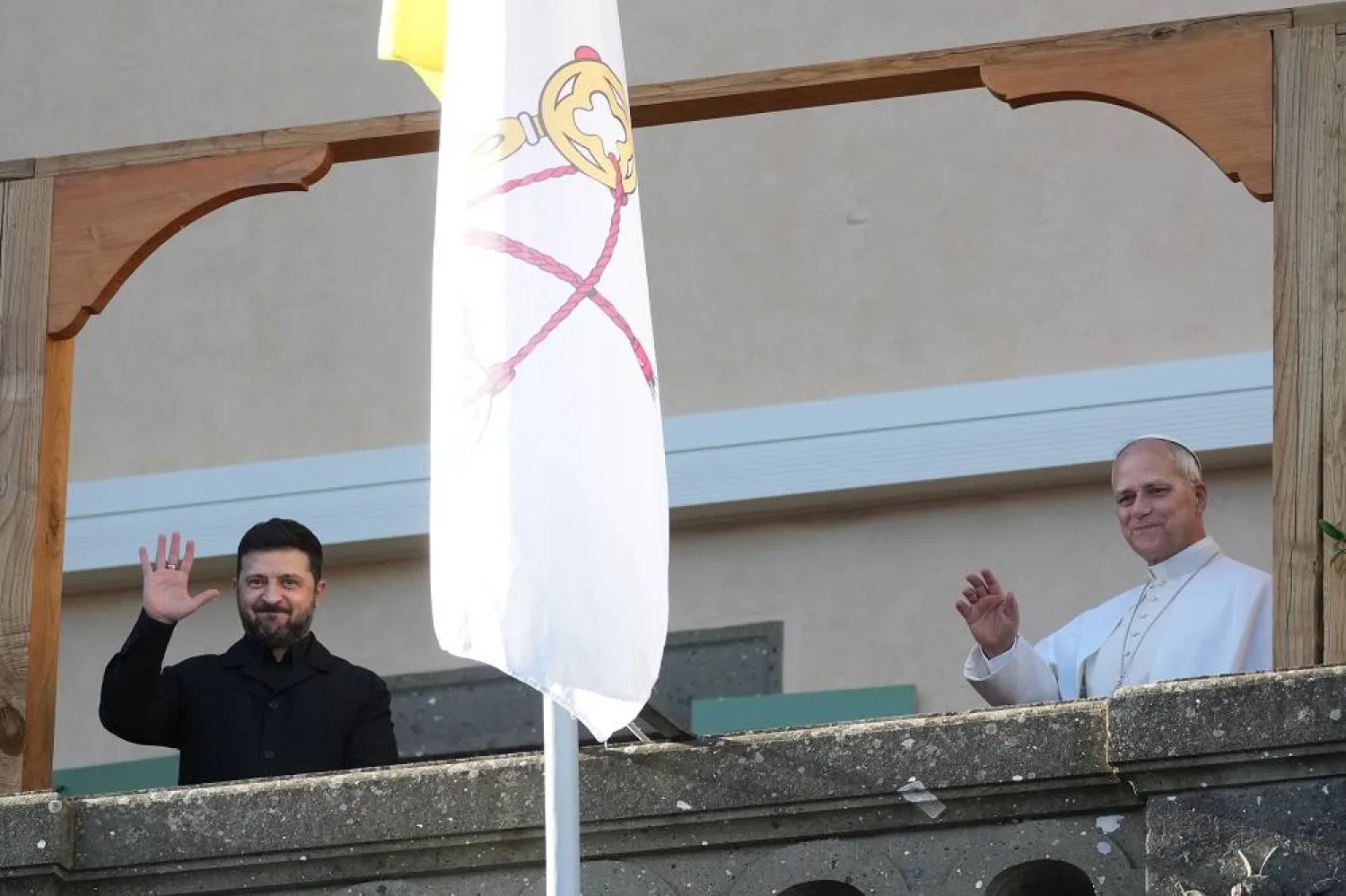
Ukraine President Volodymyr Zelenskyy and Pope Leo XIV wave to journalists during their meeting in Castel Gandolfo, Italy, Tuesday, Dec. 9, 2025. (AP)
TT

Zelenskyy Refuses to Cede Land to Russia as He Rallies European Support 

Ukraine President Volodymyr Zelenskyy and Pope Leo XIV wave to journalists during their meeting in Castel Gandolfo, Italy, Tuesday, Dec. 9, 2025. (AP)

Ukrainian President Volodymyr Zelenskyy met with the pope near Rome on Tuesday as he continued to rally European support for Ukraine while resisting US pressure for a painful compromise with Russia.

Answering reporters’ questions in a WhatsApp chat, Zelenskyy reaffirmed his firm refusal to cede any territory, saying that "we clearly don’t want to give up anything," even as "the Americans are looking for a compromise today, I will be honest."

"Undoubtedly, Russia insists for us to give up territories," he said in the message late Monday. "According to the law we don’t have such right. According to Ukraine’s law, our constitution, international law, and to be frank, we don’t have a moral right either."

The Ukrainian president met early Tuesday with Pope Leo XIV at Castel Gandolfo, a papal residence outside Rome, and is to have talks with Prime Minister Giorgia Meloni later. Zelenskyy and the Vatican didn’t comment on what was discussed.

The Holy See has tried to remain neutral in the war while offering solidarity and assistance to what it calls the "martyred" people of Ukraine. Leo has met now three times with Zelenskyy and has spoken by telephone at least once with Russian President Vladimir Putin. The American pope has called for a ceasefire and urged Russia in particular to make gestures to promote peace.

On Monday, Zelenskyy held talks in London with British Prime Minister Keir Starmer, French President Emmanuel Macron and German Chancellor Friedrich Merz to strengthen Ukraine’s hand amid mounting impatience from US President Donald Trump.

Facing pressure from Trump

US and Ukrainian negotiators completed three days of talks on Saturday aimed at trying to narrow differences on the US administration’s peace proposal.

A major sticking point in the plan is the suggestion that Kyiv must cede control of the Donbas region of eastern Ukraine to Russia, which illegally occupies most but not all of the territory. Ukraine and its European allies have firmly resisted the idea of handing over land.

In an exchange with reporters on Sunday night, Trump appeared frustrated with Zelenskyy, claiming the Ukrainian leader "hasn’t yet read the proposal."

Trump has had a hot-and-cold relationship with Zelenskyy since winning a second term, insisting the war was a waste of US taxpayers’ money. Trump has also repeatedly urged the Ukrainians to cede land to Russia to end the nearly four-year conflict.

Zelenskyy said Monday that Trump "certainly wants to end the war. ... Surely, he has his own vision. We live here, from within we see details and nuances, we perceive everything much deeper, because this is our motherland."

He said the current US peace plan differs from earlier versions in that it now has 20 points, down from 28, after he said some "obvious anti-Ukrainian points were removed."

Europeans back Ukraine

Starmer, Macron and Merz strongly backed Kyiv, with the UK leader saying Monday that the push for peace was at a "critical stage," and stressed the need for "a just and lasting ceasefire."

Merz, meanwhile, said he was "skeptical" about some details in documents released by the US. "We have to talk about it. That’s why we are here," he said. "The coming days ... could be a decisive time for all of us."

European leaders are working to ensure that any ceasefire is backed by solid security guarantees both from Europe and the US to deter Russia from attacking again. Trump has not given explicit guarantees in public.

Zelenskyy and his European allies have repeatedly accused Putin of slow-walking the talks to press ahead with the invasion as his forces are making slow but steady gains while waves of missiles and drones are pummeling Ukrainian infrastructure.

Russia and Ukraine exchange aerial strikes

Ukraine’s Air Force said Russia fired 110 drones of various types across the country last night. They said air defenses neutralized 84 drones, 24 more have struck their targets.

Several regions of Ukraine faced emergency blackouts Tuesday due to Russia’s prior attacks on energy infrastructure, according to Ukraine’s national energy operator, Ukrenergo.

Ukraine, in its turn, continued its drone attacks on Russia.

Russian air defenses destroyed 121 Ukrainian drones overnight above various Russian regions and occupied Crimea, Russia’s Ministry of Defense said Tuesday. In Chuvashia, a region about 900 kilometers (about 560 miles) northeast of the border with Ukraine, the attack damaged residential buildings and injured nine people, local governor Oleg Nikolayev said in an online statement.

Ukraine’s Security Service carried out a drone attack on an LPG terminal at the port of Temryuk in Russia’s Krasnodar region on Dec. 5, according to an official with knowledge of the operation who spoke to The Associated Press.

The official, who spoke on condition of anonymity because he was not authorized to comment publicly, said the strike sparked a large fire at the facility. More than 20 LPG storage tanks were set ablaze and burned for more than three days, he said. The attack also damaged railway tank cars, an intermediate refueling tank, and a loading and unloading rack.



Washington Cool on Nuclear Talks, Tehran Signals Conditional Readiness

Iranian flags in central Tehran on Wednesday (EPA)
TT

Washington Cool on Nuclear Talks, Tehran Signals Conditional Readiness

Iranian flags in central Tehran on Wednesday (EPA)

Washington’s silence toward Iran’s repeated calls to revive nuclear negotiations is not simply a lapse in diplomatic attention. For many analysts, it resembles a calculated test of nerves at a moment of exceptional sensitivity in Tehran.

As the United States juggles a crowded foreign policy agenda, critics say Iran’s state is fraying from within under the strain of a deep economic downturn and growing uncertainty over who will rule after Supreme Leader Ali Khamenei.

And while Tehran continues to signal conditional readiness for talks, Washington appears content to wait, perhaps for deeper internal unraveling or for a political landscape reshaped by a full reordering of Iran’s power structure.

In recent weeks, Iranian officials have repeatedly spoken of Tehran’s willingness to enter serious negotiations with the United States over the nuclear program, while Washington’s silence toward these overtures has been striking.

Tehran insists on showing a desire for dialogue under what it calls fair and balanced terms, but Washington appears in no hurry.

Analysts describe Washington’s posture as a mix of tactical patience and prioritization at a moment when Iran faces economic and political strains and lingering uncertainty over who will lead the country after Khamenei.

Washington’s Priorities

Patrick Clawson, director of research at the Washington Institute for Near East Policy, says the cool US reaction is not a final rejection but a natural result of an American political arena crowded with urgent issues from Venezuela to Ukraine, along with domestic pressures.

Clawson told Asharq Al-Awsat that President Donald Trump’s team believes Iran’s nuclear program has suffered major setbacks in recent years and no longer represents an immediate threat, making the file less pressing.

He added that US chief negotiator Steve Witkoff is overseeing dossiers the White House sees as more urgent at the moment.

This approach gives Washington comfortable room to maneuver.

The US administration does not want to enter a new round of complex and politically costly negotiations before ensuring that the right conditions exist, particularly in the absence of clear signals that Iran is ready to offer substantive concessions beyond rhetoric.

Signals of Conditional Openness

Tehran has amplified its public messaging. In an interview with Japan’s Kyodo news agency, Iranian Foreign Minister Abbas Araghchi said Iran remains open to diplomacy but is not convinced Washington is ready for genuine and serious negotiations.

Araghchi said Washington still operates with an attitude of dictates and that any return to the negotiating table must be based on fair and balanced outcomes.

Tehran also opened a technical channel with Japan, seeking assistance based on Japanese experience in dealing with nuclear crisis fallout to help secure Iranian facilities damaged by recent Israeli and US attacks.

The request reflects an implicit acknowledgment of the scale of damage to Iran’s nuclear infrastructure, even as Araghchi described the attacks as the greatest violation of international law.

This technical engagement does not indicate a shift in Tehran’s core position.

Iran continues to insist on the right to enrichment under the Nuclear Non-Proliferation Treaty and links any acceptance of new constraints to the lifting of sanctions and international recognition of its peaceful nuclear program.

Deepening Internal Divisions

Inside Iran, the situation is becoming more complex.

Clawson points to unprecedented public sparring among Iranian officials and open speculation about post-Khamenei scenarios, which he says reflect sharp disagreements within the elite.

Iranian researcher Farzin Nadimi argues the real confrontation is between two principal camps: Khamenei and his institutions on one side, and former president Hassan Rouhani and his team seeking to play a decisive role in the next phase.

There are other groups in between, Nadimi says, but these two blocs are the main poles.

Nadimi told Asharq Al-Awsat that the Islamic Revolutionary Guard Corps is acting as an observer for now, despite its direct allegiance to Khamenei.

It could, however, move forcefully after Khamenei exits the scene, possibly triggering a power struggle between the Guard and Rouhani unless the latter is pushed aside before then.

Iran is also grappling with a severe economic crisis. The national currency has lost more than 10 percent of its value in only ten days, amid persistent water shortages, repeated power outages, and what critics describe as an ineffective economic model.

Clawson cited the new gasoline pricing system, which imposes a high rate on excess consumption but remains below the cost of importing fuel, for which the government pays four billion dollars annually. Experts describe this approach as a clear sign of poor governance.

Missile Buildup and Preparing for Israel

Regionally, Israel remains a central factor in Tehran’s calculations.

Barak Barfi, a researcher at the New America Foundation in Washington, told Asharq Al-Awsat that Iran is offering no indication it is prepared to scale back its nuclear or missile programs and is instead building up its missile stockpile in preparation for another confrontation with Israel.

Barfi believes Iran aims to acquire a capacity that can overwhelm Israeli defenses through dense volleys of missile fire.

Barfi does not expect Israel to launch a military strike in the near term, citing its need to preserve freedom of action in Iranian airspace and concerns that Tehran could rebuild its air defenses.

Israeli decision makers are also weighing the risks of overstretching the home front and the possibility of an inconclusive strike, especially with the 2026 US midterm elections approaching.

A Strategy of Waiting

For now, Washington appears positioned to wait, while Tehran appears intent on buying time. With internal pressures escalating and factional rivalries sharpening, Iran’s leadership may need external de-escalation more than it needs a comprehensive agreement.

The US administration, meanwhile, believes any new negotiations require a different environment and stronger leverage, whether through sanctions or Israel’s continued “campaign between the wars.”

The American coolness is not a definitive rejection but part of a strategy of waiting and watching as Iran’s domestic situation evolves.

The only scenario that could open a genuine window for negotiation, analysts say, is Iran’s transition to the post-Khamenei era, when the system reshapes its hierarchy and when the battered economy and looming social crisis could drive Tehran to offer concessions that are not possible under current conditions.


Europeans Discuss Ukraine with Trump at ‘Critical Moment’ for Peace

This photograph taken on December 10, 2025 shows the building of a power plant of Ukrainian energy provider DTEK, which was heavily damaged during air attacks, at an undisclosed location, amid the Russian invasion of Ukraine. (AFP)
TT

Europeans Discuss Ukraine with Trump at ‘Critical Moment’ for Peace

This photograph taken on December 10, 2025 shows the building of a power plant of Ukrainian energy provider DTEK, which was heavily damaged during air attacks, at an undisclosed location, amid the Russian invasion of Ukraine. (AFP)

The leaders of Britain, France and Germany held a call on Wednesday with US President Donald Trump to discuss Washington's latest peace efforts to end the war in Ukraine, in what they said was "a critical moment" in the process.

Kyiv is under pressure from the White House to secure a quick peace but is pushing back on a US-backed plan proposed last month that many see as favorable to Moscow.

French President Emmanuel Macron, arriving late for a public debate in western France, said he had just held a 40-minute discussion with Trump and his European colleagues to see how to move forward on "a subject that concerns all of us".

Separate statements from the so-called E3 powers said the leaders had commended the Trump administration's mediation efforts to achieve a robust and lasting peace in Ukraine, nearly four years after Russia launched its full-scale invasion.

"(The leaders) agreed that this is a critical moment for Ukraine, for its people and for the common security of the Euro-Atlantic region," the British readout said.

UKRAINE UNDER INCREASED US PRESSURE TO AGREE PEACE DEAL

The three countries, along with other European partners and Ukraine, have been working frantically in the last few weeks to refine the original US proposals that envisaged Kyiv giving up swathes of its territory to Moscow, abandoning its ambition to join NATO and accepting limits on the size of its armed forces.

Among the key elements the E3 powers are trying to hammer out are potential security guarantees for Ukraine once there is a peace accord.

"Intensive work on the peace plan is continuing and will continue in the coming days," the E3 statements said.

Macron, British Prime Minister Keir Starmer and Germany's Chancellor Friedrich Merz met Ukrainian President Volodymyr Zelenskiy in London on Monday and pledged their continued support for Kyiv, amid concerns that it may be forced into accepting many of Russia's demands.

Leaders from the so-called "Coalition of the Willing" group of nations backing Ukraine will hold a follow-up meeting via videocall on Thursday, the French presidency said. Zelenskiy said he would also attend that call.

Separately, Macron and Starmer will join Merz for further talks next Monday in Berlin, two European Union diplomats told Reuters on condition of anonymity.


US Plans to Order Visa-Exempt Foreign Tourists to Disclose Social Media Histories

A passenger looks up at a flight information board on the busiest travel day of the Thanksgiving holiday, at Ronald Reagan Washington National Airport in Arlington, Virginia, US, November 25, 2025. (Reuters)
TT

US Plans to Order Visa-Exempt Foreign Tourists to Disclose Social Media Histories

A passenger looks up at a flight information board on the busiest travel day of the Thanksgiving holiday, at Ronald Reagan Washington National Airport in Arlington, Virginia, US, November 25, 2025. (Reuters)

The administration of US President Donald Trump plans to order visa-exempt foreign tourists to disclose their social media histories from the last five years before entering the country, according to an official notice.

The proposal laid out in a notice published Tuesday in the Federal Register would apply to visitors from 42 countries, including Britain, France, Australia and Japan, who do not need a visa to enter the United States.

Currently, those travelers only need to apply for a waiver known as the Electronic System for Travel Authorization (ESTA), which still requires them to provide certain personal details.

Under the proposed new rules, the collection of social media data would become a “mandatory” part of ESTA applications.

Applicants would need to provide their social media histories from the last five years, according to the notice.

They would also have to submit other “high-value data fields” including phone numbers from the last five years, email addresses from the past decade, personal details of family members and biometric information.

The public has 60 days to comment on the proposal.

The Trump administration has tightened curbs on entering the United States, part of a sweeping crackdown on migration.

Along with Mexico and Canada, the country will host the 2026 World Cup, which is certain to attract large numbers of football fans from across the world.