

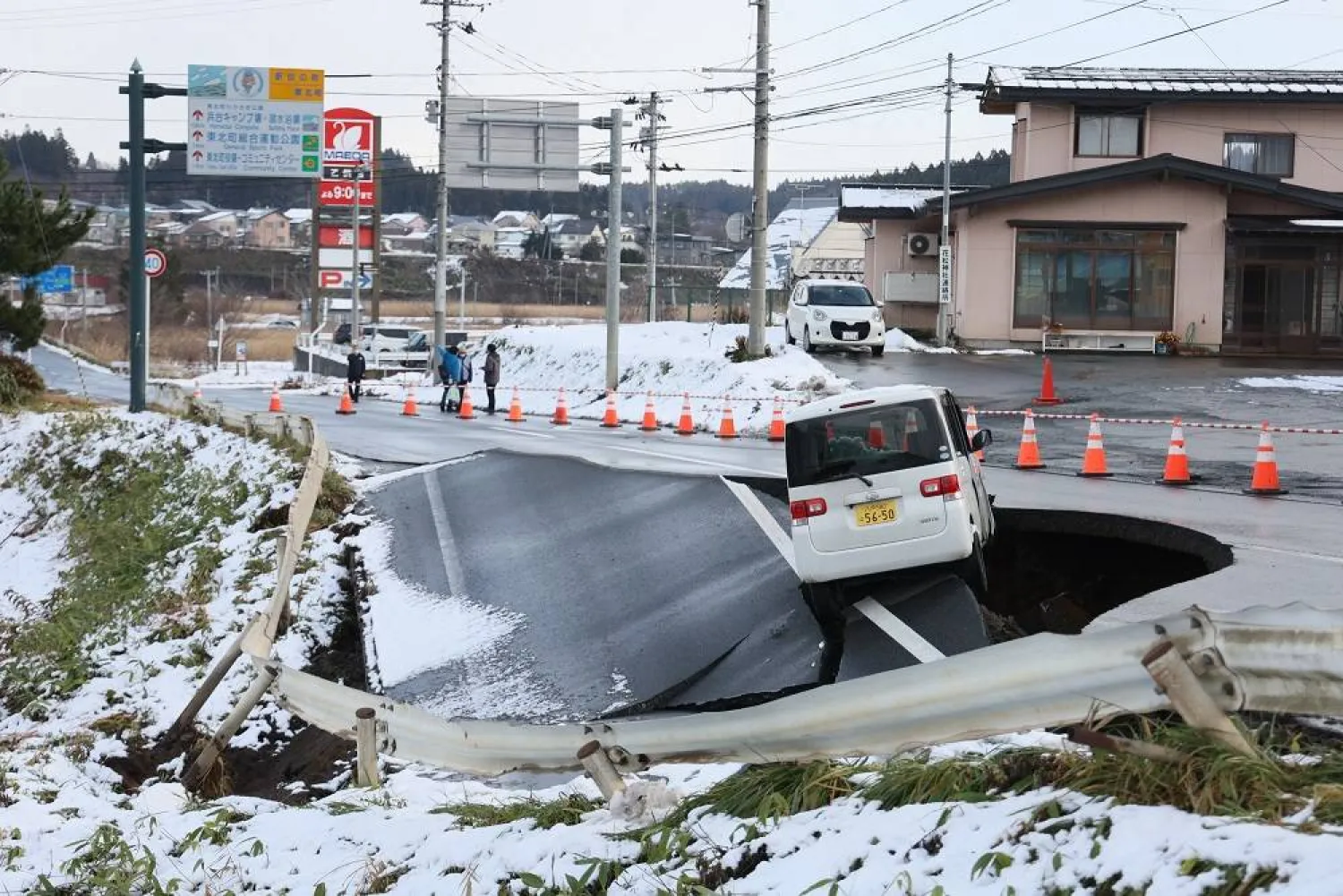

Why Japan Issued an Advisory for a Possible Megaquake in the Country’s North 

A car is stranded on a collapsed road in Tohoku, Aomori prefecture, northeastern Japan, 09 December 2025. (EPA/Jiji Press)
TT

Why Japan Issued an Advisory for a Possible Megaquake in the Country’s North 

A car is stranded on a collapsed road in Tohoku, Aomori prefecture, northeastern Japan, 09 December 2025. (EPA/Jiji Press)

Japan issued a megaquake advisory Tuesday after a magnitude 7.5 earthquake struck off the eastern coast of Aomori, the northernmost prefecture of Japan's main island of Honshu, and just south of the northern island of Hokkaido. Damage from this quake was modest — 34 mostly mild injuries and some damage to roads and buildings.

Officials said the advisory is not a prediction and the probability of a magnitude 8 or larger quake is only about 1%. But there’s hope the advisory will serve as a wake-up call for a quake that could have the devastation of the 2011 disaster that killed nearly 20,000 people and destroyed a nuclear plant.

There's said to be an increased risk of a subsequent, magnitude-8 or larger quake within the next week. Officials are urging residents, especially along coastal areas, to be well prepared so they can grab an emergency bag and run as soon as possible if a bigger quake hits.

This advisory seemed mindful compared with another advisory last year. The southern half of Japan's Pacific coastline received a "Nankai Trough" megaquake advisory in the summer of 2024, but the ambiguity of that warning led to panic buying of emergency food, event cancellations and business closures.

A megaquake advisory for Japan's northeastern coast

The Japan Meteorological Agency says Monday's powerful quake temporarily increased potential risks in the regions of Hokkaido and the Sanriku coast. That's where the Pacific Plate beneath Japan forms the two trenches — the Japan Trench and Chishima Trench — that have caused many large quakes in the past.

Experts say the deadly quake and tsunami in 2011 was caused by movement associated with the Japan Trench. It spans from off the eastern coast of Chiba to Aomori, and the Chishima Trench goes from the eastern coast of Hokkaido to the northern islands and the Kurils.

In explaining the advisory, the JMA said the magnitude 9.0 quake on March 11, 2011, that devastated large swaths of Japan's northern coast occurred two days after a magnitude 7.3 temblor that occurred at the Japan Trench off the eastern coast of Iwate, one of the hardest-hit areas in that disaster as well as in Monday's quake.

The 2011 quake caused a tsunami that battered northern coastal towns in Iwate, Miyagi and Fukushima prefectures. The tsunami, which topped 15 meters (50 feet) in some areas, slammed into and destroyed the Fukushima Daiichi nuclear power plant. That created deep fears of radiation that linger to this day.

A megaquake could cause a 98-foot tsunami and kill nearly 200,000

Another offshore megaquake in the Hokkaido-Sanriku area could cause up to a 30-meter (98-foot) tsunami in the region, kill as many as 199,000 people, destroy up to 220,000 houses and buildings, and cause estimated economic damages of up to 31 trillion yen ($198 billion), according to an estimate by the government. It says as many as 42,000 people could suffer from hypothermia in the winter.

The areas covered by the advisory extend across 182 municipalities from Hokkaido to Chiba prefecture.

Japan's separate advisory for an even more damaging megaquake stemming from the Nankai Trough, which affects the southern half of Japan's Pacific coast, was activated for the first time last August after a magnitude 7.1 quake occurred off the eastern coast of Miyazaki.

In a 2013 damage estimate for a possible Nankai Trough megaquake, the government said a magnitude 9.1 quake could generate a tsunami exceeding 10 meters (33 feet) within minutes, killing as many as 323,000 people, destroying more than 2 million buildings and causing economic damage exceeding 200 trillion yen ($1.28 trillion) in the region.

Officials call on people to be calm and prepared

Officials are stressing that the latest advisory has no prediction for any megaquake happening at any specific time or location, a Cabinet official for disaster prevention, Tsukasa Morikubo, told a news conference early Tuesday. He called on residents to be cautious and prepared while continuing their daily activity and work.

Officials urge people to keep an emergency bag containing a few days' worth of daily necessities along with shoes and helmets. People in the region are also advised to discuss evacuation procedures with family members and sleep in day clothes, not in pajamas, so they can flee immediately. Furniture should also be fixed to the floor or the wall.

The designated municipalities explained the advisory on their websites and started inspecting stocks of relief goods and equipment to be used at evacuation centers.

Iwaki City in Fukushima urged residents to register for emergency emails, while officials in the town of Oarai in Ibaraki prefecture, northeast of Tokyo, inspected wireless communication devices.

Japan's first megaquake advisory in August of last year contained a lot of scientific jargon. It worried and baffled many across the country. Some towns closed beaches and canceled annual events, disappointing many travelers during local holidays.

Many people postponed planned trips and rushed to stock up on rice, dried noodles, bottled water and portable toilets, leaving shelves empty at many supermarkets in western Japan and even Tokyo, which is outside of the at-risk area.



Russia: Man Suspected of Shooting Top General Detained in Dubai

An investigator works outside a residential building where the assassination attempt on Russian Lieutenant General Vladimir Alexeyev took place in Moscow, Russia February 6, 2026. REUTERS/Anastasia Barashkova
TT

Russia: Man Suspected of Shooting Top General Detained in Dubai

An investigator works outside a residential building where the assassination attempt on Russian Lieutenant General Vladimir Alexeyev took place in Moscow, Russia February 6, 2026. REUTERS/Anastasia Barashkova

Russia's Federal Security Service (FSB) said on Sunday that the man suspected of shooting top Russian military intelligence officer Vladimir Alexeyev in Moscow has been detained in Dubai and handed over to Russia.

Lieutenant General Vladimir Alexeyev, deputy head of the GRU, ⁠Russia's military intelligence arm, was shot several times in an apartment block in Moscow on Friday, investigators said. He underwent surgery after the shooting, Russian media ⁠said.

The FSB said a Russian citizen named Lyubomir Korba was detained in Dubai on suspicion of carrying out the shooting.

Russian Foreign Minister Sergei Lavrov accused Ukraine of being behind the assassination attempt, which he said was designed to sabotage peace talks. ⁠Ukraine said it had nothing to do with the shooting.

Alexeyev's boss, Admiral Igor Kostyukov, the head of the GRU, has been leading Russia's delegation in negotiations with Ukraine in Abu Dhabi on security-related aspects of a potential peace deal.


Factory Explosion Kills 8 in Northern China

Employees work on an electric vehicle (EV) production line at the Volkswagen Anhui factory in Hefei, Anhui province, China, February 4, 2026. REUTERS/Florence Lo
TT

Factory Explosion Kills 8 in Northern China

Employees work on an electric vehicle (EV) production line at the Volkswagen Anhui factory in Hefei, Anhui province, China, February 4, 2026. REUTERS/Florence Lo

An explosion at a biotech factory in northern China has killed eight people, Chinese state media reported Sunday, increasing the total number of fatalities by one.

State news agency Xinhua had previously reported that seven people died and one person was missing after the Saturday morning explosion at the Jiapeng biotech company in Shanxi province, citing local authorities.

Later, Xinhua said eight were dead, adding that the firm's legal representative had been taken into custody.

The company is located in Shanyin County, about 400 kilometers west of Beijing, AFP reported.

Xinhua said clean-up operations were ongoing, noting that reporters observed dark yellow smoke emanating from the site of the explosion.

Authorities have established a team to investigate the cause of the blast, the report added.

Industrial accidents are common in China due to lax safety standards.
In late January, an explosion at a steel factory in the neighboring province of Inner Mongolia left at least nine people dead.


Iran Warns Will Not Give Up Enrichment Despite US War Threat

Traffic moves through a street in Tehran on February 7, 2026. (Photo by ATTA KENARE / AFP)
TT

Iran Warns Will Not Give Up Enrichment Despite US War Threat

Traffic moves through a street in Tehran on February 7, 2026. (Photo by ATTA KENARE / AFP)

Iran will never surrender the right to enrich uranium, even if war "is imposed on us,” its foreign minister said Sunday, defying pressure from Washington.

"Iran has paid a very heavy price for its peaceful nuclear program and for uranium enrichment," Abbas Araghchi told a forum in Tehran.

"Why do we insist so much on enrichment and refuse to give it up even if a war is imposed on us? Because no one has the right to dictate our behavior," he said, two days after he met US envoy Steve Witkoff in Oman.

The foreign minister also declared that his country was not intimidated by the US naval deployment in the Gulf.

"Their military deployment in the region does not scare us," Araghchi said.