


Trial of Chinese Crime Gangs in Italian Fashion Stalls amid Sabotage Fears

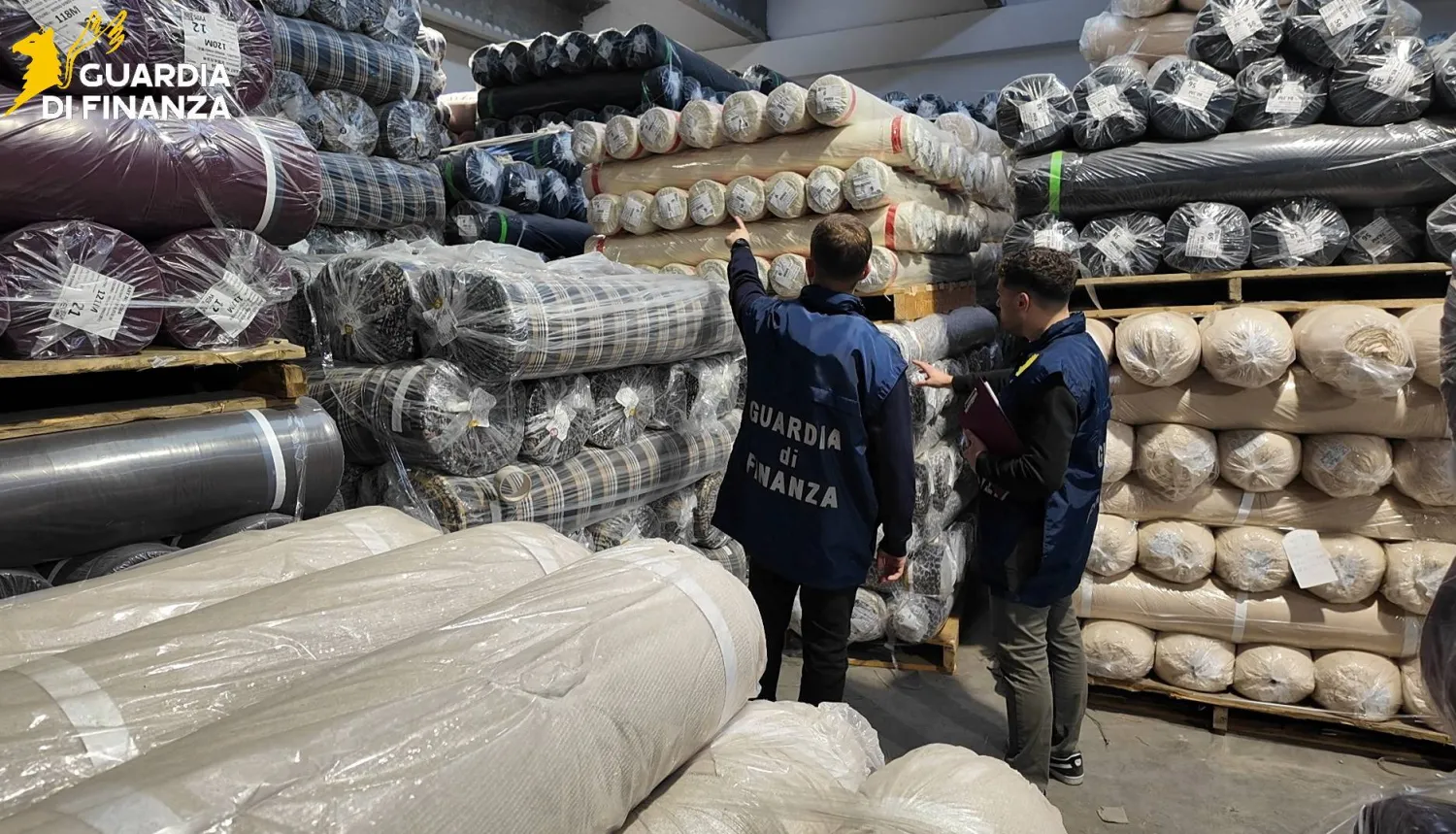
Italian Guardia di Finanza (Tax Police) carry out a search at a textile firm during an investigation, in the Tuscan city of Prato, Italy, in this handout photo obtained by Reuters. Guardia di Finanza Press Office/Handout via REUTERS
TT

Trial of Chinese Crime Gangs in Italian Fashion Stalls amid Sabotage Fears

Italian Guardia di Finanza (Tax Police) carry out a search at a textile firm during an investigation, in the Tuscan city of Prato, Italy, in this handout photo obtained by Reuters. Guardia di Finanza Press Office/Handout via REUTERS

A landmark trial in Italy of Chinese crime gangs has suffered so many mishaps - from the disappearance of documents to the resignation of interpreters - that a senior prosecutor suspects it's being sabotaged to protect the criminals' grip on Europe's fashion industry.

The case, launched after two Chinese men were hacked to death with machetes in 2010, is aimed at dismantling an illicit network accused of controlling the logistics of the continent's multi-billion-euro garments sector from the city of Prato in Tuscany.

Instead, it has become a cautionary tale about the obstacles Italy's justice system faces when confronting international organized crime without the tools it has used effectively to fight home-grown mafia groups, prosecutors say.

Reuters spoke to two of Italy's most senior anti-mafia investigators, and more than half a dozen textile workers, union representatives and defense lawyers, to gain a rare glimpse into the challenges of tackling alleged Chinese organized crime.

"The suspicion is that there is interference from the Chinese community and Chinese authorities in this matter," said Luca Tescaroli, a veteran of Italy's war against the mafia who is now Prato's chief prosecutor and leading the charge against Chinese crime gangs.

The Chinese embassy in Rome did not reply to emails requesting comment on Tescaroli's remarks. China's foreign, public security and justice ministries did not immediately reply to Reuters' requests for comment for this story.

When the latest court interpreter failed to show up to a hearing at the end of September, a quick check revealed she had returned to China and her transcripts were "incomprehensible and unusable", Tescaroli said.

The translator was the second to walk off the job and no other Chinese interpreter in Tuscany has agreed to take over. Tescaroli has opened an investigation into the possibility that someone is looking to sink the trial.

The violence prosecutors hoped to curb has only intensified as the trial flounders, with the battle for control of coat hanger production and fast-fashion freight spawning a string of bomb and arson attacks in Italy, France and Spain.

There have been at least 16 attacks, including cases of the destruction of property, since April 2024, according to a Reuters tally of official reports.

The Prato prosecutor and his colleagues are pressing the judges in the so-called China Truck trial to define the Chinese gangs legally as mafia groups – a designation that would unlock sweeping powers, asset seizures and stiffer sentence.

However, in Italy that label is difficult to secure, even more so if the organizations are rooted abroad, making them harder to penetrate than home-grown crime groups such as Sicily's Cosa Nostra.

Wedged in the hills northwest of Florence, Prato is billed as Europe's largest textile manufacturing hub, hosting more than 7,000 textile and garment companies that register some 2.3 billion euros ($2.68 billion) in official annual exports. Over 4,400 of firms are Chinese owned, local authorities say.

Almost a quarter of its residents are foreigners, the largest ratio in Italy, but the percentage is likely much higher as many newcomers are illegal immigrants without work permits.

Prato's streets are lined with Chinese-owned workshops, warehouses, and businesses that have transformed the city into a global fast-fashion production center, and a flashpoint for violence linked to criminal networks.

The China Truck investigation closed in 2018 with prosecutors alleging that the 58 suspects had formed "a criminal association equipped with very significant financial means ... with support and resources abroad".

Seven years on, not a single defendant or witness has been called to testify.

Meanwhile, the alleged mastermind Zhang Naizhong, described by investigators as a "boss of bosses", slipped back to China in 2018 after he was released from pre-trail custody and prosecutors doubt he will ever return to Italy.

His Italian lawyer Melissa Stefanacci declined to comment on any aspect of the case. Zhang and the other suspects have pleaded not guilty.

The case emerged from what Francesco Nannucci, then head of Prato's police Flying Squad, described to Reuters as a war between two rival gangs, one made up of Chinese originally from Zhejiang and the other of Chinese originally from Fujian, for control of territory in Europe.

Despite keen police interest and multiple investigations in Prato, the gang violence has escalated in the past two years.

In July 2024, a Chinese businessman based in Prato was stabbed multiple times by a group of six men, including a former soldier, who had flown in from China "to protect, through violence, the business interests of the monopolistic group in the coat-hanger sector," prosecutors said in a statement.

All six were arrested and sentenced to 7.5 years in jail for attempted murder.

In April of this year, Zhang Dayong, Zhang's alleged right-hand man who was also charged in the China Truck case, was shot dead in Rome alongside his girlfriend. No-one has been arrested for those killings.

Tescaroli said emerging companies often with the prefix "Xin" - meaning "new" in Chinese - were trying to undercut established players, selling hangers at about 6 cents each compared to the previous market rate of about 27 cents.

"Since the volumes are vast, a few cents of margin on each piece guarantee gigantic profits," he said.

Chinese businesses in the textile district have long operated within what investigators call the "Prato system", marked by corruption and irregular practices, including labor and safety abuses as well as tax and customs fraud. These companies can appear and disappear overnight, engaging in a cat-and-mouse game with authorities to dodge taxes and avoid having to give workers proper contracts, according to Arturo Gambassi, a representative from the Sudd Cobas union, which defends workers' rights in the textile sector.

"In all the firms where we have initiated labor disputes, we saw that their business name had changed in the previous two years," he told Reuters. Police say fabrics are often smuggled in from China to avoid customs duties, while profits are sent back through illicit money-transfer channels, with up to 4 million euros shipped out of Rome's Fiumicino airport each week, according to prosecutors and police.

To maintain their competitive edge, the industry depends on cheap, round-the-clock labor, largely from China and Pakistan, with workers facing a backlash if they seek legal contracts.

On November 17, more than 15 Chinese citizens assaulted a union demonstration in Prato. Plain clothes police who were observing the protest were also attacked, with two officers needing hospital treatment, a police statement said.

Italian prosecutors succeeded in dismantling major Italian mob networks, notably Cosa Nostra, in part thanks to legislation introduced specifically to tackle the mafia.

The official mafia designation carries stiffer sentences and lets courts infer membership from conduct, a key advantage when prosecutors must overcome silence and intimidation.

Tescaroli is trying to get the courts to brand the Chinese gangs as mafia groups, but Barbara Sargenti, Italy's national anti-mafia prosecutor, questioned whether this would happen.

To establish that there is a Chinese mafia, Italy needs to map these organizations either from inside sources or with help from judicial and police authorities in China.

Sargenti said cooperation with China was proving "very difficult" and, so far, only one Chinese citizen had turned state witness within Italy, in a drug-related case.

Sargenti said China's police and judicial authorities had been in touch with Italy's justice ministry in recent months, saying it was willing to send officers collaborate with the Italians but there had been no follow up.

"Investigations are, let's say, very complicated," she said. Without the mafia designation or Chinese cooperation, Tescaroli's case in the China Truck trial relies on the fragile scaffolding of Italian procedure, and the willingness of translators to show up.

After the Tuscan interpreters made themselves unavailable, two new translators were appointed on November 17 - Chinese citizens from the northern port city of Genoa, outside Tuscany.

But court officials aren't claiming victory, yet, with the new translators saying they could not guarantee they would understand the dialects captured in phone taps that form crucial evidence in the case. The next hearing is scheduled for May 15.



Hermes Shows Biker Looks in Dusky Colors for Fall/Winter Collection in Paris

A model presents a creation for Hermes for the Women's Ready to Wear Fall/Winter 2026-2027 collection fashion show as part of the Paris Women Fashion Week, in Paris, on March 7, 2026. (AFP)
TT

Hermes Shows Biker Looks in Dusky Colors for Fall/Winter Collection in Paris

A model presents a creation for Hermes for the Women's Ready to Wear Fall/Winter 2026-2027 collection fashion show as part of the Paris Women Fashion Week, in Paris, on March 7, 2026. (AFP)

‌Hermes designer Nadege Vanhee took inspiration from the ambience of twilight for a fall/winter collection featuring fluid leather coats, zip-front mini dresses, and biker shorts.

Guests entering the Garde Republicaine, the sprawling barracks of Paris' mounted gendarmes, stepped onto a floor of thick moss extending across the show space.

Models emerged from a luminous ‌circular opening ‌in the far wall evoking the ‌moon ⁠and marched along ⁠a winding raised catwalk, above the vegetation.

The looks came in dusky blue and green tones, with pops of orange, oxblood and yellow.

Tight dresses in dark leather had asymmetrical zips revealing a contrasting ⁠shirt underneath, while long brown overcoats ‌featured huge ‌sheepskin collars.

Aviator jackets and trench coats were paired ‌with glossy cycle shorts made out ‌of lambskin.

Ostrich leather was used throughout for jackets, jodhpurs, and an orange biker-inspired jumpsuit that was zipped up the front and belted ‌at the waist.

Tailoring featured double-breasted jackets and cigarette trousers in browns ⁠and ⁠iridescent burgundy.

Vanhee has been womenswear creative director since 2014 for Hermes, which caters to the ultra-wealthy and tightly controls access to its products, with years-long waiting lists for its most exclusive handbags.

Hermes is one of many major luxury brands showing at Paris Fashion Week, which started on Monday and runs through March 11, with Chanel and Louis Vuitton catwalks still to come.


Victoria Beckham Shows Sheer Dresses and Sharp Suits at Paris Fashion Week

FILED - 03 September 2019, United Kingdom, London: David Beckham (L), Victoria Beckham and Brooklyn Beckham arrive at the GQ Men of the Year Awards 2019 in association with Hugo Boss at the Tate Modern. Photo: Matt Crossick/PA Wire/dpa
TT

Victoria Beckham Shows Sheer Dresses and Sharp Suits at Paris Fashion Week

FILED - 03 September 2019, United Kingdom, London: David Beckham (L), Victoria Beckham and Brooklyn Beckham arrive at the GQ Men of the Year Awards 2019 in association with Hugo Boss at the Tate Modern. Photo: Matt Crossick/PA Wire/dpa

Victoria Beckham presented sculptural gowns in sheer fabrics, tightly cut suits and voluminous coats in Paris on Friday for a fall/winter 2026 collection that played with shape and texture.

Dresses in dark blues and greens featured bodices of three-dimensional rosettes, a motif that repeated across skirts, contrasting with sober suits in navy and ‌black, said Reuters.

Large overcoats ‌were paired with sheer ‌white ⁠skirts or drainpipe trousers, ⁠while knitwear had giant collars and cut-outs revealing the models' backs.

According to the show notes, the collection was inspired by the work of Art Deco artist Tamara de Lempicka, famous for ⁠her cubist portraits of aristocrats in ‌sumptuous clothing.

Victoria Beckham's ‌husband David and the couple's children Romeo, Cruz, ‌and Harper were on the ‌front row. Their eldest, Brooklyn, was conspicuously absent after he went public in January with accusations against his parents, laying bare a family ‌feud for the first time.

Beckham founded her brand, which sells ⁠dresses ⁠between $950 and $2,500, in 2008 and launched Victoria Beckham Beauty in 2019.

Guests at the show were gifted bottles of her recently launched perfume, Portofino '97, inspired by a holiday the British couple took when they were still a secret item.

Paris Fashion Week, which started on Monday and runs through March 11, features big-name brands including Chanel, Dior, Hermes, Louis Vuitton, and Saint Laurent.


Italy's Agnona Brand: Lamb among the Fashion Wolves

Italy's Agnona Brand: Lamb among the Fashion Wolves
TT

Italy's Agnona Brand: Lamb among the Fashion Wolves

Italy's Agnona Brand: Lamb among the Fashion Wolves

At Milan Fashion Week, headlines go to splashy names, over-the-top fashions and celebrities posing by catwalks.

But behind the scenes, Italy's smaller and medium-sized brands, the often family-owned lifeblood of the industry, are doggedly defending their craft, striving to keep alive long traditions of excellence.

One of them, Agnona, began in 1953 as a wool mill in Italy's northern Piedmont region, producing luxurious textiles in natural fabrics like cashmere, lambswool and angora that supplied top haute couture houses in Paris, from Christian Dior to Givenchy to Yves Saint Laurent.

Acquired in 1999 by the Ermengildo Zegna Group, Agnona switched from textiles to apparel and was sold in 2020 to Zegna family members Stefano Aimone, the chief executive and creative director, and his father Roberto.

Agnona, which is opening its first flagship store in Milan next month, envisions a global network of owned and franchised stores in future.

Stefano Aimone sat down with AFP to explain the challenges facing smaller names amid competition from the big fashion conglomerates, changes in consumer habits and the race towards retail.

- 'Overwhelmed by demand' -

"If you want to aim for quality and certain types of craftsmanship you have to stay here in our Italian boot. But many companies have closed. Many closed because of Covid, post-Covid they were absorbed into larger groups because costs went up, prices fluctuated, they had periods of no sales -- no work at all -- followed by excess work. Financially they didn't have the reserves.

"The businesses that remain are now extremely overwhelmed by demand from the big French groups and the Italian brands.

"The problem isn't just cut-and-sew, it's also the production of materials, because everything cascades down... the dye houses that are still around are clogged up, which creates delays, and delays weaken the quality of the entire industrial process."

- 'Made in Italy' -

"I'd say 'Made in Italy' is becoming relatively less important to them (customers); the customer now identifies more with the brand itself, with its values, with what the brand represents...

"Made in Türkiye, Made in Italy, Made in France -- it can be important, but it's definitely not as important as it once was, because brands have been very active in communicating many other values they embody, which provide justification beyond geography.

"And in a way that's right, because a brand isn't just its product -- it's also what it stands for and what it does beyond the product itself."

- 'Sowing seeds' -

"We're just under 15 million euros in revenue but we expect to reach 20 million and beyond within three years.

"We still have many markets that we haven't even started talking to, for example, all of China, the entire Middle East, all of Latin America, the whole APAC region including Australia.

"Since we took over the brand, there have been years of rebuilding: not only rebuilding our premises -- the industrial site and the headquarters -- but working on the collection.

"We introduced menswear, so we focused heavily on internal work, and we didn't necessarily want to push revenue right away. Because if you go out to market without a solid product, you risk ruining everything you're trying to achieve -- it can be counterproductive.

"So those were years of sowing seeds, and now that we're ready, we're beginning to address the global market."