


Desperate Gazans Pull Iron Bars from Rubble to Construct Tents and Scratch Out a Living

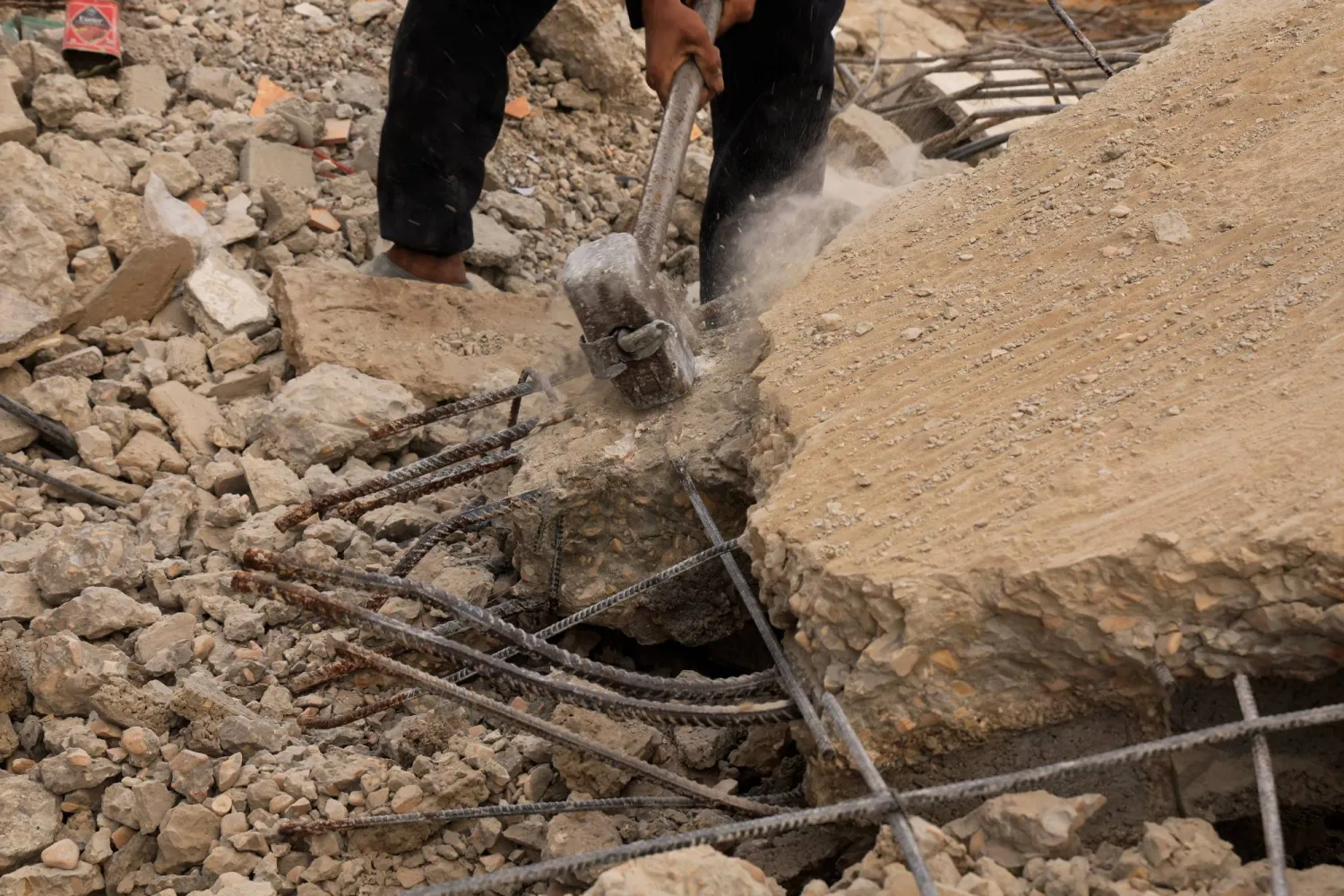
A Palestinian worker breaks concrete to extract steel bars from destroyed homes, using only simple hand tools amid a severe shortage of construction materials caused by long-standing restrictions on the entry of cement and iron, in Khan Younis, southern Gaza Strip, December 9, 2025. REUTERS/Haseeb Alwazeer
TT

Desperate Gazans Pull Iron Bars from Rubble to Construct Tents and Scratch Out a Living

A Palestinian worker breaks concrete to extract steel bars from destroyed homes, using only simple hand tools amid a severe shortage of construction materials caused by long-standing restrictions on the entry of cement and iron, in Khan Younis, southern Gaza Strip, December 9, 2025. REUTERS/Haseeb Alwazeer

As winter bites in Gaza, displaced Palestinians set out every day to homes destroyed by Israel. There they rip out iron rods from the walls and use them to prop up their flimsy tents or sell to scratch out a living in an enclave that will take years to recover from war.

The rods have become a hot item in Gaza, where they are twisted up in the wreckage left by an Israeli military campaign that spared few homes. Some residents spend days pounding away at thick cement to extract them, others do the back-breaking work for a week or more, Reuters.

With only rudimentary tools such as shovels, pickaxes and hammers, work proceeds at a snail's pace.

UN SAYS WAR GENERATED 61 MILLION TONS OF RUBBLE

Once the bars helped hold up cement walls in family homes, today they are destined for urgently-needed tents as temperatures at night fall. Heavy rainstorms have already submerged many Gazans' meagre belongings, adding to their misery.

Palestinian father-of-six Wael al-Jabra, 53, was putting together a makeshift tent, trying to hammer together two steel bars.

"I don’t have money to buy wood, of course. So, I had to extract this iron from the house. The house is made of five floors. We don’t have anything apart from God and this house that was sheltering us," he said.

In November, the UN Development Program said that the war in Gaza had generated 61 million tons of rubble, citing estimates based on satellite imagery.

Most of it can be cleared within seven years under the right conditions, it said.

A ROD CAN COST $15

A 10-meter metal rod costs displaced families $15 - a steep amount because many barely have cash.

The Palestinian group Hamas triggered the conflict after attacking Israel on Oct. 7, 2023, killing 1,200 people and taking 251 back to Gaza as hostages, according to Israeli calculations. Israel responded with a military campaign that killed over 70,000 people and laid waste to Gaza.

Carrying heavy buckets of rubble and pushing a wheelbarrow, Suleiman al-Arja, 19, described a typical day in the quest for iron rods.

"We pass by destroyed houses and agree with the house owner. He gives us a choice, whether to clean the house (clear the rubble) in exchange for iron or clean the house for money. We tell him that we want the iron and we start breaking the iron. As you can see, we spend a week, sometimes a week and a half," he said.

FOCUS IS ON DAILY STRUGGLE TO LIVE

US President Donald Trump promised to put together an international stabilization force and an economic development plan to rebuild and energize Gaza, which was impoverished even before the war. Palestinians in Gaza can't look so far ahead even though a ceasefire was reached in October. Every day is a struggle for Palestinians who have seen peace plans come and go over many decades.

Their minds are focused on finding ways to survive, every single day.

"We do this work to get our food and drink, to cover our living expenses and not need anyone, so we earn a living through halal (legitimate) means and effort. These are my hands," said Haitham Arbiea, 29.

Palestinians accuse Israel of depriving Gaza of the iron bars.

An Israeli official told Reuters that construction materials are considered dual use items - items for civilian but also potential military use - and will not be allowed into Gaza until the second phase of the US-led peace plan. The official cited concerns that the materials could be used for the building of tunnels, which have been used by Hamas.


Southern Yemen United in Welcoming Riyadh Conference

National Shield forces in Hadhramaut. (Reuters)
TT

Southern Yemen United in Welcoming Riyadh Conference

National Shield forces in Hadhramaut. (Reuters)

Parties in southern Yemen welcomed on Sunday Saudi Arabia’s call to hold a comprehensive conference on the issue of the South.

The conference will be held in Riyadh at an official request by Presidential Leadership Council (PLC) Chairman Dr. Rashad al-Alimi. The meeting will help shape the path of the southern issue, meeting the ambitions of southern and eastern Yemen governorates.

Local authorities in Hadhramaut, al-Mahra, Lahj, Shabwah and Socotra welcomed the conference, as did prominent political leaderships in the south. The Southern Transitional Council (STC) also notably welcomed the conference.

Saudi Arabia’s move to host the meeting was welcomed by Gulf and Arab countries and the international community over the weekend. It was viewed as a necessary step towards restoring dialogue in the South, overcoming efforts to eliminate the other and viewing the southern issue within a national and regional framework that would lead to a fair and sustainable solution.

Member of the PLC Dr. Abdullah al-Alimi expressed his deep appreciation for Saudi Arabia’s stance, calling all southern components, starting with the STC, to positively approach the conference and comprehensive dialogue that prioritizes the interests of the South above all else.

Serious dialogue is the only way to bridge divides, achieve rapprochement and unify southern ranks to serve security and stability, he stressed.

Shura Council Speaker Ahmed bin Dagher underlined the importance of the Riyadh conference, saying dialogue will help defuse strife.

The meeting will present realistic solutions to pending issues in the South, he added.

The STC welcomed Saudi Arabia’s call to hold the conference, saying it is in line with its policies that are based on dialogue.

It did place conditions, however, underscoring the “will of the people of the south” and demanding international guarantees, a clear timeframe, and popular referendum.

Observers said the conditions are an attempt by the STC to preserve its political position.

They noted that the very fact that it agreed to join the conference is an acknowledgment that the southern issue is greater than one party that is taking unilateral decisions.

The regional and international climate do not allow unilateral actions, they added.


Two Dead in Israeli Strike on South Lebanon

The wreckage of a car at the site after an Israeli strike on Al-Khiyam, in the Nabatieh governorate, southern Lebanon, 03 January 2026. (EPA)
TT

Two Dead in Israeli Strike on South Lebanon

The wreckage of a car at the site after an Israeli strike on Al-Khiyam, in the Nabatieh governorate, southern Lebanon, 03 January 2026. (EPA)

Lebanon said a strike in the south killed two Sunday while Israel said it had struck a Hezbollah operative, the latest raids as Beirut seeks to disarm the Iran-backed group.

Despite a year-old ceasefire between Israel and Hezbollah, Israel carries out regular strikes on Lebanon, usually saying it is targeting Hezbollah sites and operatives, and has maintained troops in five areas it deems strategic.

Lebanon's health ministry said two people were killed in an "Israeli enemy strike that targeted a vehicle" near the town of Jmaijmeh, around 10 kilometers (six miles) from the border.

An Israeli military statement said that "in response to Hezbollah's continued violations of the ceasefire understandings", it had struck an operative from the group in the area.

Under heavy US pressure and fears of expanded Israeli strikes, Beirut has committed to disarming Hezbollah, which was badly weakened after more than a year of hostilities with Israel including two months of open war that ended with the November 2024 ceasefire.

Lebanon's army was expected to complete the disarmament south of the Litani River -- about 30 kilometers from the border with Israel -- by the end of 2025, before tackling the rest of the country.

Lebanon's cabinet is to meet on Thursday to discuss the army's progress, while the ceasefire monitoring committee -- comprising Lebanon, Israel, the United States, France and UN peacekeepers -- is also set to meet this week.

On Sunday, Israel's Foreign Minister Gideon Saar acknowledged on X that the Lebanese government and army had made efforts to disarm Hezbollah but said "they are far from sufficient", citing "Hezbollah's efforts to rearm and rebuild, with Iranian support".

Israel has previously questioned the Lebanese military's effectiveness and has accused Hezbollah of rearming, while the group itself has rejected calls to surrender its weapons.

At least 350 people have been killed by Israeli fire in Lebanon since the ceasefire, according to an AFP tally of Lebanese health ministry reports.


Syrian Media Say Govt and Kurdish-Led SDF Meet on Military Merger without Progress

Syrian President Ahmed al-Sharaa signed a deal in Damascus last March with SDF commander Mazloum Abdi on integrating the force into state institutions (AP)
TT

Syrian Media Say Govt and Kurdish-Led SDF Meet on Military Merger without Progress

Syrian President Ahmed al-Sharaa signed a deal in Damascus last March with SDF commander Mazloum Abdi on integrating the force into state institutions (AP)

Syrian government officials held talks Sunday with the commander of the main Kurdish-led force in the country over plans to merge it with the national army, state media reported, adding that no “tangible results” had been achieved. 

The leadership in Damascus under interim President Ahmed al-Sharaa inked a deal in March with the Kurdish-led and US-backed Syrian Democratic Forces, which control much of the northeast. The SDF was to merge with the Syrian army by the end of 2025, but there have been disagreements on how it would happen. 

A major sticking point has been whether the SDF would remain a cohesive unit in the new army or whether it would be dissolved and its members individually absorbed. 

The SDF said in a statement Sunday that a delegation led by top commander Mazloum Abdi held talks with government officials in Damascus related to the military integration process. 

The SDF later said talks had ended, with details to be released later. The SDF has tens of thousands of fighters and is the main force to be absorbed into Syria's military. 

State TV said the meeting did not produce "tangible results” that would accelerate implementation of the agreement. It said the sides agreed to hold further meetings at a later date. 

The deal signed in March also would bring all border crossings with Iraq and Türkiye and airports and oil fields in the northeast under the central government’s control. Prisons holding about 9,000 suspected members of the ISIS group also are expected to come under government control. 

Türkiye has been opposed to the SDF joining the army as a single unit. Ankara considers the SDF a terrorist organization because of its association with the Kurdistan Workers’ Party, or PKK, which has waged a long-running insurgency in Türkiye, although a peace process is now underway. 

In late December, clashes broke out between security forces and SDF fighters in the northern city of Aleppo during a visit to Syria by Türkiye’s foreign minister. 

Sunday's meetings in Damascus came hours after three rockets struck a western neighborhood of the capital, causing some damage to a mosque and a telecommunications center without inflicting casualties, state media said. 

The state news agency called the rockets “random” without giving details on where they were fired from or who was behind it.
