


Russia, Türkiye, Iran Presidents in Turkmenistan for Rare Summit

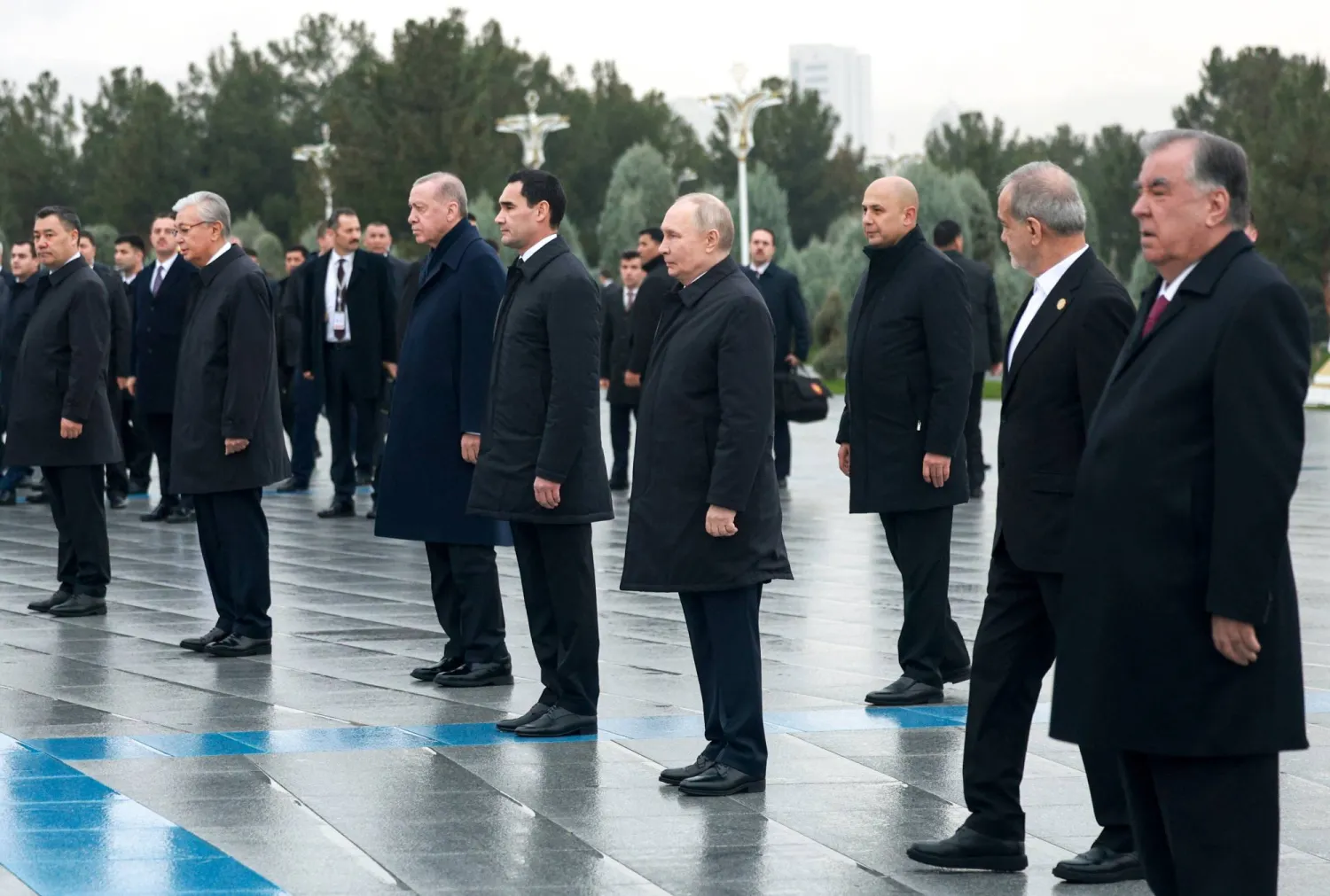
(R-L) Tajik President Emomali Rahmon, Iranian President Masoud Pezeshkian, Russian President Vladimir Putin, Turkmen President Serdar Berdimuhamedov, Turkish President Recep Tayyip Erdogan, Kazakh President Kassym-Jomart Tokayev, and Kyrgyz President Sadyr Japarov attend a wreath-laying ceremony at the Turkmenistan Neutrality Monument in Ashgabat, Turkmenistan, 12 December 2025. EPA/ALEXANDER SHCHERBAK / SPUTNIK / KREMLIN POOL MANDATORY CREDIT
TT

Russia, Türkiye, Iran Presidents in Turkmenistan for Rare Summit

(R-L) Tajik President Emomali Rahmon, Iranian President Masoud Pezeshkian, Russian President Vladimir Putin, Turkmen President Serdar Berdimuhamedov, Turkish President Recep Tayyip Erdogan, Kazakh President Kassym-Jomart Tokayev, and Kyrgyz President Sadyr Japarov attend a wreath-laying ceremony at the Turkmenistan Neutrality Monument in Ashgabat, Turkmenistan, 12 December 2025. EPA/ALEXANDER SHCHERBAK / SPUTNIK / KREMLIN POOL MANDATORY CREDIT

The leaders of Russia, Türkiye and Iran meet Friday in Turkmenistan, an isolated Central Asian state which is marking 30 years of official neutrality with a rare international summit.

The principle of "permanent neutrality" is at the heart of the former Soviet republic's foreign policy -- a doctrine that has contributed to making Turkmenistan one of the world's most isolated countries.

On the guest list are Russian President Vladimir Putin, Turkish President Recep Tayyip Erdogan, and Iranian President Masoud Pezeshkian, along with other regional leaders, AFP said.

Here's five things to know about the desert nation and its position on the world stage:

- Presidential dynasty -

Turkmenistan, which borders Iran, Afghanistan, and the Caspian Sea, has only had three presidents since gaining independence when the Soviet Union collapsed in 1991.

The first was Saparmurat Niyazov, who proclaimed himself both "president for life" and the "father of the Turkmen" (Turkmenbashi), and ruled for 15 years.

The Berdymukhamedov family took over in 2006, with father Gurbanguly becoming president before handing the job to his son Serdar in 2022.

In reality, the pair rule in tandem. Gurbanguly retains immense power and is the subject of an intense personality cult.

Officially proclaimed "leader of the Turkmen nation" and Arkadag, which means hero-protector, he built a vast city named after himself, Arkadag, at a cost of at least $5 billion. He also erected gigantic golden statues of himself, while Serdar is regularly praised in the state-run media.

- Neutrality and isolation -

Turkmenistan is one of the world's most secretive countries, often compared to North Korea for its inaccessibility.

Since the United Nations supported Turkmenistan's "permanent neutrality" status in 1995, it has become a foreign policy cornerstone. An almost 100-meter (300-feet) tall Neutrality Monument, resembling a rocket and featuring a golden statue of the first president, stands in the capital Ashgabat.

The status prohibits Turkmenistan from fully joining any union or military alliance, and is used by the government to implement its isolationist policies.

Ahead of the summit, Serdar Berdymukhamedov published yet another book -- presented as a "precious gift for the Turkmen people" -- extolling the virtues of neutrality.

Turkmenistan's closest relations are with China, Russia, Iran, and Türkiye thanks to gas contracts. Cooperation with the West remains limited.

According to Amnesty International, Turkmenistan is "effectively closed to international human rights NGOs, UN special mechanisms and independent media".

Information on the country is fragmented, tightly controlled and generally unverifiable, "aimed solely at praising the regime", according to Reporters Without Borders.

- Lots of gas, little water -

While Turkmenistan is estimated to have the world's fourth-largest natural gas reserves, water supplies are scarce -- and the situation is expected to worsen due to climate change, scientists warn.

Three-quarters of the country is covered by the vast Karakum desert.

Cotton is another important industry for the Turkmen economy, but the high use of water has contributed to water shortages across the region.

- Methane 'Gateway to Hell' -

A massive five-decade-old fire raging in a natural gas crater is the country's top tourist attraction. The fire has been burning in the Karakum desert since 1971, when Soviet scientists accidentally ignited it.

Turkmen authorities have repeatedly stated their intentions to close the Darvaza crater, dubbed the "Gateway to Hell", but so far without success.

Emissions are a huge problem. Turkmenistan is the world's top methane leaker, according to the International Energy Agency.

- Sacred animals -

Local breeds of horse and dog are sacred and have been elevated to the status of national symbols.

On the orders of Gurbanguly, numerous statues honoring the Alabai -- or Central Asian shepherd-dog -- and the Akhal-Teke horse have been erected and the animals are celebrated on public holidays.

Gurbanguly has even composed a song in honor of his favorite horse.

The father-and-son duo regularly give and receive dogs and horses as gifts, including to other world leaders. They are often filmed cuddling the animals in public.



Russia: Man Suspected of Shooting Top General Detained in Dubai

An investigator works outside a residential building where the assassination attempt on Russian Lieutenant General Vladimir Alexeyev took place in Moscow, Russia February 6, 2026. REUTERS/Anastasia Barashkova
TT

Russia: Man Suspected of Shooting Top General Detained in Dubai

An investigator works outside a residential building where the assassination attempt on Russian Lieutenant General Vladimir Alexeyev took place in Moscow, Russia February 6, 2026. REUTERS/Anastasia Barashkova

Russia's Federal Security Service (FSB) said on Sunday that the man suspected of shooting top Russian military intelligence officer Vladimir Alexeyev in Moscow has been detained in Dubai and handed over to Russia.

Lieutenant General Vladimir Alexeyev, deputy head of the GRU, ⁠Russia's military intelligence arm, was shot several times in an apartment block in Moscow on Friday, investigators said. He underwent surgery after the shooting, Russian media ⁠said.

The FSB said a Russian citizen named Lyubomir Korba was detained in Dubai on suspicion of carrying out the shooting.

Russian Foreign Minister Sergei Lavrov accused Ukraine of being behind the assassination attempt, which he said was designed to sabotage peace talks. ⁠Ukraine said it had nothing to do with the shooting.

Alexeyev's boss, Admiral Igor Kostyukov, the head of the GRU, has been leading Russia's delegation in negotiations with Ukraine in Abu Dhabi on security-related aspects of a potential peace deal.


Factory Explosion Kills 8 in Northern China

Employees work on an electric vehicle (EV) production line at the Volkswagen Anhui factory in Hefei, Anhui province, China, February 4, 2026. REUTERS/Florence Lo
TT

Factory Explosion Kills 8 in Northern China

Employees work on an electric vehicle (EV) production line at the Volkswagen Anhui factory in Hefei, Anhui province, China, February 4, 2026. REUTERS/Florence Lo

An explosion at a biotech factory in northern China has killed eight people, Chinese state media reported Sunday, increasing the total number of fatalities by one.

State news agency Xinhua had previously reported that seven people died and one person was missing after the Saturday morning explosion at the Jiapeng biotech company in Shanxi province, citing local authorities.

Later, Xinhua said eight were dead, adding that the firm's legal representative had been taken into custody.

The company is located in Shanyin County, about 400 kilometers west of Beijing, AFP reported.

Xinhua said clean-up operations were ongoing, noting that reporters observed dark yellow smoke emanating from the site of the explosion.

Authorities have established a team to investigate the cause of the blast, the report added.

Industrial accidents are common in China due to lax safety standards.
In late January, an explosion at a steel factory in the neighboring province of Inner Mongolia left at least nine people dead.


Iran Warns Will Not Give Up Enrichment Despite US War Threat

Traffic moves through a street in Tehran on February 7, 2026. (Photo by ATTA KENARE / AFP)
TT

Iran Warns Will Not Give Up Enrichment Despite US War Threat

Traffic moves through a street in Tehran on February 7, 2026. (Photo by ATTA KENARE / AFP)

Iran will never surrender the right to enrich uranium, even if war "is imposed on us,” its foreign minister said Sunday, defying pressure from Washington.

"Iran has paid a very heavy price for its peaceful nuclear program and for uranium enrichment," Abbas Araghchi told a forum in Tehran.

"Why do we insist so much on enrichment and refuse to give it up even if a war is imposed on us? Because no one has the right to dictate our behavior," he said, two days after he met US envoy Steve Witkoff in Oman.

The foreign minister also declared that his country was not intimidated by the US naval deployment in the Gulf.

"Their military deployment in the region does not scare us," Araghchi said.