2 US Service Members and One American Civilian Killed in Ambush in Syria, US Central Command Says

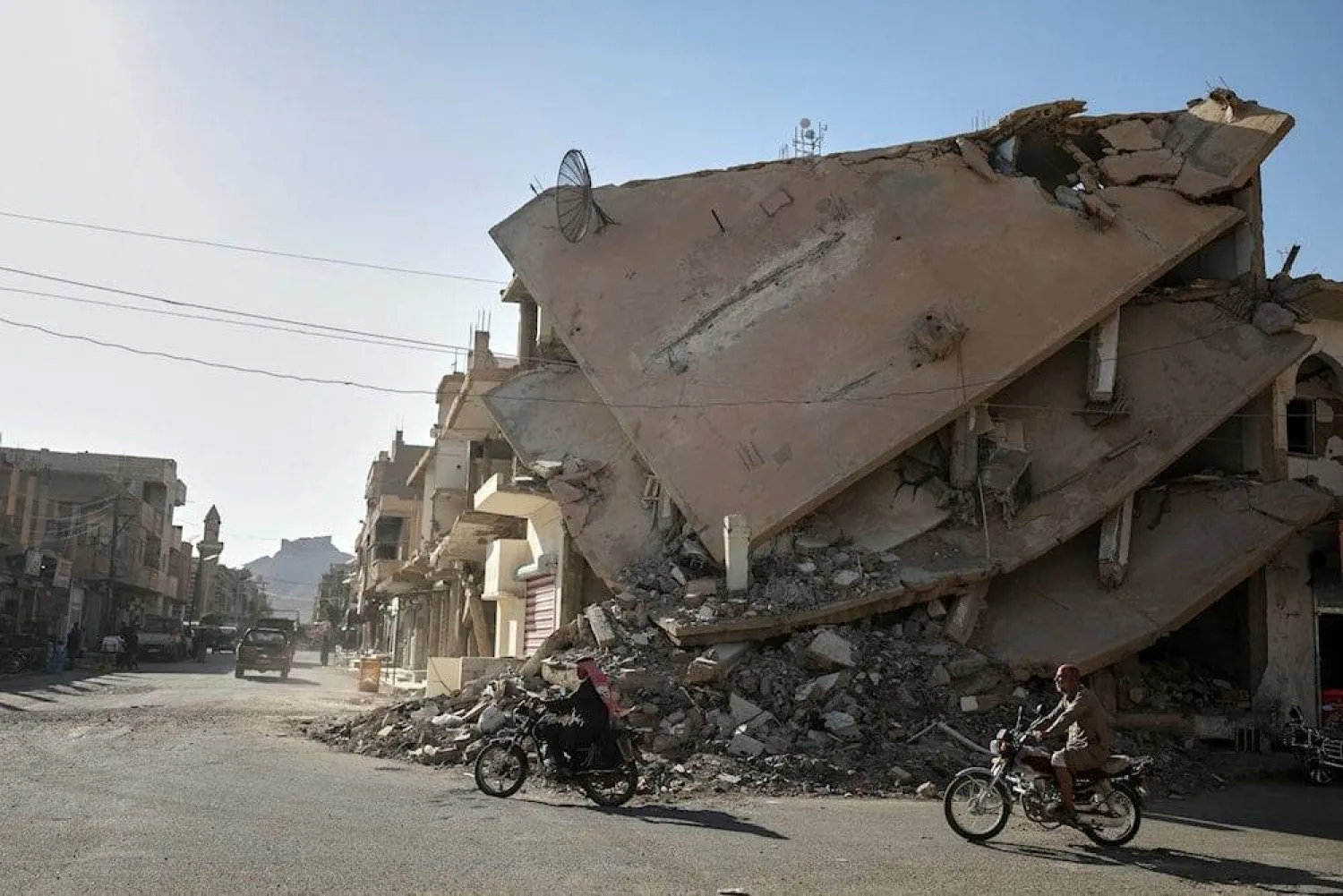
Residents ride a motorcycle along a war-damaged street in Palmyra, Syria. (AP)
TT

2 US Service Members and One American Civilian Killed in Ambush in Syria, US Central Command Says

Residents ride a motorcycle along a war-damaged street in Palmyra, Syria. (AP)

Two US service members and one American civilian were killed and three other people wounded in an ambush on Saturday by a lone member of the ISIS group in central Syria, the US military’s Central Command said. 

The attack on US troops in Syria is the first to inflict casualties since the fall of President Bashar al-Assad a year ago. 

Central Command said in a post on X that as a matter of respect for the families and in accordance with Department of Defense policy, the identities of the service members will be withheld until 24 hours after their next of kin have been notified. 

US Defense Secretary Pete Hegseth posted on X: “Let it be known, if you target Americans — anywhere in the world — you will spend the rest of your brief, anxious life knowing the United States will hunt you, find you, and ruthlessly kill you.” 

The shooting took place near historic Palmyra, according to the state-run SANA news agency, which earlier said two members of Syria’s security force and several US service members had been wounded. The casualties were taken by helicopter to the al-Tanf garrison near the border with Iraq and Jordan. 

SANA said the attacker was killed, without providing further details. 

The US has hundreds of troops deployed in eastern Syria as part of a coalition fighting the ISIS group. 

Last month, Syria joined the international coalition fighting against the ISIS as Damascus improves its relations with Western countries following the ouster of Assad when opposition factions overthrew his regime in Damascus. 

The US had no diplomatic relations with Syria under Assad, but ties have warmed since the fall of the five-decade Assad family rule. The interim president, Ahmed al-Sharaa, made a historic visit to Washington last month where he held talks with President Donald Trump. 

ISIS was defeated on the battlefield in Syria in 2019, but the group’s sleeper cells still carry out deadly attacks in the country. The United Nations says the group still has between 5,000 and 7,000 fighters in Syria and Iraq. 

US troops, which have maintained a presence in different parts of Syria, including al-Tanf garrison in the central province of Homs, to train other forces as part of a broad campaign against ISIS, have been targeted in the past.  

One of the deadliest attacks occurred in 2019 in the northern town of Manbij when a blast killed two US service members and two American civilians, as well as others from Syria while conducting a patrol. 


Millions of Sudanese Mark Eid amid Displacement, Poverty and Hunger

Sacrificial sheep at a livestock market in Khartoum, where demand remains weak (SUNA)
TT

Millions of Sudanese Mark Eid amid Displacement, Poverty and Hunger

Sacrificial sheep at a livestock market in Khartoum, where demand remains weak (SUNA)

The Sudanese mark Eid al-Adha this year as the war enters its fourth year, amid a harsh humanitarian and economic reality that has changed the face of the holiday and stripped it of many of the social meanings that had remained deeply rooted for decades.

In a country where holidays have long been associated with family gatherings, visits and invitations to share grilled sacrificial meat, millions of Sudanese are receiving Eid this year amid displacement, poverty, hunger and fear. Priorities have shifted from buying a sacrificial animal and children’s clothes to searching for food, medicine and drinking water.

Sudanese, often dressed in bright white clothes during Eid al-Adha, were accustomed to exchanging visits and invitations with neighbors, friends and relatives, and eating grilled meat in homes, neighborhoods and open squares. The practice was one of the most prominent social rituals linked to the occasion, alongside the exchange of meat and family visits.

But the war and economic collapse have greatly weakened those traditions, after large numbers of families became unable to buy sacrificial animals or even meet basic needs.

Refugees and displaced people appear to be suffering most during the holidays, after many lost their homes and sources of income and settled in camps and shelters that lack basic services. Those who remain in other cities and towns face a suffocating economic reality that consumes their limited incomes.

In displacement centers inside Sudan, Eid passes amid crowded tents and high temperatures, with shortages of food, water and healthcare, while diseases such as cholera, malaria and dengue fever spread in areas affected by the war.

“Children no longer ask about clothes or toys, but about food. Many of them do not even feel that there is an Eid,” said Amouna Ismail, a displaced woman from North Darfur who lives in a shelter in the city of Al Dabba.

In refugee camps in neighboring countries, the situation appears more complicated, with large numbers of Sudanese almost entirely dependent on humanitarian aid.

A refugee in one of the camps in Uganda, identified by her initials M.N., said she had not felt the joy of any Eid since fleeing Sudan.

“But what can we do? We are waiting for the war to stop and to return to our country,” she said. “I did not buy sheep for the sacrifice; I raised them at home.”

Umm Ahmed, who was displaced from Kordofan to Gedaref, said: “In the past, Eid was an occasion for joy and connection. Now people feel ashamed because they cannot do anything for their children or their displaced neighbors.”

Even outside areas of displacement and asylum, life remains difficult for many Sudanese who stayed in their cities and villages, amid sharp price increases, falling incomes and interruptions to basic services.

Hashim Moussa, a secondary school teacher, said his salary of 140,000 pounds is no longer enough to buy even one sack of sugar, whose price has exceeded 200,000 Sudanese pounds.

He said teachers had not received salaries or allowances, and that payments for exam monitoring had not been disbursed.

“How can a teacher bring joy to his children or buy clothes and food under these circumstances?” he asked.

Abdullah Mohammed Yusuf, 52, said the war had drained families’ savings and weakened returns from farming and work. His job as a tractor driver no longer provides enough income to cover living costs or buy an Eid sacrificial sheep, he said.

Khaled al-Tihami, a blacksmith, said repeated power cuts had directly affected his work and income. Farming has also become less viable due to water shortages, high fuel and seed costs, and seasonal pests, making it extremely difficult to buy a sacrificial animal this year.

Dr. Salah Jalal, spokesman for the Sudanese Group for Refugee Advocacy, said aid organizations and relief initiatives had worked to provide sacrificial animals in Sudanese refugee camps in eastern Chad, especially in Adre, Maji and Abu Tanqi, as well as refugee camps in South Sudan, Duweli camp and the Ugandan capital Kampala.

He said the initiatives aim to ease the suffering of families who have lost almost everything because of the war, especially during holidays when refugees and displaced people feel a deeper sense of isolation and loss.

He said the Turkish Red Crescent provided 100 bulls for Eid sacrifice to Sudanese refugees in the Kiryandongo camp in Uganda.

In recent years, the Eid sacrifice has no longer been only a religious rite. It has also become a social marker reflecting financial ability and family stability, especially in major cities. But the war and economic collapse have forced many families to abandon those rituals for the first time.

Livestock markets have been directly affected by the war, after large areas in Kordofan and Darfur, known for sheep production, were pushed out of normal activity because of fighting, insecurity and the difficulty of transporting livestock.

Livestock traders said the movement of sheep from Darfur and Kordofan to central and northern states had fallen sharply because of security risks, rising transport costs and restrictions on livestock movement, driving up prices in major cities.

Sheep prices in central and northern states range between 700,000 and 1.5 million Sudanese pounds, or about $150 to $300, sums beyond the reach of most families exhausted by war, inflation and the loss of income sources.

By contrast, prices in Darfur and Kordofan ranged between 250,000 and 300,000 Sudanese pounds because of stagnation, weak purchasing power and the difficulty of moving livestock to the rest of the country.

As the war continues and living conditions deteriorate, millions of Sudanese appear to be receiving another Eid weighed down by loss. The occasion is no longer tied to joy as much as it has become a daily reminder of the scale of the changes the war has imposed on people’s lives and society.

In another sign of the changes the war has imposed on social life, some Sudanese states have moved Eid al-Adha prayers inside mosques instead of the public squares where Sudanese had performed the prayers for decades.

In Sennar state, the state security committee approved a special Eid security plan that included instructions to hold prayers inside mosques, according to the official Sudan News Agency.

Sudanese say the absence of open-air Eid prayers this year reflects the scale of the changes the war has imposed on the details of daily life and public holiday rituals. Eid squares were once open spaces for social gatherings and exchanging greetings on the morning of Eid.



Netanyahu Seeks Alternatives to Control over Palestinian Antiquities

One of the historic Solomon’s Pools in Bethlehem, which Israeli Finance Minister Bezalal Smotrich has vowed to take control of. (Bethlehem Municipality)
TT

Netanyahu Seeks Alternatives to Control over Palestinian Antiquities

One of the historic Solomon’s Pools in Bethlehem, which Israeli Finance Minister Bezalal Smotrich has vowed to take control of. (Bethlehem Municipality)

Israeli Prime Minister Benjamin Netanyahu has ordered a comprehensive review of a controversial Antiquities Authority bill for the West Bank and Gaza Strip, and instructed Cabinet Secretary Yossi Fuchs to look for “alternatives” to the draft law, which is now being debated by the Knesset Education Committee, after security and professional bodies warned of “serious international damage.”

Hebrew media outlets quoted Israeli sources on Tuesday as saying Netanyahu was effectively obstructing the bill because it threatens Israel’s foreign relations, making the chances of passing any version of it before the current Knesset is dissolved “slim.”

Netanyahu’s position followed warnings from legal and security officials against the law, which establishes a “civil heritage authority” in the West Bank and Gaza Strip.

The Knesset plenum approved the bill in its first reading this month. The legislation would give the Antiquities Authority, once established, absolute authority over archaeological sites in the occupied West Bank. The scope was later expanded to include the Gaza Strip.

Palestinian antiquities under an Israeli minister

The bill, submitted by Likud lawmaker Amit Halevi, whose party is led by Netanyahu, calls for establishing an “Antiquities Authority” under the responsibility of Israel’s “heritage minister.”

It would be “fully responsible for handling all heritage and antiquities affairs in the area,” with powers including land confiscation, archaeological excavations and their management, and law enforcement. The powers of the “archaeology officer” in the army’s Civil Administration would be transferred to it.

The Knesset Education and Culture Committee is discussing the bill to draft its final version and submit it for a second and third reading. During that process, disputes emerged and Netanyahu intervened.

A representative of Israel’s National Security Council confirmed on Tuesday that Netanyahu “authorized the Cabinet secretary to examine the matter and submit the findings to him.”

A representative of Israel’s Foreign Ministry who attended the Knesset Education Committee on Tuesday also confirmed this, telling members that “the prime minister authorized the Cabinet secretary, and alternative options to the law are currently being examined.”

Asked about the Foreign Ministry’s position, he said: “It is too early to express a position.”

Netanyahu’s stance confused the proposal’s supporters and those who had pushed for it.

Education Committee Chairman Zvi Sukkot said that the law was getting promoted in the committee.

‘A violation of law’

Tami Sela, the legal adviser to the Knesset Education Committee, submitted a legal opinion stating that the bill violates international law, raises legal difficulties, and could be interpreted as creeping annexation.

“This is an unusual proposal and an unprecedented one, as an Israeli civil authority that is not part of the Israeli military would be granted powers in Palestinian territories and over their residents,” she said.

“In addition, the proposed law contradicts the Oslo Accords and constitutes a violation of the rules of international law.”

Sela noted that military authority in the West Bank is considered temporary, and that “passing this law could strengthen claims of a gradual annexation process.”

In addition to Sela, security officials opposed the law. The Israeli army said it “would harm the standing of military and security officials, and would be viewed internationally as a step involving de facto annexation.”

The Israel Academy of Sciences and Humanities also appealed to Netanyahu to prevent the law from passing.

According to the Academy, the passage of the law will be viewed in political and academic circles as the annexation of Judea and Samaria.

This will undoubtedly lead to an immediate deterioration in Israel’s international relations in the field of archaeology and will also affect other areas of science and research.

The council of the Israel Antiquities Authority submitted a similar position paper, warning that “the bill could cause significant damage to academic relations with international bodies.”

It said the legislation “will be interpreted as a violation of international law, and will severely harm Israeli archaeologists’ membership in international organizations and research cooperation, including important excavation projects in the country.”

Israeli media outlets, including The Times of Israel, said the antiquities bill will most likely not be brought to a final vote in the plenum before the Knesset is dissolved.

The Times of Israel said the Knesset plenum convened on Tuesday with no bills on its agenda.

The coalition currently cannot rely on the support of the ultra-Orthodox parties in the Knesset, which led the campaign to dissolve the Knesset, to back its legislation.

This is the first time the Knesset has attempted to give a civil authority powers over Palestinian Authority territory and its residents.

It comes as the Israeli government has pushed a series of laws that would weaken and dismantle the Palestinian Authority and expand Israeli powers in the West Bank.

Smotrich enters Solomon’s Pools

Ignoring Netanyahu and the criticism, Israeli Finance Minister Bezalel Smotrich entered the archaeological area of Solomon’s Pools in Bethlehem on Monday and vowed to take control of it.

Speaking from the site, Smotrich said: “Transferring these pools and this heritage achievement to the terrorist Palestinians was a mistake. It should not have been transferred to Area A for them to desecrate. We will restore the area. I have taken it upon myself to rebuild these pools and open them to visitors. This is a historic matter and a matter of Zionist heritage. We will succeed, God willing, and we will achieve this important goal.”

Solomon’s Pools are among the most important historical, archaeological, and water landmarks in Palestine. They are located southwest of Bethlehem and consist of three very large heritage pools.

The Palestinian Ministry of Awqaf and Religious Affairs condemned Smotrich’s move, stressing that the area is “purely Islamic endowment property.”

“This incursion represents a blatant attack on endowment properties, and a desperate attempt to impose a new colonial reality and falsify the historical and Islamic identity of the area,” it said.

The ministry called on the international community, rights institutions, and UNESCO to intervene immediately to stop what it called this arrogance.


Qassem’s Call to Topple Lebanon's Govt Exposes Differences with Berri

President Joseph Aoun chairs a cabinet meeting at the Baabda palace. (Lebanese Presidency file)
TT

Qassem’s Call to Topple Lebanon's Govt Exposes Differences with Berri

President Joseph Aoun chairs a cabinet meeting at the Baabda palace. (Lebanese Presidency file)

Hezbollah Secretary-General Sheikh Naim Qassem’s call to topple the Lebanese government was not only rejected by the group’s political opponents, but also appeared out of step with the position of its main ally, Parliament Speaker Nabih Berri, who along with Hezbollah has ministers in government.

While Qassem escalated his attack on the negotiations the Lebanese state is conducting with Israel and called on the street to bring down the government, the positions of Berri’s Development and Liberation bloc appeared closer to containing the escalation and stressing the priority of preserving institutions and internal stability.

In the absence of any practical signs that Hezbollah intends to move toward executive steps, such as the resignation of its ministers or an actual push to topple the government, Qassem’s remarks appeared closer to raising the political ceiling and maintaining media and popular pressure against the negotiations.

Qassem had called on Sunday evening for “toppling the government that is implementing the American Israeli project,” saying “the people have the right to take to the streets and topple the government and the American Israeli project.”

“There is no political sovereignty in Lebanon; it is subject to American tutelage,” he alleged.

He renewed his attack on the direct negotiations the Lebanese state is conducting with Israel, saying “they are rejected and a net gain for Israel,” and calling on the Lebanese authorities to abandon the talks and “not give America what it is asking for.”

Divergence within the Shiite duo

Ministerial sources close to the Lebanese presidency said Qassem’s remarks were merely “part of Hezbollah’s escalation and continuing attack on the negotiations, something that has not received a positive response, not only among Hezbollah’s opponents, but also among its allies.”

Hezbollah and Berri’s Amal movement are allies, commonly known as the Shiite duo.

“If Hezbollah wants to overthrow the government in which it is represented, it should first start by withdrawing its ministers from it, which it will not do under the current circumstances,” the sources told Asharq Al-Awsat.

MP Qassem Hashem, a member of Berri’s bloc, said Qassem’s call to topple the government “is nothing more and nothing less than an opinion.”

Hashem said in a radio interview that “more work must be done to unify the internal position and confront challenges in order to preserve common ground among the Lebanese, and this is Speaker Nabih Berri’s position.”

He ruled out any possibility that Hezbollah would withdraw its ministers, saying “the situation does not allow that.” He stressed “the need to preserve all institutions, especially as the government withstood the most difficult circumstances.”

President Joseph Aoun had issued a statement marking Liberation Day on Monday, hours after Qassem’s comments, in which he said that “Lebanon will not accept this reality and will not make peace with it. The path toward full Israeli withdrawal will remain a firm national demand that cannot be abandoned.”

He added that the Lebanese state was working to achieve this “through the option of negotiation, which will not be a concession or surrender, but an affirmation of Lebanon’s exclusive right to protect its land and sovereignty and extend its authority through its army and legitimate security forces.”

“The army will remain the sole guarantor of national security and territorial integrity,” he declared.

Rejection of Qassem’s attack

Aoun’s positions and the government’s decisions continue to receive broad support in Lebanon.

On the centenary of the Lebanese Constitution, the Kataeb Party stressed “the need to uphold its authority as the national pact among the Lebanese and the fundamental guarantee for the establishment of the state and the protection of freedoms.”

The Kataeb placed Qassem’s remarks “within the context of Iran’s insistence on undermining the independence of Lebanese decision-making,” saying that “if he objects to the government’s performance and decisions, it would be more appropriate for him to withdraw his ministers from it instead of resorting to fueling strife.”

It stressed the need to continue the direct Lebanese-Israeli negotiations and implement the Lebanese government’s decisions independently of any negotiations underway in the region, with the aim of securing a ceasefire, ensuring Israeli withdrawal, releasing prisoners, enabling the return of the displaced, reconstruction and the demarcation of the land border.

The Kataeb also called on Lebanon’s friends among Arab countries and Western countries to support the government in this effort and back the army as it implements the government’s decisions.

MP Ghada Ayoub, of the Lebanese Forces bloc. Said: “Qassem’s remarks are misplaced. Hezbollah is participating in the government, and if it has an objection to it or to the negotiations taking place in the United States, it should have taken the initiative to withdraw its ministers from the government first before targeting it.”

“I believe Qassem’s remarks are a threat that reveals Hezbollah’s plan to turn inward if the results of the negotiations are not in its favor,” she said in a radio interview, pointing to “confusion in the party’s position.”