



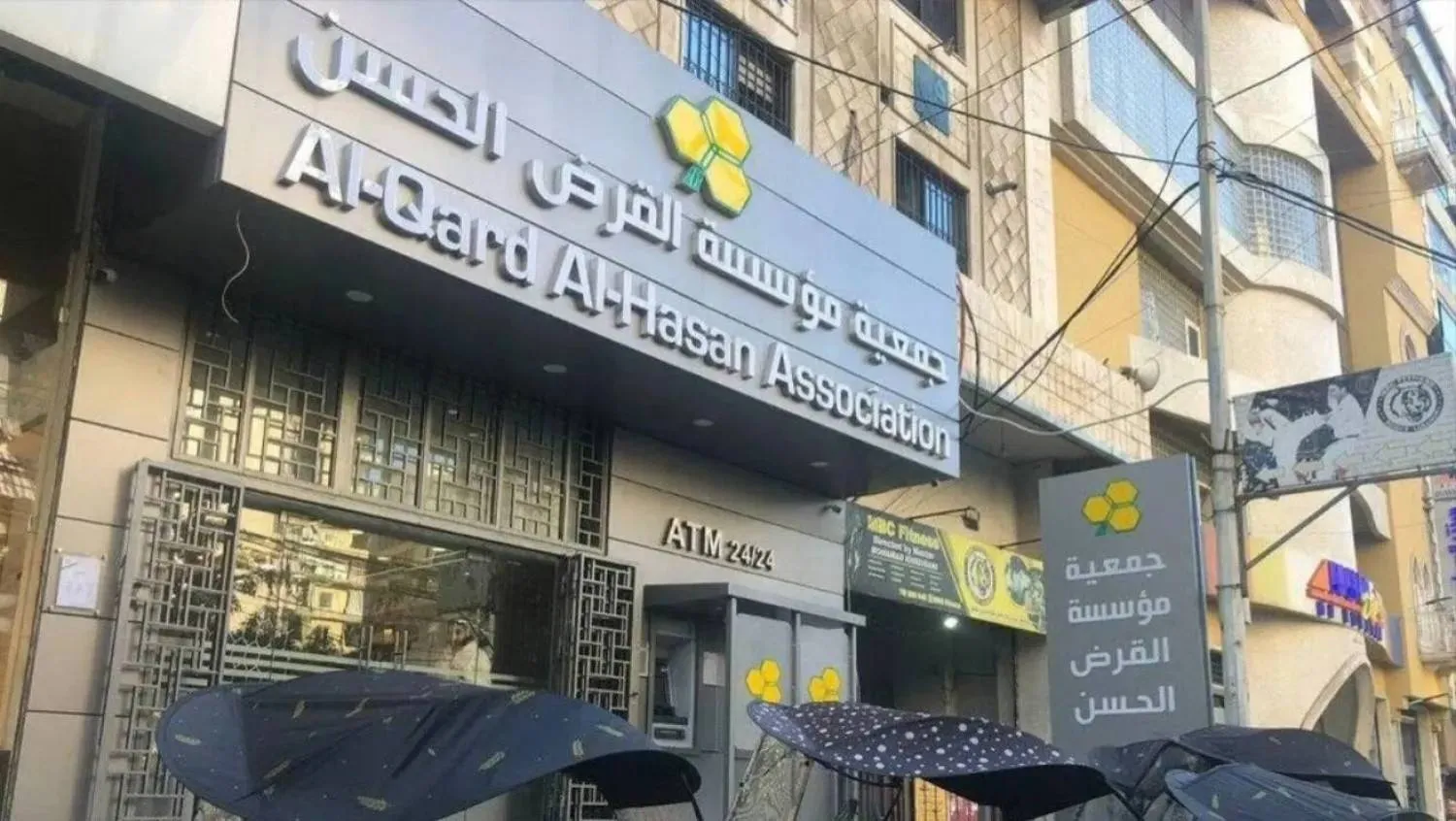

Hezbollah in Lebanon has begun taking steps that appear likely to lead to the closure of its financial arm Al-Qard Al-Hasan, or to sharply curtail its role, after mounting US pressure and measures by Lebanon’s central bank.
The moves are part of what sources describe as a legal repositioning inside the country, aimed at easing international and domestic pressure to shut the institution down.
As part of this shift, the group has established a licensed commercial entity that has begun carrying out part of Al-Qard al-Hasan’s activities by providing loans to its supporters. There are expectations that additional institutions could be created to take over other functions.
Hezbollah had previously rejected US demands conveyed through Lebanese authorities to close the institution, accusing Washington of seeking to “dry up financial resources in order to eliminate the party’s presence and prevent it from providing social services,” according to remarks by its Secretary-General Naim Qassem in a speech last month.
In recent years, Al-Qard Al-Hasan has been known as an institution that provides interest free loans, secured by gold or financial guarantees from other depositors.
The number of its clients exceeded 300,000 people in 2024, benefiting from its concessional loans. It also provided agricultural, industrial, and commercial loans to small enterprises.
The institution, which operated more than 34 branches across Lebanon, also distributed financial checks to those affected by the war, funded by Hezbollah after the latest conflict.
Amid international pressure on Lebanon to shut it down, the institution appeared to adopt what financial sources told Asharq Al-Awsat was a “legal repositioning policy,” seeking “legal alternatives that would allow it to continue operating,” following a series of domestic measures, including a decision by the Banque du Liban barring dealings with it.
Commercial entity
Al-Qard Al-Hasan has indeed begun to transform, with the first signs appearing in the form of a commercial company specializing in the buying and selling of gold on installment plans, which was established and began operating in early December.
Two sources in Beirut’s southern suburbs told Asharq Al-Awsat they were surprised, after completing transactions at the institution, to receive invoices issued by an entity called “Jood,” rather than Al-Qard Al-Hasan.
One of them said they went to the institution to obtain a small loan of $1,800 secured by his wife’s gold, only to discover that procedures had changed. “They did not carry out a gold pledge transaction as before,” they said.
“Instead, the process was conducted through two contracts. The first involved purchasing the gold in exchange for an official invoice, followed by another commercial transaction in which the same quantity of gold was sold back to us on installments, also against an official invoice.”
Under the purchase contract, he said, payments are made over 18 months in fixed monthly installments, with the gold delivered 15 days after the final installment is paid. “It is the same method used in the past, but the paperwork is different,” they added.
Promise of sale by installments
The second source said they were also able to obtain a loan in the same way and found that the installment purchase invoice included a contract with four conditions. They explained that the invoice was issued by “Jood” and included the company’s registration number and a fiscal invoice number, indicating it is subject to Lebanon’s commercial transaction laws and applicable regulations.
Asharq Al-Awsat reviewed the terms of the invoice included in the contract, which state that the invoice “constitutes a promise of sale by installments, and the sale is not considered final until the full value of the invoice is paid.”
The second clause states that all installments become immediately due if the buyer fails to pay two installments. It also authorizes the buyer, as the invoice holder, to make payment on his behalf. The fourth clause stipulates that the buyer must collect the gold within a period not exceeding 15 days from the date of paying the final installment, and that in the event of a delay, storage fees of $0.02 per gram per month will be added.
Fragmentation of services
This step is seen as part of a broader transformation plan by the institution in response to external and domestic pressure to shut it down.
Lebanese sources familiar with international demands said the shift “signals the failure of all attempts to rescue it through talks between the party and Lebanese authorities.”
They added that “the party’s conviction has pushed it to fragment the services provided by the institution in a way that allows it to continue offering some services if it complies with demands to close it entirely.”
The association states online that it “aims to help people by granting loans for specified periods, contributing to solving some of their social problems,” and that it seeks to “strengthen the spirit of cooperation, mutual support, and solidarity among members of society.”
The sources said that following the fragmentation of services, gold pledging has been removed from the institution’s functions and transferred to the commercial entity, enabling it to continue providing services within the bounds of the law. This follows the suspension of other services, including ATM services.
The move also sends a message to Lebanese authorities that these services are being offered within a legal framework, through official invoices, and are subject to taxes and commercial transaction regulations.
However, the same sources noted that in this arrangement, official financial disclosure applies to clients rather than depositors and sources of funds, “which complicates the assumption of international acceptance of this transformation.”
They said three proposals had previously been submitted to regularize the status of Al-Qard Al-Hasan, all of which were rejected by the United States. The first was to operate as a mutual aid association.
The second was to become a licensed financial company, which was also rejected by the Banque du Liban.
The third proposal was to operate as a financial cooperative providing concessional loans, similar to cooperatives that exist in Lebanon and abroad, subject to Lebanese law and declaring its clients. All proposals were “rejected outright,” the sources said.
US rejection
This assessment aligns with Lebanese financial estimates that any transformation by the institution is unlikely to gain US approval. A senior Lebanese financial source told Asharq Al-Awsat it was “unlikely that this repositioning will be accepted by the US Treasury Department, which scrutinizes tedious financial details in Lebanon.”
Lebanon, the source said under conditions of anonymity, is “under strict oversight by the US Treasury due to widespread cash circulation,” and US estimates indicate that cash outside the banking sector cannot be controlled.
“This measure is part of the cash economy operating outside the banking sector,” they said.
They added that the repositioning would not satisfy the United States, which has decided the institution must be shut down and has conveyed that to the Lebanese state.
“Changing the form will not satisfy them as long as the core remains,” they said, referring to the continued existence of Al-Qard Al-Hasan and the continuation of its services in another guise.
“From a legal standpoint, and under Lebanon’s prevailing laws, excluding the central bank, a commercial company can carry out buying and selling activities, including installment sales,” they said.
“But that does not mean the fundamental problem has been resolved, which is US rejection, because liquidity will remain outside the banking sector and will continue, from the American perspective, to be viewed with suspicion under the current political circumstances.”


