


Islamabad Puts Drivers on Notice as Smog Crisis Worsens

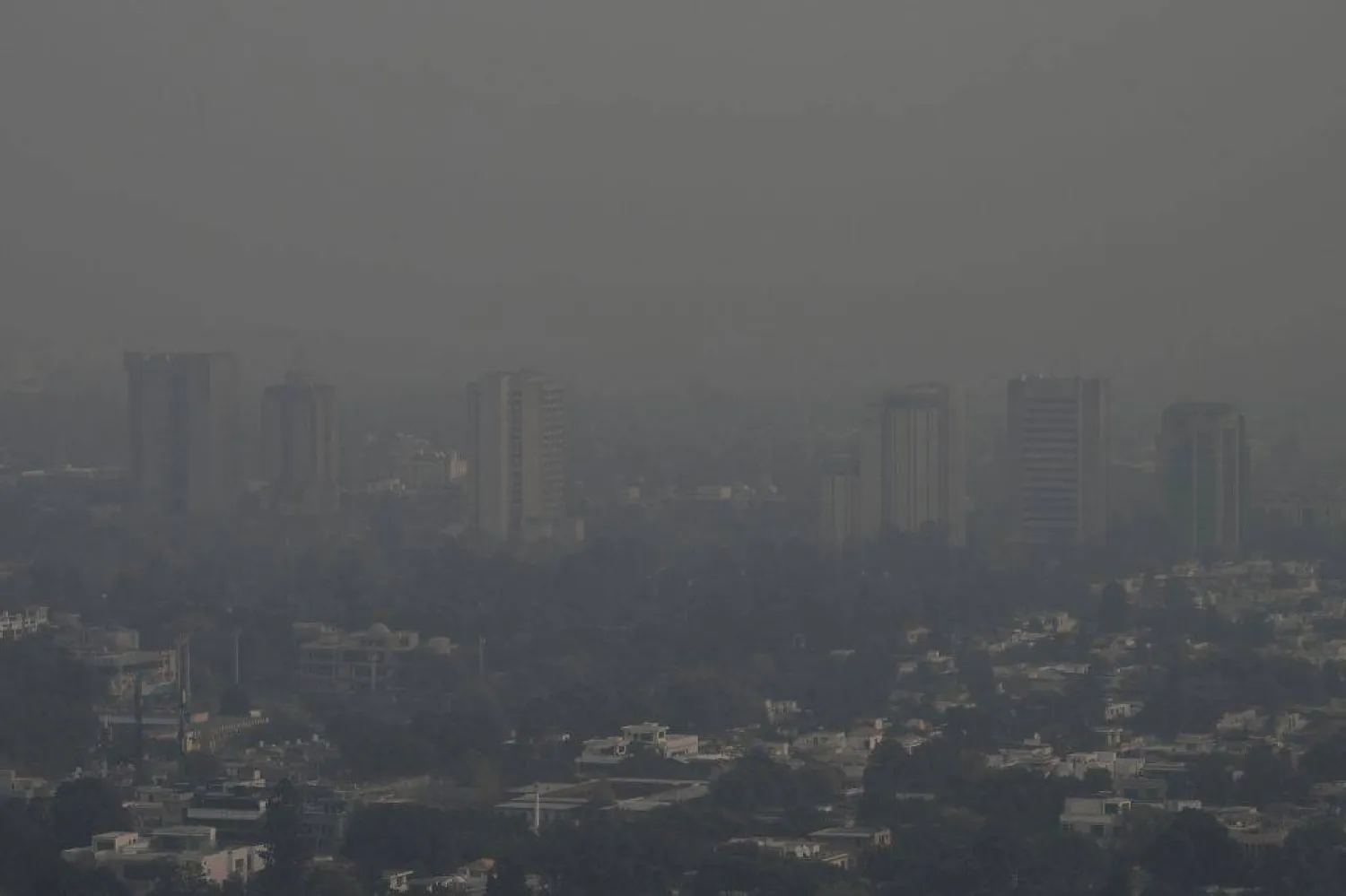
This picture taken on December 9, 2025, shows buildings engulfed in dense smog due to severe air pollution in Islamabad. (Photo by Aamir QURESHI / AFP)
TT

Islamabad Puts Drivers on Notice as Smog Crisis Worsens

This picture taken on December 9, 2025, shows buildings engulfed in dense smog due to severe air pollution in Islamabad. (Photo by Aamir QURESHI / AFP)

Truck driver Muhammad Afzal was not expecting to be stopped by police, let alone fined, as he drove into Islamabad this week because of the thick diesel fumes emanating from his exhaust pipe.

"This is unfair," he said after being told to pay 1,000 rupees ($3.60), with the threat of having his truck impounded if he did not "fix" the problem.

"I was coming from Lahore after getting my vehicle repaired. They pressed the accelerator to make it release smoke. It's an injustice," he told AFP.

Checkpoints set up this month are part of a crackdown by authorities to combat the city's soaring smog levels, with winter months the worst due to atmospheric inversions that trap pollutants at ground level.

"We have already warned the owners of stern action, and we will stop their entry into the city if they don't comply with the orders," said Dr Zaigham Abbas of Pakistan's Environmental Protection Agency (EPA), as he surveyed the checkpoint at the southeast edge of the capital.

For Waleed Ahmed, a technician inspecting the vehicles at the site, "just like a human being, a vehicle has a life cycle. Those that cross it release smoke that is dangerous to human health".

While not yet at the extreme winter levels of Lahore or the megacity Karachi, where heavy industry and brick kilns spew tons of pollutants each year, Islamabad is steadily closing the gap.

So far in December it has already registered seven "very unhealthy" days for PM2.5 particulates of more than 150 micrograms per cubic meter, according to the Swiss-based monitoring firm IQAir.

Intraday PM2.5 levels in Islamabad often exceed those in Karachi and Lahore, and in 2024 the city's average PM2.5 reading for the year was 52.3 micrograms -- surpassing the 46.2 for Lahore.

Those annual readings are far beyond the safe level of five micrograms recommended by the World Health Organization.

Built from scratch as Pakistan's capital in the 1960s, the city was envisioned as an urban model for the rapidly growing nation, with wide avenues and ample green spaces abutting the Himalayan foothills.

But the expansive layout discourages walking and public transport remains limited, meaning cars -- mostly older models -- are essential for residents to get around.

"The capital region is choked overwhelmingly by its transport sector," which produces 53 percent of its toxic PM2.5 particles, the Pakistan Air Quality Initiative, a research group, said in a recent report.

"The haze over Islamabad... is not the smoke of industry, but the exhaust of a million private journeys -- a self-inflicted crisis," it said.

Announcing the crackdown on December 7, EPA chief Nazia Zaib Ali said over 300 fines were issued at checkpoints in the first week, with 80 vehicles impounded.

"We cannot allow non-compliant vehicles at any cost to poison the city's air and endanger public health," she said in a statement.

The city has also begun setting up stations where drivers can have their emissions inspected, with those passing receiving a green sticker on their windshield.

"We were worried for Lahore, but now it's Islamabad. And that's all because of vehicles emitting pollution," said Iftikhar Sarwar, 51, as he had his car checked on a busy road near an Islamabad park.

"I never needed medicine before but now I get allergies if I don't take a tablet in the morning. The same is happening with my family," he added.

Other residents say they worry the government's measures will not be enough to counter the worsening winter smog.

"This is not the Islamabad I came to 20 years ago," said Sulaman Ijaz, an anthropologist.

"I feel uneasy when I think about what I will say if my daughter asks for clean air -- that is her basic right."



Tourism on Hold as Middle East War Casts Uncertainty

Tourism to the Middle East has boomed in recent years but war now threatens that success. Ryan Lim / AFP
TT

Tourism on Hold as Middle East War Casts Uncertainty

Tourism to the Middle East has boomed in recent years but war now threatens that success. Ryan Lim / AFP

Cancelled flights, postponed trips and a great deal of uncertainty: the war in the Middle East is casting a long shadow over the tourism outlook for a region that has become a prized destination for travelers worldwide.

"My last group of tourists left three days ago, and all the other groups planned for March have been cancelled," said Nazih Rawashdeh, a tour guide near Irbid, in northern Jordan.

"This is the start of the high season here. It's catastrophic," he told AFP.

"And yet there's no problem in Jordan. It's perfectly safe."

Across the world, tour operators are scrambling to find solutions for clients stranded in the region or who had trips planned there.

"The priority is getting those already there back home," said Alain Capestan, president of the French tour operator Comptoir des Voyages.

He said however that the war is also affecting customers who have travelled to other parts of the world, as the Gulf region is home to several major aviation hubs.

Like other companies, the German tour operators surveyed by AFP -- Alltours, Dertour, Schauinsland-Reisen -- announced they would cover the cost of extra nights for clients stranded in the Middle East. They also cancelled trips to the UAE and Oman until at least March 7.

The British travel industry association ABTA said agencies "would not be sending customers to the region for as long as the British Foreign Office advises against all non-essential travel".

Customers whose holidays were cancelled in recent days will be able to rebook or receive a refund, it said.

- Economic impact -

The war is disrupting a sector that had been booming in the region.

According to UN Tourism, in 2025 around 100 million tourists visited the Middle East -- nearly seven percent of all international tourists recorded worldwide. That figure had grown three percent year-on-year and 39 percent compared to the pre-pandemic period.

Depending on the destination, Europeans make up a large share of visitors, followed by tourists from South Asia, the Americas, and other Middle Eastern countries.

For example, nearby markets accounted for 26 percent of total visitors to Dubai in 2025, according to its Ministry of Tourism and Economy.

Against this backdrop analysts Oxford Economics warns that "a decline in tourist flows to the region will deal a more severe economic blow than in the past, as tourism's share of GDP has grown, as has employment in the sector".

"We estimate inbound arrivals to the Middle East could decline 11-27 percent year-on-year in 2026 due to the conflict, compared to our December forecast that projected 13 percent growth," said Director of Global Forecasting Helen McDermott.

That would translate, according to the firm, to between 23 and 38 million fewer international visitors compared to the prior scenario, and a loss of $34 to $56 billion in tourist spending.

After Covid and then the conflict in Gaza, tourists had been coming back, said Rawashdeh, the Jordanian tour guide.

"For the past six months, people working in tourism here had hope. And now there's a war. This is going to be terrible for the economy," he said.

"We've definitely noticed an understandable slowdown in new bookings from our partners right now, but we fully expect that to bounce back as soon as things settle down and travelers feel more confident," said Ibrahim Mohamed, marketing director of Middle East Travel Alliance, which offers direct tours to American and British operators.

He remains optimistic: "The Middle East has always been an incredibly resilient market, and demand always bounces back fast once stability returns."


Punch the Orphan Macaque is Outgrowing his Plushie and Making Friends

Punch, a Japanese macaque born on July 26, 2025, climbs on the back of another in the monkeys' playground at the Ichikawa city zoo in Tokyo's eastward neighboring city, Tuesday, March 3, 2026. (AP Photo/Hiro Komae)
TT

Punch the Orphan Macaque is Outgrowing his Plushie and Making Friends

Punch, a Japanese macaque born on July 26, 2025, climbs on the back of another in the monkeys' playground at the Ichikawa city zoo in Tokyo's eastward neighboring city, Tuesday, March 3, 2026. (AP Photo/Hiro Komae)

Punch the baby orphan macaque is outgrowing the orangutan plushie that comforted him through early rejection from his mother and other monkeys.

Images of Punch dragging around the toy bigger than him drew attention to the residents of a zoo near Tokyo. When other monkeys shooed the baby away, Punch rushed back to the toy orangutan, hugging it for comfort.

But he's been using the toy less. On a recent day, Punch was seen climbing on the back of another monkey, sitting with adults and sometimes getting groomed or hugged, The Associated Press reported.

“It was good to see him grow, and I’m reassured,” said Sanae Izumi, a 61-year-old Punch fan from Osaka who came to the zoo because she was worried about the baby monkey. “He is adorable!”

Punch was abandoned by his mother after his birth, presumably because of exhaustion. Zookeepers nursed him and gave him the toy to train him to cling, an ability newborn macaques need to survive.

“Helping Punch learn the rules of monkey society and being accepted as a member is our most important task,” said Kosuke Kano, a 24-year-old zookeeper.

Punch was so popular after images of him and his toy showed up online last month, the zoo had to set rules to make visitors be quiet and to limit viewing to 10 minutes to reduce stress for the more than 50 other monkeys.

Punch eschewing the toy most of the time now is a good thing.

“When he grows out of the plush toy that encourages his independence, and that’s what we are hoping for,” zoo director Shigekazu Mizushina said.

Punch still sleeps with his toy every night, but Mizushina said the next thing keepers want to see is Punch bunched up with other monkeys to sleep.


Saudi Arabia: NCW Marks World Wildlife Day with Strategic Plan for Biodiversity Protection

The NCW says it is focused on enhancing wildlife management efficiency. SPA
TT

Saudi Arabia: NCW Marks World Wildlife Day with Strategic Plan for Biodiversity Protection

The NCW says it is focused on enhancing wildlife management efficiency. SPA

The National Center for Wildlife (NCW) reaffirmed its commitment to protecting wildlife and preserving natural habitats, recognizing this responsibility as essential to nature conservation and ecosystem sustainability in Saudi Arabia. This observance aligns with World Wildlife Day, marked annually on March 3.

The center emphasized its efforts in wildlife development, which include breeding endangered species and reintroducing them into their natural habitats, developing and managing protected areas, and implementing environmental monitoring programs and scientific research.

This approach builds on a phased institutional effort, expanding breeding and reintroduction programs for wildlife species from seven to 21, with a strategic plan to reach 50 programs by 2030.

The NCW is also focused on enhancing wildlife management efficiency and advancing operational tools, thereby strengthening a national approach grounded in science and long-term planning.