

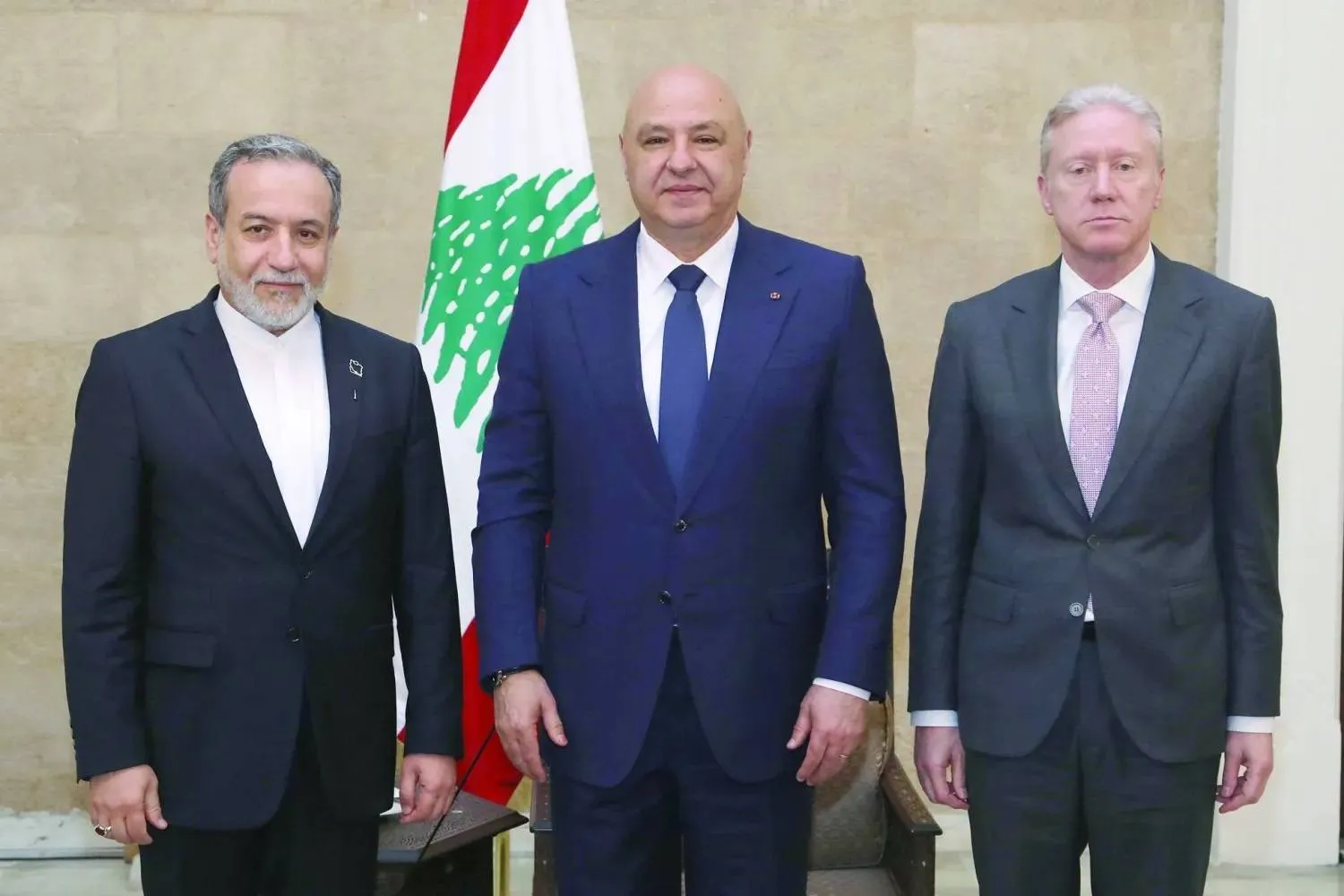

Political Tensions between Lebanon and Iran Reach New Heights

Lebanese President Joseph Aoun (center), Foreign Minister Youssef Raggi (left) and Iranian FM Abbas Araqchi meet in Lebanon in June. (Lebanese Presidency)
TT

Political Tensions between Lebanon and Iran Reach New Heights

Lebanese President Joseph Aoun (center), Foreign Minister Youssef Raggi (left) and Iranian FM Abbas Araqchi meet in Lebanon in June. (Lebanese Presidency)

Tensions between Lebanon and Iran have reached unprecedented levels, reflecting a shift in how Beirut views its ties with Tehran, especially when it comes to Hezbollah’s arsenal and Iranian meddling in Lebanese internal affairs.

The tensions are not just playing out in the media, but in official positions taken by Lebanon’s top officials.

The latest example was Lebanese Foreign Minister Youssef Raggi’s announcement last week that he was declining an invitation by his Iranian counterpart Abbas Araqchi to visit Tehran. He instead proposed meeting in a neutral country.

An official Lebanese source told Asharq Al-Awsat that Raggi’s position does not stem from his personal views, but from a “clear political stance that Lebanese-Iranian relations cannot go back on track if they are not based on equality.

Iran must only limit its dealings in Lebanon to the state and no other party, namely Hezbollah, it added.

The root of the crisis lies in Iran’s absolute support for Hezbollah and how Tehran views it as an extension of its Revolutionary Guards Corps, an entity that exists parallel to the Lebanese state and even violates its jurisdiction in taking decisions of war and peace.

Speaking on condition of anonymity, the source warned that Iran maintaining this position towards Lebanon, “complicates the situation inside Lebanon and exposes the country to a new war with Israel.”

Lebanon cannot withstand such a new conflict, it added.

Araqchi on Thursday said he would visit Lebanon after Raggi issued a formal invitation.

Raggi was not the only senior Lebanese official to take issue with Iran. Earlier this year, President Joseph Aoun refused to meet with Secretary of Iran's Supreme National Security Council Ali Larijani while he was visiting Beirut.

The source said the refusal was a “direct message that the Lebanese state no longer tolerates parallel channels or relations that go beyond formal and constitutional levels.”

“This is the Lebanese state’s official position,” it stressed. “Iran will be welcomed if its changes the way it approaches Lebanon, whereby relations should be between official and constitutional institutions. Both countries should be equals, not with one being subordinate to the other.”

Earlier in 2025, Aoun received Iranian Speaker of the Shura Council Mohammad Bagher Qalibaf, informing him that Lebanon has “grown weary” of other countries “waging their wars on its territory.”

“It is about time that the Lebanese people are relieved of wars and tragedies,” he said, referring to the “support war” Hezbollah had launched in 2023 in solidarity with Hamas in Gaza with Iran’s backing.

On Sunday, Iranian foreign ministry spokesman Esmaeil Baghaei renewed Tehran’s call on Beirut to hold dialogue.

“Iran would rather avoid making statements that would distract Lebanon from focusing on its sovereignty and territorial integrity. The real danger against Lebanon’s sovereignty and dignity are Israel’s ambitions and hegemony,” he remarked.

Meanwhile, a senior adviser to Iran's supreme leader, Ali Akbar Velayati, declared that Tehran will continue to support Hezbollah.

Meeting with Hezbollah representative in Tehran, Abdullah Safieddine, he described the party as one of “the most important pillars of the Resistance Axis.”

Hezbollah is playing a “fundamental role in confronting Zionism,” he added.

Such statements demonstrate how Iran views Hezbollah’s arsenal as part of Tehran's regional security system, not as an issue related to Lebanon’s sovereignty.

The Lebanese government earlier this year took a landmark decision to impose state monopoly over arms, which effectively calls on Hezbollah to lay down its weapons.

Another adviser to Iran’s supreme leader, Ali Shamkhani, had previously openly declared that efforts to disarm Hezbollah “will fail.”

“These arms are those of the Lebanese people to defend their territory against Israel,” he added, rejecting any discussions about handing them over to the Lebanese state.

The official Lebanese source stressed that “there can be no going back” from the decision to impose state monopoly over arms.

“The internal and external objections will not change the state’s policy that has taken the decision to impose its authority throughout Lebanon,” it continued.



IMF Hails Yemen’s Reforms, Supports its Recovery Path

The light of the setting sun illuminates some clouds in the sky over Sanaa, Yemen, 30 March 2026. (EPA)
TT

IMF Hails Yemen’s Reforms, Supports its Recovery Path

The light of the setting sun illuminates some clouds in the sky over Sanaa, Yemen, 30 March 2026. (EPA)

The Executive Board of the International Monetary Fund (IMF) on Saturday resumed Article IV consultations with the Yemeni legitimate government after 11 years.

Reflecting the country’s improved institutional performance, this development is an important indicator of restoring channels of cooperation with international financial institutions and boosting confidence in the reform path being taken by the government.

“The renewed consultation reflects enhanced institutional capacity and data production,” the IMF said in a statement.

It positively noted the government’s efforts to achieve the minimum economic stabilization despite the extraordinary circumstances the country is going through.

The Fund said Yemen’s economy is gradually emerging from the deep recession following the suspension of oil exports in 2022, with the pace of contraction moderating and fiscal and external pressures easing. However, it warned that the war in the Middle East is expected to weigh on Yemen’s economy this year, while risks to the outlook remain substantial.

IMF directors affirmed the authorities' commitment to revenue mobilization and fiscal governance enables the delivery of essential public services.

They noted that a market-based exchange rate supports Yemen’s economic recovery and social stability.

Directors said that engagement with creditors to support a comprehensive debt treatment is also essential to restore debt sustainability.

Meanwhile, the prioritization of essential spending is expected to weigh temporarily on the fiscal balance, the IMF said, but over time will help protect the most vulnerable.

The Yemeni government welcomed the approval of the IMF’s Article IV consultation results after an 11-year pause - an important step restoring international engagement and confidence in its reform agenda to strengthen financial management, transparency and fight corruption, despite the war outcomes and the suspension of oil exports as a result of Houthi attacks.

The government reaffirmed its commitment to continue implementing a comprehensive reform program in various sectors, and to work in coordination with international partners to alleviate human suffering and achieve economic stability.

It then noted the adoption of the 2026 general budget as part of efforts to revive state institutions.

Despite the positive indicators, the IMF said the challenges facing Yemen's economy remain large and complex amid the ongoing war, institutional fragmentation and lack of financial resources.

The IMF stressed that the risks surrounding the future outlook remain high, especially in light of regional developments and their potential impact on the global economy.

It said inflation, fluctuating exchange rates and rising import costs will cause major pressure on the economy, requiring the adoption of balanced precautionary policies to maintain monetary and financial stability.

From 2027 onward, the IMF said the economy is expected to begin regaining momentum as inflation declines, real incomes recover and remittances and non-oil exports expand under the authorities’ Agriculture Plan.


Israel Aiming to Impose Security Control through Fire over Southern Lebanon

Israeli military vehicles drive through mud on the Lebanese side of the Israel-Lebanon border, after Israeli forces launched a campaign against Iran-backed Hezbollah in southern Lebanon, amid the US-Israeli conflict with Iran, as seen from northern Israel April 4, 2026. (Reuters)
TT

Israel Aiming to Impose Security Control through Fire over Southern Lebanon

Israeli military vehicles drive through mud on the Lebanese side of the Israel-Lebanon border, after Israeli forces launched a campaign against Iran-backed Hezbollah in southern Lebanon, amid the US-Israeli conflict with Iran, as seen from northern Israel April 4, 2026. (Reuters)

The conflict between Hezbollah and Israel in southern Lebanon is taking on a more complex shape, no longer limited to images of tanks and front line. Based on its operations on the ground and statements from its officials, Israel is not aiming for a traditional sense of occupation of the South, but rather imposing security control without actually holding territory.

This position reflects a shift in tactics and push towards managing the conflict, moving from military control that is based on advances and positioning, to security hegemony based on prevention, control, and reshaping geography and the population.

Modern security belt

Here rises the concept of the security belt, but in a more modern form than the one that prevailed pre-2000 when Israel occupied the South for nearly two decades. Israeli Prime Minister Benjamin Netanyahu has spoken of “expanding the security belt in southern Lebanon.”

Defense Minister Israel Katz has also said that Israel aims to disarm Iran-backed Hezbollah and that it will target its leaders and members “throughout Lebanon.” Houses that are used as Hezbollah positions “will be destroyed according to the model adopted in [Gaza’s] Rafah and Khan Younis.”

Israel will seek to control territories up to the Litani River and prevent tens of thousands of people from returning to their homes before it achieves its security.

Despite the escalation, Israel keeps saying that it is not aiming to fully occupy Lebanon. Israel’s Haaretz reported that the army has not set this as a war goal, despite acknowledging that in theory, the disarmament of Hezbollah would demand it.

This contradiction reflects the essence of the strategy: avoiding the cost of occupation, while achieving its end goals through other means based on control by fire and clearing the area.

18 positions

An informed source on the ground told Asharq Al-Awsat that Israel is seeking to re-occupy 18 strategic positions it had held before 2000. They include al-Bayyada, Shamaa, Beit Leef, Tallet al-Aweida, al-Tayba hills, the Beaufort Castle, and the Iqlim al-Tuffah heights that overlook the western Bekaa region.

Israel will not deploy its forces, but impose complete security control by fire over the Nabatieh district, all the way to al-Zahrani, Sidon, western Bekaa and Jezzine, allowing for control on the ground without actually having to position its troops there permanently.

Israel is aiming to acquire the ability to manage the South from heights and strategic points, the source explained.

Of the 600,000 people displaced from the area, the source said Israel will prevent them from returning. This includes areas beyond Iqlim al-Tuffah, al-Nabatieh and parts of the western Bekaa, reflecting an intent to change demographics on the ground.

Retired General Naji Malaeb told Asharq Al-Awsat that Israel does not want a permanent ground occupation, but the ability to control the field through fire, air or alternate forces.

This can happen through either direct military presence that runs the area or through establishing a buffer zone on scorched earth that prevents the people from returning to their homes and prevents any military positioning in the area.

This approach also prevents Israel’s adversaries from using the territory, he added.


Indonesia Lays to Rest Peacekeepers Killed in Lebanon

The coffin containing the body of Indonesian soldier Farizal Rhomadhon is carried by soldiers at his home in Kulon Progo, Yogyakarta, on April 4, 2026, after being killed while serving with the United Nations Interim Force in Lebanon (UNIFIL) in southern Lebanon. (AFP)
TT

Indonesia Lays to Rest Peacekeepers Killed in Lebanon

The coffin containing the body of Indonesian soldier Farizal Rhomadhon is carried by soldiers at his home in Kulon Progo, Yogyakarta, on April 4, 2026, after being killed while serving with the United Nations Interim Force in Lebanon (UNIFIL) in southern Lebanon. (AFP)

Three Indonesian peacekeepers killed in two separate explosions in southern Lebanon last week were laid to rest in their hometowns on Sunday.

Peacekeeper Farizal Rhomadhon, 28, died when a projectile exploded on March 29 in southern Lebanon, where Israel and Hezbollah have been fighting since Lebanon was drawn into the Middle East war.

Two other blue helmets, Zulmi Aditya Iskandar, 33, and Muhammad Nur Ichwan, 26, died a day later when an explosion struck a logistics convoy of the UN Interim Force in Lebanon (UNIFIL), also in southern Lebanon.

The deadly incidents sparked calls from Indonesian authorities for an investigation and security guarantees for peacekeeping forces.

The soldiers were buried on Sunday in coffins draped in the Indonesian flag during military funerals with gun salutes.

Weeping family members scattered flower petals on their graves.

Zulmi was buried in a military cemetery in his hometown in Bandung, West Java, while Ichwan and Farizal were laid to rest in their respective hometowns in Central Java and Yogyakarta.

"I'm letting him go proudly. I accept it sincerely, even though it is not what I had hoped as a parent," Zulmi's father Iskandarudin told reporters after the funeral.

"I am certain that he's waiting for me in heaven."

Agus Subiyanto, the commander of the Indonesian National Armed Forces, told reporters that every fallen soldier will receive compensation in recognition of their service.

"We have prepared all the rights and entitlements that must be given to the fallen soldiers. Among these is compensation from the United Nations," Agus said after attending Zulmi's funeral.

The bodies of the three peacekeepers arrived in Jakarta on Saturday, received with honors in a ceremony attended by President Prabowo Subianto.

Prabowo said on Instagram that Indonesians "strongly condemn every heinous act that undermines peace and causes the deaths of our nation's soldiers".

Less than a week after the explosions that killed the three peacekeepers, another blast took place at a UN facility near Adeisseh on Friday, injuring three more Indonesian blue helmets.

Indonesia's Foreign Ministry called the attacks "unacceptable" and urged the UN Security Council "to immediately convene a meeting of troop-contributing countries to UNIFIL to conduct a review and take measures to enhance the protection of personnel serving with UNIFIL".

Foreign Minister Sugiono, who like many Indonesians only has one name, told reporters on Saturday that Indonesia wanted a thorough UN investigation, and demanded better security guarantees for peacekeeping soldiers.