


US-Yemen Engagement Seeks to Bolster Partnership, Contain Divisions

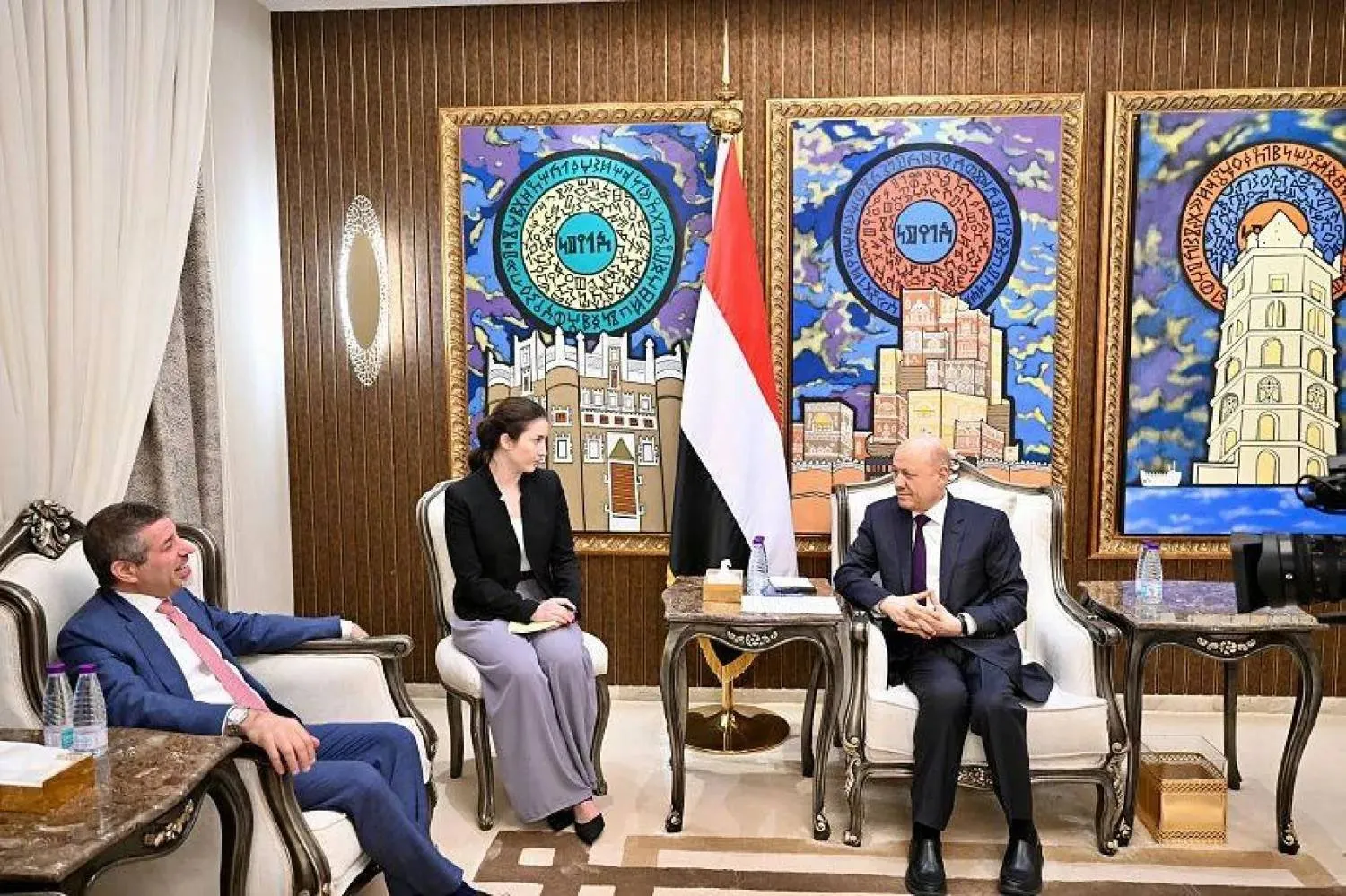
Al-Alimi met with US Ambassador Steven Fagin in Riyadh (SABA)
TT

US-Yemen Engagement Seeks to Bolster Partnership, Contain Divisions

Al-Alimi met with US Ambassador Steven Fagin in Riyadh (SABA)

Several meetings held by US Ambassador to Yemen Steven Fagin with the leadership of Yemen’s Presidential Leadership Council (PLC) point to American attempts to reinforce the political and security partnership with the Yemeni government while containing internal divisions within the internationally recognized camp.

The move comes amid a complex domestic environment and growing regional challenges affecting Yemen’s security and stability.

The engagement included talks with PLC President Rashad al-Alimi, a meeting with council member Sheikh Othman Mujalli, and a video call with Major General Sultan al-Aradah.

Discussions focused on bilateral relations, political and military developments, and certain priorities, notably counterterrorism and confronting threats posed by the Iran-backed Houthi militia.

Discussions with al-Alimi reportedly centered on the scope of Yemeni-US partnership and Washington’s role in supporting the Yemeni state, politically in international forums and through counterterrorism cooperation, as well as efforts to curb Iran-linked arms smuggling and financial networks.

Government reforms were also raised, in light of the need for international backing to ease economic and humanitarian pressures.

The talks addressed recent developments in Yemen’s eastern governorates and unilateral measures taken there, alongside regional efforts led by Saudi Arabia and the United Arab Emirates to contain tensions and restore normal conditions.

Yemeni leaders stressed the need to preserve consensus within the framework of legitimacy and prevent internal disputes from undermining unified security and military decision-making.

Yemeni officials also stressed adherence to the key references governing the transitional phase, particularly the Declaration on the Transfer of Power and the Riyadh Agreement, warning that bypassing these frameworks could create security vacuums exploited by the Houthis and terrorist groups.

In a broader assessment during his call with Fagin, al-Aradah described Yemen’s current phase as one in which political, military, and economic challenges intersect, calling for a firmer international stance and practical support to restore state institutions, cut off militia funding, and safeguard UN-led efforts.

In his meeting with Mujalli, Fagin discussed Iran’s role in enhancing Houthi military capabilities and the resulting risks to Yemen, neighboring states, and maritime security in the Red Sea and the Arabian Sea.

According to Yemeni official media, the US ambassador reaffirmed Washington’s support for the country’s unity and territorial integrity, the cohesion of the PLC and government, and continued partnership in counterterrorism, humanitarian relief, and efforts to promote stability and development.



EU Condemns Israel's West Bank Control Measures

The Israeli settlement of Har Homa, seen from the West Bank city of Bethlehem, Tuesday, Dec. 17, 2024. (AP)
TT

EU Condemns Israel's West Bank Control Measures

The Israeli settlement of Har Homa, seen from the West Bank city of Bethlehem, Tuesday, Dec. 17, 2024. (AP)

The European Union on Monday condemned new Israeli measures to tighten control of the West Bank and pave the way for more settlements in the occupied Palestinian territory, AFP reported.

"The European Union condemns recent decisions by Israel's security cabinet to expand Israeli control in the West Bank. This move is another step in the wrong direction," EU spokesman Anouar El Anouni told journalists.


Atrocities in Sudan's El-Fasher Were 'Preventable Human Rights Catastrophe'

Sudanese displaced people who left El Fasher after its fall, sit in the shade in Tawila at the Rwanda camp reception point on December 17, 2025. (Photo by AFP)
TT

Atrocities in Sudan's El-Fasher Were 'Preventable Human Rights Catastrophe'

Sudanese displaced people who left El Fasher after its fall, sit in the shade in Tawila at the Rwanda camp reception point on December 17, 2025. (Photo by AFP)

The atrocities unleashed on El-Fasher in Sudan's Darfur region last October were a "preventable human rights catastrophe", the United Nations said Monday, warning they now risked being repeated in the neighbouring Kordofan region.


"My office sounded the alarm about the risk of mass atrocities in the besieged city of El-Fasher for more than a year ... but our warnings were ignored," UN rights chief Volker Turk told the Human Rights Council in Geneva.


He added that he was now "extremely concerned that these violations and abuses may be repeated in the Kordofan region".


Arab League Condemns Israel's Decisions to Alter Legal, Administrative Status of West Bank

A general view shows the opening session of the meeting of Arab foreign ministers at the Arab League Headquarters (Reuters)
TT

Arab League Condemns Israel's Decisions to Alter Legal, Administrative Status of West Bank

A general view shows the opening session of the meeting of Arab foreign ministers at the Arab League Headquarters (Reuters)

The General Secretariat of the Arab League strongly condemned decisions by Israeli occupation authorities to impose fundamental changes on the legal and administrative status of the occupied Palestinian territories, particularly in the West Bank, describing them as a dangerous escalation and a flagrant violation of international law, international legitimacy resolutions, and signed agreements, SPA reported.

In a statement, the Arab League said the measures include facilitating the confiscation of private Palestinian property and transferring planning and licensing authorities in the city of Hebron and the area surrounding the Ibrahimi Mosque to occupation authorities.

It warned of the serious repercussions of these actions on the rights of the Palestinian people and on Islamic and Christian holy sites.

The statement reaffirmed the Arab League’s firm support for the legitimate rights of the Palestinian people, foremost among them the establishment of their independent state on the June 4, 1967 borders, with East Jerusalem as its capital.