
Two Warnings, Arab and Western, ‘Tip the Balance’ in Iraq

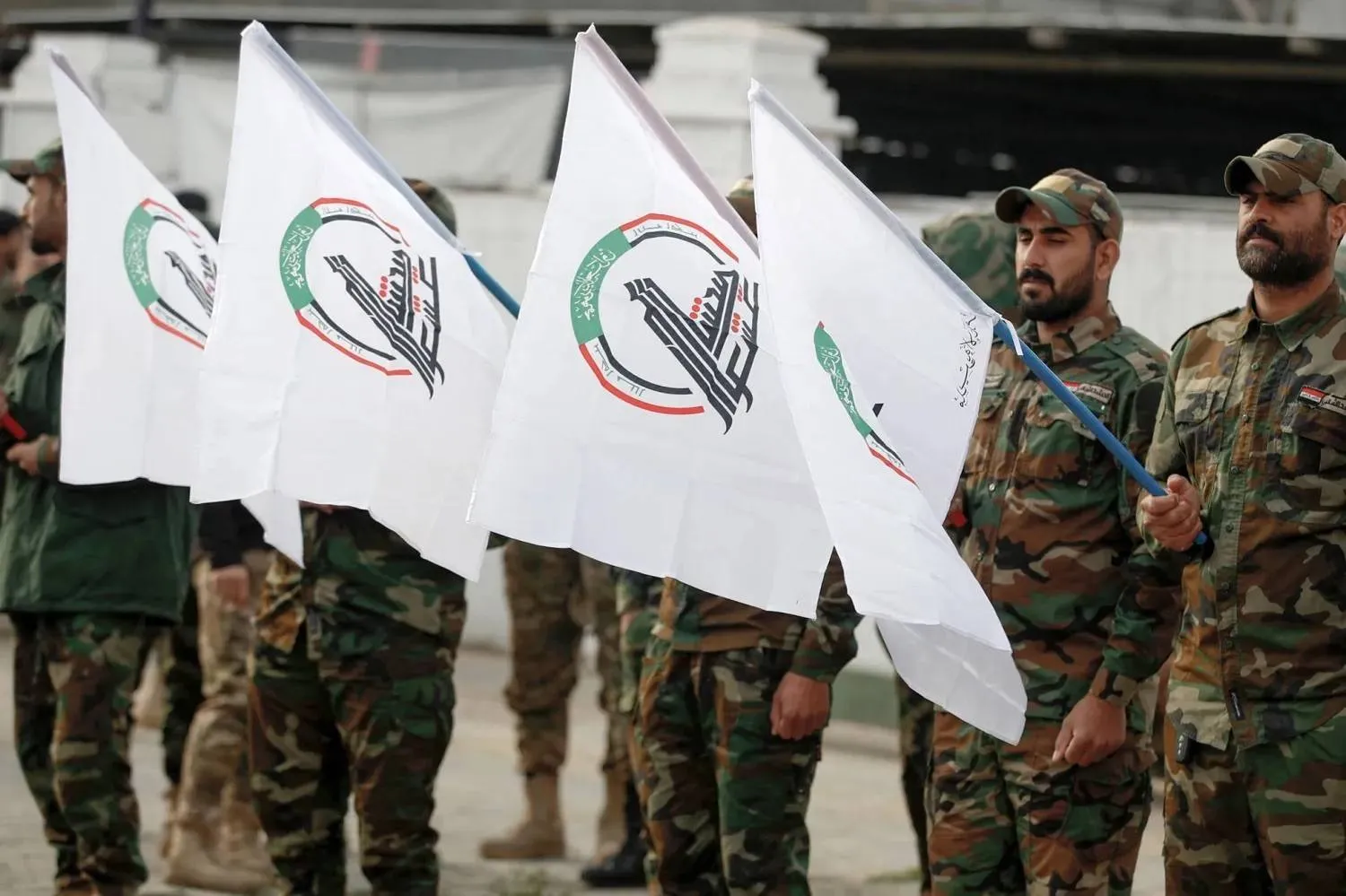
Members of the Popular Mobilization Forces during the funeral of comrades killed in a US strike (AFP). 
TT

Two Warnings, Arab and Western, ‘Tip the Balance’ in Iraq

Members of the Popular Mobilization Forces during the funeral of comrades killed in a US strike (AFP). 

In an unusual development, informed sources told Asharq Al-Awsat that the Iraqi government and influential political actors received two extraordinary warning messages over the past two weeks — one from an Arab country and another from a Western intelligence service — containing what were described as “serious” indications of impending, wide-ranging military strikes inside Iraq.

An Iraqi official confirmed that a “friendly state” had briefed Baghdad on the substance of the threat, prompting Shiite factions to move swiftly toward concessions.

According to the sources, potential targets could have included government institutions linked to Shiite factions and the Popular Mobilization Forces (PMF), powerful financial and military figures, sites and depots for drones and missiles, and training camps.

The two warnings are widely believed to have accelerated a recent wave of political statements by factions calling to “confine weapons to the state,” while simultaneously requesting time and freedom of action, within what they termed a “national framework”, to dismantle their military capabilities. This position remains a point of contention among leaders of the Coordination Framework.

A Message from a “Friendly State”

The threat level first rose with a message from an Arab country that maintains good relations with both Washington and Tehran. The message warned that Baghdad was perilously close to a swift military strike, likened to the targeting of Hamas’ political office in Doha in September 2025.

The message, delivered to Iraqi officials and politicians, stressed that the threat was “extremely serious” and that Israelis were now speaking openly of having received a green light from the United States to act unilaterally in the Iraqi theater.

Iraq has been among the arenas Israel has contemplated striking since the Oct. 7, 2023 attacks. Iraqi politicians told Asharq Al-Awsat in recent months that Washington had restrained Israel from operating in Iraq, while pressing Baghdad to remove the risks posed by weapons outside state control.

A Western diplomat said US officials felt Iraqi leaders did not fully grasp the gravity of the situation and had grown frustrated with what they saw as a weak response.

An Iraqi government official acknowledged receiving multiple warnings about armed groups from friendly states and Western embassies in Baghdad.

“A Massive File”

Days after the Arab message, Iraqi officials received what sources described as a “massive file” from a Western intelligence service. The file included Israeli-prepared lists packed with detailed information on Iraqi armed factions.

The breadth, precision, and depth of the intelligence stunned Iraqi officials. One told Asharq Al-Awsat that the timing of revealing the extent of Israel’s knowledge was critical. The lists reportedly detailed faction leaders, covert operatives within their inner circles, financiers and business figures tied to the groups, and government institutions serving as fronts for factional influence.

The Western service warned that Israel was on the verge of a broad operation now that the factions’ operational and financial capabilities and the deep networks underpinning their military structures had been exposed. After reviewing parts of the file, Shiite politicians reportedly recalled the pager explosions in Lebanon as a cautionary precedent.

“What Now?”

A senior Shiite leader within the Coordination Framework revealed that the two messages “changed the equation,” pushing party leaders to accelerate steps related to factional arms. Many are now grappling with a single question: what to do next? Disagreements persist over the method and the trusted authority to oversee a transitional phase of weapons consolidation.

The leader noted the first phase would involve handing over ballistic missiles and drones and dismantling and surrendering strategic camps north and south of Baghdad. A second phase, he claimed, would include removing faction-affiliated officials from the PMF, pending the US response.

An official in the State of Law Coalition said an agreement to remove heavy weapons had already existed within the Coordination Framework, even before US pressure intensified. Current disputes center on which state body would take custody of the weapons, amid US distrust of security institutions seen as influenced by factions.

Complicating matters, factions fear implementing disarmament amid fraught negotiations to form a new government. Caretaker Prime Minister Mohammad Shia al-Sudani is seeking a second term after winning the largest bloc within the Coordination Framework, a bid opposed by his rival Nouri al-Maliki, who favors a compromise candidate.

US Pressure

The Western intelligence message coincided with the arrival in Iraq of Senior Defense Official Colonel Stephanie Bagley. US defense funding will hinge on three conditions set out in the 2025 National Defense Authorization Act, passed on Dec. 11, 2025.

The law conditions assistance on Iraq’s ability to publicly and verifiably reduce the operational capacity of Iran-aligned armed groups not integrated into the security forces through disarmament, demobilization, and reintegration. It also requires strengthening the Iraqi prime minister’s authority as commander-in-chief and investigating and prosecuting militia members or security personnel operating outside the official chain of command if involved in attacks or destabilizing acts.

Western diplomatic sources said Bagley is expected to seek a clear, enforceable timeline from Iraqi officials. She met twice in one week with Army Chief of Staff Lt. Gen. Abdul Amir Yarallah in October 2025.

A former Iraqi official noted that Washington has repeatedly pressed Baghdad for a timeline to dismantle militia influence, especially ahead of 2026, when the US-led coalition is set to complete its mission. A US State Department spokesperson reaffirmed that Washington will continue to press for the disarmament of Iran-backed militias that undermine Iraq’s sovereignty and threaten Iraqis and Americans alike.


Sudan Paramilitary Strike on Southeastern City Kills 27

RSF fighters. (AFP file photo)
TT

Sudan Paramilitary Strike on Southeastern City Kills 27

RSF fighters. (AFP file photo)

Sudan's paramilitary Rapid Support Forces launched drones at an army base in the southeastern city of Sinja on Monday, killing 27 people, military and health sources told AFP.

Sinja, the capital of Sennar state, lies around 300 kilometers (180 miles) southeast of the capital Khartoum, along a strategic road connecting the national capital to the army-controlled east.

The strike comes a day after the army-aligned government announced its return to Khartoum after close to three years operating from its wartime base in the eastern city of Port Sudan.

Since April 2023, the war between the army and the RSF has killed tens of thousands of people, displaced 11 million internally and across borders, and created the world's largest displacement and hunger crises.

Sinjah had largely been spared the fighting since the army recaptured the area in late 2024 as part of a wider offensive that saw it later retake Khartoum.

The military source, speaking anonymously because they were not authorized to brief the media, said RSF drones "targeted the headquarters of the army's 17th Infantry Division" in Sinja.

Ibrahim al-Awad, the Sennar state health minister, said that the attack carried out by the RSF also wounded 73 people.

A security source told AFP on condition of anonymity that the attack targeted the army headquarters "during a meeting attended by military, security and government officials" from several eastern and central states.

One resident of Sinja told AFP that they "heard explosions and anti-aircraft fire".

The Sennar region had last been targeted by drones in October.

- Fragile return -

In the year following its recapture, more than 200,000 people returned to Sennar state, according to the United Nations' migration agency.

But the agency has warned many such returns across the country remain "fragile", often taking place in areas with damaged infrastructure and ongoing insecurity.

Along with the government, millions of civilians had fled Khartoum early in the war when RSF fighters quickly overran it.

Since the army regained control last year, around 1.2 million have gradually returned, according to the latest UN figures.

Reconstruction efforts are underway, but the RSF, which with its allies now rules around a third of the country, sporadically launches long-range drones deep into army-controlled territory, particularly targeting infrastructure.

The army and its government control Sudan's north, east and center.

The RSF now dominates the vast western region of Darfur and has pushed through the southern region of Kordofan, aiming to capture cities that would bring it closer to Khartoum.

With multiple cities under paramilitary siege, hundreds of thousands face mass starvation in Kordofan.

The UN has called the conflict a "war of atrocities", with both sides accused of targeting civilians.


Drone Strike Kills 3 in Gaza as Hamas Prepares to Transfer Governance to New Committee

 A tent camp for displaced Palestinians stretches across an area in Deir al-Balah, in the central Gaza Strip, Saturday, Jan. 10, 2026. (AP)
A tent camp for displaced Palestinians stretches across an area in Deir al-Balah, in the central Gaza Strip, Saturday, Jan. 10, 2026. (AP)
TT

Drone Strike Kills 3 in Gaza as Hamas Prepares to Transfer Governance to New Committee

 A tent camp for displaced Palestinians stretches across an area in Deir al-Balah, in the central Gaza Strip, Saturday, Jan. 10, 2026. (AP)
A tent camp for displaced Palestinians stretches across an area in Deir al-Balah, in the central Gaza Strip, Saturday, Jan. 10, 2026. (AP)

An Israeli drone strike on Monday killed three Palestinians who had crossed the ceasefire line near central Gaza’s Morag corridor, hospital officials said.

Israel’s military did not immediately respond to questions about the strike, which came as Gaza awaits an expected announcement this week of a “Board of Peace” to oversee its governance.

Hamas said it will dissolve its existing government once the new committee takes over the territory, as mandated under the US-brokered peace plan.

The Gaza Health Ministry reports that more than 440 people have been killed since Israel and Hamas agreed last October to suspend their two-year war. Since then each side has accused the other of violating the ceasefire, which remains in its initial stage as efforts continue to recover the remains of the final Israeli hostage in Gaza.

Israel’s military controls a buffer zone that covers more than half of Gaza, while the Hamas-run government retains authority over the rest.

Throughout the war, Israel has supported anti-Hamas groups, including an armed group in southern Gaza that claimed responsibility on Monday for the killing of a senior Hamas police officer in Khan Younis.

Lt. Col. Mahmoud al-Astal was gunned down in the Muwasi area, the Hamas-run Interior Ministry said in a statement.

Hamas spokesperson Hazem Kassem, in a post on Telegram on Sunday, called for a speeding up of the establishment of the Palestinian technocratic committee set to govern Gaza.

Hamas and the rival Palestinian Authority have not announced the names of who will sit on the committee and it remains unclear if they will be cleared by Israel and the US.

Officials say that Trump will announce his appointments to the Board of Peace in the coming days.

Under Trump’s plan, the board would supervise the new Palestinian government, the disarmament of Hamas, the deployment of an international security force, additional pullbacks of Israeli troops and reconstruction. The US has reported little progress on any of these fronts so far.

According to Turkish officials, Foreign Minister Hakan Fidan participated on Monday in a video conference with the US and others meeting to discuss “preparations for the second stage” of the ceasefire agreement. The talks, held as a continuation of the meeting in Miami at the end of December, also included officials from Egypt and Qatar.

Dozens of Palestinians, including medical workers, held a protest in Gaza City on Monday to demand the release of thousands of Palestinian prisoners still being held in Israeli prisons. The protest was organized by the Palestinian Prisoners Committee outside the building of the International Committee of the Red Cross in Gaza City.

Meanwhile, groups that advocate for Palestinian prisoners said that Israeli authorities have confirmed the death of a detainee from Gaza.

In a statement Sunday, the Prisoners’ Affairs Commission and the Palestinian Prisoner Society said that Hamza Abdullah Abdelhadi Adwan died in prison on Sept. 9, based on information the family received from the Israeli military.

Adwan, 67, a father of nine with serious health problems, had been detained at a checkpoint on Nov. 12, 2024. Two of his children were killed in the Gaza war.

Since the start of the war, 87 Palestinian detainees have died in Israeli prisons — including 51 from Gaza — according to the Palestinian Prisoners’ Affairs Commission. They said that more than 100 detainees — some not yet identified — had died of torture, starvation, medical neglect, and abuse.


Israeli-Backed Group Kills a Senior Hamas Police Officer in Gaza, Threatens More Attacks

Palestinians walk along a road amid destroyed buildings in Jabalia, in the northern Gaza Strip, on January 10, 2026. (AFP)
TT

Israeli-Backed Group Kills a Senior Hamas Police Officer in Gaza, Threatens More Attacks

Palestinians walk along a road amid destroyed buildings in Jabalia, in the northern Gaza Strip, on January 10, 2026. (AFP)

An Israeli-backed Palestinian group said on Monday it had killed a senior Hamas police officer in the southern Gaza Strip, an incident which Hamas blamed on "Israeli collaborators".

A statement from the Hamas-run interior ministry said gunmen opened fire from a passing car, ​killing Mahmoud Al-Astal, head of the criminal police unit in Khan Younis, in the south of the enclave. It described the attackers as "collaborators with the occupation".

Hussam Al-Astal, leader of an anti-Hamas group based in an area under Israeli control east of Khan Younis, claimed responsibility for the killing in a video he posted on his Facebook page. The surname he shares with the dead man, Al-Astal, is common in that part of Gaza.

"To those who work with Hamas, your destiny is to be killed. Death is coming to you," he ‌said, dressed in ‌a black military-style uniform and clutching an assault rifle.

Reuters could ‌not ⁠independently ​verify ‌the circumstances of the attack. An Israeli military official said the army was not aware of any operations in the area.

The emergence of armed anti-Hamas groups, though still small and localized, has added pressure on the movement and could complicate efforts to stabilize and unify a divided Gaza, shattered by two years of war.

These groups remain unpopular among the local population as they operate in areas under Israeli control, although they publicly deny they take Israeli orders. Hamas has held public executions ⁠of people it accuses of collaboration.

Under a ceasefire in place since October, Israel has withdrawn from nearly half of ‌the Gaza Strip, but its troops remain in control of ‍the other half, largely a wasteland ‍where virtually all buildings have been levelled.

Nearly all of the territory's two million people ‍now live in Hamas-held areas, mostly in makeshift tents or damaged buildings, where the group has been reasserting its grip. Four Hamas sources said it continues to command thousands of fighters despite suffering heavy losses during the war.

Israel has been allowing rivals of Hamas to operate in areas it controls. In ​later phases, US President Donald Trump's plan for Gaza calls for Israel to withdraw further and for Hamas to yield power to an internationally backed administration, ⁠but there has so far been no progress towards those steps.

Prime Minister Benjamin Netanyahu acknowledged Israeli backing for anti-Hamas groups in June, saying Israel had "activated" clans, but has given few details since then.

The ceasefire has ended major combat in Gaza over the past three months, but both sides have accused the other of regular violations. More than 440 Palestinians and three Israeli soldiers have been killed since the truce took effect.

Gaza health authorities said on Monday Israeli drone fire killed at least three people near the center of Khan Younis.

The Israeli military did not have an immediate comment on the drone incident.

The war erupted on October 7, 2023 when Gazan fighters invaded Israel, killing about 1,200 people and taking some 250 hostages, according to ‌Israeli tallies.

Israel’s subsequent military assault on Gaza has killed more than 71,000 Palestinians, according to the enclave’s health ministry, and led to accusations of genocide and war crimes, which Israel denies.