

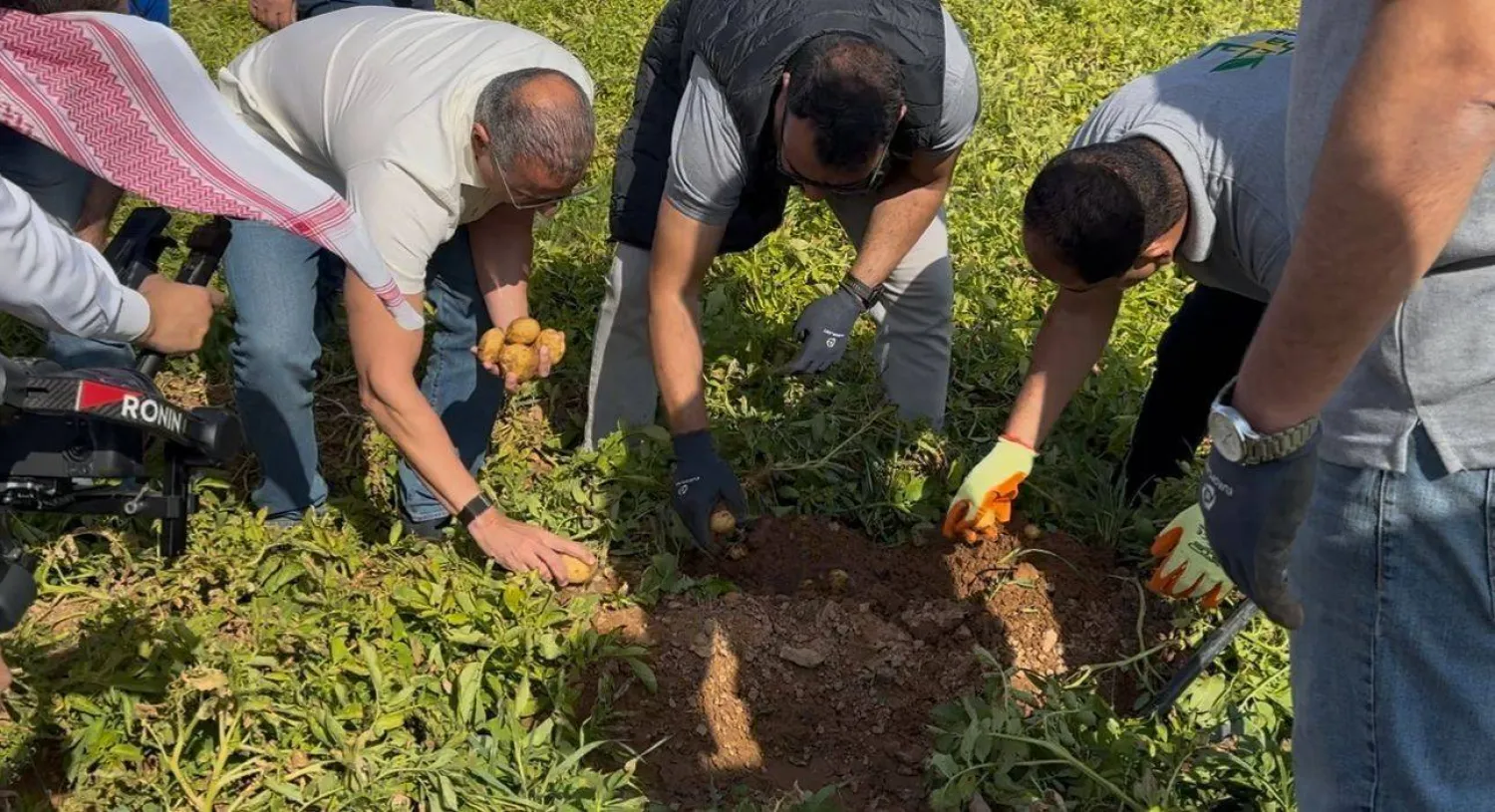

Saudi Arabia Turns Potato Farming Challenge into Export Opportunity

Saudi Arabia Turns Potato Farming Challenge into Export Opportunity
TT

Saudi Arabia Turns Potato Farming Challenge into Export Opportunity

Saudi Arabia Turns Potato Farming Challenge into Export Opportunity

In the deserts of Hail in northern Saudi Arabia, where rugged mountains border a climate that turns mild in summer and biting in winter, an unlikely agricultural success story has emerged.

From sandy soil that appears unforgiving at first glance, uniform potatoes are harvested to meet the exacting standards of local and international markets, supplying global food companies and contributing to the growth of a thriving export industry.

Grown not on traditional farmland but in a desert landscape long constrained by water and energy shortages, the crop has become a case study in how agricultural innovation and industrial sustainability can converge, positioning Saudi Arabia among the world's exporters of potatoes and processed potato products.

Potatoes in Hail are cultivated in sandy soil that gives the crop sufficient room to grow without deformities, setting it apart from harder soils that reduce quality and market acceptance. The main challenge, however, was not the soil but groundwater scarcity, making the search for innovative irrigation solutions a necessity rather than a choice.

That marked the start of a shift. Farmers have adopted drip irrigation systems powered by solar energy to reduce consumption and increase productivity, transforming Hail into a strategic production hub that contributes to self-sufficiency and exports to global markets.

According to previous remarks by Saudi Industry Minister Bandar Alkhorayef, the kingdom developed an irrigation model tailored to potatoes grown for potato chip manufacturing and export.

Alkhorayef said at the time that PepsiCo, which produces the well-known Lay’s brand, faced difficulties exporting potatoes grown in the kingdom. He stated that the government had collaborated with the Ministry of Agriculture to address the issue.

“They had a valid concern related to water scarcity, so we developed an appropriate irrigation model, which was approved by the agriculture ministry, resolving the export problem,” he said.

According to the Ministry of Environment, Water, and Agriculture, Saudi Arabia experienced a significant increase in potato production in 2023, with output rising by 47 percent to exceed 621,750 tonnes. The self-sufficiency rate reached 86.8 percent, according to the latest officially announced figures.

Hamoud Al Saleh, founder and chairman of Lahaa Agricultural Production, one of the Saudi suppliers to PepsiCo, said the kingdom had exported potatoes to Russia for six consecutive years, in addition to other countries including Norway, Lebanon, Syria and Jordan, while also supplying local factories.

Challenges

Some European markets still face hurdles in importing Saudi potatoes due to the absence of trade protocols, while Norway has proven more flexible, continuing imports over recent years, Al Saleh said.

He said groundwater remains the biggest challenge for farmers. Speaking to Asharq Al Awsat, Al Saleh said PepsiCo supported the company in implementing drip irrigation, covering part of the cost for three years and providing experts to help design and approve the system, which significantly increased productivity.

He said yields per hectare rose to between 50 and 60 tonnes in some fields, alongside a notable reduction in water consumption. He added that Saudi potatoes show high resilience to environmental conditions.

Energy has also been a challenge, with agricultural equipment relying heavily on diesel. This has prompted many farmers to adopt solar power, thereby easing operating costs for both farmers and the state.

Al Saleh unveiled a new project costing 15 million riyals, approximately $4 million, spanning 700 hectares and utilizing a combination of diesel and solar energy, describing it as a long-term investment aimed at enhancing sustainability and reducing consumption.

Resource efficiency

PepsiCo said resource efficiency has become a central pillar of its regional strategy. Ahmed El Sheikh, president and general manager for the Middle East, North Africa and Pakistan, said the company had adopted advanced drip irrigation systems in cooperation with specialized firms and the agriculture and industry ministries.

He said this helped cut water use by around 30 percent compared to traditional irrigation, alongside a shift toward solar energy instead of diesel, which reduced fuel and energy consumption.

Regarding exports, El Sheikh stated that most products are shipped to Gulf states and Jordan, with efforts underway to explore exports to Syria from plants within the kingdom.

In terms of investments linked to Vision 2030, he stated that the company has invested 300 million riyals, approximately $80 million, in new production lines targeting both local and export markets.

He stated that local content reached 95 percent for certain packaging materials that were previously imported, while locally sourced potatoes also achieved 95 percent, with ongoing efforts to reach 100 percent.

Local content refers to the share of raw materials, manufactured inputs, or extracted resources produced inside Saudi Arabia, whether agricultural, industrial, or packaging-related.

Regarding workforce localization, El Sheikh stated that some plants, including the Dammam factory, have achieved Saudization rates of 80 percent, with the appointment of the first Saudi female plant manager.

In research and development, the company stated that it has established an R&D center with investments exceeding 30 million riyals, approximately $8 million, thereby localizing operations within the kingdom instead of relying on overseas centers.

El Sheikh said the company has reached full operational capacity in working with farmers on potato crops, calling it a major achievement that it hopes to replicate with other crops in the future.

Water scarcity by the numbers

This agricultural experience comes amid mounting challenges to water resources. The National Water Strategy says Saudi Arabia has a limited stock of exploitable non-renewable groundwater, with low recharge rates not exceeding 2.8 billion cubic meters annually.

Total water demand is estimated at approximately 24.8 billion cubic meters, with an annual growth rate of around 7 percent.

The strategy states that agriculture is the largest consumer of water in the kingdom, accounting for approximately 84 percent of total demand, and relies heavily on non-renewable resources that make up nearly 90 percent of agricultural water use.

Agriculture ministry data show irrigation efficiency does not exceed 50 percent, compared with more than 75 percent under global best practices. Fodder cultivation alone consumes about 67 percent of agricultural water, according to the latest available figures.

Government role

This shift in potato farming would not have been completed without government support. The kingdom developed and approved an irrigation model suited to potatoes grown for chips and export as the preferred method, prompting PepsiCo to expand its factories in the Eastern Province with investments exceeding 300 million riyals.

This helped make Saudi Arabia the world’s second-largest hub for potato chip manufacturing, according to previous remarks by the industry minister.

Beyond exports, the model strengthens self-sufficiency. Under this approach, Saudi potatoes have become more than just an ingredient in chips, turning into a symbol of integration between agriculture and industry and evidence of the kingdom’s ability to transform environmental challenges into global economic and investment opportunities, in line with the ambitions of Vision 2030.



India’s Modi Lauds Interim Trade Pact After US Tariff Rollback

Indian Prime Minister Narendra Modi addresses the media before the budget session of Parliament at Parliament House in New Delhi, India, 29 January 2026. (EPA)
TT

India’s Modi Lauds Interim Trade Pact After US Tariff Rollback

Indian Prime Minister Narendra Modi addresses the media before the budget session of Parliament at Parliament House in New Delhi, India, 29 January 2026. (EPA)

Indian Prime Minister Narendra Modi on Saturday hailed an interim trade agreement with the United States, saying it would bolster global growth and deepen economic ties between the two countries.

The pact cuts US "reciprocal" duties on Indian products to 18 percent from 25 percent, and commits India to large purchases of US energy and industrial goods.

US President Donald Trump, while announcing the deal Tuesday, had said Modi promised to stop buying Russian oil over the war in Ukraine.

The deal eases months of tensions over India's oil purchases -- which Washington says fund a conflict it is trying to end -- and restores the close ties between Trump and the man he describes as "one of my greatest friends."

"Great news for India and USA!" Modi said on X on Saturday, praising US President Donald Trump's "personal commitment" to strengthening bilateral ties.

The agreement, he said, reflected "the growing depth, trust and dynamism" of their partnership.

Modi's remarks came hours after Trump issued an executive order scrapping an additional 25 percent levy imposed over New Delhi's purchases of Russian oil, in a step to implement the trade deal announced this week.

Modi, who has faced criticism at home about opening access of Indian agricultural markets to the United States and terms on oil imports, did not mention Russian oil in his statement.

"This framework will also strengthen resilient and trusted supply chains and contribute to global growth," he said.

It would also create fresh opportunities for Indian farmers, entrepreneurs and fishermen under the "Make in India" initiative.

In a separate statement, Commerce Minister Piyush Goyal said the pact would "open a $30 trillion market for Indian exporters".

Goyal also said the deal protects India's sensitive agricultural and dairy products, including maize, wheat, rice, soya, poultry and milk.

Other terms of the agreement include the removal of tariffs on certain aircraft and parts, according to a separate joint statement released Friday by the White House.

The statement added that India intends to purchase $500 billion of US energy products, aircraft and parts, precious metals, tech products and coking coal over the next five years.

The shift marks a significant reduction in US tariffs on Indian products, down from a rate of 50 percent late last year.

Washington and New Delhi are expected to sign a formal trade deal in March.


Gold Bounces Back on Softer Dollar, US-Iran Concerns; Silver Rebounds

Gold and silver bars are stacked in the safe deposit boxes room of the Pro Aurum gold house in Munich, Germany, January 10, 2025. REUTERS/Angelika Warmuth
TT

Gold Bounces Back on Softer Dollar, US-Iran Concerns; Silver Rebounds

Gold and silver bars are stacked in the safe deposit boxes room of the Pro Aurum gold house in Munich, Germany, January 10, 2025. REUTERS/Angelika Warmuth

Gold rebounded on Friday and was set for a weekly gain, helped by bargain hunting, a slightly weaker dollar and lingering concerns over US-Iran talks in Oman, while silver recovered from a 1-1/2-month low.

Spot gold rose 3.1% to $4,916.98 per ounce by 09:31 a.m. ET (1431 GMT), recouping losses posted during a volatile Asia session that followed a fall of 3.9% on Thursday. Bullion was headed for a weekly gain of about 1.3%.

US gold futures for April delivery gained 1% to $4,939.70 per ounce.

The US dollar index fell 0.3%, making greenback-priced bullion cheaper for the overseas buyers.

"The gold market is seeing perceived bargain hunting from bullish traders," said Jim Wyckoff, senior analyst at Kitco Metals.

Iran and the US started high-stakes negotiations via Omani mediation on Friday to try to overcome sharp differences over Tehran's nuclear program.

Wyckoff said gold's rebound lacks momentum and the metal is unlikely to break records without a major geopolitical trigger.

Gold, a traditional safe haven, does well in times of geopolitical and economic uncertainty.

Spot silver rose 5.3% to $74.98 an ounce after dipping below $65 earlier, but was still headed for its biggest weekly drop since 2011, down over 10.6%, following steep losses last week as well.

"What we're seeing in silver is huge speculation on the long side," said Wyckoff, adding that after years in a boom cycle, gold and silver now appear to be entering a typical commodity bust phase.

CME Group raised margin requirements for gold and silver futures for a third time in two weeks on Thursday to curb risks from heightened market volatility.

Spot platinum added 3.2% to $2,052 per ounce, while palladium gained 4.9% to $1,695.18. Both were down for the week.


Europe, Türkiye Agree to Work Toward Updating Customs Union

European Union (R) and Turkish flags fly at the business and financial district of Levent in Istanbul, Türkiye September 4, 2017. REUTERS/Osman Orsal
TT

Europe, Türkiye Agree to Work Toward Updating Customs Union

European Union (R) and Turkish flags fly at the business and financial district of Levent in Istanbul, Türkiye September 4, 2017. REUTERS/Osman Orsal

The European enlargement chief and the Turkish foreign minister said on Friday they had agreed to continue work toward modernizing the EU-Türkiye customs union and to improve its implementation, Reuters reported.

European Commissioner for Enlargement Marta Kos met Turkish Foreign Minister Hakan Fidan in the capital Ankara on Friday.

"They shared a willingness to work for paving the way for the modernization of the Customs Union and to achieve its full potential in order to support competitiveness, and economic security and resilience for both sides," they said in a joint statement afterward.

The sides also welcomed the gradual resumption of European Investment Bank (EIB) operations in Türkiye and said they intended to support projects across the country and neighbouring regions in cooperation with the bank.