


Yemen Welcomes Saudi Arabia's Hosting of Conference on the South

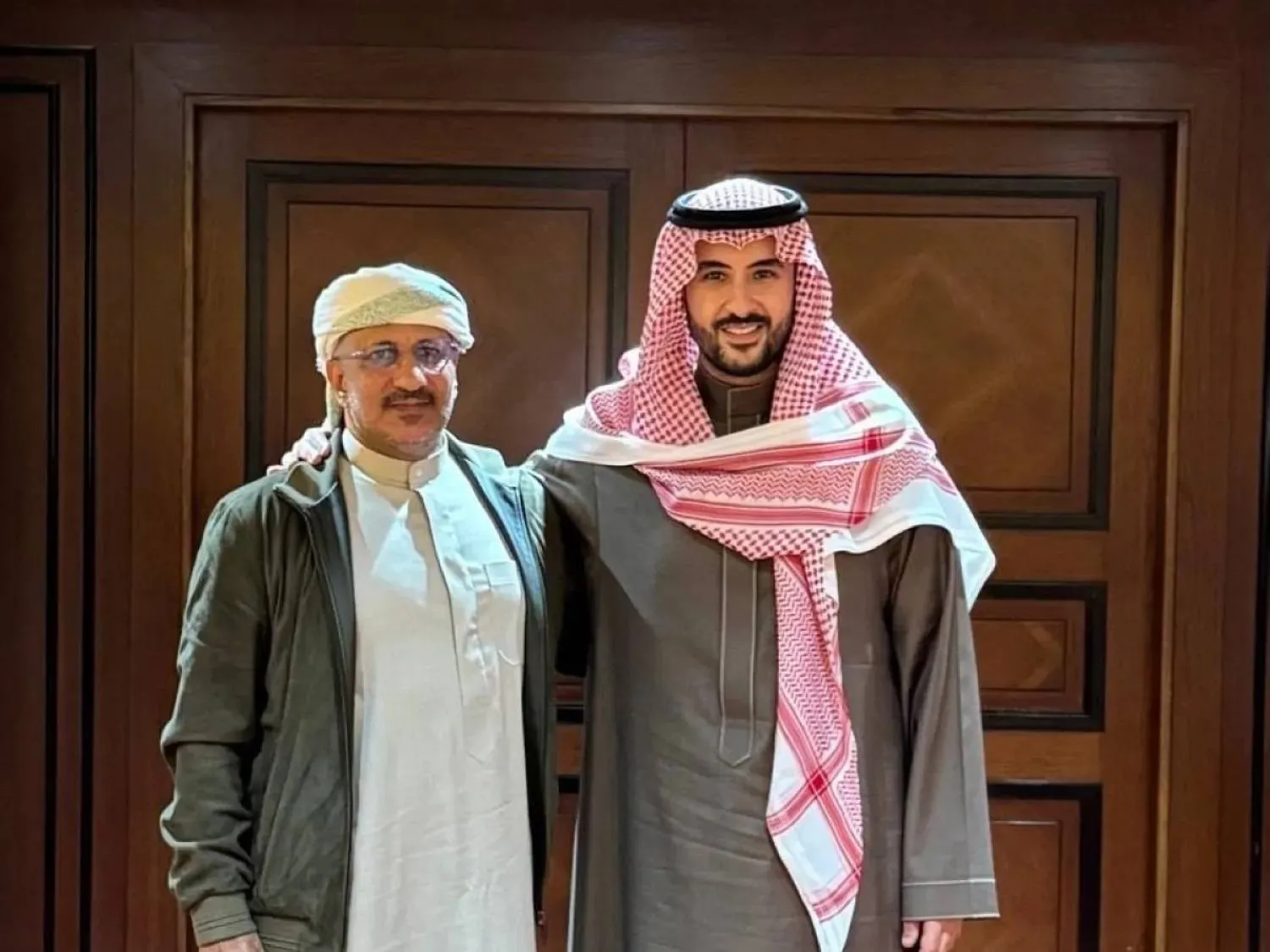
Saudi Defense Minister Prince Khalid bin Salman and Deputy head of the Presidential Leadership Council (PLC) Tariq Saleh meet in Riyadh. (Tariq Saleh on X)
TT

Yemen Welcomes Saudi Arabia's Hosting of Conference on the South

Saudi Defense Minister Prince Khalid bin Salman and Deputy head of the Presidential Leadership Council (PLC) Tariq Saleh meet in Riyadh. (Tariq Saleh on X)

Yemeni parties continued on Sunday to welcome Saudi Arabia's efforts to unite Yemeni ranks to help restore calm and tackle fundamental issues, starting with the southern cause.

Riyadh said it will host a conference on the southern issue.

Deputy head of the Presidential Leadership Council (PLC) Tariq Saleh said that he met in Riyadh with Saudi Defense Minister Prince Khalid bin Salman to discuss developments in Yemen and means to bolster its stability and the security of the region.

Another deputy head of the PLC, Abdulrahman Abou Zaraa, said that through its call to hold dialogue over the southern issue, Saudi Arabia reflected its deep keenness on supporting peace and stability in Yemen.

The initiative embodies the Kingdom's firm commitment to bolstering comprehensive political solutions based on dialogue and consensus, he added.

Saudi Arabia took the initiative based on its historic responsibility and constructive regional role, he remarked.

The dialogue aims to address the southern issue, meet the legitimate aspirations of the residents of the South and help bolster regional and international security and stability, Abou Zaraa went on to say.

Moreover, the conference is a "historic opportunity" to unify southern ranks, come up with a united stance that reflects the aspirations of southerners and it serves as a platform to find just political solutions related to the South, he stressed.

Yemeni Foreign Minister Dr. Shaya Mohsin Zindani said the dialogue is an opportunity to address pending issues in the South.

It will act as a platform for southerners to come up with a united stance so that they can move from managing the crisis to coming up with a clear policy that includes goals, guarantees and mechanisms, he stated.

He hoped the southerners will seize the opportunity to reach a just and sustainable settlement.

He expressed the legitimate government's deep gratitude to Saudi Arabia for hosting the dialogue, its pivotal role in sponsoring agreements and uniting national ranks, and keenness on averting more conflicts and bloodshed.

The Southern Transitional Council welcomed Saudi Arabia's call to hold the conference, saying the STC believes that dialogue is the only way to address pending political issues, starting with the southern issue and the right of the people to reclaim their state.



Multinational Maritime Defense Coalition Begins Operations from Saudi Headquarters

Coalition commander Rear Admiral Abdullah Al-Shehri receives his deputy, Commodore Rashid Sheikh, at the command headquarters. (Saudi Defense Ministry)
TT

Multinational Maritime Defense Coalition Begins Operations from Saudi Headquarters

Coalition commander Rear Admiral Abdullah Al-Shehri receives his deputy, Commodore Rashid Sheikh, at the command headquarters. (Saudi Defense Ministry)

The Multinational Maritime Defense Coalition has begun operations from its headquarters in Saudi Arabia, with Pakistan’s Commodore Rashid Sheikh taking up his post as deputy commander.

Liaison officers from member states and countries completing accession procedures have also started work at the headquarters. Others will follow in stages, based on the number of posts allocated to each country.

The move follows the completion of arrangements to activate the coalition’s bodies, approved at its third planning meeting in Jeddah in August and attended by representatives from 39 countries.

It marks the start of the coalition’s institutional and operational phase and the integration of member states’ military capabilities, while other countries finalize accession procedures.

Work on the coalition’s institutional structure has also advanced rapidly. Saudi Arabia has appointed its commander, while members agreed that the first deputy commander would come from Pakistan.

Saudi Arabia announced the coalition in late July as an international defensive initiative open to all countries.

It aims to strengthen maritime security, protect international waterways and global trade, and counter emerging threats. Rear Admiral Abdullah Al-Shehri was appointed coalition commander.

The coalition is a strategic step toward protecting shared maritime interests in the Bab al-Mandeb Strait, Red Sea and Gulf of Aden.

It is founded on the principle that securing international waterways is a collective responsibility requiring coordinated action against growing threats.

Membership remains open to interested countries.

Saudi Arabia’s hosting and leadership of the coalition reflects the Kingdom’s role in strengthening regional and international security and building effective alliances to deter and confront shared maritime threats.

The coalition seeks to safeguard freedom of navigation, secure trade routes, supply chains and energy resources, and protect shared maritime interests across the Bab al-Mandeb Strait, Red Sea and Gulf of Aden.

The coalition operates under the principles of the United Nations Charter and international law. It is exclusively defensive, does not target any country or organization, fully respects state sovereignty and safeguards freedom of navigation.


Gulf, Arab Condemnation of Iranian Attack on Saudi Tanker

Vessels near the Strait of Hormuz, as seen from Musandam, Oman, September 2, 2026. (Reuters)
TT

Gulf, Arab Condemnation of Iranian Attack on Saudi Tanker

Vessels near the Strait of Hormuz, as seen from Musandam, Oman, September 2, 2026. (Reuters)

Qatar strongly condemned on Wednesday Iran's attack on the Saudi tanker SIDR in the Strait of Hormuz, which resulted in the deaths among the crew.

It slammed the strike as a blatant violation of international maritime law and UN Security Council Resolution 2817.

In a statement, the Qatari Ministry of Foreign Affairs “categorically rejected the weaponization of the Strait of Hormuz and demanded its unconditional reopening.”

The ministry emphasized that “freedom of navigation in the vital waterway is a non-negotiable principle”.

It warned that its continued closure jeopardizes regional security and the global economy.

Demanding an immediate halt to Iran's unjustified aggression, the ministry stressed Doha's “full solidarity with Saudi Arabia and expressed unequivocal support for all measures taken by Riyadh to protect its national assets.”

Jordan also condemned the attack, saying it was a flagrant violation of international law and a direct threat to the security and safety of global maritime navigation.

In a statement, the Jordanian Ministry of Foreign Affairs and Expatriates underlined the country's “absolute solidarity with Saudi Arabia, expressing full support for all measures taken by Riyadh to protect its security, stability, and national resources.”

Gulf Cooperation Council (GCC) Secretary-General Jasem Albudaiwi strongly condemned the attack, slamming it as a “dangerous escalation, a grave violation of international law, and a direct threat to the security and safety of international maritime navigation.”

He warned that the attack exposes regional security and stability and the flow of global trade to “grave risks”.

Albudaiwi underscored that the GCC member states stand firmly with Saudi Arabia in every measure to safeguard its security and protect its interests.


Riyadh Condemns Iran Attack on Saudi Vessel in Hormuz

A view of Riyadh, Saudi Arabia. (SPA file)
TT

Riyadh Condemns Iran Attack on Saudi Vessel in Hormuz

A view of Riyadh, Saudi Arabia. (SPA file)

Saudi Arabia condemned on Wednesday Iran for attacking a Saudi vessel, SIDR, as it sailed the Hormuz Strait and the resulting loss of life among the crew.

A Foreign Ministry statement said the Kingdom also condemns the Iranian attacks against Jordan, Bahrain and Kuwait.

Saudi Arabia “stands by the fraternal states and the measures they take to protect their security and sovereignty against any threat,” it added.

The Kingdom “underscored the need to stop the escalation and respect international marine lanes and their safety, as well as the global energy supplies.”

It urged “good neighborliness and respect for the sovereignty of nations, the UN Charter and international laws and norms.”

The Kingdom “called on all parties to restore calm, end the escalation, respect international law, return to the negotiations and turn to peaceful solutions.”