


After Maduro, Who's Next? Trump Spurs Speculation about His Plans for Greenland, Cuba and Colombia

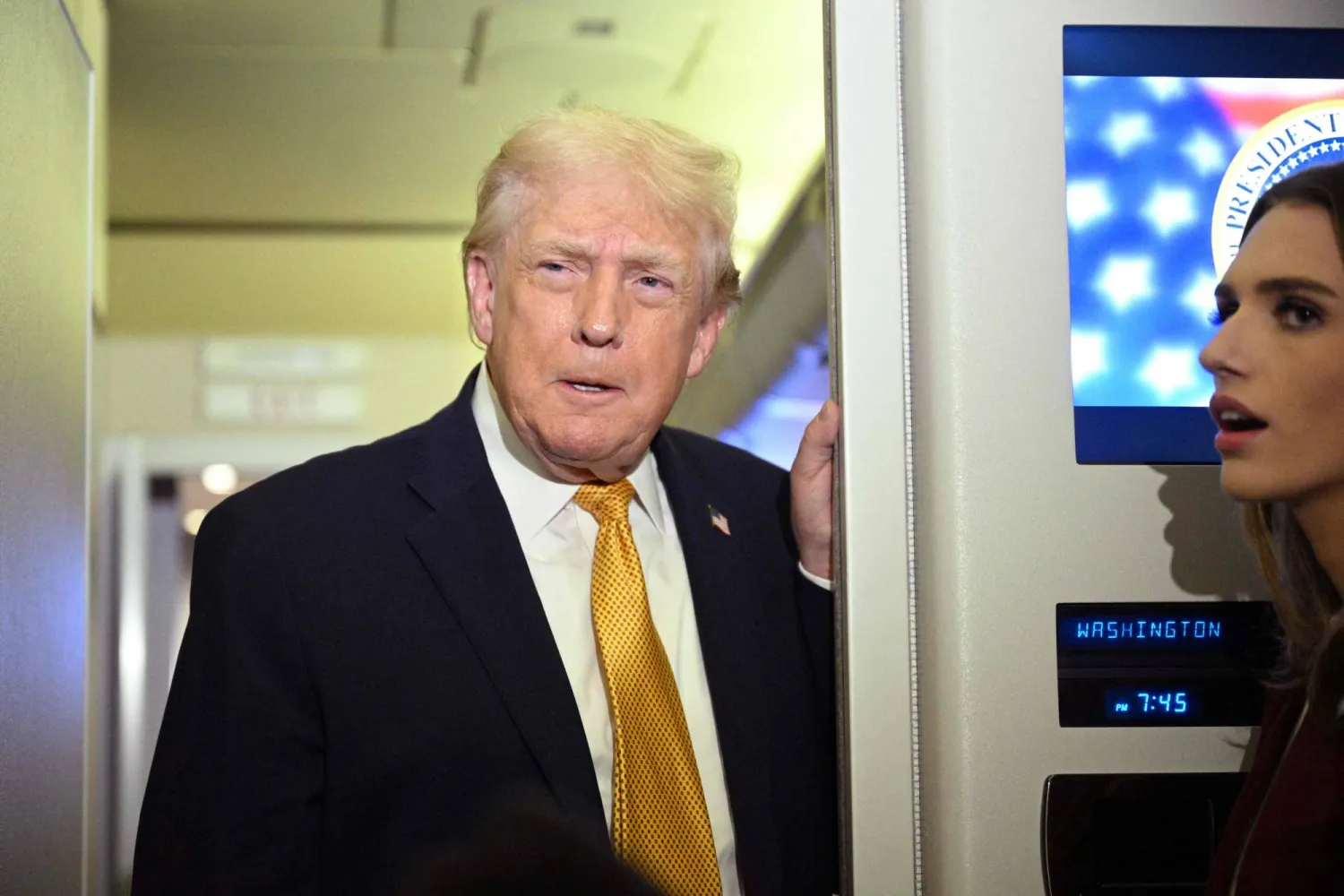
US President Donald Trump speaks with reporters aboard Air Force One on his way back to Washington, DC, on January 4, 2026. (Photo by Jim WATSON / AFP)
TT

After Maduro, Who's Next? Trump Spurs Speculation about His Plans for Greenland, Cuba and Colombia

US President Donald Trump speaks with reporters aboard Air Force One on his way back to Washington, DC, on January 4, 2026. (Photo by Jim WATSON / AFP)

A day after the audacious US military operation in Venezuela, President Donald Trump on Sunday renewed his calls for an American takeover of the Danish territory of Greenland for the sake of US security interests and threatened military action on Colombia for facilitating the global sale of cocaine, while his top diplomat declared the communist government in Cuba is “in a lot of trouble.”

The comments from Trump and Secretary of State Marco Rubio after the ouster of Venezuela's Nicolás Maduro underscore that the US administration is serious about taking a more expansive role in the Western Hemisphere.

With thinly veiled threats, Trump is rattling hemispheric friends and foes alike, spurring a pointed question around the globe: Who's next?

“It’s so strategic right now. Greenland is covered with Russian and Chinese ships all over the place," Trump told reporters as he flew back to Washington from his home in Florida. "We need Greenland from the standpoint of national security, and Denmark is not going to be able to do it.”

Asked during an interview with The Atlantic earlier on Sunday what the US-military action in Venezuela could portend for Greenland, Trump replied: “They are going to have to view it themselves. I really don’t know.”

Trump, in his administration's National Security Strategy published last month, laid out restoring “American preeminence in the Western Hemisphere” as a central guidepost for his second go-around in the White House.

Trump has also pointed to the 19th century Monroe Doctrine, which rejects European colonialism, as well as the Roosevelt Corollary — a justification invoked by the US in supporting Panama’s secession from Colombia, which helped secure the Panama Canal Zone for the US — as he's made his case for an assertive approach to American neighbors and beyond.

Trump has even quipped that some now refer to the fifth US president's foundational document as the “Don-roe Doctrine.”

Causing unease in Denmark Saturday's dead-of-night operation by US forces in Caracas and Trump’s comments on Sunday heightened concerns in Denmark, which has jurisdiction over the vast mineral-rich island of Greenland.

Danish Prime Minister Mette Frederiksen in a statement that Trump has "no right to annex" the territory. She also reminded Trump that Denmark already provides the United States, a fellow member of NATO, broad access to Greenland through existing security agreements.

“I would therefore strongly urge the US to stop threatening a historically close ally and another country and people who have made it very clear that they are not for sale,” Frederiksen said.

Denmark on Sunday also signed onto a European Union statement underscoring that “the right of the Venezuelan people to determine their future must be respected” as Trump has vowed to “run” Venezuela and pressed the acting president, Delcy Rodriguez, to get in line.

Social media posting angers Danes Trump on Sunday mocked Denmark’s efforts at boosting Greenland’s national security posture, saying the Danes have added “one more dog sled” to the Arctic territory’s arsenal.

Greenlanders and Danes were further rankled by a social media post following the raid by a former Trump administration official turned podcaster, Katie Miller. The post shows an illustrated map of Greenland in the colors of the Stars and Stripes accompanied by the caption: “SOON."

“And yes, we expect full respect for the territorial integrity of the Kingdom of Denmark,” Amb. Jesper Møller Sørensen, Denmark's chief envoy to Washington, said in a post responding to Miller, who is married to Trump's influential deputy chief of staff Stephen Miller.

During his presidential transition and in the early months of his return to the White House, Trump repeatedly called for US jurisdiction over Greenland, and has pointedly not ruled out military force to take control of the mineral-rich, strategically located Arctic island that belongs to an ally.

The issue had largely drifted out of the headlines in recent months. Then Trump put the spotlight back on Greenland less than two weeks ago when he said he would appoint Republican Gov. Jeff Landry as his special envoy to Greenland.

The Louisiana governor said in his volunteer position he would help Trump “make Greenland a part of the US.”

A stern warning to Cuba Meanwhile, concern is simmering in Cuba, one of Venezuela’s most important allies and trading partners, as Rubio issued a new stern warning to the Cuban government. US-Cuba relations have been hostile since the 1959 Cuban revolution.

Rubio, in an appearance on NBC's “Meet the Press,” said Cuban officials were with Maduro in Venezuela ahead of his capture.

“It was Cubans that guarded Maduro,” Rubio said. “He was not guarded by Venezuelan bodyguards. He had Cuban bodyguards.” The secretary of state added that Cuban bodyguards were also in charge of “internal intelligence” in Maduro’s government, including “who spies on who inside, to make sure there are no traitors.”

The Cuban government said in a statement read on state television on Sunday evening that 32 officers were killed in the US military operation.

Trump said that the Cuban economy, battered by years of a US embargo, is in tatters and will slide further now with the ouster of Maduro, who provided the Caribbean island subsidized oil.

“It's going down,” Trump said of Cuba. “It's going down for the count.”

Warning delivered to Colombia Trump, as he made his way back to Washington on Sunday evening, also put Venezuela's neighbor, Colombia, and its leftist president, Gustavo Petro, on notice.

Trump in a back-and-forth with reporters said Colombia is “run by a sick man who likes making cocaine and selling it to the United States.”

The Trump administration imposed sanctions in October on Petro, his family and a member of his government over accusations of involvement in the global drug trade. Colombia is considered the epicenter of the world's cocaine trade.

Trump began his monthslong pressure campaign on Maduro by ordering dozens of lethal strikes on alleged drug smuggling boats launched from Venezuela in the Caribbean. He eventually expanded the operations to also target suspected vessels in the eastern Pacific that came from Colombia.

The US in September also added Colombia, the top recipient of American assistance in the region, to a list of nations failing to cooperate in the drug war for the first time in almost 30 years. The designation led to a slashing of US assistance to the country.

“He’s not going to be doing it for very long,” Trump said of Petro on Sunday. “He has cocaine mills and cocaine factories. He’s not going to be doing it.”

Asked whether he might order the US to conduct an operation against Colombia, Trump replied, “It sounds good to me.”



Zelenskiy Seeks New Trump Meeting as Peace Negotiators Tackle Land Issue

 Ukraine's President Volodymyr Zelenskiy arrives for a meeting with his Cypriot counterpart Nikos Christodoulides at the presidential palace in Nicosia, , Cyprus, Wednesday, Jan. 7, 2026. (Petros Karadjias/Pool via Reuters)
Ukraine's President Volodymyr Zelenskiy arrives for a meeting with his Cypriot counterpart Nikos Christodoulides at the presidential palace in Nicosia, , Cyprus, Wednesday, Jan. 7, 2026. (Petros Karadjias/Pool via Reuters)
TT

Zelenskiy Seeks New Trump Meeting as Peace Negotiators Tackle Land Issue

 Ukraine's President Volodymyr Zelenskiy arrives for a meeting with his Cypriot counterpart Nikos Christodoulides at the presidential palace in Nicosia, , Cyprus, Wednesday, Jan. 7, 2026. (Petros Karadjias/Pool via Reuters)
Ukraine's President Volodymyr Zelenskiy arrives for a meeting with his Cypriot counterpart Nikos Christodoulides at the presidential palace in Nicosia, , Cyprus, Wednesday, Jan. 7, 2026. (Petros Karadjias/Pool via Reuters)

Ukraine's President Volodymyr Zelenskiy is seeking a new meeting with US President Donald Trump as their officials revisited the two most problematic issues in peace talks aimed at ending Russia's war in Ukraine.

Kyiv is under US pressure to secure peace quickly but wants security guarantees from allies and is pushing back on Russian demands to cede its eastern Donetsk region and give up control of the Zaporizhzhia nuclear power plant.

Speaking to reporters over WhatsApp on Wednesday, Zelenskiy said he wanted to meet Trump again soon to gauge his openness to a Ukrainian proposal that Washington provide security guarantees for more than 15 years in the event of ‌a ceasefire.

He ‌also urged Trump to step up pressure on Russia, which ‌has been ⁠cool on ‌the US-backed peace push and is continuing its massive air attacks on Ukrainian cities and the country's energy grid.

"The Americans, in my view, are being productive right now; we have good results... They need to put pressure on Russia. They have the tools, and they know how to use them," Zelenskiy said.

The White House did not immediately respond to a request for comment on the suggestion of a new meeting between Zelenskiy and Trump.

Citing the US operation to seize Venezuelan leader Nicolas Maduro, Zelenskiy suggested ⁠Washington could similarly move against Chechen leader Ramzan Kadyrov, a Vladimir Putin ally whose troops became known for their brutality in ‌Ukraine.

"Maybe then Putin would see it and think twice," he ‍said.

Talks in Paris this week produced ‍commitments from Kyiv's allies to back up a ceasefire with guarantees such as a multinational troop ‍presence.

But Zelenskiy said the expression of "political will" had yet to be translated into legally binding pledges backed by national parliaments.

MAJOR STUMBLING BLOCKS

Zelenskiy spoke as US and Ukrainian officials in Paris discussed the matter of territory and the fate of the Zaporizhzhia plant , Europe's largest nuclear facility, which he described as the two thorniest issues in the talks.

Kyiv has refused to pull out of the industrialized Donetsk region, which Russia has failed to seize entirely despite occupying wide swathes of it.

⁠Zelenskiy has said the US has floated the idea of a free economic zone there if Ukraine withdraws from the parts of the region that it still controls.

On Tuesday, US and Ukrainian officials had already talked through "some ideas" to address the issue of territory. White House special envoy Steve Witkoff said "land options" had been discussed and that he hoped for compromise to be reached.

Any compromises on land should be put to a referendum for Ukrainians, Zelenskiy has previously said. According to an opinion poll last month, around three-quarters of Ukrainians are prepared for a deal that would freeze the current front line, but oppose ceding territory.

The US has also proposed trilateral operation of the Zaporizhzhia plant, which Moscow captured in 2022 and connected to its own power grid, with an American chief manager, ‌Zelenskiy said last month.

Kyiv has instead proposed joint Ukrainian-American use of the plant, according to Zelenskiy, with the US itself determining how to use 50% of the energy produced.


US Says It Needs to Control Venezuelan Oil Sales Indefinitely to Drive Change

The city of Caracas, days after the US launched a strike on Venezuela and captured President Nicolas Maduro and his wife Cilia Flores, Venezuela January 7, 2026. (Reuters)
TT

US Says It Needs to Control Venezuelan Oil Sales Indefinitely to Drive Change

The city of Caracas, days after the US launched a strike on Venezuela and captured President Nicolas Maduro and his wife Cilia Flores, Venezuela January 7, 2026. (Reuters)

The United States needs to control Venezuela's oil sales and revenue indefinitely to drive the changes it wants to see in the country, Energy Secretary Chris Wright said on Wednesday.  

The comments reflect the importance of the South American country's crude oil reserves to President Donald Trump's strategy since US forces ousted Venezuelan leader Nicolas Maduro in a raid on the capital Caracas on Saturday. 

"We need to have that leverage and that control of those oil sales to drive the changes that simply must happen in Venezuela," Wright said at the Goldman Sachs Energy, CleanTech & Utilities Conference in Miami. 

STORED OIL MOVING TO MARKET FIRST 

He said ‌the US would ‌market stored Venezuelan oil first, then sell ongoing future production, including ‌to ⁠US refineries specially equipped ‌to process it, with revenues deposited into accounts controlled by the US government. 

Wright added he was speaking to US oil companies to learn what conditions would enable them to enter Venezuela to help boost production there. 

"The resources are immense. This should be a wealthy, prosperous, peaceful energy powerhouse," he said. 

"That's the plan." On Tuesday, Caracas and Washington reached a deal to export up to $2 billion worth of Venezuelan crude to the United States, an accord that would divert supplies from China while helping Venezuela avoid deeper oil production cuts. 

The agreement ⁠is a sign Venezuelan government officials are responding to Trump's demand that they open up to US oil companies or risk more military ‌intervention. 

Trump has said he wants interim President Delcy Rodriguez to give ‍the US and private companies "total access" to Venezuela's ‍oil industry. 

"Instead of the oil being blockaded as it is right now, we're going to let ‍the oil flow," Wright said at the conference. 

Selling Venezuelan oil "will benefit the American people, the American economy and global energy markets, but of course, it will also massively benefit the people of Venezuela," he said. 

Shares of US refiners Marathon Petroleum, Phillips 66 and Valero Energy were up between 2.5% and 5%. 

WHITE HOUSE MEETINGS 

Raising crude output from Venezuela is a top objective for Trump, who is scheduled to meet with the heads of major oil companies at the White House on Friday, according to sources. 

Representatives from ⁠Exxon Mobil, ConocoPhillips, and Chevron - the top three US companies, all of which have experience in Venezuela - would be present, according to a source familiar with the planning. 

The companies have declined to comment. 

Venezuela was producing as much as 3.5 million barrels per day in the 1970s. But mismanagement and limited foreign investment led to a huge drop in annual production, which averaged about 1.1 million bpd last year. 

Wright said he believed short-term production increases in Venezuela are possible, but that a bigger recovery to past production levels would take years. 

"We could get several hundred thousand barrels a day of additional production in the short to medium term if the conditions are there for just small capital deployments," Wright said. "To get back to the historical production numbers, you know that takes tens of billions of dollars and significant time," he said. 

The South American country ‌sits atop the world's largest oil reserves but accounts for only about 1% of global supply.  


Netanyahu Tries to Calm Tensions After Israeli Bus Runs Over and Kills Ultra-Orthodox Teen

Israeli Prime Minister Benjamin Netanyahu (C) attends a debate initiated by the opposition as part of a plenary session in the Knesset, the Israeli parliament, in Jerusalem, 05 January 2026. (EPA)
TT

Netanyahu Tries to Calm Tensions After Israeli Bus Runs Over and Kills Ultra-Orthodox Teen

Israeli Prime Minister Benjamin Netanyahu (C) attends a debate initiated by the opposition as part of a plenary session in the Knesset, the Israeli parliament, in Jerusalem, 05 January 2026. (EPA)

Israel's Prime Minister Benjamin Netanyahu urged calm on Wednesday after a bus driver ran over and killed a teenage boy during a protest by thousands of ultra-Orthodox Jewish demonstrators against a law seeking to draft them into Israel’s military.

“I call for restraint to prevent the mood from becoming further inflamed so that, heaven forbid, we do not have additional tragedies,” Netanyahu said in a statement, adding that the death would be thoroughly investigated.

The incident on Tuesday evening killed yeshiva student Yosef Eisenthal, who police said was 14. Video from the protest obtained by The Associated Press showed the boy being trapped under the vehicle while the driver continued to drive on for several meters as onlookers jostled and screamed.

Police officers arrested and questioned the bus driver, who told investigators he was attacked by protesters before his vehicle hit the boy. Police said Wednesday that the driver's arrest had been extended until Jan. 15. He has not yet been charged.

Protesters had been blocking the road and acting violently toward police officers, throwing eggs and other objects at them, a police spokesperson said.

The violence reflected growing tensions between the Israeli authorities and the ultra-Orthodox, known as Haredim, as the government mulls plans to draft them into the military.

When Israel was founded in 1948, a small number of gifted ultra-Orthodox scholars were granted exemptions from the draft, which is compulsory for most Jews in the country. But with a push from politically powerful religious parties, those numbers have swelled over the decades.

There is support for rolling back the ultra-Orthodox exemption among many secular Israelis, especially those who have served multiple rounds of duty in the latest war between Israel and the Palestinian Hamas group in Gaza.

Measures to draft the ultra-Orthodox have been met with staunch opposition and occasional violence from religious protesters who claim serving in the military will destroy their way of life. The pushback has created a political problem for Netanyahu, who relies on the support of religious parties in the Israeli Parliament.