

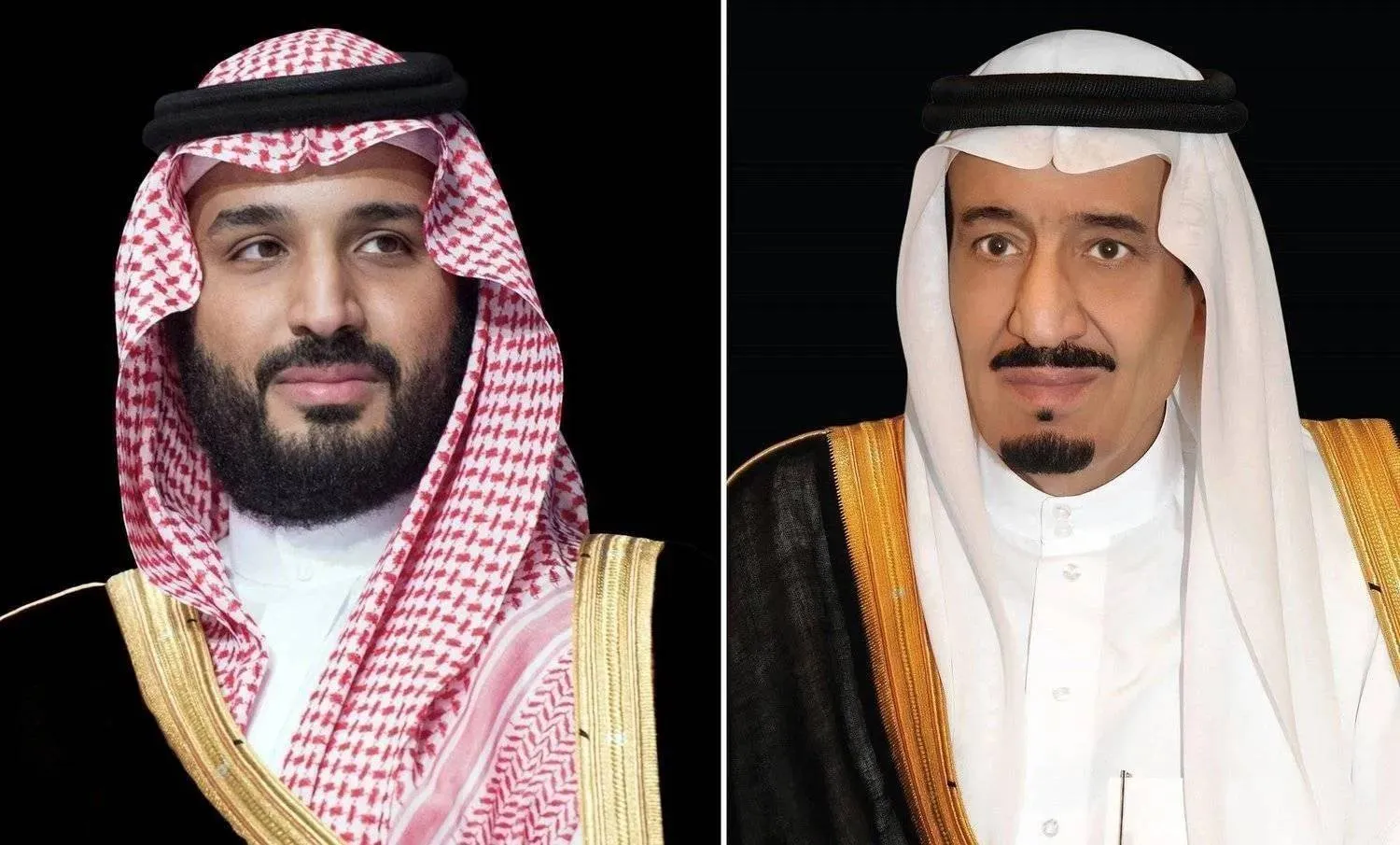

Saudi Leadership Extends Condolences to Jordan on Passing of Former PM

Joint photo of King Salman bin Abdulaziz Al-Saud and Saudi Crown Prince Mohammed bin Salman bin Abdulaziz Al-Saud - File Photo
TT

Saudi Leadership Extends Condolences to Jordan on Passing of Former PM

Joint photo of King Salman bin Abdulaziz Al-Saud and Saudi Crown Prince Mohammed bin Salman bin Abdulaziz Al-Saud - File Photo

The Saudi leadership extended condolences to Jordan's King Abdullah II on the passing of former Prime Minister Eng. Ali Abu Al-Ragheb, the Saudi Press Agency said on Monday.

The Custodian of the Two Holy Mosques, King Salman bin Abdulaziz Al Saud, sent a cable expressing his sincere condolences to the Jordanian monarch and the family of the deceased, praying that Allah grant the late statesman mercy and forgiveness and bestow patience and comfort upon his family.

Separately, Prince Mohammed bin Salman bin Abdulaziz Al Saud, Saudi Crown Prince and Prime Minister, sent a similar cable to King Abdullah II.



Saudi Foreign Minister, US Secretary of State Discuss Regional Developments

Saudi Minister of Foreign Affairs Prince Faisal bin Farhan bin Abdullah and US Secretary of State Marco Rubio - (Saudi Foreign Ministry)
TT

Saudi Foreign Minister, US Secretary of State Discuss Regional Developments

Saudi Minister of Foreign Affairs Prince Faisal bin Farhan bin Abdullah and US Secretary of State Marco Rubio - (Saudi Foreign Ministry)

Saudi Minister of Foreign Affairs Prince Faisal bin Farhan bin Abdullah, on an official visit to the United States, met Wednesday in Washington with US Secretary of State Marco Rubio.

During the meeting, the two ministers reviewed the historical and strategic bilateral relations and ways to develop them in line with their shared interests, SPA reported.

They also discussed recent regional developments and efforts to achieve security and stability.

The meeting was attended by Saudi Ambassador to the United States Princess Reema bint Bandar bin Sultan bin Abdulaziz and Advisor to the Minister of Foreign Affairs Mohammed Alyahya.

Earlier, Prince Faisal also met with the US House of Representatives Foreign Affairs Committee Chairman Brian Mast, senior member Gregory Meeks, and several committee members.

The discussions covered ways to advance historic relations between Saudi Arabia and the United States to serve mutual interests and addressed regional and international developments and efforts made to address them.

Saudi Arabian Ambassador to the United States Princess Reema Bandar Al-Saud and Advisor to the Foreign Minister Mohammed Alyahya attended the meeting, which was held as part of the foreign minister’s official visit to the United States.


Saudi FM Arrives in Washington on Official Visit

Saudi Foreign Minister Prince Faisal bin Farhan bin Abdullah looks on during a meeting with Egyptian Foreign Minister Badr Abdelatty (not pictured) at Waldorf Astoria Hotel in Cairo, Egypt, 05 January 2026. (EPA)
TT

Saudi FM Arrives in Washington on Official Visit

Saudi Foreign Minister Prince Faisal bin Farhan bin Abdullah looks on during a meeting with Egyptian Foreign Minister Badr Abdelatty (not pictured) at Waldorf Astoria Hotel in Cairo, Egypt, 05 January 2026. (EPA)

Saudi Foreign Minister Prince Faisal bin Farhan bin Abdullah arrived in Washington on Wednesday on an official visit.

He is set to meet with Secretary of State Marco Rubio to discuss bilateral ties and regional and international developments.


How Saudi Arabia’s Responsible Approach Contained Developments in Southern Yemen

A government soldier mans a machine gun mounted on a pick-up truck in the Arabian Sea port city of Mukalla, Yemen January 4, 2026. (Reuters)
TT

How Saudi Arabia’s Responsible Approach Contained Developments in Southern Yemen

A government soldier mans a machine gun mounted on a pick-up truck in the Arabian Sea port city of Mukalla, Yemen January 4, 2026. (Reuters)

Saudi Arabia has shown a high degree of containment and a calm approach in dealing with the latest developments in southern Yemen after forces of the Southern Transitional Council seized control of the provinces of Hadhramaut and al-Mahra without any coordination with the legitimate government or the Arab coalition backing legitimacy, analysts said.

Abdulaziz Sager, chairman of the Gulf Research Center, said the meetings in Riyadh by Saudi Defense Minister Prince Khalid bin Salman of figures from Yemen’s political movement, including Presidential Leadership Council member Tariq Saleh and PLC Vice President Abdul Rahman Al-Mahrami, also known as Abou Zaraa, was a clear example of the prudent policy pursued by the Kingdom in managing Yemen’s complex affairs.

Sager told Asharq Al-Awsat that Saudi Arabia, since its founding by the late King Abdulaziz, has relied on a policy of containment, wisdom in engagement and measured rhetoric.

From this perspective came the defense minister’s meeting with the various Yemeni officials, foremost among them members of the PLC who had declared positions at odds with the Yemeni legitimacy backed by the Arab coalition.

Sager added that when they returned to the right path and responded to the Saudi call, Prince Khalid and the Saudi leadership moved to contain them, reflecting an inherent trait of Saudi governance and the ethical values that frame the core characteristics of Saudi policy.

The Kingdom attaches great importance to Yemen not only as a neighbor but because of the many shared ties and strong social links, including the convergence of customs and traditions between the two peoples, he stressed.

On December 3, the Southern Transitional Council dispatched military columns toward the eastern provinces, taking control of several institutions, most notably the headquarters of the First Military Region in Seiyun and the presidential palace, and deploying in Mukalla and al-Mahra without significant clashes.

Saudi Arabia swiftly sent Maj. Gen. Mohammed Ubaid Al Qahtani at the head of a delegation to calm the situation and de-escalate tensions, calling for the STC forces to return to Aden and their original provinces, and for the legitimate government’s Nation Shield forces to be deployed in their place.

On December 27, Prince Khalid bin Salman also sent a message titled “To Our People in Yemen,” outlining the fairness of the southern cause and urging that the safe southern provinces not be dragged into futile conflicts.

He called for awareness of the major challenges Yemen faces and for denying spoilers the opportunity to advance their goals in Yemen and the region.

Sager said Saudi Arabia has no enemies within Yemen’s political makeup and understands the positions of all sides, enabling it to play the role of guarantor and mediator for any political settlement to the Yemeni conflict.

He stressed that Riyadh views the situation in Yemen as a core component of its regional national security. The Yemen file, he added, has two dimensions the Kingdom cannot ignore, protecting its national security and ensuring Yemen’s stability and prosperity.

In recent days, Nation Shield forces loyal to the legitimate government, backed by coalition air support, have reasserted control over Hadhramaut and al-Mahra, with STC forces retreating to their home provinces after limited clashes.

According to Sager, the Saudi move to engage constructively with the southern Yemen issue, openness on the file and acceptance of differing views among rival parties are part of a process to guarantee long-term stability in Yemen.

Seeking acceptable solutions and formulas to contain southern demands, while preserving the state entity as much as possible, is part of Saudi Arabia’s strategy to close the door to negative external interference in Yemen’s stability, which threatens Yemen and Saudi national security interests, Sager remarked.

Political analyst Khaled Al-Habbas said Saudi Arabia’s position on Yemen has been clear from the outset, prioritizing Yemen’s security and stability across all its components.

This was the same approach Riyadh adopted toward developments in southern Yemen, given that Yemen is a strategic sphere for the Kingdom and events there directly affect Saudi national security, he explained.

The Kingdom is committed to supporting security and stability and to maintaining equal distance from all national components that put the public interest ahead of narrow interests or external agendas, he went on to say.

According to Al-Habbas, Riyadh’s expected hosting of a southern dialogue conference, with the participation of various relevant southern forces including the Southern Transitional Council, is clear evidence of its responsible and inclusive approach.

The fate of the southern issue should be decided by Yemenis themselves through dialogue and diplomacy, not by imposing a fait accompli or through a military coup, he stressed.