

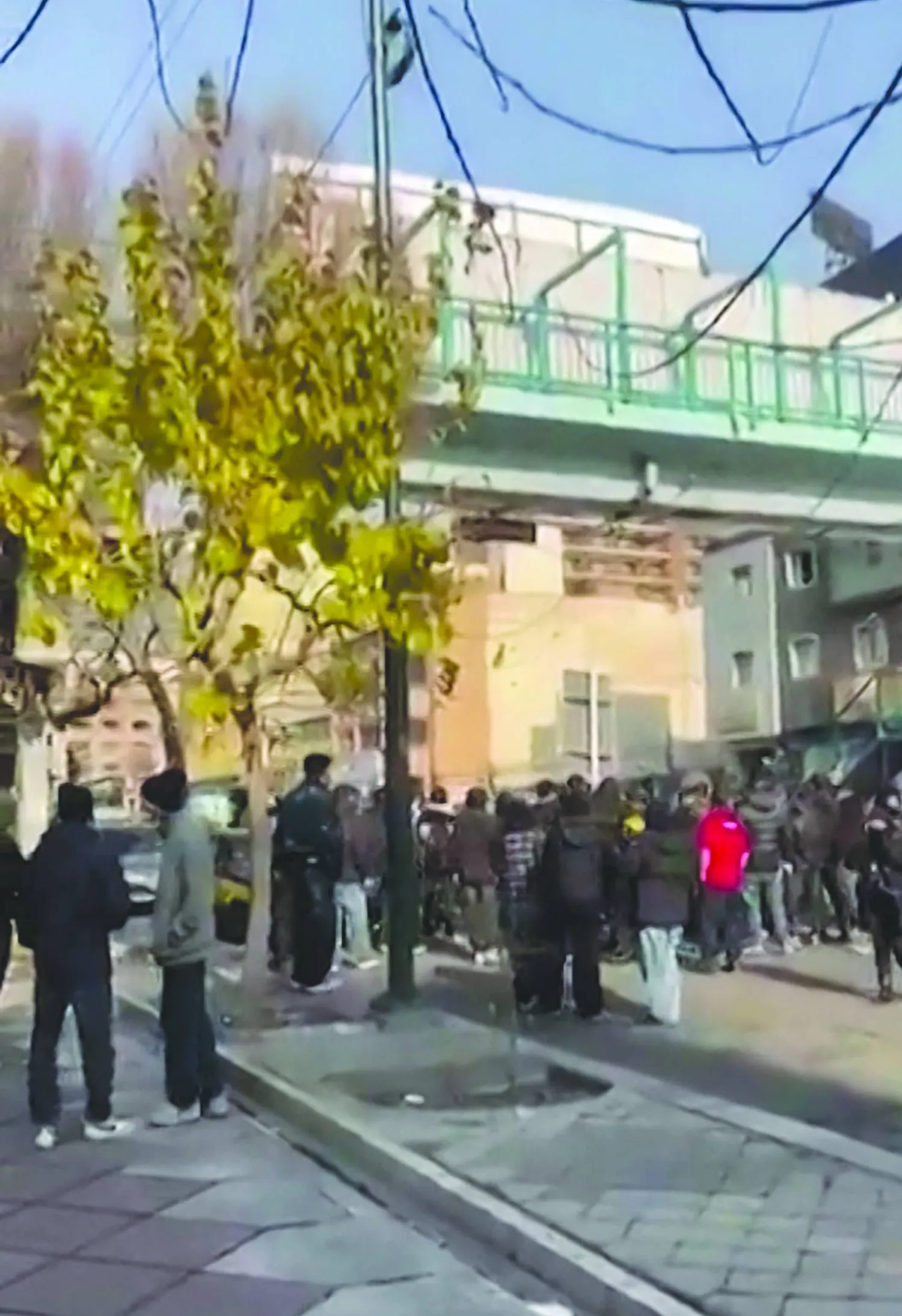

Security Forces Clash with Protesters in Iran’s Main Market as at Least 36 Killed in Demonstrations

This video grab taken from UGC images and posted online on January 4, 2026, show Iranian security forces dispersing protesters with tear gas in central Tehran, as demonstrations first sparked by anger over the rising cost of living entered a second week. (Photo by UGC / AFP)
TT

Security Forces Clash with Protesters in Iran’s Main Market as at Least 36 Killed in Demonstrations

This video grab taken from UGC images and posted online on January 4, 2026, show Iranian security forces dispersing protesters with tear gas in central Tehran, as demonstrations first sparked by anger over the rising cost of living entered a second week. (Photo by UGC / AFP)

Protesters angry over Iran's ailing economy conducted a sit-in Tuesday at Tehran's Grand Bazaar, witnesses said, with security forces ultimately firing tear gas and dispersing demonstrators as the rest of the market shut down. 

The protest at the Grand Bazaar, the beating heart for centuries of both Iran's economic and political life, represented the latest signal that the demonstrations likely are to continue as the country's rial currency fell to a record low Tuesday. Already, violence surrounding the protests has killed at least 36 people with authorities detaining more than 1,200 others, activists abroad say. 

Meanwhile, the situation was likely to worsen as Iran's Central Bank drastically reduced the subsidized exchange rates for dollars it offers to importers and producers in the country. That likely will see merchants pass on price hikes in the coming days for goods directly onto consumers, whose life savings already have dwindled over years of international sanctions targeting the country. 

Iran's reformist President Masoud Pezeshkian, while ordering a government investigation into one incident involving the protests, otherwise signaled Tuesday that the crisis may be rapidly moving beyond the control of officials. 

"We should not expect the government to handle all of this alone," Pezeshkian said in a televised speech. "The government simply does not have that capacity." 

Turmoil shakes Grand Bazaar 

In the Grand Bazaar, a labyrinth-like warren of covered passages and alleyways, demonstrators sat down in one passage in front of security forces as other shops nearby shut down on Tuesday, online videos showed and witnesses said. Other demonstrations similarly have seen people sit down in front of police after a photo circulated earlier of a man seen sitting alone in front of security forces. 

Authorities later fired tear gas to disperse the protesters. Iranian state-run media did not immediately acknowledge the incident, which has been common in the days since the demonstrations began on Dec. 28. Later footage purportedly showed tear gas at a hospital and a metro station in Tehran. 

Iran has faced rounds of nationwide protests in recent years. As sanctions tightened and Iran struggled after a 12-day war with Israel in June, its rial currency collapsed in December, reaching 1.4 million to $1. Protests began soon after, with demonstrators chanting against Iran’s theocracy. 

On Tuesday, $1 traded at 1.46 million rials, a new low, with no signs of slowing. Prior to Iran’s 1979 revolution, the rial was broadly stable, trading at around 70 to $1. At the time of Iran’s 2015 nuclear deal with world powers, $1 traded for 32,000 rials. 

Exchange rate change points to more pain coming  

More pain may be coming for Iranian consumers. Iran’s Central Bank in recent days ended a preferential, subsidized dollar-rial exchange rate for all products except medicine and wheat. Iran’s government had offered that rate to importers and producers to try to ensure the flow of essential goods despite international sanctions over its nuclear program and other issues. 

However, many of those firms took advantage of the difference in rates, pocketing ever-greater profits as normal Iranians watched their savings rapidly lose value against the dollar. 

The currency and rate depreciation has directly impacted what's available in stores — and at what price. The average bottle of cooking oil just doubled in price, the state-run IRNA news agency reported. Many have complained about shelves being empty in stores, likely as suppliers and merchants fear selling cooking oil at a loss. Cheese and chicken prices also spiked, while imported rice hasn't been available in some shops. 

Pezeshkian in his speech blamed inflation, sanctions and other woes for causing the depreciation and warned tougher times may be coming. 

"If we do not make realistic decisions, we ourselves will push the country toward crisis and then complain about the consequences," he warned. 

Iran promises Ilam investigation  

Late Monday, Pezeshkian assigned the interior ministry to form a special team for a "full-fledged investigation" of what had been happening in Ilam province. Protesters in Malekshahi County in Iran’s Ilam province, some 515 kilometers (320 miles) southwest of Iran's capital, Tehran, were killed as online videos purported to show security forces firing on civilians. 

The presidency also acknowledged an "incident in a hospital in the city of Ilam." Online video showed security forces wearing riot gear raiding a hospital, where activists said they were seeking demonstrators. 

The hospital assault drew criticism from the US State Department, which in Iran's Farsi language called the incident "a crime." 

"Storming the wards, beating medical staff and attacking the wounded with tear gas and ammunition is an clear crime against humanity," a post on the social platform X read. "Hospitals are not battlefields." 

A report by the semiofficial Fars news agency earlier alleged without offering evidence that demonstrators carried firearms and grenades. Tuesday night, Fars reported that an angry crowd from a funeral for two of the dead stormed and damaged three banks in Malekshahi, leading to one person being killed and several wounded. 

Ilam province is mainly home to the country's Kurdish and Lur ethnic groups and faces severe economic hardship. 

Protester deaths a focus of Trump  

The US-based Human Rights Activists News Agency offered the latest death toll of 36 for the demonstrations. It said 29 protesters, four children and two members of Iran’s security forces have been killed. Demonstrations have reached over 270 locations in 27 of Iran’s 31 provinces, 

The group, which relies on an activist network inside of Iran for its reporting, has been accurate in past unrest. 

Fars, believed close to Iran’s paramilitary Revolutionary Guard, reported late Monday that some 250 police officers and 45 members of the Guard’s all-volunteer Basij force have been hurt in the demonstrations. 

The growing death toll carries with it the chance of American intervention. US President Donald Trump warned Iran on Friday that if Tehran "violently kills peaceful protesters," the United States "will come to their rescue." Supreme Leader Ali Khamenei on Saturday said "rioters must be put in their place." 

While it remains unclear how and if Trump will intervene, his comments sparked an immediate, angry response, with officials within the theocracy threatening to target American troops in the Middle East. The comments took on new importance after the US military on Saturday captured Venezuelan President Nicolas Maduro, a longtime ally of Tehran. 


US Tanker Approached by Iranian Gunboats in Strait of Hormuz

An Iranian Revolutionary Guard vessel watches an American warship in the Strait of Hormuz, May 19, 2023. (AP)
TT

US Tanker Approached by Iranian Gunboats in Strait of Hormuz

An Iranian Revolutionary Guard vessel watches an American warship in the Strait of Hormuz, May 19, 2023. (AP)

British maritime security firm Vanguard Tech said Tuesday that a US-flagged tanker was approached and challenged by Iranian gunboats in the Strait of Hormuz, before continuing on its way.

The Stena Imperative was approached by three pairs of small armed boats belonging to the Iranian Revolutionary Guards while transiting the strait approximately 16 nautical miles (30 kilometers) north of Oman, the company said.

The gunboats hailed it by radio, ordering the captain "to stop the engines and prepare to be boarded", but the ship increased speed and maintained course, the firm added, stressing it did not enter Iranian territorial waters.

"The vessel is now being escorted by a US warship," Vanguard Tech said.

Earlier, the British maritime security agency UKMTO reported the incident without specifying the nationality of the ship or the boats that approached it.

The Iranian news agency Fars said a vessel, whose nationality it did not specify, had entered the country's territorial waters in the Strait of Hormuz illegally, at which point Iranian units "requested" that it present the necessary permissions.

"The vessel had no legal authorization to be in these waters," Fars said. "It was therefore warned and immediately left Iranian waters."

The strait, a key passage for the global transport of oil and liquefied natural gas, has been the scene of several incidents in the past.

A senior Iranian official from the naval forces of the Revolutionary Guards threatened last week to block the passage in the event of a US attack.


NATO Says ‘Planning Underway’ for New Arctic Mission

The Danish Navy ocean patrol vessel F357 Thetis is pictured during a visit of Denmark's Defense Minister at the army contribution in Nuuk, Greenland, on January 31, 2026. (AFP)
TT

NATO Says ‘Planning Underway’ for New Arctic Mission

The Danish Navy ocean patrol vessel F357 Thetis is pictured during a visit of Denmark's Defense Minister at the army contribution in Nuuk, Greenland, on January 31, 2026. (AFP)

NATO said Tuesday that military planning has started for a new mission to bolster security in the Arctic, after US President Donald Trump made protecting the region central to his demands for Greenland.

"Planning is underway for a NATO enhanced vigilance activity, named Arctic Sentry," said Martin O'Donnell, a spokesman for NATO's Supreme Headquarters Allied Powers Europe.

"The activity will even further strengthen NATO's posture in the Arctic and High North," he added, without providing further details.

Trump's threats against Greenland last month plunged the transatlantic alliance into its deepest crisis in years.

The unpredictable US leader backed off his desire to take control of Denmark's autonomous Arctic territory after saying he had struck a "framework" deal with NATO chief Mark Rutte to ensure greater American influence.

NATO said it would take steps to boost its presence in the Arctic after Trump used the alleged threat of Russia and China to justify his designs on Greenland.

Meanwhile Denmark and Greenland have kicked off talks with the United States over the territory and are expected to renegotiate a 1951 treaty governing American troop deployments on the island.

Danish Prime Minister Mette Frederiksen has said that NATO countries back having a "permanent presence" in the Arctic, including around Greenland, as part of efforts to step up security.


WHO Appeals for $1 Bn for World’s Worst Health Crises in 2026

 Displaced Palestinian children gather at a tent camp in Gaza City, February 3, 2026. (Reuters)
Displaced Palestinian children gather at a tent camp in Gaza City, February 3, 2026. (Reuters)
TT

WHO Appeals for $1 Bn for World’s Worst Health Crises in 2026

 Displaced Palestinian children gather at a tent camp in Gaza City, February 3, 2026. (Reuters)
Displaced Palestinian children gather at a tent camp in Gaza City, February 3, 2026. (Reuters)

The World Health Organization on Tuesday appealed for $1 billion to tackle health crises this year across the world's 36 most severe emergencies, including in Gaza, Sudan, Haiti and the Democratic Republic of Congo.

The UN health agency estimated 239 million people would need urgent humanitarian assistance this year and the money would keep essential health services going.

WHO health emergencies chief Chikwe Ihekweazu told reporters in Geneva: "A quarter of a billion people are living through humanitarian crises that strip away the most basic protections: safety, shelter and access to health care.

"In these settings, health needs are surging, whether due to injuries, disease outbreaks, malnutrition or untreated chronic diseases," he warned.

"Yet access to care is shrinking."

The agency's emergency request was significantly lower than in recent years, given the global funding crunch for aid operations.

Washington, traditionally the UN health agency's biggest donor, has slashed foreign aid spending under President Donald Trump, who on his first day back in office in January 2025 handed the WHO his country's one-year withdrawal notice.

Last year, WHO had appealed for $1.5 billion but Ihekweazu said that only $900 million was ultimately made available.

Unfortunately, he said, the agency had been "recognizing ... that the appetite for resource mobilization is much smaller than it was in previous years".

"That's one of the reasons that we've calibrated our ask a little bit more towards what is available realistically, understanding the situation around the world, the constraints that many countries have," he said.

The WHO said in 2026 it was "hyper-prioritizing the highest-impact services and scaling back lower-impact activities to maximize lives saved".

Last year, global funding cuts forced 6,700 health facilities across 22 humanitarian settings to either close or reduce services, "cutting 53 million people off from health care", Ihekweazu said.

"Families living on the edge face impossible decisions, such as whether to buy food or medicine," he added, stressing that "people should never have to make these choices".

"This is why today we are appealing to the better sense of countries, and of people, and asking them to invest in a healthier, safer world."
