Abou Zaraa Al-Mahrami: PLC's Go-to Man in Handling Yemen's Challenging Files
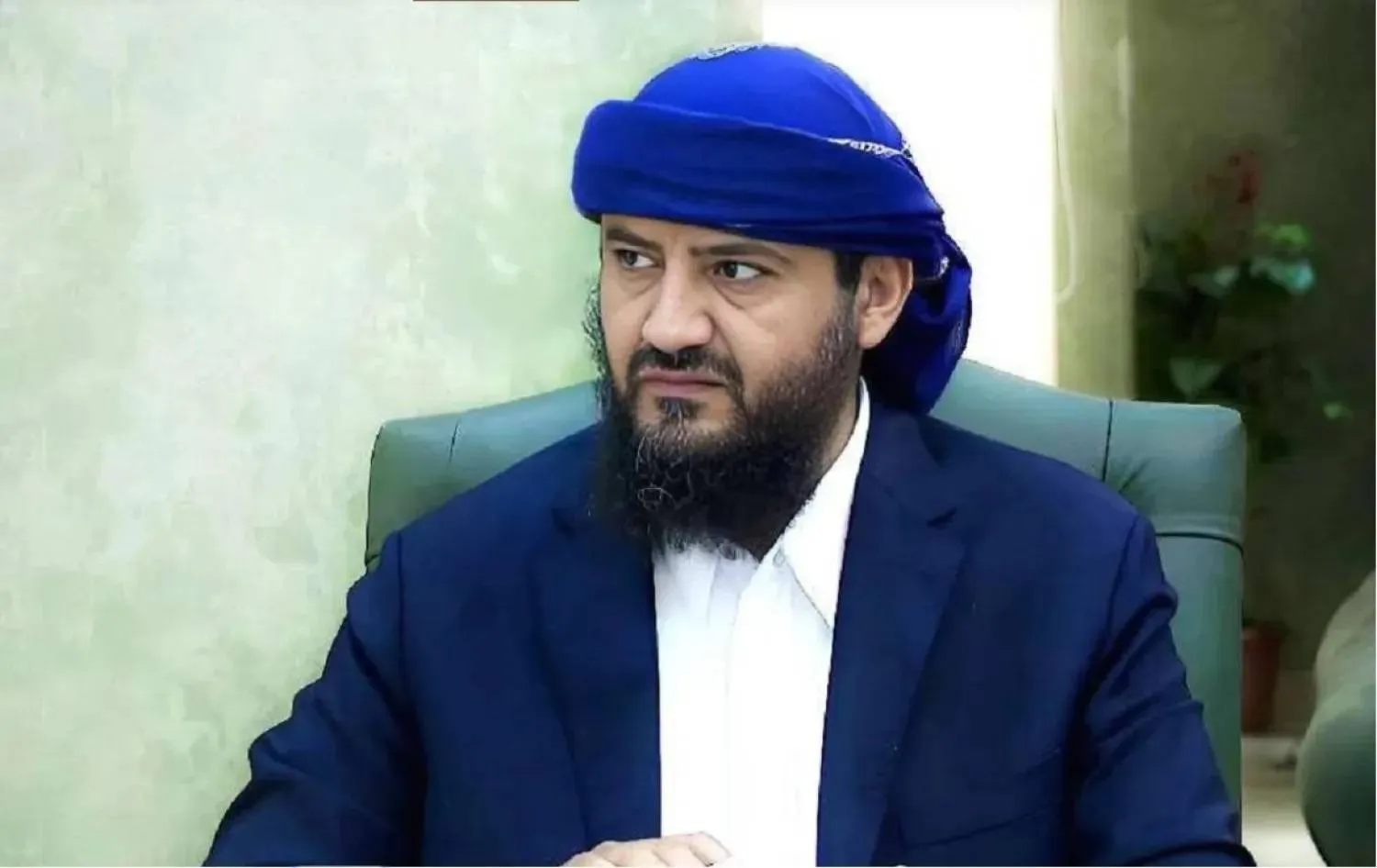
Abdul Rahman Al-Mahrami. (Saba)
Amid the tensions in Yemen's interim capital Aden rose the name of Vice President of the Presidential Leadership Council Abdul Rahman Al-Mahrami, also known as Abou Zaraa, as one of the main figures trying to restore calm in southern Yemen.
He was tasked with imposing security and preventing clashes in Aden, reflecting the confidence he enjoys inside the PLC and his rising role in handling sensitive military files.
Abou Zaraa Al-Mahrami was born in 1980 in the Yafaa region in the Abyan province.
He rose to prominence as a decisive field commander during the war in Yemen. In a short period of time, he managed to impose himself through the leadership of the southern Giants Brigades, which had turned into a mighty force in combating the Houthis.
In contrast to several military commanders, Abou Zaraa Al-Mahrami was actually involved in ground operations that helped reclaim strategic regions. He consequently gained a military and popular reputation, consolidating his standing in Yemen.
He was named a member of the PLC in April 2022 during one of the most complicated phases of Yemen's recent history. Since then, he has maintained his image as a disciplined military commander who balances between political and security duties.
In May 2023, he was named Vice President of the Southern Transitional Council (STC), placing him in a prominent position in both the PLC and on the southern scene. He remained committed to the work of the legitimate government and maintaining security.
Abou Zaraa Al-Mahrami has long held firm stances in combating terrorism and preventing the proliferation of weapons. These positions made him the go-to man for tackling sensitive security files.
He has been tasked with imposing security in Aden in wake of the latest tensions with the STC.
People familiar with his work said he is keen on protecting civilians and state institutions and preventing political disputes from turning into armed clashes - a challenging task in a city where weapons are everywhere and tensions are high.
Abou Zaraa Al-Mahrami has also represented Yemen at important regional meetings. He recently met with Saudi Defense Minister Prince Khalid bin Salman in Riyadh to discuss the security and political developments in Yemen, reflecting the trust he enjoys among regional partners.
Israeli Settlers Impeded Firefighting Near West Bank Village, Palestinians Sayhttps://english.aawsat.com/arab-world/5282625-israeli-settlers-impeded-firefighting-near-west-bank-village-palestinians-say
Smoke rises after Israeli settlers reportedly set fire to agricultural fields surrounding the village of Taybeh, in the Israeli-occupied West Bank on June 10, 2026. (AFP)
TT
TT
Israeli Settlers Impeded Firefighting Near West Bank Village, Palestinians Say
Smoke rises after Israeli settlers reportedly set fire to agricultural fields surrounding the village of Taybeh, in the Israeli-occupied West Bank on June 10, 2026. (AFP)
Israeli settlers obstructed Palestinians putting out a large blaze near a Christian village in the Israeli-occupied West Bank late on Tuesday, a local priest and Palestinian civil defense firefighters said.
The incident comes amid rising strife in the West Bank, where some Western countries announced sanctions on settler groups this week over violent Israeli attacks on Palestinians.
Father Bashar Fawadleh, parish priest of Taybeh, said settlers had shot firearms and surrounded people trying to take a water tanker to the site to fight the fire.
The Israeli military also temporarily stopped firefighters reaching the blaze while they arranged security coordination, Palestinian Authority Civil Defense spokesperson Nael al-Azza said.
The firefighters were eventually able to reach the fire and put it out, though settlers continued trying to obstruct them, Fawadleh and Azza said.
Israel's military did not immediately respond to a Reuters request for comment on the incident.
'ONGOING PATTERN OF INTIMIDATION'
Reuters visited the village on Wednesday and smoke was still rising from a large area of burned hillside.
Fawadleh said he believed the fire was a result of arson, but he did not say who he thought was responsible.
"What we are experiencing is not a series of isolated incidents, but an ongoing pattern of intimidation and unjustified violence that undermines our fundamental right to safety, security, and dignity," he said in a statement.
The West Bank and Jerusalem are home to around 50,000 Palestinian Christians, members of a religious community there stretching back to antiquity in a region that is home to many of the faith's most important holy sites.
Taybeh is one of the only Christian villages remaining in the West Bank and was visited last year by the Greek Orthodox patriarch and the Roman Catholic cardinal of Jerusalem.
Around 700,000 Israeli settlers live among 3.4 million Palestinians in the West Bank and East Jerusalem, territories Israel captured from Jordan in the 1967 war, which Palestinians see as part of a future state.
A UN inquiry released on Tuesday found that Israeli authorities were directly involved in settler attacks that have killed, injured and displaced Palestinians in the West Bank.
Israel's mission in Geneva rejected that report's findings. Israel says its military and police maintain security in the West Bank and condemn any forms of violence.
Governance in the West Bank has been split since the 1993 Oslo Accords into different zones delineating Israeli military and Palestinian Authority control.
Parts of Taybeh are located in Area B, where the PA runs civil administration but where security control must be coordinated with Israeli authorities.
The movement and deployment of Palestinian emergency responders into Area B generally requires coordination with Israeli security bodies, Palestinians say.
Although the PA has a Civil Defense center in Taybeh, the Israeli military prevented them accessing the site of the fire until the security coordination was complete, Azza said.
Asharq Al-Awsat Publishes Palestinian Factions’ Amendment to 8th Clause of Gaza Agreementhttps://english.aawsat.com/arab-world/5282610-asharq-al-awsat-publishes-palestinian-factions%E2%80%99-amendment-8th-clause-gaza
Palestinians are seen at a school sheltering displaced people in Jabalia refugee camp in northern Gaza on Tuesday. (AFP)
TT
TT
Asharq Al-Awsat Publishes Palestinian Factions’ Amendment to 8th Clause of Gaza Agreement
Palestinians are seen at a school sheltering displaced people in Jabalia refugee camp in northern Gaza on Tuesday. (AFP)
Mediators of Gaza’s fragile ceasefire, along with Palestinian factions, are counting on US President Donald Trump’s administration to press Israel to accept the agreed wording on a 15-point roadmap received by Hamas last April.
Palestinian factions reached “close” positions with mediators from Egypt, Qatar, and Türkiye on amendments to the roadmap, focusing mainly on the disputed eighth clause on weapons in Gaza.
The amended wording of the eighth clause, seen by Asharq Al-Awsat, calls for the inventorying and storage of weapons, including infrastructure, to be carried out gradually and in stages, according to a timetable.
The process would take place in parallel with Israel’s withdrawal from the areas it controls in the Gaza Strip and the completion of the first phase of the ceasefire agreement with all its requirements.
Those include “the full implementation of the humanitarian protocol, the halt to targeted attacks, Israel’s commitment to withdrawal from the enclave, the entry of the National Committee for the Administration of Gaza and its assumption of duties, the deployment of the International Stabilization Force, and the dismantling of armed militias.”
The amendment added that implementation shall be carried out through the national committee, with the support of international forces and in cooperation with Palestinian organizations.
All of this comes within the framework of Trump’s plan and in accordance with relevant international resolutions and laws.
Indirect talks between Israel on one side and Hamas and other factions on the other have stalled over moving to new phases of the Gaza ceasefire announced last October, which Israel has repeatedly breached, killing more than 970 Palestinians since then.
The Palestinian side has insisted on implementing the requirements of the first phase, including the Israeli army’s withdrawal from the territory it occupies and the entry of aid and goods into Gaza. Tel Aviv, meanwhile, is pressing for the factions to disarm, describing this as the most prominent provision of the second phase.
Hamas delegation stays in Cairo
According to two Hamas sources and other sources from Palestinian factions involved in the Cairo meetings, the Hamas delegation was asked to stay in Cairo and await the response to the agreed wording.
Other faction delegations that had come from abroad left, while some members who had recently been based in Egypt remained.
A Hamas source said the movement’s delegation in Egypt would likely be asked to hold further consultations with the mediators on some issues that Israel, and even the Trump administration, may object to in the proposed amendments, mainly over the text rather than the substance.
According to the four sources, the mediators told the factions that took part in the meetings that they would seek agreement with the US administration and Israel on the wording reached and would brief them on developments from consultations with all parties.
Another Hamas source said Türkiye was playing “an important and major role” in persuading the US administration, while Qatari Prime Minister Sheikh Mohammed bin Abdulrahman Al Thani was in direct contact with US envoy Steve Witkoff to push for the success of the important step that had been reached.
Nickolay Mladenov, the High Representative for Gaza at the Board of Peace, is expected to arrive in Cairo on Wednesday or Thursday.
But a source close to the Board of Peace team told Asharq Al-Awsat that Mladenov would likely begin his visit “in Israel first, to reach understandings with officials there before moving on to Cairo.”
Palestinian sources were pessimistic about Israel’s response and expected it to be “negative” toward the wording of the roadmap amendments.
Attacks on Gulf States...an Obstacle to Egypt-Iran Rapprochementhttps://english.aawsat.com/arab-world/5282516-attacks-gulf-statesan-obstacle-egypt-iran-rapprochement
Attacks on Gulf States...an Obstacle to Egypt-Iran Rapprochement
Egyptian President Abdel Fattah el-Sisi during his meeting with his Iranian counterpart in Cairo in December 2024 (Egyptian Presidency)
After two years of steadily improving ties that appeared to be moving toward the restoration of full diplomatic relations, Egypt and Iran now seem to be facing a major setback. Egypt views Iran's current war and the subsequent attacks it carried out against Gulf states as a violation of one of its key conditions for fully normalizing relations: that Iran must not threaten the security of the Gulf or the wider region.
In a series of official statements and comments, Egypt has strongly condemned the Iranian attacks targeting Gulf Arab states, describing them as a dangerous escalation, a blatant violation of national sovereignty, and a direct threat to regional security and stability.
In its latest position, Egypt on Wednesday condemned "in the strongest terms" what it described as Iran's attacks on Jordan, Bahrain and Kuwait, saying they constituted "a flagrant violation of the sovereignty and territorial integrity of these sisterly states and a highly dangerous escalation that threatens the security and stability of the entire region," according to a Foreign Ministry statement.
Egypt stressed that "the security and stability of sisterly Arab states are an integral part of Egyptian and Arab national security," reiterating its categorical rejection of any actions or practices that undermine state sovereignty or threaten territorial integrity and security. It also underscored the importance of de-escalation and respect for international law in order to preserve regional security and stability.
For its part, Iran has been seeking to restore momentum in its relationship with Egypt. On Monday, Iran's mission in Cairo announced that Foreign Minister Abbas Araghchi had met in Tehran with Mojtaba Ferdowsi, head of Iran's Interests Section in Cairo, to discuss the course of bilateral relations.
According to the mission, Ferdowsi briefed Araghchi on the latest developments in relations between the two countries, as well as ongoing political contacts and cooperation in several fields.
The mission said Araghchi emphasized the importance of continuing bilateral consultations, adding that Egypt-Iran relations had made notable progress in recent years and that "continuous dialogue and consultation between Cairo and Tehran constitute an important pillar in supporting efforts for peace and stability in the Middle East."
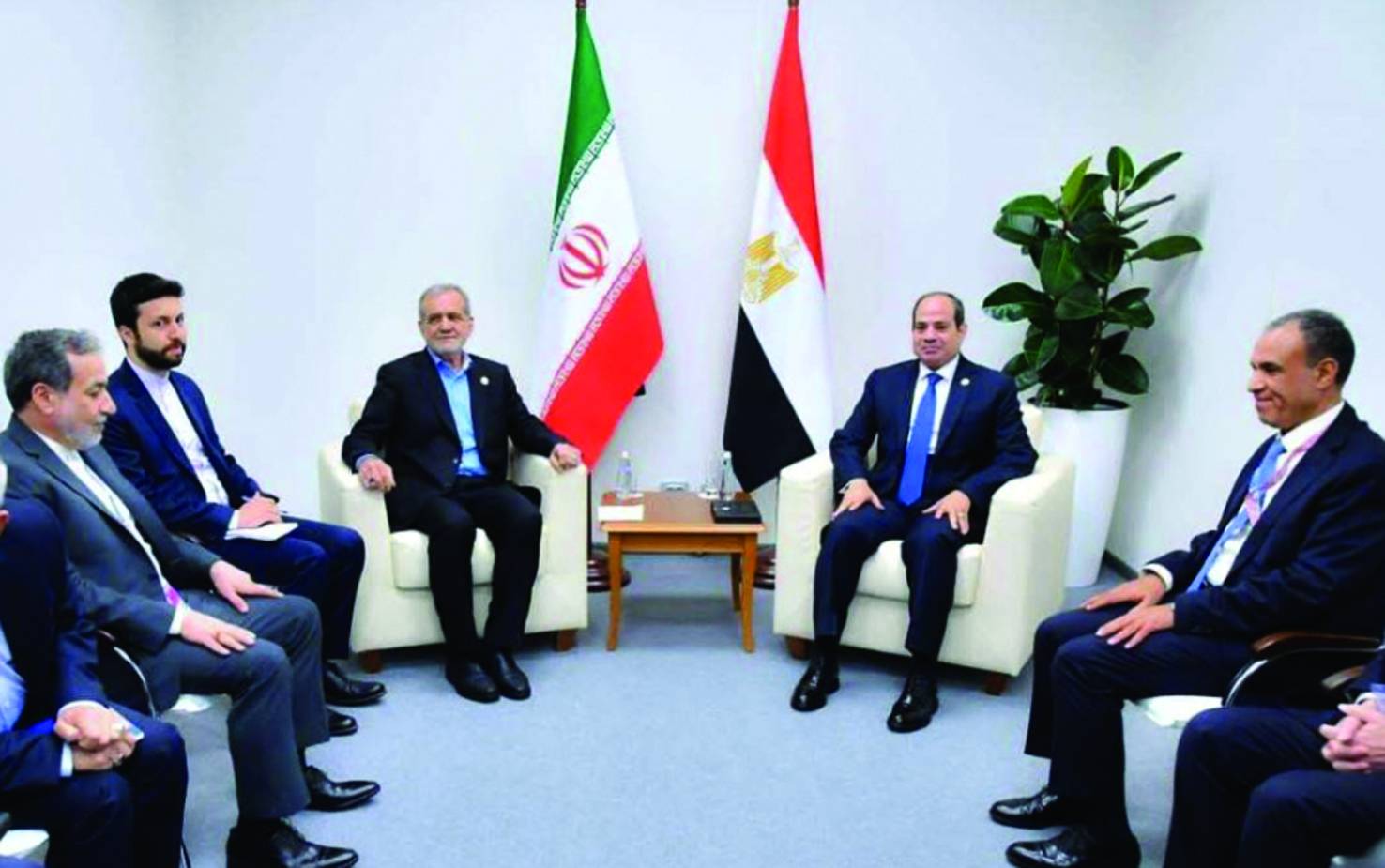
Egyptian and Iranian presidents and their delegations on the sidelines of the BRICS summit in Russia in October 2024 (Egyptian Presidency)
Bare Minimum
Diplomatic relations between Egypt and Iran were severed in 1979 before being resumed 11 years later at the chargé d'affaires level.
Over the past two years, Egyptian and Iranian officials have held a series of meetings to discuss the possibility of developing relations further. Progress gained momentum in May 2023 following a presidential directive in Iran instructing the Foreign Ministry to take the necessary steps to strengthen relations with Egypt.
The period also saw meetings between the two countries' foreign ministers, as well as encounters between Egyptian President Abdel Fattah el-Sisi and both Iran's late president Ebrahim Raisi and current President Masoud Pezeshkian.
Asked about the prospects for advancing bilateral ties under current circumstances, former Egyptian Foreign Minister Mohamed El-Orabi said there was little room at present to speak of further development in Egypt-Iran relations.
"The region is experiencing turmoil that requires maintaining only the minimum level of relations necessary to manage the situation, reduce tensions and prevent further escalation," he told Asharq Al-Awsat.
He added: "The situation is not as dynamic as Tehran portrays it. There are certainly contacts and consultations, but they are aimed at addressing concerns that could further destabilize the region, not at deepening relations. Egypt rejects Iran's attacks on Gulf states and has strongly condemned them. That message has reached Iran, which is now trying to restore the level of rapprochement that existed before the current war."
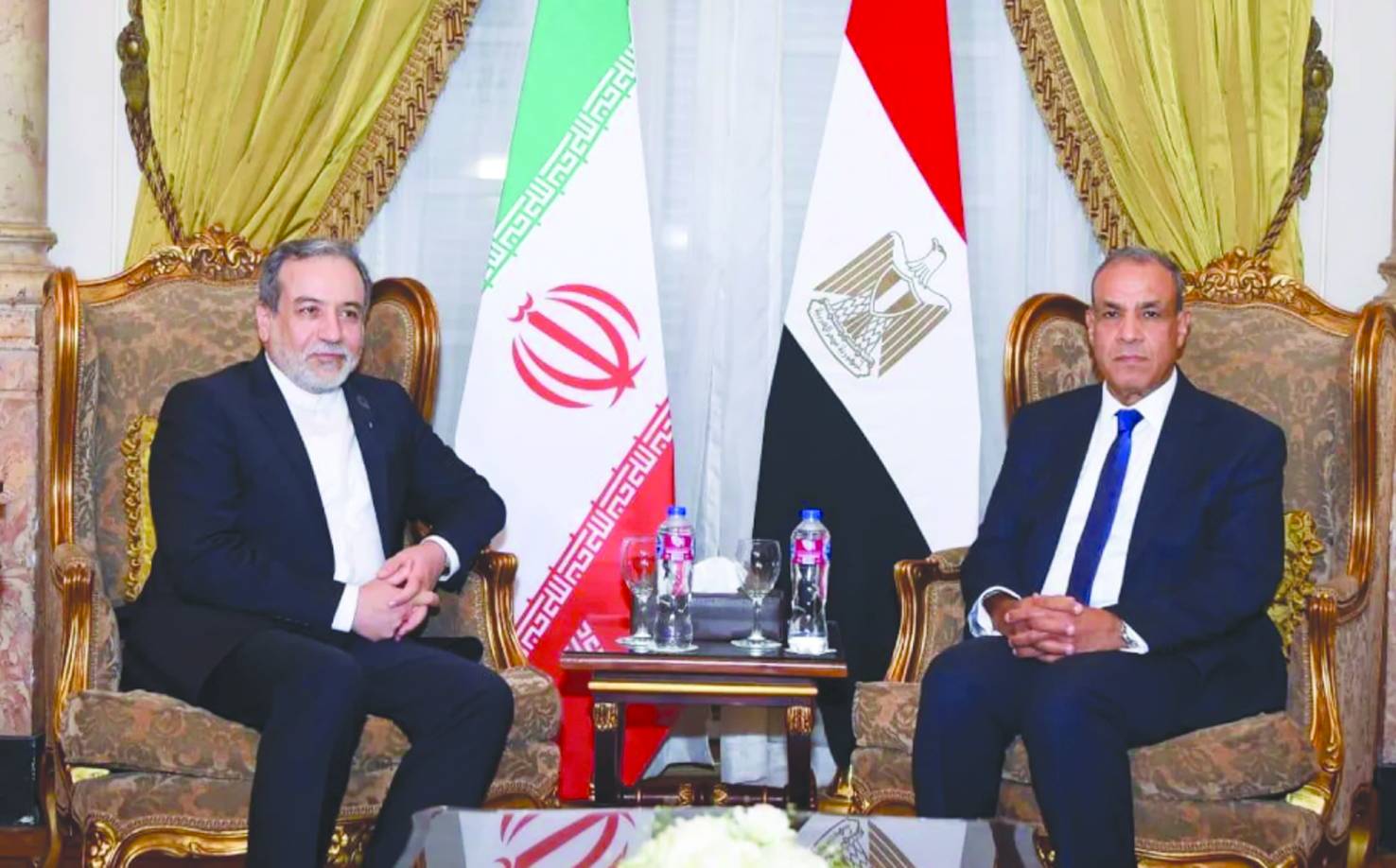
File: The Egyptian Foreign Minister and his Iranian counterpart in Cairo (Egyptian Foreign Ministry)
Tarek Fahmy, professor of political science and international relations at Cairo University, said Egypt had approached Iran cautiously even before the war because of a longstanding lack of trust.
"Even when Iran responded by changing the name of Islambouli Street, named after the assassin of President Anwar Sadat, Egyptian officials stressed that this was not the basis of Egypt's demands for restoring relations with Iran," Fahmy said.
"There were broader political and security requirements related to regional security, foremost among them the security of the Gulf states and non-interference in Arab affairs."
He added that despite Iranian assurances intended to demonstrate goodwill and meet Egypt's requirements, which helped advance relations to some extent, Iran's current war and the subsequent attacks directed at Gulf states prompted Egypt to stand firmly behind Gulf security.
The Message Was Received
During two phone calls with the Iranian president in March and May, Sisi stressed Egypt's categorical rejection of any violation of Gulf states' sovereignty.
"The message has reached Iran, and Tehran has taken notice of it," Fahmy said. "It is now working to address the issue in an effort to restore the trajectory of relations with Cairo."
According to Fahmy, Iran wants Egypt to be one of the principal parties involved in any current or future negotiations with the United States, Israel or the International Atomic Energy Agency because of Egypt's credibility and its ability to maintain channels of communication with all sides.
"Tehran understands that its negotiations cannot rely on Pakistan alone," he said, adding that Iran also views Egypt as a key stabilizing force for regional security and stability.
Nevertheless, Fahmy does not expect Cairo to restore full diplomatic relations with Tehran unless Iran fulfills Egypt's conditions and requirements.
"Egypt will not take that step unless stability and balance are restored in the Gulf and the region as a whole," he said.
لم تشترك بعد
انشئ حساباً خاصاً بك لتحصل على أخبار مخصصة لك ولتتمتع بخاصية حفظ المقالات وتتلقى نشراتنا البريدية المتنوعة