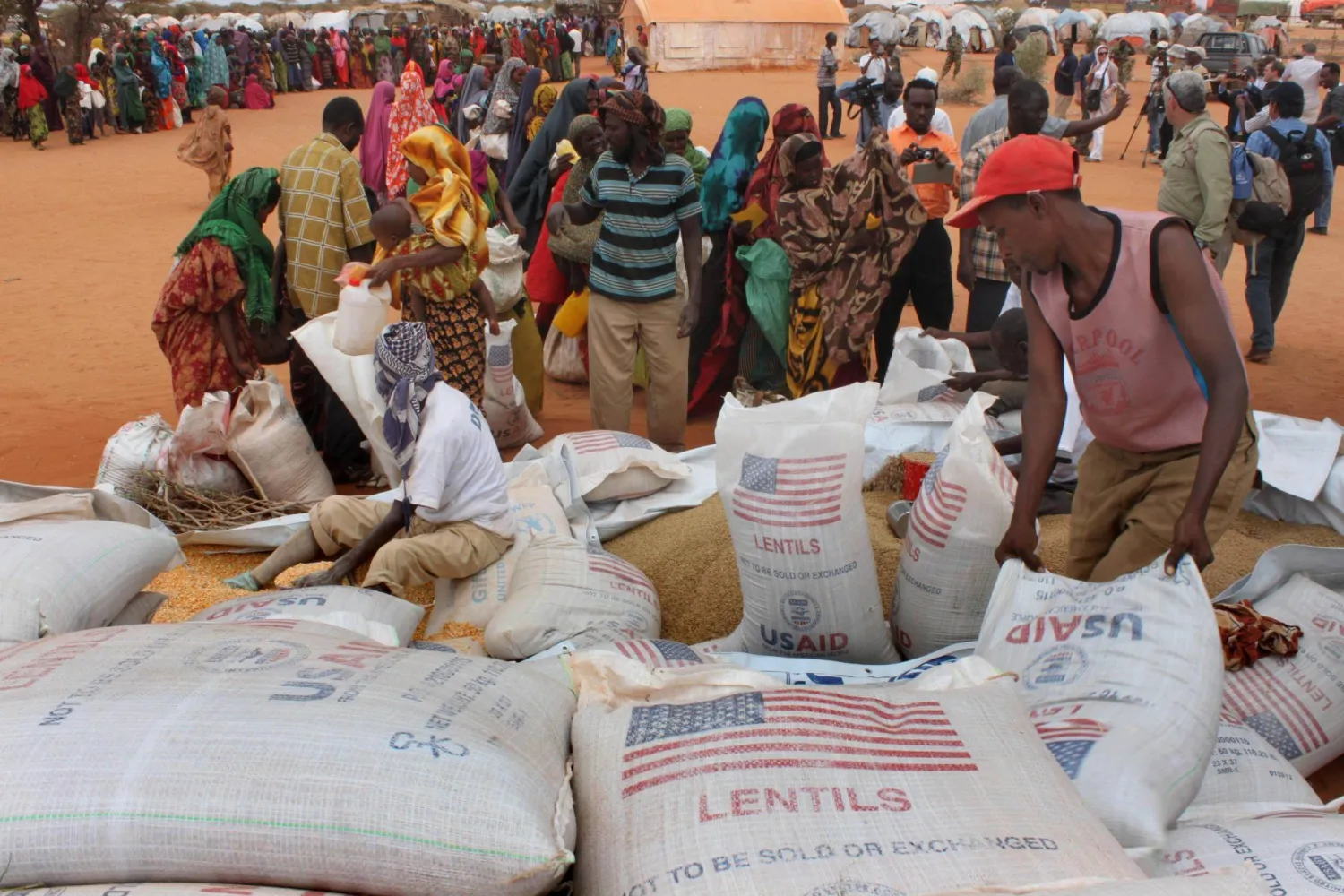
US Pauses Some Aid to Somalia, South Sudan over 'Theft'

FILE - Workers distribute food aid from the World Food Program at a refugee camp in Dolo, Somalia on July 18. 2012. (AP Photo/Jason Straziuso, file)
TT

US Pauses Some Aid to Somalia, South Sudan over 'Theft'

FILE - Workers distribute food aid from the World Food Program at a refugee camp in Dolo, Somalia on July 18. 2012. (AP Photo/Jason Straziuso, file)

The United States paused aid in Somalia and South Sudan on Thursday over reports of theft and government interference, declaring a "zero-tolerance policy" for the misuse of its assistance.

The suspension of aid to Somalia followed the destruction of a US-funded World Food Program (WFP) warehouse in the capital Mogadishu's port.

The US Under Secretary for Foreign Assistance, Humanitarian Affairs and Religious Freedom posted on X late Wednesday that Somali officials had "illegally seized 76 metric tons of donor-funded food aid for vulnerable Somalis".

A WFP spokesperson confirmed to AFP that the warehouse had been demolished by port authorities, but the government and two local sources said the food had not been stolen.

"The warehouse was partially demolished during the weekend without the knowledge of the WFP team, but there was no looting involved," a WFP staff member in Mogadishu, speaking on condition of anonymity, said.

"All the stocked supply was kept intact. The government gave the space for WFP to build the warehouse in the first place, and they wanted it back," a port staff member, also speaking anonymously, told AFP.

In a statement, the Somali government said the warehouse was demolished as part of "expansion and repurposing works" at the port.

US officials said any future aid would be "dependent on the Somali Federal Government taking accountability" and resolving the matter.

Meanwhile, the US embassy in South Sudan, another conflict-hit country in east Africa, said it was suspending parts of its aid program over the "continued abuse, exploitation, and theft directed against US foreign assistance by South Sudanese officials at national, state, and county levels".

It highlighted the detention of a US-linked aid worker after he refused to illegally hand over assets to a county commissioner in South Sudan's Ayod County in Jonglei state, and the refusal to allow the transfer of US-funded pharmaceutical supplies in Bahr el-Ghazal state.

The embassy said it was suspending aid in Ayod County and "considering significant reductions" in Bahr el-Ghazal.

The Trump administration has slashed aid over the past year.

Somalis in the United States have also become a particular target for the administration in recent weeks, targeted in immigration raids.

They have also been accused of large-scale public benefit fraud in Minnesota, which has the largest Somali community in the country with around 80,000 members.

There has also been a rift with Somalia over Israel's recognition of Somaliland, a breakaway region of Somalia, which was supported by the US.


Macron Seeks New Int’l Force for South Lebanon After UNIFIL Mandate Ends

This picture taken from a position in northern Israel, near the border with Lebanon shows a United Nations Interim Force in Lebanon (UNIFIL) armored vehicle driving past destroyed buildings in southern Lebanon on June 22, 2026. (AFP)
TT

Macron Seeks New Int’l Force for South Lebanon After UNIFIL Mandate Ends

This picture taken from a position in northern Israel, near the border with Lebanon shows a United Nations Interim Force in Lebanon (UNIFIL) armored vehicle driving past destroyed buildings in southern Lebanon on June 22, 2026. (AFP)

French President Emmanuel Macron pressed ahead with efforts to shape a new international force for southern Lebanon after the mandate of the United Nations Interim Force in Lebanon (UNIFIL) expires at the end of this year.

Macron spoke by phone on Tuesday with Lebanese President Joseph Aoun and Prime Minister Nawaf Salam, discussing developments in Lebanon and the region in light of the US-Iran negotiations in Switzerland. They also tackled the situation in southern Lebanon amid the ceasefire between Israel and Hezbollah, the future of international forces operating in the south, and international efforts to support Lebanon.

In his call with Aoun, talks focused on “the situation in the south and the next steps after the announcement of the ceasefire.”

They reviewed the outcome of last week’s G7 summit in the French city of Evian, according to a statement from the Lebanese presidency. Aoun thanked Macron for the position issued by the summit on Lebanon.

UNIFIL’s future took up a central part of the discussion. The two leaders examined the period after its mission ends, especially given the willingness of several European countries, with Lebanon’s backing, to keep forces inside the international area of operations.

Macron told Aoun he would contact several countries to clarify their positions, particularly as UNIFIL’s withdrawal from Lebanon is set to begin at the start of 2027.

The call also covered Lebanese-Syrian relations and coordination between the two countries. Aoun welcomed remarks by Syrian President Ahmed al-Sharaa in his latest television interview, in which he stressed Syria’s commitment to Lebanon’s sovereignty, independence and territorial integrity.

Sharaa said Syria did not intend to intervene militarily in Lebanon, despite comments by US President Donald Trump.

France's President Emmanuel Macron, left, and Lebanon's Prime Minister Nawaf Salam visit the Vivatech fair in Paris, Thursday, June 18, 2026. (AP)

Sharaa stressed that any Syrian role would go exclusively through the Lebanese state and not through other parties, and that Damascus wanted to bolster Lebanon’s stability and strengthen its official institutions.

During Macron’s call with Salam, the two leaders “continued discussions on the results of Salam’s recent visit to Paris, as well as an assessment of the negotiations that began in Switzerland and their repercussions for the region and Lebanon.”

They discussed efforts to secure the necessary conditions for two planned conferences, one to support the army and security forces and another to support reconstruction in wake of the war between Israel and Hezbollah.

The calls come as the future of the international forces in southern Lebanon emerges as one of the most prominent issues under global discussion. At the G7 summit, leaders devoted a significant part of their talks to Lebanon, focusing on the need to find an alternative to UNIFIL once its mandate ends.

According to diplomatic information, discussions are moving toward the creation of a multinational force in which France and other European countries, including Germany, Spain and Italy, have shown readiness to participate.

Its core mission would be to support and train the Lebanese army, equipping it with the capabilities needed to expand its deployment and extend state authority, thereby reinforcing stability and implementing security arrangements in southern Lebanon.


Egypt-Syria Meetings Give Rapprochement New Momentum

Egyptian Foreign Minister Badr Abdelatty and Syrian Foreign Minister Asaad al-Shaibani meet in Jordan on Monday evening. (Egyptian Foreign Ministry)
TT

Egypt-Syria Meetings Give Rapprochement New Momentum

Egyptian Foreign Minister Badr Abdelatty and Syrian Foreign Minister Asaad al-Shaibani meet in Jordan on Monday evening. (Egyptian Foreign Ministry)

A series of recent meetings between Egyptian and Syrian officials has given momentum to rapprochement between the two countries, observers said, particularly after a dispute over Syria’s diplomatic mission in Cairo was resolved.

Egyptian Foreign Minister Badr Abdelatty met his Syrian counterpart Asaad al-Shaibani on Monday on the sidelines of an Arab League meeting in the Jordanian capital, Amman.

In a statement on Tuesday, Egypt’s foreign ministry said the two ministers had affirmed “the depth of the historic ties between Egypt and Syria ... and the importance of building on the visit made by the Syrian foreign minister to Cairo in early May.”

They welcomed plans to hold the second Egyptian-Syrian government meeting at the senior official level, with ministries and agencies responsible for trade and investment in both countries participating, to discuss practical steps to boost economic cooperation.

“Relations with Egypt are moving along their natural path, and Syria is keen to develop them,” Mohammad Taha al-Ahmad, Director of the Arab and Regional Affairs Department at Syria’s foreign ministry, told Asharq Al-Awsat.

The two countries had held talks in recent weeks after Egypt raised reservations over names proposed by Syria to represent its diplomatic mission in Cairo, delaying arrangements for the mission’s arrival.

The issue was resolved after Syria put forward another nominee, Yahya Diab, to lead its mission in Egypt.

Amr al-Shobaki, an Egyptian political analyst at Al-Ahram Center for Political and Strategic Studies, said regional challenges made it necessary to develop Egyptian-Syrian ties.

He said cultural, social and political links between the two peoples were strong, adding that Egyptian authorities “had concerns more than disagreements with the new governing system in Syria, given Egypt’s well-known experience with political Islam.”

“Those concerns are being gradually overcome according to two basic principles: respect for each country’s experience and political model, and non-interference in the affairs of the other,” he added. He said Egypt had already established those principles in its relationship with Türkiye.

“The successive Egyptian-Syrian meetings point to an improvement in relations according to the same two principles,” he said.

In late April, Egyptian President Abdel Fattah al-Sisi met his Syrian counterpart Ahmed al-Sharaa on the sidelines of the Arab-European Consultative Summit held in Cyprus.

Media outlets in Cairo and Damascus said at the time that the two had held “friendly” discussions on regional developments and ways to strengthen cooperation.

Damascus hosted the first Egyptian-Syrian economic and investment forum in January, with the participation of leaders and business figures from the Egyptian Chamber of Commerce. The forum aimed to build active partnerships between the two countries and explore cooperation in trade, industry, services, infrastructure and reconstruction.


Seven European Countries Urge ‘Immediate Halt’ to Sudan Violence

People fill water containers at a free distribution point amid water outages in Khartoum, Sudan, May 18, 2026. (AP)
TT

Seven European Countries Urge ‘Immediate Halt’ to Sudan Violence

People fill water containers at a free distribution point amid water outages in Khartoum, Sudan, May 18, 2026. (AP)

Britain and six European allies Tuesday called for an immediate halt to violence targeting the Sudanese city of El-Obeid encircled by paramilitary forces, a statement issued by the UK Foreign Office said.

"There are now credible signs of an imminent offensive. This is a critical moment, and the international community must act," a joint statement signed by Britain, France, Germany, Ireland, Italy, the Netherlands and Norway said.

"We call on the RSF (Rapid Support Forces) to halt its attack immediately," it added.

The joint statement said repeated drone strikes over recent weeks had "killed civilians and driven acute shortages of fuel, food and water" with aid workers providing life-saving assistance also being "deliberately targeted".

"Civilians must be able to leave safely, and all parties must ensure rapid, safe and unhindered humanitarian access," the statement said.

Those attacking the city and their allies should "de-escalate, uphold international humanitarian law", it added.

UK Foreign Minister Yvette Cooper said there must not be a repeat of atrocities seen in the city of al-Fashir in 2025.

"Last year, the world watched in horror as the Rapid Support Forces raped, pillaged, and murdered their way through al-Fashir - leaving nothing but devastation and death in their wake. This cannot be repeated.

"El-Obeid is on the precipice of an atrocity that will deepen the wounds already inflicted on Sudan in El Fasher," she said in a statement.

The United States on Monday warned of the danger of "mass atrocities" in El-Obeid.

The city, in the Kordofan region of Sudan has been under siege for several months by RSF, which has been at war with the regular army since April 2023.

The UN Security Council on Saturday expressed the same concerns and called on paramilitary forces encircling El-Obeid to back down.

The conflict in Sudan has killed tens of thousands of people and forced more than 11 million from their homes, creating what the UN describes as the world's largest displacement and hunger crises.