


Southern Transitional Council Dissolution Paves Way for Calm South Yemen Talks

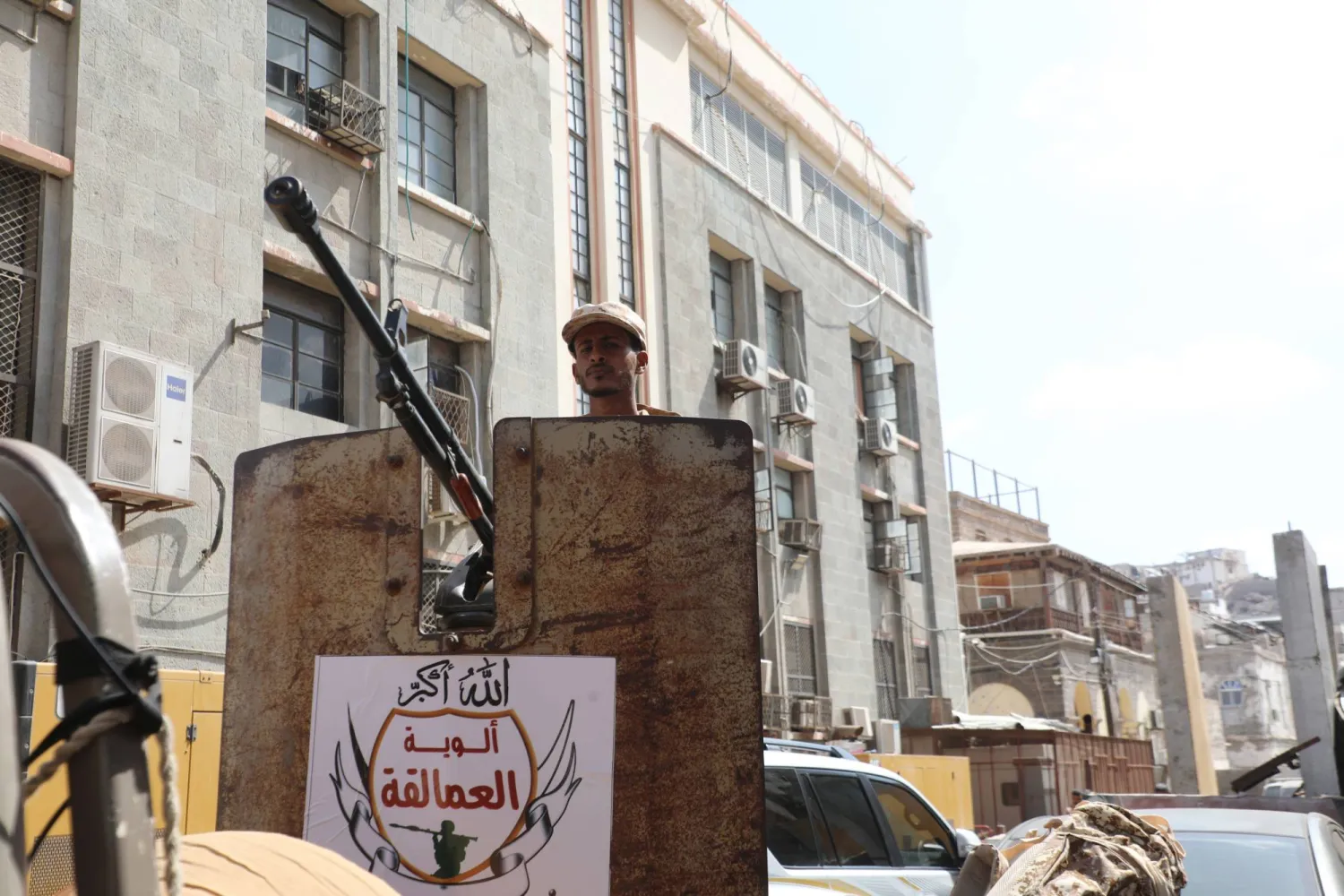
A member of Yemeni government forces mans a machine gun on a pick-up truck while on patrol outside the headquarters of the Central Bank of Yemen in the southern port city of Aden, Yemen, 08 January 2026. (EPA)
TT

Southern Transitional Council Dissolution Paves Way for Calm South Yemen Talks

A member of Yemeni government forces mans a machine gun on a pick-up truck while on patrol outside the headquarters of the Central Bank of Yemen in the southern port city of Aden, Yemen, 08 January 2026. (EPA)

As Yemen’s government, led by the Presidential Leadership Council, moves to consolidate military and security authority in the south under the defense and interior ministries, it is seeking to contain the fallout from recent turmoil, prevent a return to rebellion, and avert a slide back into violence.

At the same time, political and social forces across the south face mounting pressure to revive a stalled political process capable of delivering practical and equitable solutions to crises, foremost among them the southern issue.

Recent developments, foremost among them the dissolution of the Southern Transitional Council itself, which occurred days after its head, Aidrous al-Zubaidi, fled Yemen have brought about a shift in the political and security power balances.

They have opened the way for a phase marked by the absence of major divisions, allowing space for calm arrangements and dialogue, with focus on the southern issue, amid fears of renewed unrest.

While Zubaidi’s exit and the folding of the Southern Transitional Council mark the end of a project that lasted more than eight years before sliding into chaos and violence in recent weeks, the legitimate government and the Saudi-led Arab coalition have shown significant flexibility toward its leaders.

Atiq Bahuqayba, a leader in the Socialist Party in Hadhramaut, has called for the implementation of what Rashad al-Alimi, chairman of the Presidential Leadership Council, stated during his visit to Hadhramaut in mid-2023, when he promised that the province would manage its own affairs fully.

Flexible governance

No southern settlement can pass without Hadhramaut playing an active role and having the most prominent voice in shaping it, especially in light of the events and developments it has witnessed, which explains the intensified political and security activity there in recent weeks.

Bahuqayba told Asharq Al-Awsat that the Hadhramaut Tribes Alliance remains committed to self-rule for the province, describing it as one of the core demands of its residents and its various political and social forces.

He said recent events involving forces from outside the province nearly dragged it into security and military chaos, were it not for the firmness of presidential decisions and Saudi intervention.

He added that the southern dialogue conference called for by Riyadh carries major importance for Hadhramaut and the south at this sensitive juncture, requiring all Hadhrami forces to participate effectively, while aligning with the local authority led by Governor Salem al-Khanbashi and the commander of the Nation Shield Forces in the province.

Once again, following the dissolution of the Southern Transitional Council, the southern issue has been returned to the fore. It opens the door to tangible gains on the ground, provided there is southern leadership capable of managing reality rather than retreating into violent rhetoric.

Developments over the years in Yemen have shown that engaging seriously with southern demands is more effective than ignoring or confronting them. Flexible governance enables stability and prevents the opening of new fronts, without undermining calls for justice and fairness.

Ali al-Khawlani, a Yemeni academic and political researcher, told Asharq Al-Awsat that the opportunity is now available for political action away from unilateral actions, after recent events demonstrated that there would be no tolerance for attempts to divide Yemen or for practices that harm the national security of neighboring countries, particularly those resembling the behavior of the Houthi group, which required a forceful response.

Al-Khawlani, who heads the Independent Yemeni Center for Strategic Studies, said that the dissolution of the Southern Transitional Council, following its leaders' agreement to participate in a south-to-south dialogue, places all southern forces under the responsibility of participating in decision-making.

He warned against any adventurism that could harm regional security or involve cooperation with forces seeking to sow chaos and instability.

Promoting a model

Political and social forces in Hadhramaut have pushed toward formulating solutions that are more sustainable, rejecting both the dismantling of the Yemeni state and a full return to pre-war centralization.

This has been prompted by calls for self-administration in southern provinces, led by the country’s largest province.

Hadhramaut plays a pivotal role in the country’s future, both generally and in the south in particular, as the province that has seen more stability than others during the war, despite complex circumstances. It is also the most attractive to governance models that move away from rigid centralization.

Ahlam Jaber, a political activist in the city of Mukalla, expects the upcoming dialogue conference in Riyadh to lead to a reordering of the southern political landscape on fair foundations that recognize realities on the ground, with Hadhramaut playing an effective role.

Jaber told Asharq Al-Awsat that Hadhramaut represents a model that could extend to other provinces, not only in the south, but across Yemen.

This, she said, would help untangle long-standing challenges and adjust approaches to managing crises. She pointed to the presence of a local authority that represents the province, a tribal alliance with significant social and security influence, as well as social, economic, academic, and administrative figures capable of shaping visions and setting strategies.

The post-Southern Transitional Council phase does not represent a political vacuum, but a repositioning. Backed by the firmness of the legitimate authority and support from the Saudi-led coalition, the south is moving toward a phase of stability that awaits a political resolution and a comprehensive settlement without renewed security tensions.



Israel Announces Arrest of Prominent Jamaa Islamiya Member in Southern Lebanon

Smoke rises from the site of an Israeli airstrike that targeted a building in the southern Lebanese village of Ain Qana on February 2, 2026. (AFP)
TT

Israel Announces Arrest of Prominent Jamaa Islamiya Member in Southern Lebanon

Smoke rises from the site of an Israeli airstrike that targeted a building in the southern Lebanese village of Ain Qana on February 2, 2026. (AFP)

The Israeli army announced on Monday the arrest of a member of the Jamaa al-Islamiya group in Lebanon.

The military said a unit carried out a night operation in Jabal al-Rouss in southern Lebanon, arresting a “prominent” member of the group and taking him to Israel for investigation.

Israeli army spokesman Avichai Adree revealed that the operation took place based on intelligence gathered in recent weeks.

The military raided a building in the area where it discovered combat equipment, he added, while accusing the group of “encouraging terrorist attacks in Israel”.

He vowed that the Israeli army will “continue to work on removing any threat” against it.

Also on Monday, an Israeli drone struck a car in the southern Lebanese village of Yanouh, killing three people, including a child, Lebanon’s state-run National News Agency. 

Adree confirmed the strike, saying the army had targeted a Hezbollah member.

The Jamaa al-Islamiya slammed the Israeli operation, acknowledging on Monday the kidnapping of its official in the Hasbaya and Marjeyoun regions Atweh Atweh.

In a statement, the group said Israel abducted Atweh in an overnight operation where it “terrorized and beat up his family members.”

It held the Israeli army responsible for any harm that may happen to him, stressing that this was yet another daily violation committed by Israel against Lebanon.

“Was this act of piracy a response to Prime Minister Nawaf Salam’s tour of the South?” it asked, saying the operation was “aimed at terrorizing the people and encouraging them to leave their villages and land.”

The group called on the Lebanese state to pressure the sponsors of the ceasefire to work on releasing Atweh and all other Lebanese detainees held by Israel. It also called on it to protect the residents of the South.

Salam had toured the South over the weekend, pledging that the state will reimpose its authority in the South and kick off reconstruction efforts within weeks.

After the outbreak of the Israel-Hamas war in October 2023, the Jamaa al-Islamiya's Fajr Forces joined forces with Hezbollah, launching rockets across the border into Israel that it said were in support of Hamas in Gaza.

Hezbollah started attacking Israel on Oct. 8, 2023, a day after Hamas attacked southern Israel, triggering the latest Israel-Hamas war. Israel later launched a widespread bombardment of Lebanon that severely weakened Hezbollah, followed by a ground invasion.

The conflict ended with a US-brokered ceasefire in 2024, and since then, Israel has carried out almost daily airstrikes and ground incursions into Lebanon. Israel says it is carrying out the operations to remove Hezbollah strongholds and threats against Israel.

The Israel-Hezbollah war killed more than 4,000 people in Lebanon, including hundreds of civilians, and caused an estimated $11 billion in damage and destruction, according to the World Bank. In Israel, 127 people died, including 80 soldiers. 


Israel Says Killed Four Militants Exiting Tunnel in Gaza’s Rafah

Boys walk past the rubble of destroyed buildings in the Jabalia camp for Palestinian refugees in the northern Gaza Strip on February 8, 2026. (AFP)
TT

Israel Says Killed Four Militants Exiting Tunnel in Gaza’s Rafah

Boys walk past the rubble of destroyed buildings in the Jabalia camp for Palestinian refugees in the northern Gaza Strip on February 8, 2026. (AFP)

Israel's military said it killed four suspected militants who attacked its troops as the armed men emerged from a tunnel in southern Gaza on Monday, calling the group's actions a "blatant violation" of the ceasefire.

Despite a US-brokered truce entering its second phase last month, violence has continued in the Gaza Strip, with Israel and Hamas accusing each other of breaching the agreement.

"A short while ago, four armed terrorists exited an underground tunnel shaft and fired towards soldiers in the Rafah area in the southern Gaza Strip.... Following identification, the troops eliminated the terrorists," the military said in a statement.

It said none of its troops had been injured in the attack, which it called a "blatant violation of the ceasefire agreement" between Israel and Hamas.

Israeli troops "are continuing to operate in the area to locate and eliminate all the terrorists within the underground tunnel route", the military added.

Gaza health officials have said Israeli air strikes last Wednesday killed 24 people, with Israel's military saying the attacks were in response to one of its officers being wounded by enemy gunfire.

That wave of strikes came after Israel partly reopened the Rafah border crossing between Gaza and Egypt on February 2, the only gateway to the Palestinian territory that does not pass through Israel.

Israeli forces seized control of the crossing in May 2024 during the war with Hamas, and it had remained largely closed since.

Around 180 Palestinians have left the Gaza Strip since Rafah's limited reopening, according to officials in the territory.

Israel has so far restricted passage to patients and their accompanying relatives.

The second phase of the Gaza ceasefire foresees a demilitarization of the territory -- including the disarmament of Hamas -- along with a gradual withdrawal of Israeli forces.

Hamas has repeatedly said that disarmament is a red line, although it has indicated it could consider handing over its weapons to a future Palestinian governing authority.

Israeli officials say Hamas still has around 20,000 fighters and about 60,000 Kalashnikovs in Gaza.

A Palestinian technocratic committee has been set up with a goal of taking over day-to-day governance in the strip, but it remains unclear whether, or how, it will address the issue of demilitarization.


Building Collapse in Lebanon's Tripoli Kills 13, Search for Missing Continues

Rescue workers and residents search for survivors in the rubble of a building that collapsed in the northern city of Tripoli, Lebanon, Sunday, Feb. 8, 2026. (AP Photo)
TT

Building Collapse in Lebanon's Tripoli Kills 13, Search for Missing Continues

Rescue workers and residents search for survivors in the rubble of a building that collapsed in the northern city of Tripoli, Lebanon, Sunday, Feb. 8, 2026. (AP Photo)

The death toll from the collapse of a residential building in the Lebanese city of Tripoli rose to 13, as rescue teams continued to search for missing people beneath the rubble, Lebanon's National News ‌Agency reported ‌on Monday. 

Rescue ‌workers ⁠in the ‌northern city's Bab al-Tabbaneh neighborhood have also assisted nine survivors, while the search continued for others still believed to be trapped under the ⁠debris, NNA said. 

Officials said on ‌Sunday that two ‍adjoining ‍buildings had collapsed. 

Abdel Hamid Karameh, ‍head of Tripoli's municipal council, said he could not confirm how many people remained missing. Earlier, the head of Lebanon's civil defense rescue ⁠service said the two buildings were home to 22 residents, reported Reuters. 

A number of aging residential buildings have collapsed in Tripoli, Lebanon's second-largest city, in recent weeks, highlighting deteriorating infrastructure and years of neglect, state media reported, ‌citing municipal officials.