


Brew, Smell, and Serve: AI Steals the Show at CES 2026

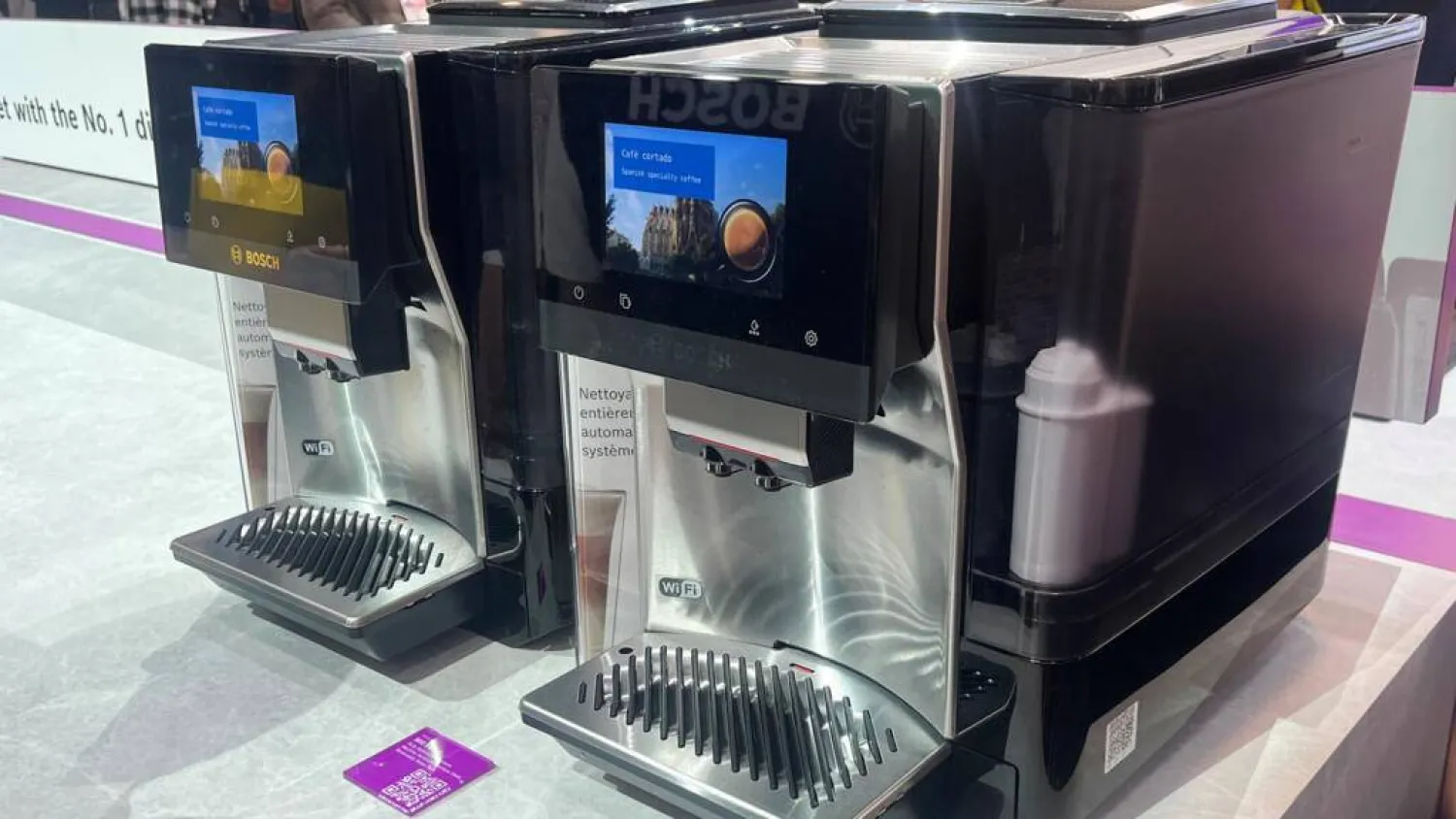
German group Bosch presented its fully automated 800 Series coffee machine (sold from $1,700) that can be synchronized with Amazon's Alexa voice assistant. Thomas URBAIN / AFP
TT

Brew, Smell, and Serve: AI Steals the Show at CES 2026

German group Bosch presented its fully automated 800 Series coffee machine (sold from $1,700) that can be synchronized with Amazon's Alexa voice assistant. Thomas URBAIN / AFP

AI took over CES 2026, powering coffee machines to brew the perfect espresso, a device to create your perfect scent, and ball-hitting tennis robots that make you forget it's human against machine.

Alexa, make me an espresso

German group Bosch presented a new feature for its fully automated 800 Series coffee machine (sold from $1,700) that can be synchronized with Amazon's Alexa voice assistant, said AFP.

After a short night's sleep, users can order a double espresso with voice commands only, and the coffee maker will deliver. Some 35 different espresso options are available.

"We're one of the first manufacturers to really lean in with AI," explained Andrew de Lara, spokesperson for Bosch.

The century-old company, positioned at the high end of the market in the United States, wants to gradually bring AI into the kitchen, notably through its Home Connect mobile app, which already allows users to control several appliances remotely.

Scent of AI

South Korean company DigitalScent has developed a machine, already available in some airports, that creates a personalized fragrance based on your mood and preferences.

Once you have picked your preferences, it releases a scent that gives you an idea of the final result. You can then make adjustments before making your final decision.

Once you have placed your order, the machine uses AI to produce a virtually unique fragrance in a matter of seconds, choosing from a range of over 1,150 combinations.

The fragrance is contained in a small, portable vial, costing $3 to $4, according to a spokesperson.

Game, set, AI

Several start-ups unveiled new-generation ball machines powered by artificial intelligence.

While Singapore-based Sharpa already offers a convincing humanoid table tennis robot with a reaction time of just two hundredths of a second, there is no equivalent on the market for tennis.

A few days ago, China's UBTech posted a video online of its Walker S2 robot playing rallies with a human, but at a slow speed and without any real movement.

UBTech's robots are designed for industrial use rather than tennis courts and, in all likelihood, the video was produced solely to demonstrate the agility of the Walker S2 to attract business customers.

While we wait for the humanoid robot that can volley at the net, another Chinese company, Tenniix, is marketing a robot that sends balls at speeds of up to 75 miles per hour (120.7 kilometers per hour).

It has 10 different shots, some with spin, and even a lob that reaches eight meters high.

The basic version, which can hold up to 100 balls, will set you back $699, but the most complete version, at $1,600, includes cameras and wheels that allow it to move around.

The fast-moving machine uses AI to analyze the trajectory of your cross-court forehand and fires off a ball from about where a real-life return shot would most likely come, giving the player the impression of a real rally.

"There's a real rhythm," says Run Kai Huang, spokesperson for Tenniix, "as if you were playing with a real person."



Russia Confirms Ban on WhatsApp, Says No Plans to Block Google

Men pose with smartphones in front of displayed Whatsapp logo in this illustration September 14, 2017. REUTERS/Dado Ruvic/File Photo
TT

Russia Confirms Ban on WhatsApp, Says No Plans to Block Google

Men pose with smartphones in front of displayed Whatsapp logo in this illustration September 14, 2017. REUTERS/Dado Ruvic/File Photo

Russia has blocked the popular messaging service WhatsApp over its failure to comply with local legislation, the Kremlin said Thursday, urging its 100 million Russian users to switch to a domestic alternative.

Moscow has for months been trying to shift Russian users onto Max, a domestic messaging service that lacks end-to-end encryption and that activists have called a potential tool for surveillance.

"As for the blocking of WhatsApp ... such a decision was indeed made and implemented," Kremlin spokesman Dmitry Peskov told reporters.

Peskov said the decision was due to WhatsApp's "reluctance to comply with the norms and letter of Russian law".

"Max is an accessible alternative, a developing messenger, a national messenger. And it is an alternative available on the market for citizens," he said.

Anton Gorelkin, a member of the Russian parliament and vice chair of its IT committee, said on Thursday that there were no plans to block Google in Russia.

WhatsApp, owned by US social media giant Meta, said Wednesday that it believed Russia was attempting to fully block the service in a bid to force users onto Max.

"We continue to do everything we can to keep users connected," it said.


Samsung Starts Mass Production of Next-gen AI Memory Chip

A man walks past the logo of Samsung Electronics displayed on a glass door at the company's Seocho building in Seoul on January 29, 2026. (Photo by Jung Yeon-je / AFP)
TT

Samsung Starts Mass Production of Next-gen AI Memory Chip

A man walks past the logo of Samsung Electronics displayed on a glass door at the company's Seocho building in Seoul on January 29, 2026. (Photo by Jung Yeon-je / AFP)

Samsung Electronics has started mass production of a next-generation memory chip to power artificial intelligence, the South Korean firm announced Thursday, touting an "industry-leading" breakthrough.

The high-bandwidth "HBM4" chips are a key component for AI data centers, with US tech giant Nvidia -- now the world's most valuable company -- widely expected to be one of Samsung's main customers.

Samsung said it had "begun mass production of its industry-leading HBM4 and has shipped commercial products to customers".

"This achievement marks a first in the industry, securing an early leadership position in the HBM4 market," AFP quoted it as saying in a statement.

A global frenzy to build AI data centers has sent orders for advanced, high-bandwidth memory microchips soaring.

South Korea's two chip giants, SK hynix and Samsung, have been racing to start HBM4 production.

Taipei-based research firm TrendForce predicts that memory chip industry revenue will surge to a global peak of more than $840 billion in 2027.

The South Korean government has pledged to become one of the world's top three AI powers, alongside the United States and China.

Samsung and SK hynix are among the leading producers of high-performance memory chips.


Siemens Energy Trebles Profit as AI Boosts Power Demand

FILED - 05 August 2025, Berlin: The "Siemens Energy" logo can be seen in the entrance area of the company. Photo: Britta Pedersen/dpa
TT

Siemens Energy Trebles Profit as AI Boosts Power Demand

FILED - 05 August 2025, Berlin: The "Siemens Energy" logo can be seen in the entrance area of the company. Photo: Britta Pedersen/dpa

German turbine maker Siemens Energy said Wednesday that its quarterly profits had almost tripled as the firm gains from surging demand for electricity driven by the artificial intelligence boom.

The company's gas turbines are used to generate electricity for data centers that provide computing power for AI, and have been in hot demand as US tech giants like OpenAI and Meta rapidly build more of the sites.

Net profit in the group's fiscal first quarter, to end-December, climbed to 746 million euros ($889 million) from 252 million euros a year earlier.

Orders -- an indicator of future sales -- increased by a third to 17.6 billion euros.

The company's shares rose over five percent in Frankfurt trading, putting the stock up about a quarter since the start of the year and making it the best performer to date in Germany's blue-chip DAX index.

"Siemens Energy ticked all of the major boxes that investors were looking for with these results," Morgan Stanley analysts wrote in a note, adding that the company's gas turbine orders were "exceptionally strong".

US data center electricity consumption is projected to more than triple by 2035, according to the International Energy Agency, and already accounts for six to eight percent of US electricity use.

Asked about rising orders on an earnings call, Siemens Energy CEO Christian Bruch said he thought the first-quarter figures were not "particularly strong" and that further growth could be expected.

"Demand for gas turbines is extremely high," he said. "We're talking about 2029 and 2030 for delivery dates."

Siemens Energy, spun out of the broader Siemens group in 2020, said last week that it would spend $1 billion expanding its US operations, including a new equipment plant in Mississippi as part of wider plans that would create 1,500 jobs.

Its shares have increased over tenfold since 2023, when the German government had to provide the firm with credit guarantees after quality problems at its wind-turbine unit.