

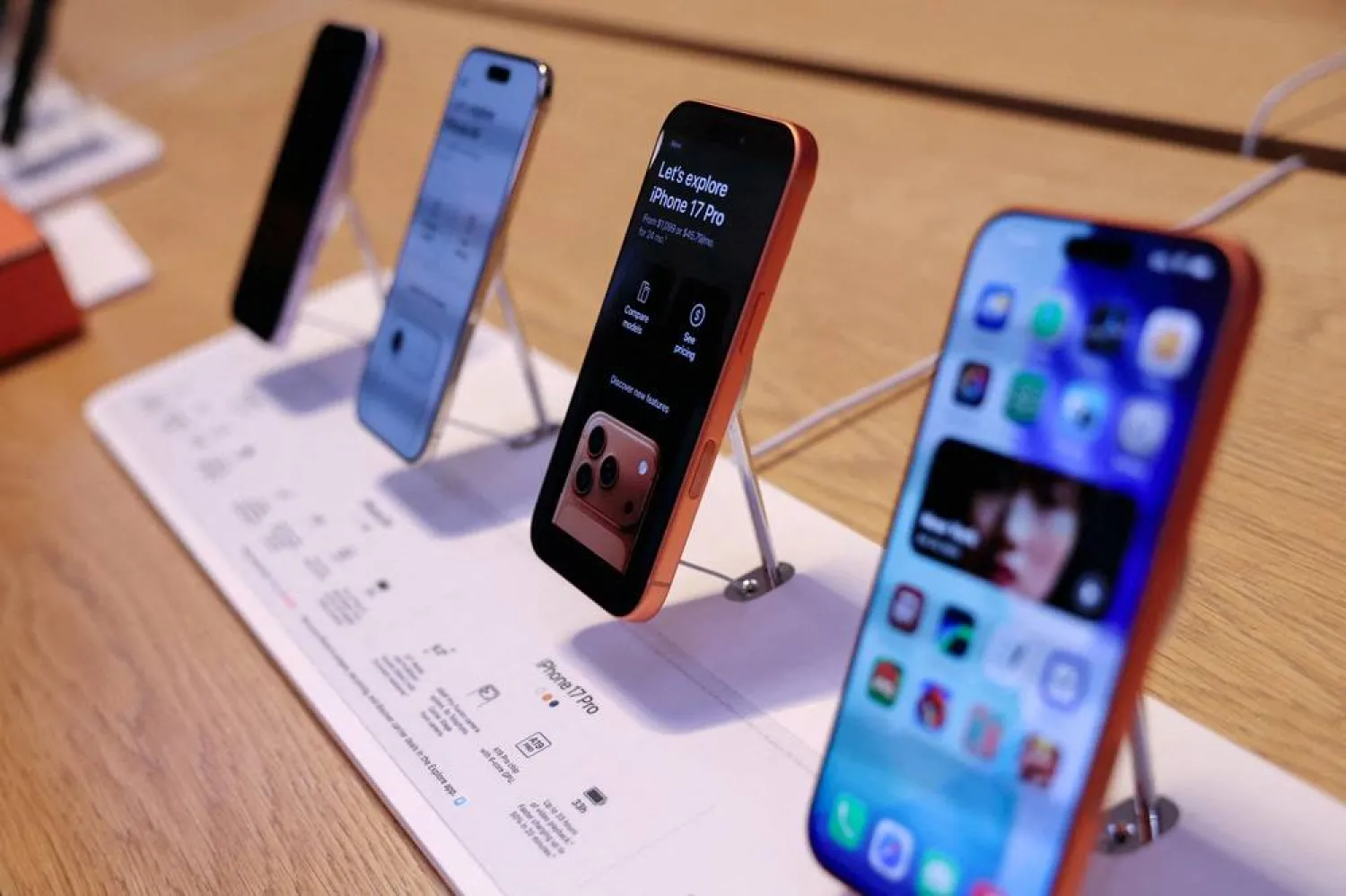

Global Smartphone Market Faces Record Annual Decline as Chip Crunch Worsens

The iPhone 17 series on display at the Apple Store in New York City, US, September 19, 2025. (Reuters)
TT

Global Smartphone Market Faces Record Annual Decline as Chip Crunch Worsens

The iPhone 17 series on display at the Apple Store in New York City, US, September 19, 2025. (Reuters)

The global smartphone market is heading for its steepest annual contraction on record, with shipments projected to slump by 13.9% this year to 1.08 billion units, Counterpoint Research said on Monday, citing a worsening shortage of memory chips.

The forecast is a downgrade from the 12.4% decline projected in February, with the squeeze in global chip supply exacerbated by the Iran war.

IMPACT MOST ACUTE AT BUDGET END OF MARKET

The impact is being felt most acutely in lower-end smartphones as ‌chipmakers shift ‌production capacity to AI-related chips, making entry-level devices less ‌economical ⁠to produce.

Global smartphone wholesale ⁠prices rose 14% in the first quarter while shipments fell 3.1% year on year. That trend is expected to continue as inventory built before the supply shock becomes depleted, with some models priced below $150 likely to disappear from the market.

"Smartphone makers in the low and mid-tier are caught between cost increases they cannot absorb and consumers with limited spending power," said Wang ⁠Yang, a principal analyst at Counterpoint, an independent research ‌company that publishes quarterly smartphone shipment data.

"The ‌question is no longer how to grow shipments or market share, but whether ‌to remain in the market at all."

The memory chip shortage ‌is the most severe supply-side disruption the smartphone industry has faced, Wang said, adding that manufacturers are unable to offset the impact through pricing or product changes.

PREMIUM END OF THE MARKET MORE RESILIENT

The premium segment has proven more resilient. Apple posted ‌record revenue for the first three months of the year, helped by customers upgrading to its iPhone ⁠17 series. ⁠Apple's 2026 shipments are expected to remain flat before rising 5% next year, Counterpoint projections show.

With more stable chip supply and stronger margins than many rivals, Apple is well placed to gain market share and could face less pressure to raise prices.

Samsung Electronics kept volumes steady in the first quarter and is expected by Counterpoint to register only a 4% decline in shipments over the full year, outperforming the wider market thanks to stable supply and a consistent product line-up.

Transsion, which is heavily exposed to the market for smartphones priced below $150, is forecast to suffer a 32% drop in shipments this year. Rivals Xiaomi and Honor, meanwhile, are projected to post full-year declines of 28% and 20% respectively, Counterpoint said.



How Some Venezuelans’ Smartphones Warned of Quake

A man searches for survivors in the rubble of a collapsed building following twin earthquakes in Caraballeda, La Guaira State, some 40 km northeast of Caracas, on June 25, 2026. (AFP)
TT

How Some Venezuelans’ Smartphones Warned of Quake

A man searches for survivors in the rubble of a collapsed building following twin earthquakes in Caraballeda, La Guaira State, some 40 km northeast of Caracas, on June 25, 2026. (AFP)

Many social media users in Venezuela have reported receiving alerts on Android smartphones moments before Wednesday's quake with almost 600 confirmed dead.

Google's Android and Apple's iOS, both include the option to display government alerts for emergencies like earthquakes.

But the search giant last year also detailed its system that uses the billions of Android smartphones worldwide to detect earthquakes in the first place.

- How it works -

Almost all smartphones contain an accelerometer, a movement sensor used for tasks like flipping the screen when users turn it sideways.

That same sensor "can also detect the ground shaking from an earthquake," Google wrote in a July 2025 blog post.

Accelerometers can spot potential earthquakes' fast-moving initial "P" wave, sending information about the tremor to a Google server.

By rapidly cross-referencing many such reports, the system can "confirm that an earthquake is happening and estimate its location and magnitude," Google said.

"The goal is to warn as many people as possible before the slower, more damaging S-wave of an earthquake reaches them".

Google offers two stages of alerts.

"BeAware" warns of weaker tremors, while for the heaviest quakes, "TakeAction" takes over the screen and plays a loud sound even when the phone is on silent mode.

- How effective is the system? -

Google said last year that its systems had already sent 790 million alerts to individual phones, warning of over 2,000 potentially dangerous earthquakes detected from April 2021.

While that gives many more people than before access to early warning information, there have been hiccups.

Android phones failed to sound warnings ahead of devastating February 2023 earthquakes that killed almost 60,000 people across Türkiye and Syria.

Google said last year that it has since updated its algorithms to avoid a repeat.

The company also apologized in February 2025 for a false alarm sent to some Android users in Brazil.

This week in Venezuela, hundreds of people have posted praise for Google on X, with some including unverified videos of alerts prompting people to leave buildings.

- What about Apple? -

Beyond government warnings, Apple says on its website that users in the US and Taiwan can also receive alerts from other "alert originators" about earthquakes.

The company did not respond to AFP's questions about how that system works by time of publication.

Neither has the iPhone giant enlisted its users' phones for a distributed detection system like Google's.

The hundreds of millions of iPhones around the globe are, however, able to forward alerts they receive to other nearby Apple devices that do not have mobile reception or a WiFi connection -- potentially helping life-saving warnings to get through.


Reports: Samsung to Unveil Record $650 Bn South Korea Investment amid AI Boom

FILE PHOTO: A Samsung Electronics semiconductor plant in Pyeongtaek, South Korea, May 21, 2026. REUTERS/Kim Hong-Ji/File Photo
TT

Reports: Samsung to Unveil Record $650 Bn South Korea Investment amid AI Boom

FILE PHOTO: A Samsung Electronics semiconductor plant in Pyeongtaek, South Korea, May 21, 2026. REUTERS/Kim Hong-Ji/File Photo

South Korea's Samsung Electronics is expected to announce a record domestic investment plan next week, according to local media reports, in a massive bet on AI-driven semiconductor demand.

The 1,000 trillion won ($650 billion) package, to be announced by the chip giant and the government, is in line with President Lee Jae Myung's agenda for development in regions outside of the capital Seoul.

Lee will host a "National Mega Project" briefing on Monday, where Samsung will unveil major long-term investment plans, the reports said.

Rival chipmaker SK hynix is also expected to announce spending plans at the same event.

Both companies are top producers of advanced memory chips used in the data centers that train and run artificial intelligence tools like chatbots and image generators.

The AI boom has sent the firms' profits and share prices skyrocketing, with Samsung recently agreeing a bonus deal with its workers' union to avert a major strike.

The Samsung investment package is expected to include about 300 trillion won for a new semiconductor complex in southwest South Korea -- one of the regions that has fallen behind the capital in tech investment.

Some 60 trillion won would likely be earmarked for six chip manufacturing plants at Yongin in the south, and more than 350 trillion won for AI infrastructure including data centers, according to Maeil Business Newspaper.

The proposed 10-year spending package would be the largest investment commitment ever announced by a South Korean company, AFP reported.

Lee met Samsung chairman Lee Jae-yong in Seoul this week to discuss semiconductor investments, according to news reports.

The president also reportedly met SK Group Chairman Chey Tae-won last week.

Samsung Electronics last year posted an operating profit of 43.6 trillion won -- a 33 percent increase year-on-year.

The company is projected to achieve an operating profit in the mid-to-high 300 trillion won range this year, and 550 trillion won next year.

Kim Yong-beom, the presidential chief of staff for policy, said Wednesday that discussions on the planned semiconductor project in Yongin were in their final stages.

"Once everything is confirmed, we plan to bring together the companies and relevant ministries to explain the plan to the public at once," Kim said.


Meta to ‘Asharq Al-Awsat’: Messaging Apps Are Saudi Arabia’s New Digital Services Gateway

Success is measured by response speed, accurate resolutions and lower costs, not message volume alone. (Reuters)
TT

Meta to ‘Asharq Al-Awsat’: Messaging Apps Are Saudi Arabia’s New Digital Services Gateway

Success is measured by response speed, accurate resolutions and lower costs, not message volume alone. (Reuters)

Saudi Arabia’s vast digital base is positioning messaging apps to move beyond communication and become full-service channels.

Internet penetration in the kingdom has reached 99%, while nine in 10 Saudi adults use WhatsApp daily, according to data cited in a report prepared by BCG.

That daily use is not limited to personal chats. It gives companies and government agencies a ready platform to deliver services inside a single window, from search and inquiry to placing requests, resolving problems and following up.

In an exclusive interview with Asharq Al-Awsat, Fares Akkad, Meta’s regional director for the Middle East and Africa, said messaging is becoming central to Saudi Arabia’s next phase of digital transformation.

“It is evolving from a communication tool into a space where the full journey happens, from finding and using a service to resolving a problem, all within one conversation,” he said.

Plans show scale of shift

The BCG report says 84% of institutions in Saudi Arabia plan to invest in rich messaging technologies over the next five years, putting them ahead of traditional channels such as SMS and email.

Rich messaging moves services beyond one-way alerts. Users can ask a question, receive an answer, request a service, complete a procedure and return to the same conversation when needed, without losing the context of the exchange.

Akkad said the shift reflects a clear change in user expectations. People now expect interaction that is immediate, personal and continuous, rather than moving between call centers, websites and separate apps.

“Legacy systems that rely on one-way messages, call centers with long waiting times and separate channels where context is lost at every transition create friction felt by both sides,” he said.

The trend is not limited to Saudi Arabia. Globally, 72% of internet-connected adults prefer messaging as a primary way to communicate with companies, while 79% contact a company through messages at least once a week.

More than alerts

The core change is the move from using messaging to send notifications to using it as a main service channel.

An organization no longer simply sends a confirmation or update. It lets the user complete the action inside the same conversation.

Akkad said the change goes deeper than communication habits because it affects how services are designed and how people reach them.

“This reflects a structural change in how services are delivered and how interaction is designed across companies, ministries and national platforms,” he said.

In government services, messaging can reduce the need to learn new portals or navigate multiple systems, especially when services are delivered through an app citizens already use and understand.

Akkad said familiar channels “reduce the learning curve and lower barriers to access,” especially for users who may struggle with new portals or systems.

AI handles scale and context

Messaging provides the channel. Artificial intelligence makes it scalable.

AI allows large volumes of conversations to be managed around the clock, while helping systems understand the intent behind a question, provide an answer or escalate the case when needed.

The data shows that 80% of decision-makers believe AI agents will change how customers are engaged.

In practice, those agents can understand user intent, answer frequent questions instantly, provide information in Arabic and English, and refer more complex cases to human employees.

Akkad told Asharq Al-Awsat: “AI manages scale, from routine inquiries and multilingual responses to round-the-clock availability, while human employees remain at the center of cases that require judgment, sensitivity or personal interaction.”

That view aligns with a Digital Government Authority study that described “AI agents as partners to government.” Conversational agents can act as frontline digital employees, answering basic questions immediately and referring cases that need specialist intervention.

But the human role remains essential, Akkad said. Human expertise is still needed in complex situations, in decisions that require judgment and in interactions that cannot be reduced to an automated answer.

More than one billion conversations a day

Global figures show how quickly commercial interaction is moving into messaging apps.

Akkad said more than one million companies currently use Meta Business Agent to respond to customers around the clock.

He said “more than one billion active conversations take place daily between businesses and customers across WhatsApp, Messenger and Instagram,” a sign of growing reliance on these platforms as direct channels for interaction and service delivery.

Akkad said the trend is no longer just about directing a question to the right employee. It is about delivering a more personalized experience from the first moment.

“The vision is for every company to be able to show up for every customer as if it had an unlimited team behind it,” he said.

That scale is changing how institutions view messaging apps. Instead of treating them as an extra channel alongside phone and email, they are becoming part of the operating infrastructure that receives requests, processes them and measures results.

Saudi Post’s SPL as an example

Saudi Post’s SPL shows what messaging can achieve when used at scale.

As e-commerce grew and pressure on traditional channels increased, the organization moved to a model led by message-based interaction.

Today, 90% of customer inquiries are resolved inside the messaging channel. Call center waiting times have fallen by 50%, and operating costs have dropped by 75%.

Akkad said the gains did not come from adding a new channel to an old system. They came from redesigning the entire customer journey.

“The SPL experience shows what can be achieved at national scale, not inside a limited pilot project, but in live, high-usage operations serving the Saudi public,” he told Asharq Al-Awsat.

The figures also show that lower costs and better service do not have to move in opposite directions. In this case, operational pressure fell while answers became faster, information more accurate and the experience simpler for users.

Value lies in outcomes

The success of messaging cannot be measured only by the number of conversations or the speed of the first response. Institutions need to connect the channel to clear operational and business outcomes.

Akkad proposed measuring performance across three levels.

The first is user experience, including response speed, accuracy of resolution and satisfaction levels. The second is operational performance, such as lower costs and the share of inquiries fully resolved inside the channel. The third is commercial or institutional performance.

BCG data shows that institutions using multiple messaging use cases generate 2.1 times higher customer lifetime value and 1.5 times better customer acquisition efficiency.

Akkad said “the most important measurement is the one that links messaging directly to outcomes rather than activity.”

That means asking whether the channel reduces calls, shortens the steps needed to complete a service, improves customer retention and lowers the cost of each transaction or inquiry.

Five capabilities for successful scaling

The BCG report identified five capabilities institutions need to move from limited use cases to integrated service delivery through messaging.

The first is treating messaging as a core service channel and choosing use cases that deliver direct value.

The second is data and technology readiness. An AI agent cannot give accurate answers if information is outdated or scattered across systems that do not connect.

The third is an operating model that allows technology, customer service, marketing and operations teams to work together.

The fourth is partnerships between technology providers, platforms and service operators.

The fifth is a clear measurement framework that links messaging performance to satisfaction, efficiency and growth.

Akkad said these capabilities “will determine which public and private institutions lead the next phase of digital transformation.”

The risk of unready data

AI-backed messaging projects can fail when they are treated as a more advanced version of SMS.

Akkad said using the channel for one-way alerts is not a full strategy. The main value lies in continuous two-way dialogue and in keeping the user in one context from the start of the journey to the end.

The second risk is deploying AI tools before preparing the data they rely on.

If the system cannot access accurate and updated information, it will give weak or incorrect answers, damaging trust.

“If the system cannot show accurate and updated information, the experience is damaged, and this affects trust in ways that are difficult to recover from,” he said.

The third mistake is underestimating partnerships. Delivering conversational service at scale requires coordination between the platform, solution providers and the service provider, as well as the teams managing data, operations and experience.

The Saudi market is moving from having the channel available to redesigning services around it. The success of that shift will depend on how well institutions connect conversations to data, operations and measurement, rather than simply adding another window for communication.