
Mohammad Mahdi Shamseddine to Shiites: Integrate Into Your States

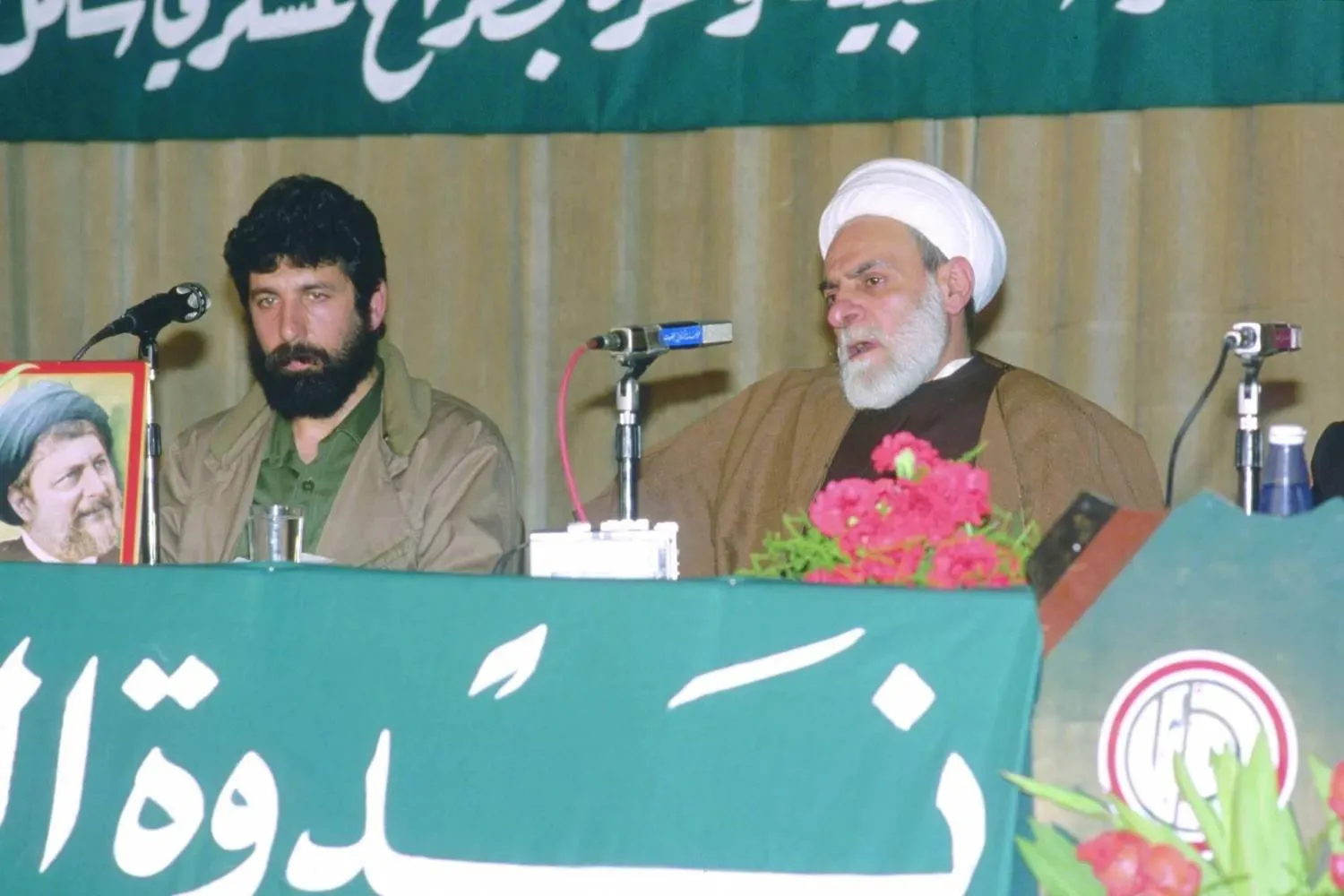
Sheikh Mohammad Mahdi Shamseddine during an event with Amal Movement military commander Akel Hamiyeh (Getty). 
TT

Mohammad Mahdi Shamseddine to Shiites: Integrate Into Your States

Sheikh Mohammad Mahdi Shamseddine during an event with Amal Movement military commander Akel Hamiyeh (Getty). 

Asharq Al-Awsat begins publishing an extended text in the form of a dialogue held in 1997 between the late Sheikh Mohammad Mahdi Shamseddine, then head of Lebanon’s Higher Islamic Shiite Council, and figures close to Hezbollah’s milieu.

The text is of exceptional importance, as it addresses the situation of Shiites in their countries and the need for them to integrate into their states rather than become part of a project subordinate to Iran.

As is well known, Shamseddine was marginalized for many years by supporters of Hezbollah and the Amal Movement. He was displaced from Haret Hreik in Beirut’s southern suburbs and lived outside it because of positions that conflicted with those of Iran-aligned forces in Lebanon.

The dialogue is scheduled to be published by Ibrahim Mohammad Mahdi Shamseddine, the cleric’s son, in a book titled Lebanese Shiites and Arab Shiites: The Relationship with Others and the Relationship with the Self. Asharq Al-Awsat is publishing lengthy excerpts from the text on the occasion of the 25th anniversary of the Lebanese Shiite cleric’s death, which falls today, Saturday, January 10.

Ibrahim Shamseddine: Why now?

Ibrahim Shamseddine introduces the publication with a preface explaining why he chose to reveal the contents of the dialogue after all these years. He writes that he decided to publish the text marking 25 years since his father’s passing in order to honor him, revive his thought, and recall his deep insight, courage and firmness in expressing what he believed to be the truth — truth that safeguards people and preserves the nation and the state for all.

Central to this vision, he notes, was placing the unity of the national political community above any particularism, without exception, including that of Lebanese Shiites and Arab Shiites, who are part of the broader national, Arab and Islamic collectives.

The text is the outcome of a dialogue session, preserved on audio recordings, lasting more than four hours on the night of Tuesday, March 18, 1997. It brought together Sheikh Shamseddine and a large group of cadres from the “Islamic movement” in Lebanon, closely linked to the party-based Shiite political current that emerged in the mid-1980s under direct and sustained Iranian sponsorship.

Ibrahim Shamseddine explains that he was especially motivated to publish this previously unpublished text because it addresses highly sensitive and contentious issues — particularly relations between Lebanese Shiites and their fellow citizens, their national framework, their Arab and Islamic surroundings, and, most notably, their relationship with Iran.

He adds that these same issues remain at the heart of today’s debates, charged with urgency and tension, and continue to interact with shifting regional and global geopolitical dynamics. For this reason, he argues that the document is not a relic of the past but a living text that speaks directly to a volatile and uncertain present. The full text, with an expanded summary, will later be published in the aforementioned book.

Lebanese Shiites and Arab Shiites

The dialogue opens with a question from one of the young participants, who tells Shamseddine that he had long been regarded as a leading figure of the Islamist movement, but that over time a distance had emerged between him and part of its base. The questioner suggests this may be due to Shamseddine’s position and proximity to official authority, and asks whether he now speaks in the name of state necessities or the choices of the people.

Shamseddine replies that he remains in his original position, unchanged “by even a hair’s breadth,” but rather deeper, broader and more mature. What some perceive as distance, he insists, did not originate from him but from certain clerics and those influenced by them, driven by a purely partisan spirit he describes as almost idolatrous. Barriers were erected, through suspicion or inducement, leaving him personally surprised by developments he had not planned.

He speaks of hidden maneuvering rooted in the pursuit of status and influence, noting that such dynamics have existed within Shiism since the era of the infallible imams. He recounts how the Lebanese Union of Muslim Students, which he helped establish and nurture, was later taken out of his hands, eventually aligning with partisan currents that later fed into Hezbollah. He stresses that many were innocent or misled, while responsibility for others he leaves to divine judgment.

Shamseddine affirms that assuming the presidency of the Higher Islamic Shiite Council did not alter his religious understanding or commitments formed since the 1950s. He reiterates his well-known formulation distinguishing between “the necessities of regimes and the choices of Al-Umma (the community),” stressing that the council has always expressed the latter. Disagreement over whether a given stance falls under necessity or choice, he says, is legitimate.

He laments deliberate distortions portraying him and the council as aligned with the state, exploiting Shiite sensitivities toward authority. While a few acted knowingly, he says the majority were misled. He declares that he harbors no personal grievance, leaving judgment to God.

The relationship with regimes

Responding to a question about the cordiality shown during his visits to Arab states and whether it served the interest of avoiding escalation, Shamseddine dismisses the premise. Affection, he says, is natural and mutual among Muslims, whether in Egypt, Saudi Arabia, the Gulf, India or Pakistan. He notes that during his visits he met governments and oppositions alike, including Islamist groups critical of their own states.

He rejects the suggestion that cordiality implies submission, stressing that shared causes, above all the broader Islamic cause and opposition to the Zionist project, create common ground and understanding.

Shamseddine then addresses what he calls a deep-seated Shiite psychological complex: the belief of being universally rejected. While acknowledging that Shiites do face hostility at times, he argues that the deeper problem is self-isolation rooted in a siege mentality cultivated through poor social and political upbringing. This mindset, he says, has been cynically exploited by some Shiite leaders, particularly after the rise of Islamist movements, to mobilize followers without ethical restraint.

He adds that conflict is not unique to Shiites. Sunnis fight Sunnis in Algeria, Sudan and Afghanistan, just as Shiites have fought Shiites in Iraq and Lebanon. Social struggle, he says, is a universal reality.

“Integrate into your states”

Shamseddine then lays out his central message. His overriding concern, he says, is for the blood, dignity, freedom and honor of Shiites. To protect these, Shiites must be accepted within their homelands and not perceived as a threat or contagion.

“I say this openly,” he declares. “Integrate into your states. Integrate into your societies. Integrate into your systems of shared interests. Do not create a separate system of interests. Do not arouse suspicion. Respect your laws.”

He insists this position is grounded in firm religious conviction, stressing that stealing public funds is forbidden regardless of whether a state is Sunni or Shiite. He argues that acceptance should come from being a constructive citizen, not from acting as a proxy or protected extension of another state.

Shamseddine warns against behavior that seeks to intimidate others through transnational partisan threats, recounting instances where individuals exploited partisan affiliations to evade accountability abroad. Such conduct, he says, ultimately harms the broader Shiite community.

He concludes that his mission is to make Shiites accepted within their societies and the wider Islamic world, accepted as they are, in their religious practices and traditions. Portraying Shiites as a distinct, abnormal case within Islam, he argues, is both false and dangerous. He says that his religious and intellectual duty is to pull Shiites out of this predicament, a task he believes he had already achieved to a significant extent.

Below are some of the key issues addressed by Shamseddine in the dialogue, revealed for the first time:

• When you do not threaten others’ system of interests with your own, few people will stand in your way.

• I say: integrate into your states, integrate into your societies, integrate into your systems of interests. Do not create a separate system of interests. Do not arouse the suspicions of others. Respect your laws.

• My message is to make Shiites acceptable within their societies and within the wider Muslim community. I want them to be accepted in their own right, not because they represent a “protectorate” of another state, meaning to be accepted because Iran protects me.

• The secret group that was formed in Egypt as the nucleus of a party or grouping, including that wretched creature “Shehata” and others like him, does not concern us, whether they are sincere or charlatans.

• The psychological complex among Shiites, that they are ostracized, stems from the fact that they themselves ostracize others. The world is not against us. We are against the world. One of the tasks of my mission is to remove Shiites from a posture of being against the world.

• If Iran is building a party for itself in Egypt and wants to build work upon it, that is not my business. Iran manages its own affairs.

• Shiites make up one-fifth of Muslims compared with four-fifths. My role is to create a state of friendship between them and their societies, far from any political sectarianism.

• I am not speaking only about Arab Shiites. Shiites in Türkiye or Azerbaijan belong to Türkiye and Azerbaijan, not to Iran. Shiites in the Indian subcontinent belong to their homelands, ethnicities and peoples. Iran represents neither a political nor a religious authority for them.

• It is impermissible for there to be a separate project for Shiites within their homelands.

• What interest do Shiites have in killing the emir of Kuwait? Why do we conspire against this or that regime or official? Managing Shiite affairs begins with integration.

• I moved into besieged Beirut in 1982 and said: Shiites will not leave Beirut. Their glory and dignity lie in being besieged alongside Sunnis and Palestinians inside it.

• Shiites are not in danger. If there is any danger to them, it comes from themselves, not from others.

• Had I wanted to flatter the Iranians, I would have mentioned them, praised and lauded them, and you would then have heard applause from Iran and Hezbollah.

• The state cannot deal with secret systems of interests, as some are trying to create here or elsewhere.

• Shiites have no interest, regionally or nationally, in establishing a separate system of interests and linking it to Iran.

• Shiite strength lies in integrating into the body of Islam, not in becoming a special community affiliated with Iranians.

• I call for citizenship without deceit. If one of the turbaned pretenders issues a fatwa saying that stealing the property of a Sunni or a Christian is permissible, absolutely not. This is forbidden.

• The concept of an unjust system or an unjust ruler no longer exists. The modern state has legitimate ownership. We issue religious rulings forbidding the embezzlement of public funds, the betrayal of laws and the undermining of public order.


Axios: US Plans Meeting for Gaza 'Board of Peace' in Washington on Feb 19

Trump and leaders and representatives of the countries participating in the signing of the founding charter of the “Peace Council” in Davos (AFP - Archive)
TT

Axios: US Plans Meeting for Gaza 'Board of Peace' in Washington on Feb 19

Trump and leaders and representatives of the countries participating in the signing of the founding charter of the “Peace Council” in Davos (AFP - Archive)

The White House is planning the first leaders meeting for President Donald Trump's so-called "Board of Peace" in relation to Gaza on February 19, Axios reported on Friday, citing a US official and diplomats from four countries that are on the board.

The plans for the meeting, which would also be a fundraising conference for Gaza reconstruction, are in early stages and could still change, Axios reported.

The meeting is planned to be held at the US Institute of Peace in Washington, the report added, noting that Israeli Prime ‌Minister Benjamin Netanyahu ‌is scheduled to meet Trump at the ‌White ⁠House on ‌February 18, a day before the planned meeting.

The White House and the US State Department did not respond to requests for comment.

In late January, Trump launched the board that he will chair and which he says will aim to resolve global conflicts, leading to many experts being concerned that such a board could undermine the United Nations, Reuters said.

Governments around ⁠the world have reacted cautiously to Trump's invitation to join that initiative. While some ‌of Washington's Middle Eastern allies have joined, many ‍of its traditional Western allies have ‍thus far stayed away.

A UN Security Council resolution, adopted in ‍mid-November, authorized the board and countries working with it to establish an international stabilization force in Gaza, where a fragile ceasefire began in October under a Trump plan on which Israel and Palestinian militant group Hamas signed off.

Under Trump's Gaza plan revealed late last year, the board was meant to supervise Gaza's temporary governance. Trump thereafter said ⁠it would be expanded to tackle global conflicts.

Many rights experts say that Trump overseeing a board to supervise a foreign territory's affairs resembled a colonial structure and have criticized the board for not including a Palestinian.

The fragile ceasefire in Gaza has been repeatedly violated, with over 550 Palestinians and four Israeli soldiers reported killed since the truce began in October.

Israel's assault on Gaza since late 2023 has killed over 71,000 Palestinians, caused a hunger crisis and internally displaced Gaza's entire population.

Multiple rights experts, scholars and a UN inquiry say it amounts to genocide. Israel calls its actions self-defense after Hamas-led ‌militants killed 1,200 people and took over 250 hostages in a late 2023 attack.


A Man Detonates Explosive Belt during Arrest Attempt in Iraq, Injuring 2 Security Members

A man wearing an explosives belt blew himself up Friday while a security force was trying to arrest him in western Iraq near the Syrian border, killing himself and wounding two security members, an Iraqi security official said. (Reuters/File)
TT

A Man Detonates Explosive Belt during Arrest Attempt in Iraq, Injuring 2 Security Members

A man wearing an explosives belt blew himself up Friday while a security force was trying to arrest him in western Iraq near the Syrian border, killing himself and wounding two security members, an Iraqi security official said. (Reuters/File)

A man wearing an explosives belt blew himself up Friday while a security force was trying to arrest him in western Iraq near the Syrian border, killing himself and wounding two security members, an Iraqi security official said.

The raid was being conducted in the al-Khaseem area in Qaim district that borders Syria, said the official who spoke on condition of anonymity in line with regulations.

The official added that “preliminary information” confirms that no members of the security forces were killed, while two personnel were injured and transferred for medical treatment, The Associated Press said.

Iraq’s National Security Agency said in a statement that its members besieged a hideout of an ISIS group security official and two of his bodyguards. One bodyguard ignited his explosives belt, killing him. It gave no further details.

ISIS once controlled large parts of Syria and Iraq and declared a caliphate in 2014. The extremist group was defeated on the battlefield in Iraq in 2017 and in Syria in 2019 but its sleeper cells still carry out deadly attacks in both countries.

In December, two US service members and an American civilian were killed in an attack in Syria that the United States blamed on ISIS. The US carried out strikes on Syria days later in retaliation.

US and Iraqi authorities in January began transferring hundreds of the nearly 9,000 ISIS members held in jails run by the US-backed and Kurdish-led Syrian Democratic Forces in northeast Syria to Iraq, where Iraqi authorities plan to prosecute them.


UN Peacekeepers in Lebanon Allege Surge in Israeli Violence toward Them

United Nations Spanish UNIFIL forces arrive to inspect chalets, after the Israeli army reportedly booby-trapped and blew them up at dawn, on the outskirts of the town of al-Khiam, southern Lebanon on January 31, 2026. (Photo by Rabih DAHER / AFP)
TT

UN Peacekeepers in Lebanon Allege Surge in Israeli Violence toward Them

United Nations Spanish UNIFIL forces arrive to inspect chalets, after the Israeli army reportedly booby-trapped and blew them up at dawn, on the outskirts of the town of al-Khiam, southern Lebanon on January 31, 2026. (Photo by Rabih DAHER / AFP)

UN peacekeepers patrolling southern Lebanon have faced a dramatic surge of “aggressive behavior” by Israeli forces over the last year, including drone-dropped grenades and machine-gun fire, according to an internal report seen by The Associated Press.

The report by one of the 48 nations that together have more than 7,500 peacekeepers in southern Lebanon says the number of incidents jumped from just one in January to 27 in December. The hilly frontier zone where the UNIFIL force patrols has seen decades of cross-border violence. Israel and Lebanon's Hezbollah militants fought a full-scale war in 2024.

The targeting of peacekeepers appears aimed at undermining the international force and strengthening Israel’s military footprint along the UN-drawn border with Lebanon, known as the Blue Line, the report alleges. It was shared with AP on condition that the news organization not identify the country whose peacekeepers compiled the findings for internal use by their senior command.

Israel has long mistrusted UNIFIL, accusing it of failing to prevent Hezbollah from building up its military presence along the border in violation of ceasefire agreements going back two decades.

The growing catalog of run-ins comes as a half-century of international peacekeeping efforts along the border face an uncertain future. UNIFIL’s mission is scheduled to end this year and US President Donald Trump ’s administration regards it as a waste of money.

Israel says it tries to reduce harm

In a statement to AP, the Israeli military said it “is not conducting a deterrence campaign against UNIFIL forces" and is working within accepted frameworks to dismantle Hezbollah, largely based in southern Lebanon.

The military “takes steps to reduce harm to UNIFIL forces and other international actors operating in the area,” it said.

UNIFIL said in a statement that “the number of attacks on or near peacekeepers, as well as aggressive behavior toward peacekeepers, have increased since September 2025,” with most of those incidents attributed to the Israeli military.

“The majority of incidents do not involve physical harm to peacekeepers, but any action that interferes with our mandated activities is a matter of concern,” it said.

The UN force has reported additional incidents this year. An Israeli tank opened fire with small-caliber bullets on a UNIFIL post on Jan. 16, it said. This week, it reported that a drone dropped a stun grenade that exploded in the vicinity of a peacekeeping patrol before flying toward Israeli territory.

Report details array of incidents

The report seen by AP details multiple instances in 2025 of grenades being dropped by Israeli drones near UNIFIL patrols, including an attack in October that wounded a peacekeeper, as well as machine-gun fire near UNIFIL positions. In some cases, UNIFIL vehicles were damaged.

The last four months of 2025 also saw a surge in incidents of direct fire at all targets from Israeli positions on both sides of the Blue Line, the report says. Such incidents spiked to 77 in December, up from just two in January, it says.

UNIFIL vehicles and positions are clearly marked as belonging to the UN, and Hezbollah militants have not maintained a visible presence or fired on Israeli forces in recent months.

The report says “it cannot be excluded” that Israel is using the incidents to maintain a military presence north of the border and prevent people who have fled the zone from returning.

Israel-Hezbollah conflict

After the Oct. 7, 2023, Hamas -led attack on Israel that triggered war in Gaza, Hezbollah began firing rockets from Lebanon into Israel in support of Hamas and the Palestinians.

Israel responded with airstrikes and shelling. The low-level conflict escalated into full-scale war in September 2024, later reined in but not fully stopped by a US-brokered ceasefire two months later.

Since then, Israel has accused Hezbollah of trying to rebuild in the south, in violation of the ceasefire, and has carried out near-daily strikes in Lebanon that it says target Hezbollah militants and facilities. Israeli forces also continue to occupy five hilltop points on the Lebanese side of the border. Hezbollah has claimed one strike against Israel since the ceasefire.

Spraying of chemicals spurs an outcry

The UN and Lebanon say Israeli forces dropped herbicide on Lebanese territory on Sunday, forcing a more than nine-hour pause in peacekeeping activities, including patrols.

“The use of herbicides raises questions about the effects on local agricultural lands, and how this might impact the return of civilians to their homes and livelihoods in the long-term,” UN spokesperson Stéphane Dujarric said. There was no Israeli comment.

Dujarric added that “any activity” by the Israeli military north of the Blue Line violates a UN resolution adopted in 2006 that expanded the UNIFIL mission, in hopes of restoring peace to the area after a monthlong war between Israel and Hezbollah.

Uncertain future for border area UNIFIL was created nearly five decades ago to oversee Israel's withdrawal from southern Lebanon after its troops invaded in 1978.

The UN Security Council voted last August to terminate its mission at the end of 2026.

Israel had long sought an end to its mandate, saying UNIFIL failed to keep Hezbollah away from the border. Under the 2006 UN ceasefire, the Lebanese army was supposed to maintain security in the south with backing from UNIFIL and militants were to disarm.

Hezbollah supporters in Lebanon have frequently accused UNIFIL of collusion with Israel and have sometimes attacked its patrols.

The Lebanese government says UNIFIL serves a necessary purpose. Prime Minister Nawaf Salam said in December that Lebanon will need a follow-up force to fill the vacuum and to help Lebanese troops along the border as they expand their presence there.

In an AP interview this week, Lebanese Deputy Prime Minister Tarek Mitri said several proposals are under discussion.

One possibility is an expansion of the United Nations Truce Supervision Organization, or UNTSO, which maintains a small observer force in Lebanon. The European Union has also offered to contribute to an international observer force, he said.

Whatever the arrangement, Mitri said: “We need a neutral, internationally mandated force to observe and make sure that whatever is agreed upon in negotiations is fully respected."