


Deaths from Iran Protests Reach More than 500

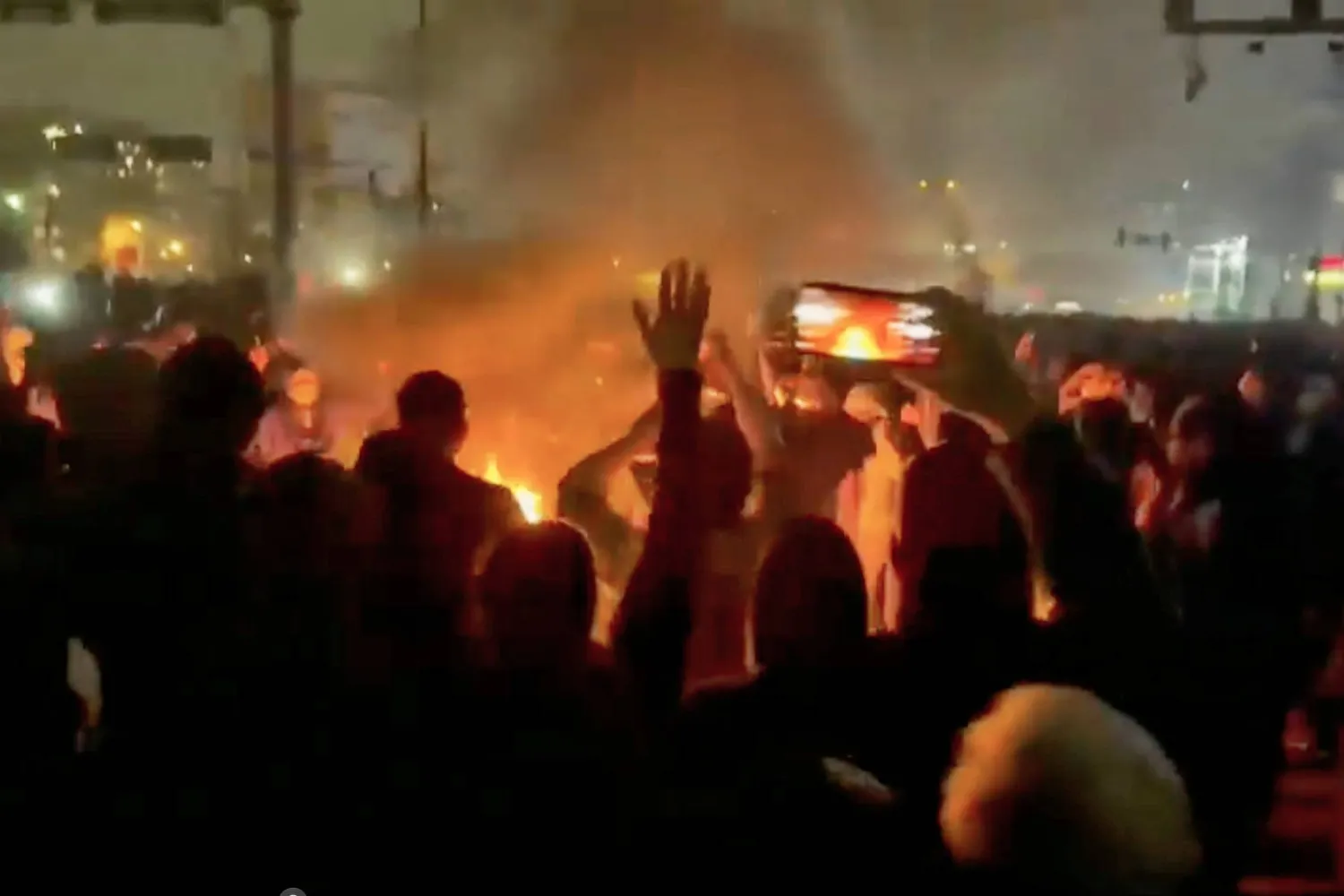
In this frame grab from footage circulating on social media shows protesters dancing and cheering around a bonfire as they take to the streets despite an intensifying crackdown as the Iranian Republic remains cut off from the rest of the world, in Tehran, Iran, Friday, Jan. 9, 2026.(UGC via AP)
TT

Deaths from Iran Protests Reach More than 500

In this frame grab from footage circulating on social media shows protesters dancing and cheering around a bonfire as they take to the streets despite an intensifying crackdown as the Iranian Republic remains cut off from the rest of the world, in Tehran, Iran, Friday, Jan. 9, 2026.(UGC via AP)

Unrest in Iran has killed more than 500 people, a rights group said on Sunday, as Tehran threatened to target US military bases if President Donald Trump carries out his renewed threats to intervene on behalf of protesters. 

With Iran’s clerical establishment facing the biggest demonstrations since 2022, Trump has repeatedly threatened to get involved if force is used on protesters. 

According to its latest figures - from activists inside and outside Iran - US-based rights group HRANA said it had verified the deaths of 490 protesters and 48 security personnel, with more than 10,600 people arrested in two weeks of unrest. 

Iran has not given an official toll and Reuters was unable to independently verify the tallies. 

Trump was to meet with senior advisers on Tuesday to discuss options for Iran, a US official told Reuters on Sunday. The Wall Street Journal had reported that options included military strikes, using secret cyber weapons, widening sanctions and providing online help to anti-government sources. 

"The military is looking at it, and we're looking at some very strong options," Trump told reporters travelling on Air Force One on Sunday night. 

Trump said he was in contact with Iranian opposition leaders. He also said, without elaborating, that Iran's leaders had called him on Saturday and want to negotiate, and that he might talk to them. 

Iranian Parliament Speaker Mohammad Baqer Qalibaf warned Washington against "a miscalculation." 

"Let us be clear: in the case of an attack on Iran, the occupied territories (Israel) as well as all US bases and ships will be our legitimate target," said Qalibaf, a former commander in Iran's elite Revolutionary Guards. 

AUTHORITIES ‌INTENSIFY CRACKDOWN The protests began ‌on December 28 in response to soaring prices, before turning against the clerical rulers who have governed since the 1979 Iranian ‌Revolution. 

Iranian ⁠authorities accused the US and ‌Israel of fomenting trouble and called for a nationwide rally on Monday to condemn "terrorist actions led by the United States and Israel," state media reported. The flow of information from Iran has been hampered by an internet blackout since Thursday. Trump said on Sunday he would talk to Elon Musk about restoring internet access in Iran through his Starlink satellite service. 

Footage posted on social media on Saturday from Tehran showed large crowds marching at night, clapping and chanting. The crowd "has no end nor beginning," a man is heard saying. 

Footage from the northeastern city of Mashhad showed smoke billowing into the night sky from fires in the street, masked protesters and a road strewn with debris, another video posted on Saturday showed. Explosions could be heard. 

Reuters verified the locations. 

State TV showed dozens of body bags on the ground at the Tehran coroner's office, saying the dead were victims of events caused by "armed terrorists", as well as footage of loved ones gathered outside the Kahrizak Forensic Medical Center in Tehran waiting to identify bodies. 

UN Secretary-General Antonio Guterres said he was shocked by ⁠reports of violence by the Iranian authorities and urged maximum restraint. "The rights to freedom of expression, association & peaceful assembly must be fully respected & protected," he said on X. 

Authorities on Sunday declared three days of national mourning "in honor of martyrs killed in resistance against the United States ‌and the Zionist regime," according to state media. 

Three Israeli sources, who were present for Israeli security consultations over the weekend, ‍said Israel was on a high-alert footing for the possibility of any US intervention. Israel and ‍Iran fought a 12-day war in June 2025, which the United States briefly joined by attacking nuclear installations. Iran retaliated by firing missiles at Israel and an American air base in Qatar. 

'RIOTERS ‍AND TERRORISTS' While Iranian authorities have weathered previous protests, the latest have unfolded with Tehran still recovering from last year's war and with its regional position weakened by blows to allies such as Lebanon's Hezbollah since the October 7, 2023 Hamas-led attacks against Israel. Iran's unrest comes as Trump flexes US muscles internationally, having ousted Venezuelan President Nicolas Maduro, and discussing acquiring Greenland by purchase or force. 

Iranian President Masoud Pezeshkian said Israel and the US was masterminding destabilization and that Iran's enemies had brought in "terrorists ... who set mosques on fire ... attack banks, and public properties". 

"Families, I ask you: do not allow your young children to join rioters and terrorists who behead people and kill others," he said in a TV interview, adding that the government was ready to listen to the people and to resolve economic problems. 

Iran summoned Britain’s ambassador on Sunday to the foreign ministry over “interventionist comments” attributed to the British foreign minister and a protester removing the Iranian flag from the London Embassy building and replacing it ⁠with a style of flag used prior to the 1979 Iranian Revolution. 

Britain's foreign office did not immediately reply to a request for comment. 

Alan Eyre, a former US diplomat and Iran expert, thought it unlikely the protests would topple the establishment. 

"I think it more likely that it puts these protests down eventually, but emerges from the process far weaker," he told Reuters, noting that Iran's elite still appeared cohesive and there was no organized opposition. 

Iranian state TV broadcast funeral processions in western cities such as Gachsaran and Yasuj for security personnel killed in protests. 

State TV said 30 members of the security forces would be buried in the central city of Isfahan and that six more were killed by "rioters" in Kermanshah in the west. 

US READY TO HELP, SAYS TRUMP 

Trump, posting on social media on Saturday, said: "Iran is looking at FREEDOM, perhaps like never before. The USA stands ready to help!!!" 

In a phone call on Saturday, Israeli Prime Minister Benjamin Netanyahu and US Secretary of State Marco Rubio discussed the possibility of US intervention in Iran, according to an Israeli source present for the conversation. 

Some protesters in the United States took to the streets in support of the demonstrators in Iran. In the Los Angeles neighborhood of Westwood, a rental truck drove into a crowd of a few hundred people who were holding a rally in support of the Iranian protesters, the KNBC news outlet reported on Sunday. 

Los Angeles Police officer Sean Murray said that, based on video news accounts, the driver was escorted away by police. Murray said it was not clear how many people were injured, but that all of the injured were treated at the scene. 

Reza Pahlavi, the exiled son of Iran's last shah ‌and a prominent voice in the fragmented opposition, said Trump had observed Iranians' "indescribable bravery". "Do not abandon the streets," Pahlavi, who is based in the US, wrote on X.   


Trump Pressures NATO, China over Iran's Closure of Key Waterway

FILE PHOTO: Tankers sail in the Gulf, near the Strait of Hormuz, as seen from northern Ras al-Khaimah, near the border with Oman’s Musandam governance, amid the US-Israeli conflict with Iran, in United Arab Emirates, March 11, 2026. REUTERS/Stringer//File Photo
TT

Trump Pressures NATO, China over Iran's Closure of Key Waterway

FILE PHOTO: Tankers sail in the Gulf, near the Strait of Hormuz, as seen from northern Ras al-Khaimah, near the border with Oman’s Musandam governance, amid the US-Israeli conflict with Iran, in United Arab Emirates, March 11, 2026. REUTERS/Stringer//File Photo

President Donald Trump urged NATO partners and China to help reopen the Strait of Hormuz, the critical conduit for crude that Iran has effectively closed, as major economic players began releasing oil reserves on Monday to ward off supply disruptions.

Global oil prices have surged by 40 to 50 percent after Iran choked off the waterway and attacked energy and shipping industry targets in the Gulf in retaliation for the US-Israeli war against the Iranian republic.

Crude prices were hovering around $100 on Monday as the Middle East war entered its third week, with Israel saying it still has "thousands of targets in Iran", where it was also "identifying new targets every day".

Trump said the United States was in discussions with Iran but that Tehran was not ready for a deal to end the war, although the Iranian republic's foreign minister had earlier denied any talks with Washington.

"I don't think they're ready. But they are getting pretty close," Trump said.

The US president had called on countries including China, France, Japan, South Korea and Britain at the weekend to send ships to escort tankers through the strait.

"It's only appropriate that people who are the beneficiaries of the strait will help to make sure that nothing bad happens there," Trump told the Financial Times on Sunday. Unlike the United States, Europe and China are heavily dependent on the Gulf for oil imports.

Trump threatened to delay a planned summit with Chinese leader Xi Jinping later this month if Beijing does not assist with reopening the strait.

He also warned that no response or a negative reply to his request would be "very bad for the future of NATO".

But Tokyo and Canberra both said they were not planning deployments.

- Iran warning -

Trump's comments came after Iran warned other countries against getting involved in the war, which has spread across the Middle East.

In a phone conversation with his French counterpart Jean-Noel Barrot, Tehran's top diplomat Abbas Araghchi called on other countries to "refrain from any action that could lead to escalation and expansion of the conflict".

Arguing that the US security umbrella in the region was "inviting rather than deterring trouble", Araghchi on X urged neighboring countries "to expel foreign aggressors".

Iran has launched waves of attacks on countries in the Middle East that host US forces, and Italy's military said a drone attack at Ali Al Salem airbase in Kuwait -- which hosts both US and Italian forces -- destroyed an unmanned aircraft belonging to Italy but caused no casualties.

Italy's foreign minister, Antonio Tajani, sought to play down the attack -- the second on an Italian base in the Middle East this week -- insisting: "We are not at war with anyone."

Iraqi authorities meanwhile said rockets wounded five people at Baghdad's airport, which houses a US diplomatic facility, while Iran's Revolutionary Guards said about 700 missiles and 3,600 drones had been fired at US and Israeli targets so far.

Saudi Arabia intercepted more than 60 drones since midnight, according to a tally of defense ministry figures released on Monday, while Dubai airport suspended flights briefly after a "drone-related incident" sparked a fire nearby.

And French President Emmanuel Macron told Iran's President Masoud Pezeshkian it was "unacceptable" to target French interests after an Iranian-designed drone killed a French soldier in Iraq's Kurdistan region.

The war has also spread to Lebanon, where Israel launched a new strike on Beirut's southern suburbs late on Sunday.

- Energy markets -

On the economic front, the International Energy Agency said members will begin releasing 400 million barrels of oil from their strategic reserves, with Asia Oceania nations to make stocks available immediately, and Europe and the Americas follow in the weeks to come.

Japan, which depends on the Middle East for 95 percent of its oil imports, said Monday in a notice in its official government gazette that the level of oil reserves in the country "is being lowered".

The issuance of the notice compels managers of oil reserves to release part of their stockpile to meet the new standard.

The blockade of Hormuz has been felt across the globe, with Australia officials urging the public against price-gouging and panic buying as prices soar, while India restaurants were forced to adapt their menus to save cooking gas.

On the outskirts of Sydney, landscaper Emma Futterleib, who drives up to 500 km a week, told AFP "there's definitely some penny pinching going on".

"It hurts the budget, that's for sure," she said, adding she was "trying to be a bit careful on how much we are spending on groceries."

In Tehran, some residents sought to restore some normalcy at the weekend compared to the start of the war on February 28.

Traffic was busier than last week and some cafes and restaurants had reopened, as had more than a third of stalls in the Tajrish bazaar, a popular shopping hub, with Nowruz, the Persian New Year, just days away.

Some shoppers queued at ATMs to withdraw cash. Online operations at Bank Melli, one of the country's largest, had been paralyzed in recent days.

It was a similar story outside the capital. In an interview from Tonekabon, a city in Mazandaran province on the Caspian Sea, 49-year-old Ali told AFP that shops were open and crowded despite steep price rises.

"Only the main square is closed every night, and government demonstrations take place," he said, adding that only Iran's domestic intranet was working, without outside connections.

More than 1,200 people have been killed by US and Israeli strikes, according to Iranian health ministry figures that could not be independently verified.

The UN refugee agency says up to 3.2 million people have been displaced in Iran.


War-Related Oil Squeeze a ‘Short-Term Pain,’ US Official Insists

 A customer fuels up with regular gasoline priced at $5.29 at a Chevron gas station in Bellevue, Wash., Friday, March 13, 2026. (AP)
A customer fuels up with regular gasoline priced at $5.29 at a Chevron gas station in Bellevue, Wash., Friday, March 13, 2026. (AP)
TT

War-Related Oil Squeeze a ‘Short-Term Pain,’ US Official Insists

 A customer fuels up with regular gasoline priced at $5.29 at a Chevron gas station in Bellevue, Wash., Friday, March 13, 2026. (AP)
A customer fuels up with regular gasoline priced at $5.29 at a Chevron gas station in Bellevue, Wash., Friday, March 13, 2026. (AP)

President Donald Trump's top energy official said Sunday that Americans will have to endure the "short-term pain" of higher prices at the pump as US forces conduct their war against Iran.

Now in the third week of a multi-dimensional Middle East conflict that has seen US and Israeli forces pound Iran's military targets, and Tehran responding with missile and drone attacks against several neighboring states, global energy prices have soared.

And concern has swelled that a lengthy blockage by Iran of the critical Strait of Hormuz could send crude prices through the roof.

"President Trump needed to act now... to stop the killing of American soldiers, to stop the destabilization of the region, and to end Iran's ability to threaten energy markets," US Energy Secretary Chris Wright told ABC News talk show "This Week."

He said economic conditions would grow dramatically worse without the ongoing military operation "to defang the Iranian regime" and ensure it can no longer threaten the world with nuclear weapons.

"This is short-term pain to get through to a much better place where the Middle East can no longer be held hostage by the one rogue nation in Iran," Wright added.

The energy secretary also said he predicted the war could end "in the next few weeks, and we'll see a rebound in (fuel) supplies and a pushing down of prices after that."

Since the war began, gas prices have soared in the United States, where Trump in 2024 campaigned relentlessly on a vow to lower fuel costs for Americans. The issue is a critical one for US voters, who head to the polls in November for the country's mid-term congressional elections.

Gas prices have jumped 25 percent in the past month, to $3.70 per gallon, according to the American Automobile Association.

The Trump administration has stressed other governments should help in a possible effort to unblock the Strait of Hormuz by escorting tankers through the narrow waterway along Iran's coast.

US Transportation Secretary Sean Duffy, speaking on Fox News "Sunday Morning Futures," said oil could soon flow through the strait if such escorts -- and shipping insurance -- are worked out.

"Could be a day, could be a week," Duffy said of possible escorts.


Israel Says ‘No Interceptor Shortage’ After Reports of Scarcity as Iranian Missiles Injure at Least 8

15 March 2027, Israel, Tel Aviv: People watch the site of a projectile impact following an Iranian strike on Tel Aviv. (dpa)
TT

Israel Says ‘No Interceptor Shortage’ After Reports of Scarcity as Iranian Missiles Injure at Least 8

15 March 2027, Israel, Tel Aviv: People watch the site of a projectile impact following an Iranian strike on Tel Aviv. (dpa)

An Israeli military source on Sunday denied media reports that Israel was running low on missile interceptors crucial to its air defenses, adding that the army was "continuously monitoring the situation". 

Citing US officials, news outlet Semafor had reported that Israel had informed the United States that it was "running critically low on ballistic missile interceptors", as the US-Israeli war against Iran entered its third week. 

"As of now, there is no interceptor shortage. The Israeli army is prepared for prolonged combat. We are continuously monitoring the situation," the military source said, in response to media queries. 

Israeli Foreign Minister Gideon Saar also dismissed the reports when questioned by journalists earlier on Sunday. 

At least eight people were injured in Israel Sunday following repeated missile launches from Iran, at least two of which contained cluster munitions according to Israeli authorities. 

Israeli police released footage from a CCTV camera in the Tel Aviv area showing an impact on a road, saying that it was from "cluster munitions" that caused "damage at several locations". 

Bomblets and shrapnel from the missile wounded four people in various parts of the Tel Aviv metropolitan area, according to the Magen David Adom (MDA) rescue service. 

A man in his 60s was hospitalized with moderate injuries to his head from broken glass, while three were treated due to the shock waves from the blast. 

In another barrage shortly before noon, two men aged 62 and 44 reported minor injuries "from pieces of asphalt that struck them as a result of the blast", according to MDA. 

During a salvo toward the Tel Aviv area at around 3:00 am (0100 GMT), a man and a woman in their 80s suffered light injuries, from glass shards and smoke inhalation respectively. 

Another Iranian missile directed at Israel's southernmost city of Eilat was intercepted before reaching the target, without causing injuries. The municipality of Eilat quoted security sources saying it was a cluster missile. 

By late midday on Sunday, seven missile salvos were launched from Iran toward the State of Israel, some of which were intercepted. 

Saar on Sunday accused Iran of targeting civilian areas, during a visit to the northern Arab Israeli town of Zarzir, hit two days prior by shrapnel from an Iranian missile that lightly wounded almost 60 residents. 

"While we are targeting military objectives... the Iranian regime is targeting civilians," Saar said. 

"All the casualties we faced during these two weeks of confrontation... are civilians from Iranian missiles. This is of course a war crime," he added. 

His words were echoed by police superintendent Shlomi Schlezinger while speaking near the site of one of the impacts on Sunday. 

Iran is "always targeting crowded places, with people, the big major cities," he said in central Tel Aviv. 

He attributed the relatively low number of Israeli casualties to civilians' adherence to safety instructions. 

"We have a lot of collateral damage to cars and buildings, as you can see," he said. 

"We're used to, in the last 16 days, to be in shelters and in safe rooms when we have the alarm." 

According to Haaretz, citing security officials, 250 ballistic missiles had been fired by Iran at Israel as of March 13. 

Twelve people have been killed in Israel by missiles or falling debris since the start of the war, according to an AFP tally of figures given by Israeli authorities and first responders.
