

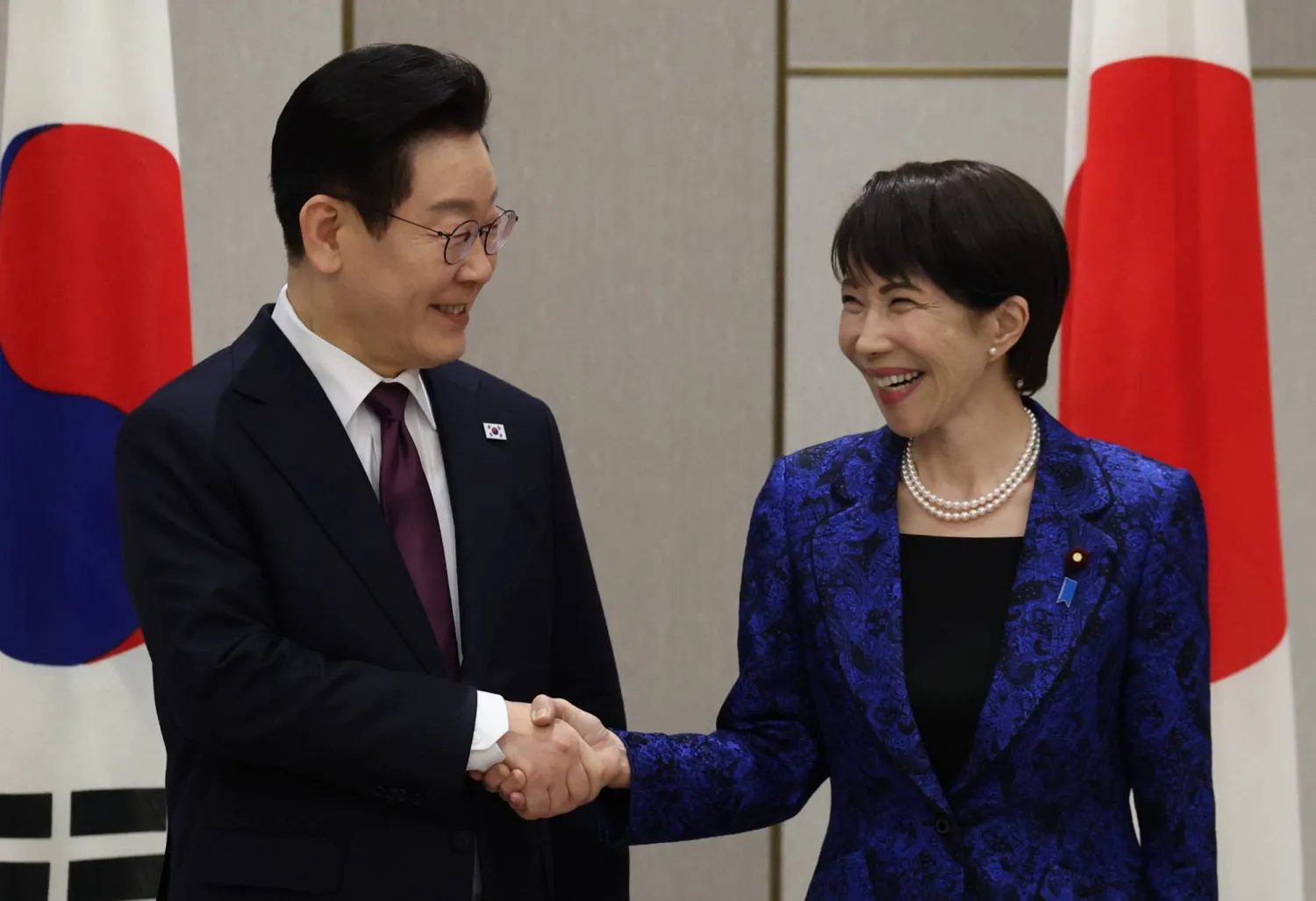

Leaders of Japan and South Korea Discuss Economy and Regional Challenges at Summit

13 January 2026, Japan, Nara: Japan's Prime Minister Sanae Takaichi shakes hands with South Korea's President Lee Jae Myung at the start of their summit meeting in Nara. (dpa)
TT

Leaders of Japan and South Korea Discuss Economy and Regional Challenges at Summit

13 January 2026, Japan, Nara: Japan's Prime Minister Sanae Takaichi shakes hands with South Korea's President Lee Jae Myung at the start of their summit meeting in Nara. (dpa)

South Korean President Lee Jae Myung and Japanese Prime Minister Sanae Takaichi agreed to step up cooperation between the neighbors, whose relations are occasionally strained, as they both face growing uncertainty and regional challenges.

"I believe cooperation between Korea and Japan is now more important than ever and anything else, as we have to continue moving forward to a new, better future amid this complex, unstable international order," Lee said at the outset of the summit Tuesday.

Takaichi said she renewed her determination to further improve Japan's relations with South Korea “as I believe the two countries should cooperate and contribute for the stability in the region.”

“This year I will elevate Japan-South Korea relations even higher," said Takaichi, who aims to secure stable ties with Seoul while Tokyo struggles with a worsening dispute with China.

The meeting could deliver a political win as Takaichi seeks to shore up her power. A few months after taking office, she enjoys strong approval ratings but her party has a majority in only one of two houses of Parliament. There is growing speculation she may be planning a snap election in hopes of gaining more seats.

Takaichi is hosting Lee in her hometown, Nara, an ancient capital known for its treasured deer and centuries-old Buddhist temples, following a request by Lee during the October APEC meeting in Gyeongju, South Korea.

Nara, the center of cultural exchanges between the Korean Peninsula and Japan in ancient times, “carries a special meaning at a time Korea-Japan exchanges are more important than ever," Lee said.

Takaichi was in Nara on Monday to prepare and posted on X: “I hope to further push forward Japan’s relations with South Korea in the forward-looking way as we meet in the ancient capital of Nara with more than 1,300 years of history and longstanding cultural exchanges between Japan and the Korean Peninsula.”

The Japanese prime minister faces intensifying trade and political tension with China over a remark about Taiwan that angered Beijing days after she took office. Takaichi said that potential Chinese military action against Taiwan, the island democracy Beijing claims as its own, could justify Japanese intervention.

Tuesday's meeting was intended to focus on trade and the challenges of China and North Korea, as well as efforts to deepen trust between the two countries.

Japan and South Korea, both key US allies, must also figure out how to deal with President Donald Trump’s unpredictable diplomacy, and both countries are under US pressure to increase defense spending.

Lee was in Beijing last week for talks with Chinese leader Xi Jinping as China steps up economic and political pressure against Japan and seeks to cozy up to Seoul. During the visit, the South Korean leader told reporters that relations with Japan are as important as those with China but that South Korea's ability to broker reconciliation between its neighbors is limited.

Lee, in an interview Monday with Japan’s NHK television, noted his interest in gaining Japanese backing for South Korea's participation the 12-member Comprehensive and Progressive Agreement for Trans-Pacific Partnership. He said that would involve South Korea lifting a ban on imports from Fukushima and nearby Japanese prefectures affected by the 2011 Fukushima Daiichi nuclear disaster and may take time because of health concerns among South Koreans.

Lee also said his country wants to cooperate with Japan on security under a trilateral framework that includes the US, but “what’s really important is the issue of deep mutual trust.”

Relations between Seoul and Tokyo have begun improving in recent years in the face of shared challenges such as growing China-US competition and North Korea’s advancing nuclear program.

There were early concerns about Takaichi's ability to work with Lee, fed by her reputation as a security hawk and an assumption by some that the left-wing South Korean leader would tilt toward North Korea and China. But so far, both leaders have sought to set aside their differences.

While the two leaders are expected to avoid discussing their historical disputes, media reports say they may discuss possible humanitarian cooperation in the ongoing effort to recover remains from a former undersea mining site in western Japan where 180 workers, mostly Korean forced laborers, were killed in a 1942 accident.



UN Rights Office Says Hundreds Killed in Iran Protests

This video grab taken on January 13, 2026 from UGC images posted on social media on January 10, 2026 shows clashes in Mashhad, in northeastern Iran. (UGC/AFP)
TT

UN Rights Office Says Hundreds Killed in Iran Protests

This video grab taken on January 13, 2026 from UGC images posted on social media on January 10, 2026 shows clashes in Mashhad, in northeastern Iran. (UGC/AFP)

The UN human rights chief said on ​Tuesday that he was "horrified" by mounting violence by Iran's security forces against peaceful protesters, with the UN citing its own sources as saying that hundreds have been killed so far.

The country's clerical authorities are ‌facing the biggest ‌demonstrations since 2022 ‌and ⁠on ​Sunday ‌a rights group said that unrest has killed more than 500 people. An Iranian official indicated on Tuesday it was higher, at around 2,000.

"This cycle of horrific violence cannot continue. The Iranian people and ⁠their demands for fairness, equality and justice must ‌be heard," UN High ‍Commissioner for ‍Human Rights Volker Turk said in a ‍statement read out by UN rights office spokesperson Jeremy Laurence.

Asked to comment on the scale of the killings, Laurence, citing ​the United Nations' sources in Iran, said: "The number that we're hearing is ⁠hundreds."

Turk also voiced concern that the death penalty might be used against thousands of protesters who have been arrested.

The unrest has prompted US President Donald Trump to reissue threats to intervene militarily on behalf of Iran's protesters.

"There's concern that (the protests) have been instrumentalized, and they shouldn't be instrumentalized by anyone," ‌said Laurence on a possible US intervention.


Russia Strikes Power Plant, Kills Four in Ukraine Barrage

Ukrainian rescuers work at the site of a Russian strike on a residential area a day before, in Kharkiv, northeastern Ukraine, 03 January 2026, amid the Russian invasion. EPA/SERGEY KOZLOV
TT

Russia Strikes Power Plant, Kills Four in Ukraine Barrage

Ukrainian rescuers work at the site of a Russian strike on a residential area a day before, in Kharkiv, northeastern Ukraine, 03 January 2026, amid the Russian invasion. EPA/SERGEY KOZLOV

Russia battered Ukraine with more than two dozen missiles and hundreds of drones early Tuesday, killing four people and pummelling another power plant, piling more pressure on Ukraine's brittle energy system.

An AFP journalist in the eastern Kharkiv region, where four people were killed, saw firefighters battling a fire at a postal hub and rescue workers helping survivors by lamp light in freezing temperatures.

Ukrainian President Volodymyr Zelensky said "several hundred thousand" households near Kyiv were without power after the strikes, and again called on allies to bolster his country's air defense systems.

"The world can respond to this Russian terror with new assistance packages for Ukraine," President Volodymyr Zelensky wrote on social media.

"Russia must come to learn that cold will not help it win the war," he added.

Authorities in Kyiv and the surrounding region rolled out emergency power cuts in the hours after the attack, saying freezing temperatures were complicating their work.

DTEK, Ukraine's largest energy provider, said Russian forces had struck one of its power plants, saying it was the eighth such attack since October.

The operator did not reveal which of its plants was struck, but said Russia had attacked its power plants over 220 times since Moscow invaded Ukraine in 2022.

Moscow has pummelled Ukraine with daily drone and missile barrages in recent months, targeting energy infrastructure and cutting power and heating in the frigid height of winter.

The Ukrainian air force said that Tuesday's bombardment included 25 missiles and 247 drones.

The Kharkiv governor gave the death toll and added that six people were wounded in the overnight hit outside the region's main city, also called Kharkiv.

White helmeted emergency workers could be seen clambering through the still-smoking wreckage of a building occupied by postal company Nova Poshta, in a video posted by the regional prosecutor's office.

Within Ukraine's second city, Kharkiv Mayor Igor Terekhov said a Russian long-range drone struck a medical facility for children, causing a fire. No casualties were reported.

The overnight strikes hit other regions as well, including the southern city of Odesa.

Residential buildings, a hospital and a kindergarten were damaged, with at least five people wounded in two waves of attacks, regional governor Sergiy Lysak said.

Russia's use last week of a nuclear-capable Oreshnik ballistic missile on Ukraine sparked condemnation from Kyiv's allies, including Washington, which called it a "dangerous and inexplicable escalation of this war".

Moscow on Monday said the missile hit an aviation repair factory in the Lviv region and that it was fired in response to Ukraine's attempt to strike one of Russian President Vladimir Putin's residences -- a claim Kyiv denies and that Washington has said it does not believe happened.


Israel Says It Remains on Alert Because of Iran Protests

A member of the Iranian police attends a pro-government rally in Tehran, Iran, January 12, 2026. Stringer/WANA (West Asia News Agency) via Reuters
TT

Israel Says It Remains on Alert Because of Iran Protests

A member of the Iranian police attends a pro-government rally in Tehran, Iran, January 12, 2026. Stringer/WANA (West Asia News Agency) via Reuters

The Israeli military said on Tuesday it continues to be “on alert for surprise scenarios” due to the ongoing protests in Iran, but has not made any changes to guidelines for civilians, as it does prior to a concrete threat.

“The protests in Iran are an internal matter,” Israeli military spokesperson Brig. Gen. Effie Defrin wrote on X.

Also on Tuesday, Iranian security forces arrested what a state television report described as terrorist groups linked to Israel in the southeastern city of Zahedan.

The report, without providing additional details, said the group entered through Iran’s eastern borders and carried US-made guns and explosives that the group had planned to use in assassinations and acts of sabotage.

Israel attacked Iran’s nuclear program over the summer, resulting in a 12-day war that killed nearly 1,200 Iranians and almost 30 Israelis. Over the past week, Iran has threatened to attack Israel if Israel or the US attacks.