
Aoun, Hezbollah Ties Cool as Contacts Stay at Minimum

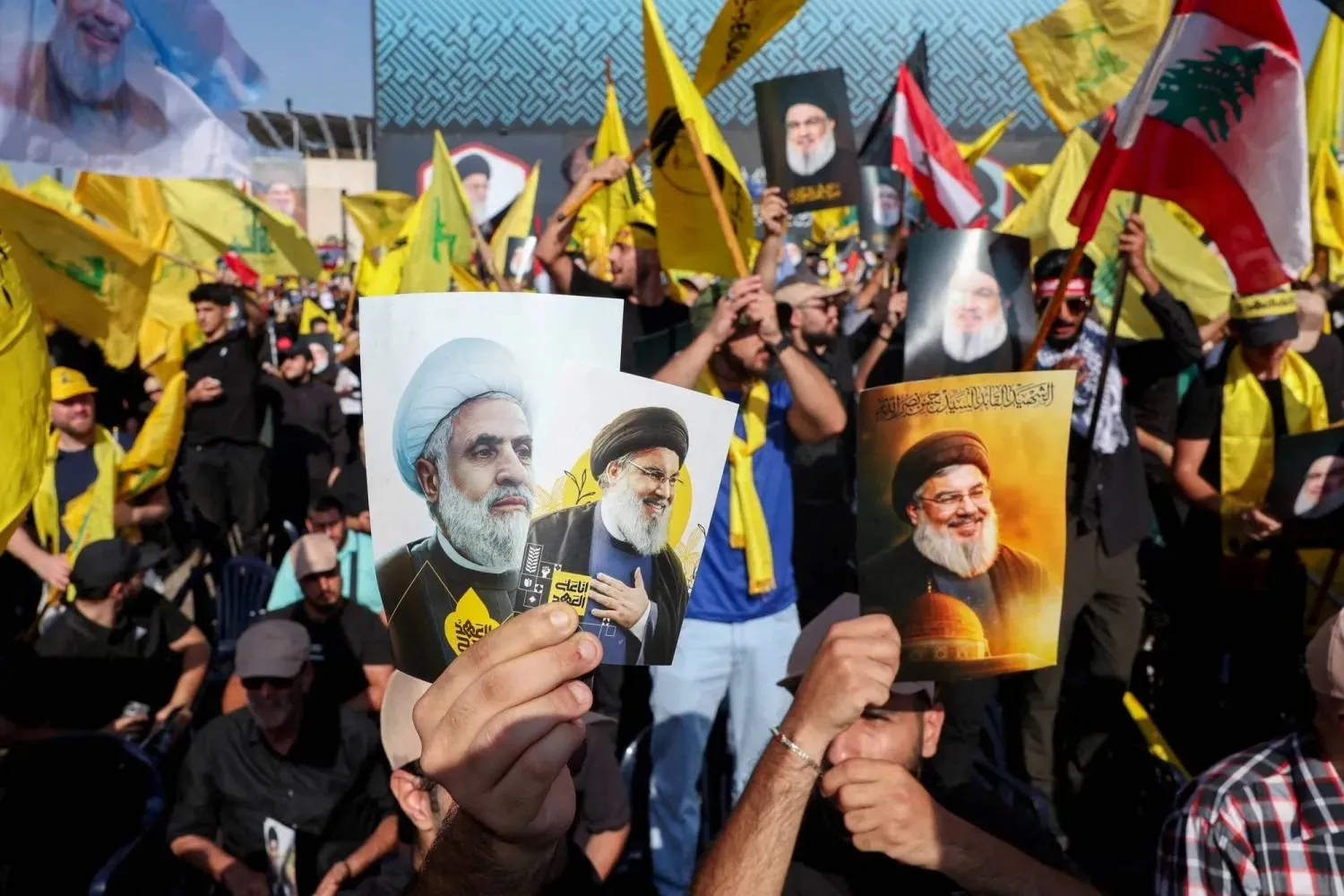
Supporters of Hezbollah hold portraits of its general secretaries on the first anniversary of the assassination of Hassan Nasrallah. (Reuters file)
TT

Aoun, Hezbollah Ties Cool as Contacts Stay at Minimum

Supporters of Hezbollah hold portraits of its general secretaries on the first anniversary of the assassination of Hassan Nasrallah. (Reuters file)

Relations between Lebanese President Joseph Aoun and Hezbollah have grown visibly strained, with contacts confined to what ministerial sources described as “the bare minimum.”

The chill has deepened following Aoun’s recent remarks on Hezbollah’s weapons, which widened the rift between the two sides and triggered pointed criticism from the group at the president.

In a televised interview last week marking the first anniversary of his election, Aoun said that “the role of weapons outside the state has ended with the presence of the army, and their continued existence has become a burden on their own environment and on Lebanon as a whole, with no remaining deterrent role.”

In response, former Hezbollah-aligned minister Mohammed Fneish said in a television interview that the party had “reservations on the president’s recent positions,” adding: “We disagree with him in form and substance in some passages. We are not another party. We are a resistance force that played a major role in liberating Lebanon.”

Cool communication

Ministerial sources familiar with Aoun’s position stressed that “the stances he expressed are not new, but the current circumstances may differ from previous ones.”

Speaking to Asharq Al-Awsat, the sources said the remarks stem from the president’s conviction that weapons outside the framework of the state no longer serve any purpose, that their role has ended, and that they have become a burden on everyone, including the Shiite community and Hezbollah’s own base.

“This is, ultimately, a description of an existing reality,” the sources said.

They added that reactions from Hezbollah’s supporters were expected, but would not prevent communication from continuing, since maintaining contact serves the interests of both sides, particularly Hezbollah.

Aoun and Salam

In recent years, Hezbollah had sought to maintain good relations with Aoun. Its lawmakers voted for him during the presidential election session after months of backing Suleiman Franjieh’s candidacy.

The group’s leadership even opened discreet talks with Aoun on what became known as the “national security strategy,” though these discussions yielded no results. Channels of communication remain open on the issue of weapons north of the Litani River, amid Hezbollah’s refusal to cooperate on this file.

Since the cabinet approved a decision last August restricting weapons to the state, Hezbollah’s leadership and supporters have focused their criticism on the government in which the group is represented.

Ties have worsened between Hezbollah and Prime Minister Nawaf Salam, whom the group did not back during parliamentary consultations that named him as premier last year.

A natural reaction

Political writer Dr. Kassem Kassir, who closely follows Hezbollah’s position, said the reaction of the party's supporters to Aoun’s remarks was “a natural response,” particularly because the president did not take into account what he described as the "role of the resistance in protecting Lebanon."

He added that calls to end the role of weapons were made without offering guarantees for what would follow or proposing alternative options.

Kassir told Asharq Al-Awsat that the stance of Hezbollah’s supporters did not necessarily reflect the position of the leadership. Communication channels remain open, but contacts have failed to produce a unified vision.

He added that Hezbollah has formal reservations about the performance of the government and the state, especially regarding Israeli negotiations and what it views as concessions made without guarantees or tangible results.

Duality in rhetoric

University professor and lawyer Ali Murad said that segments of Hezbollah’s supporters on social media adopt an extreme accusatory tone toward anyone who disagrees with them, leaving no room for nuance.

However, he argued that the problem goes beyond the supporters themselves and lies in the political rhetoric and mobilization Hezbollah has relied on for decades, "which entrenched a culture that recognizes only black and white and promotes accusations of betrayal, either fully with us or fully against us."

Murad told Asharq Al-Awsat that the "real issue lies in Hezbollah’s dual rhetoric."

He said the party "is fully aware that the reality has become extremely difficult following major losses and a military defeat on one hand, and the broader retreat of the Axis of Resistance on the other. As a result, a clear contradiction has emerged between what Hezbollah says and what it actually believes."

This contradiction, Murad said, is evident in the speeches of Hezbollah’s secretary general Sheikh Naim Qassem, which reflect two parallel narratives. "One acknowledges reality to a degree while maintaining rejection of handing over weapons. The other is a mobilizing discourse rooted in an earlier era, before the pager operation and the 'support front' war."

“What Aoun said falls in this direction,” Murad said, arguing that Hezbollah in its former state has ended and has become a burden on Lebanon, the Shiite community, and the residents of the south.

"Persisting with the same rhetoric today amounts to rejecting reality and practicing denial, a form of political arrogance reflected by both supporters and the group’s media circles."

No interest in breaking ties

Murad said what angered Hezbollah’s supporters most was “the truth they do not want to acknowledge,” namely that Hezbollah’s role has ended, that it has exited the deterrence equation, and that it can no longer achieve Lebanon’s objectives on its own.

“The president stated a truth that needed to be said,” he said.

Asked whether the relationship between Hezbollah and Aoun was nearing a breaking point, Murad said it was not in Hezbollah’s interest to sever political ties with the president, or even with the prime minister.

He noted that the group understands that the actions of both officials serve Lebanon’s interests and, in particular, the interests of the south.

In some respects, he added, this approach also spares Hezbollah and its base the risks of "fatal choices that could lead to a bleak outcome if denial or political self-destruction were to prevail."

Iraqi Officials Arrest Man Wanted by Australian Police as 'Number One Priority'

Australian Federal Police Commissioner Krissy Barrett said the arrested man, Kazem Hamad, was a threat to national security. (Getty Images file)
TT

Iraqi Officials Arrest Man Wanted by Australian Police as 'Number One Priority'

Australian Federal Police Commissioner Krissy Barrett said the arrested man, Kazem Hamad, was a threat to national security. (Getty Images file)

Iraqi officials have arrested a man wanted by Australian Federal Police as a person of interest in ​the investigation into a spate of firebombings, including an antisemitic attack on a Melbourne synagogue, police said on Wednesday.

Australian Federal Police Commissioner Krissy Barrett said the arrested man, Kazem Hamad, was a threat to national security and that she had identified ‌him as her "Number ‌One priority".

Iraq's National ‌Center ⁠for ​International ‌Judicial Cooperation said in a statement that Kadhim Malik Hamad Rabah al-Hajami had been arrested as part of a drugs investigation, after a request from Australia.

Barrett said Iraqi officials had made an independent decision to arrest the man ⁠in their own criminal investigation, after Australian Federal Police provided ‌information to Iraqi law enforcement ‍late last year.

"This ‍arrest is a significant disruption to an ‍alleged serious criminal and his alleged criminal enterprise in Australia," she said in a statement.

In October, Barrett said that in addition to being a ​suspect in arson attacks in Australia linked to the tobacco trade, the man ⁠was "a person of interest in the investigation into the alleged politically-motivated arson attack on the Adass Israel Synagogue" in Melbourne.

Australia expelled Iran's ambassador in August after the Australian Security Intelligence Organization traced the funding of hooded criminals who allegedly set fire to the Melbourne synagogue in December 2024 to Iran's Revolutionary Guard Corps.

Hamad, previously convicted in Australia for drug trafficking ‌offences, was deported from Australia to Iraq in 2023.


Syria Asks Lebanon to Hand Over Assad-Era Officers

A drone view shows the port of the coastal city of Latakia, Syria, March 11, 2025. (Reuters)
TT

Syria Asks Lebanon to Hand Over Assad-Era Officers

A drone view shows the port of the coastal city of Latakia, Syria, March 11, 2025. (Reuters)

Syrian authorities have asked Lebanese security forces to hand over more than 200 senior officers who fled to Lebanon after the fall of Bashar al-Assad, following a Reuters investigation that showed how the neighboring country was a hub for insurgent plotting.

On December 18, a ​top Syrian security official, Brig. Abdul Rahman al-Dabbagh, met with his Lebanese counterparts in Beirut to discuss the exiled Assad-era officers, according to three senior Syrian sources, two Lebanese security officials, and a diplomat with knowledge of the visit.

The meetings came days after a Reuters investigation detailed rival plots being pursued by Rami Makhlouf, the billionaire cousin of the ousted president, and Maj. Gen. Kamal Hassan, former head of military intelligence, both living in exile in Moscow, to finance potential Alawite militant groups in Lebanon and along the Syrian coast. Syria and Lebanon share a 375-kilometer border.

The two rival camps aim to undermine the new Syrian government under President Ahmed al-Sharaa. Reuters found they are sending money to intermediaries in Lebanon to try and stir uprisings that would divide Syria and allow the plotters to regain control over the coastal areas. The population of those areas is dominated ‌by Alawites, the minority ‌sect associated with the Assad family and the dictatorship’s ruling elite.

Al-Dabbagh, an aide to the ‌head ⁠of ​internal security ‌in Syria’s Latakia province, an Alawite stronghold, met with Lebanese intelligence chief Tony Kahwaji and Major General Hassan Choucair, head of the General Security Directorate, and presented them with the list of senior officers wanted by Syria.

The visit focused on gathering information about the whereabouts and legal status of the officers, as well as trying to find ways to prosecute or extradite them to Syria, according to the Syrian sources.

They described it as a direct request from one security agency to another, rather than a demand for extradition.

Three senior Lebanese security officials confirmed the meetings. One of the Lebanese officials denied receiving any demands from the Syrians to hand over the officers. Two others acknowledged receiving a list of names but said none were senior officers.

One of the Lebanese security ⁠officials said there is no evidence of any insurgency being planned, despite the threats against Syria’s new government detailed in the Reuters reporting.

All the officials spoke on condition of anonymity to reveal details of ‌a highly sensitive cross-border issue.

Among the names handed over by Syrian officials to ‍Lebanon were several high-ranking figures acting as intermediaries for Makhlouf or Hassan in ‍Lebanon, according to a Syrian source who saw the list.

A Lebanese judicial official said Syria had not made a formal extradition request to ‍Lebanon, typically done through the two countries’ justice and foreign ministries.

Accompanying Dabbagh on his Beirut visit was Khaled al-Ahmad, a former Assad advisor and childhood friend of Sharaa, who is leading the government’s efforts to win over the Alawite community through development projects and aid, according to two witnesses who saw the men together on that mid-December day.

According to the two witnesses, who are both ex-Assad officers, al-Ahmad and Dabbagh went together to an upscale Beirut restaurant that is popular among Assad’s ​men. The two witnesses said they and others interpreted the outing as a warning to those trying to influence Alawites to rise up against Syria’s new leaders that Lebanon is no longer a haven.

In a January 2 post on X, Lebanese Deputy Prime Minister Tarek Mitri called on his government’s security agencies to verify the information circulating in the media and take action against the Lebanon-based agents for Assad’s former insiders, Makhlouf and Hassan.

“It is incumbent upon them, and upon all of us, to avert the dangers of any actions that undermine Syria’s unity or threaten its security and stability, whether in Lebanon or originating from it,” the tweet read.

In response to questions from Reuters, Lebanon’s General Security referred to January 11 remarks by Lebanese President Joseph Aoun, who said Lebanon’s military intelligence and other security agencies had carried out raids in several areas of the country’s north and east.

Aoun said the raids did not produce evidence of the presence of officers linked to the Assad dictatorship and said Lebanon was continuing to coordinate with Syria on the issue.

Syrian government officials did not respond to requests for comment.

From January 3 to January 6, Lebanese soldiers raided locations and shelters housing displaced Syrians. The Lebanese Army said 38 Syrians were arrested during the raids on different charges such as possession of drugs or weapons, or entering the country illegally.

A senior Lebanese security official told Reuters those ‌raids were linked to the exiles’ plots.

Another senior Lebanese security official emphasized that there was no arrest warrant for the Syrian officers in Lebanon, nor Interpol requests for them.

“We can't do anything against them,” the official added.


Israel Army Says Killed Six Gaza Gunmen Despite Ceasefire

 Internally displaced Palestinians move between the ruins of destroyed buildings at Al Rashid road in the west of Gaza City on, 06 January 2026, amid a ceasefire between Israel and Hamas. (EPA)
Internally displaced Palestinians move between the ruins of destroyed buildings at Al Rashid road in the west of Gaza City on, 06 January 2026, amid a ceasefire between Israel and Hamas. (EPA)
TT

Israel Army Says Killed Six Gaza Gunmen Despite Ceasefire

 Internally displaced Palestinians move between the ruins of destroyed buildings at Al Rashid road in the west of Gaza City on, 06 January 2026, amid a ceasefire between Israel and Hamas. (EPA)
Internally displaced Palestinians move between the ruins of destroyed buildings at Al Rashid road in the west of Gaza City on, 06 January 2026, amid a ceasefire between Israel and Hamas. (EPA)

The Israeli military said Wednesday it had killed six gunmen in an updated toll from an exchange of fire in Gaza the day before, accusing them of violating the ceasefire in the territory.

The military said in a statement late on Tuesday that it had killed two of six fighters it had identified adjacent to its troops in western Rafah and that tanks had fired on them.

It said they were killed in an ensuing exchange of fire, including aerial strikes, while troops continued to search for the rest.

In a statement on Wednesday, the military said that "following searches that were conducted in the area, it is now confirmed that troops eliminated the six terrorists during the exchange of fire".

It said the presence of the gunmen adjacent to troops and the subsequent incident were a "blatant violation of the ceasefire agreement".

A security source in Gaza reported late on Tuesday that Israeli forces had "opened fire west of Rafah city".

Under a truce that entered into force in October following two years of war between Israel and Hamas, Israeli forces in Gaza withdrew to positions behind a demarcation known as the "yellow line".

The city of Rafah is located behind the yellow line, under Israeli army control. The area beyond the yellow line remains under Hamas authority.

Both sides have repeatedly accused the other of violating the ceasefire.

According to the health ministry in Gaza, which operates under Hamas authority, at least 165 children have been killed in Israeli attacks since the ceasefire began on October 10.

The UN children's agency UNICEF said on Tuesday that at least 100 children -- 60 boys and 40 girls -- had been killed since the truce.

Israeli forces have killed a total of at least 447 Palestinians in Gaza since the ceasefire took effect, according to the ministry.

The Israeli army says gunmen have killed three of its soldiers during the same period.