
Saudi Arabia has expanded its network of international partnerships after the Ministry of Industry and Mineral Resources signed three memorandums of understanding on cooperation in mineral resources with Chile, Canada, and Brazil, aimed at strengthening frameworks for technical and investment cooperation in the mining and metals industry in a way that serves shared interests.
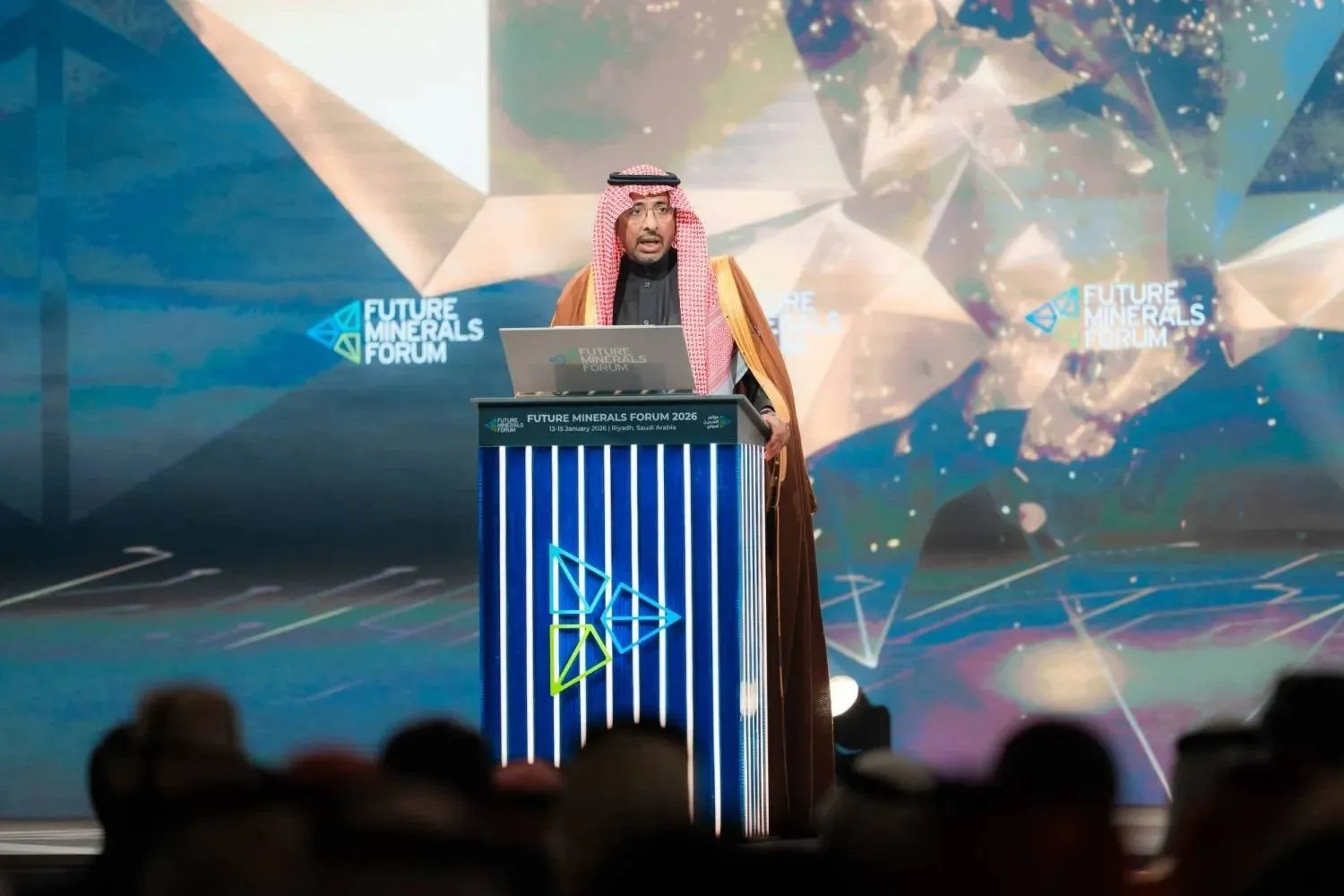
The move coincides with the launch on Wednesday of the fifth edition of the Future Minerals Forum in Riyadh, held under the patronage of King Salman bin Abdulaziz, and drawing unprecedented international participation of more than 20,000 attendees and around 400 speakers, including ministers, experts, executives from major global mining companies, international organizations, academic institutions, and financial bodies.
In his opening remarks, Minister of Industry and Mineral Resources Bandar Alkhorayef stressed that the forum would continue to play a pivotal role, noting its evolution from a platform for dialogue into a global decision-making hub that influences policy and mobilizes investment.
Alkhorayef said the fifth edition marks a qualitative milestone in the forum’s journey as a central platform for shaping decisions and building partnerships across the entire mineral value chain, adding that the major transformations the world is witnessing, including artificial intelligence applications and the energy transition, cannot be achieved without securing minerals and their associated supply chains in a responsible and sustainable manner.
Exploration licenses
On the domestic front, he stated that the kingdom continues to play its role in enhancing the resilience of global mineral supplies, in line with Vision 2030, through a thriving and sustainable mining sector that is attractive to investment, supports economic diversification, and creates jobs.
Alkhorayef said Saudi Arabia has allocated more than 33,000 square kilometers to local and international companies through competitive rounds for exploration and mining licenses, noting that the ninth round alone saw the award of 172 mining sites to 24 companies, the largest licensing round to date.
He also said geophysical and geochemical surveying of the Arabian Shield has been completed at a rate of 100 percent, and that spending on exploration has grown by more than fivefold since 2020, rising from one million riyals to 1.052 billion riyals, about $280 million, in 2024.
He reaffirmed the kingdom’s commitment to accelerating investment in its estimated mineral potential of around 9.4 trillion riyals, about $2.5 trillion, by offering competitive exploration opportunities in 2026 and 2027.
As part of efforts to enable investment and reduce risk, Alkhorayef announced the launch of a mining infrastructure enablement initiative in partnership with the Saudi Authority for Industrial Cities and Technology Zones, commonly referred to as Modon.
Its first project will involve building a 75-kilometer treated water pipeline to support development in the Jabal Sayid area and accelerate the implementation of mining projects.
The launch of the forum’s fifth edition also coincides with the announcement of two new private funds designed to support opportunities across the mineral value chain in the kingdom, reflecting investor confidence and the sector's increasing maturity.
The initiatives include strategic partnerships to support mining projects and midstream value chain projects, as well as the launch of a new investment fund to back mineral and industrial opportunities.
On the research front, national bodies involved in research and development are signing strategic agreements with international partners to enhance innovation in exploration, processing, and digitalization, thereby supporting higher efficiency in the mining sector and facilitating the faster adoption of advanced solutions.
Capital flows
In a panel discussion, Finance Minister Mohammed al-Jadaan said the mining sector plays a pivotal role in attracting capital, underscoring the need for clear, stable, and well-defined policies to support long-term investment.
He noted that global markets are experiencing rising uncertainty due to economic changes and geopolitical developments.
Al-Jadaan stated that many countries view minerals as strategic assets due to the significant opportunities they offer for growth and development. In the current climate of global volatility, he added, the sector requires greater reliability and predictability, as well as disciplined investment decisions when selecting countries and minerals most suitable for investment.
He said geopolitical tensions have become the main source of uncertainty hanging over the global economy, with their impact clearly visible in sectors that require long-term investment, foremost among them mining, which needs high levels of stability and predictability given its long operating cycles.
Despite the challenges, he said the environment offers opportunities if handled correctly by states or investors, noting that many countries now view minerals as a national or, at the very least, economic security issue, opening the door to partnerships with host countries or even third parties.
Al-Jadaan stressed the importance of discipline in seizing these opportunities through careful selection of investment destinations and target minerals, particularly in light of current geopolitical and economic challenges.
He said the mining sector cannot focus solely on the near term, but needs a forward-looking vision extending to 2040.
He described current global conditions as only the beginning of what could be expected in 2026, stressing that credibility, predictability, and certainty are the main drivers of major investment decisions, and that their absence at present poses a real challenge to capital inflows.
He urged investors to exercise discipline by carefully choosing target countries and strategic minerals, noting that partnerships with third parties could be an effective way to overcome the economic and political volatility the world is currently experiencing.
Mining investment
In another panel, Investment Minister Khalid al-Falih stated that estimates by global institutions, including McKinsey and IHS, indicate that the global mining sector will require approximately $5 trillion in investment over the next decade, encompassing the entire value chain, including supporting infrastructure.
He said a gap remains between the amount of capital available globally and the investment required to expand mining activity, noting that while the investment community has ample liquidity, the challenge lies in directing that funding toward a sector that is essential rather than optional.
Al-Falih said the sector’s importance stems from geopolitical considerations that require diversification and resilience in supply chains, in addition to the demands of the energy transition and changes driven by artificial intelligence and digital technologies, all of which depend on rare and critical minerals that can only be supplied by a mining sector capable of exploration, development, and production.
He said the sector includes leading global companies with the expertise and capabilities required, alongside the availability of promising geological areas that remain underexplored, such as the Arabian Shield in Saudi Arabia and other regions in what he described as the super region stretching from Central Asia to West Africa.
Al-Falih also touched on the financial market performance of Maaden and its positive results, which have been reflected in its market valuation, stressing the need to inject the investments required to support the sector’s growth.
He said the biggest challenge lies in perceived risks, ranging from exploration risk to environmental risk, as well as social, and governance obligations. He noted that Saudi Arabia has worked to address the risk-return gap through an investment strategy, an investment law, and an active government role in reducing risk.
He added that mining revenues and fees are redirected to a dedicated fund to address gaps not covered by the private sector, and said transparent data is a key factor in reducing risk, particularly after the completion of a comprehensive geological survey and the availability of its data to investors.
He concluded by saying that Saudi Arabia has developed railways, ports, and industrial cities to ease the burden on companies, as part of an integrated strategy that addresses regulation, policy, and financing, and helps set the kingdom’s experience apart from global trends.
New discoveries
Maaden Chief Executive Robert Wilt said Saudi Arabia has a strong foundation as it moves into diversification models under Vision 2030 and seeks to leverage all of the country’s resources.
He said that on the back of this foundation, the company plans to invest $110 billion over the next decade, doubling its aluminum and phosphate businesses and tripling gold exploration.
Wilt said the scale of infrastructure required demands strong government enablers, and that by working with multiple ministries to implement mining policies in Saudi Arabia, significant capital is available for construction and development.
He said the company expects to announce a partnership this week with a global firm to attract thousands of developers and engineers from leading international companies.
He also referred to the government’s announcement last year of the discovery of 7.8 million ounces of gold in the kingdom, while disclosing global exploration programs.
“We can achieve 30 percent in our portfolio by growing partnerships that result from enhancing mineral exploration capabilities in the kingdom,” he said.
Panel discussions
Other sessions highlighted key themes on strengthening the role of mining in building the national economy. The chairman of Chile’s Codelco stated that the country’s economy is built on copper, with one of the world’s largest reserves. Copper forms a major part of its exports, cementing its position as one of the world’s leading copper producers.
David Copley, special assistant to the US president on the National Security Council, said minerals have become a priority for the national economy and are the building blocks for everything countries need to reindustrialize.
The forum’s program includes a wide range of events, including the Mining Investment Journey, the Finance Gateway in partnership with the Bank of Montreal, MinGen workshops aimed at youth and women in mining, the MinValley innovation and technology platform, and a knowledge exchange platform that brings together leading experts to share the latest developments in geology, technology, sustainability and skills development.
The forum will conclude with the announcement of winning teams and the honoring of partners in a closing ceremony highlighting the outcomes of the Future Minerals Pioneers competition, celebrating innovators, boosting the competitiveness of the mining and metals sector, supporting Vision 2030 targets, and reinforcing Saudi Arabia’s position as a global innovation hub in this vital sector.
As part of efforts to promote innovation, the forum will also see the launch of the Start-Up Derby, organized by the National Industrial Development and Logistics Program, as an event held at the Minerals Café in the outdoor exhibition area on January 14 and 15.
The initiative serves as an open platform to showcase emerging technologies and innovative business models in mining, critical minerals, and processing, with direct links between innovators and investors.