



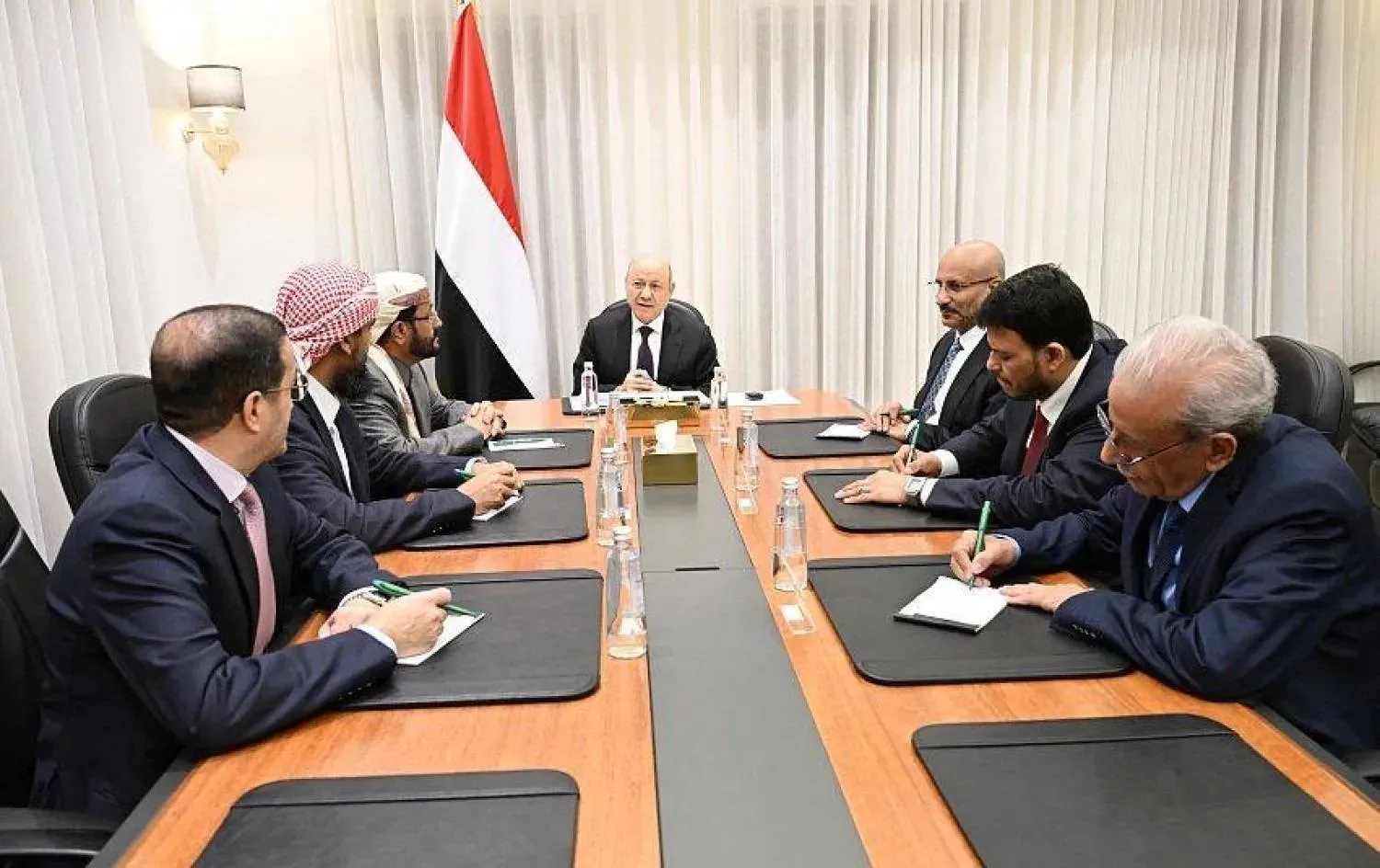

Yemen’s Presidential Leadership Council (PLC) on Thursday approved a package of measures to fill membership vacancies and improve public services and administrative performance, in a move it said was aimed at meeting citizens’ expectations and opening a new phase based on partnership and justice.
The PLC is stepping up efforts to restore state institutions and end the Iran-backed Houthi coup.
The decisions are expected to include the appointment of two new members to the council to replace Aidarous al-Zubaidi, whose membership was revoked on charges of high treason, and Faraj al-Bahsani, who has been absent from council meetings.
Meeting in Riyadh, the council said the successful handover of military camps and the unification of military and security decision-making in liberated provinces marked a pivotal turning point in the restoration of state institutions and the consolidation of security and stability.
The meeting took place as regional and international efforts intensify to support a comprehensive political solution to end the conflict in the country.
The meeting was chaired by PLC Chairman Rashad al-Alimi and attended by council members Sultan al-Arada, Tareq Saleh, Abdulrahman al-Muharrami, Abdullah Bawazeer, and Othman Megali.
State media said the meeting reviewed the latest political and security developments considering recent events in Hadhramaut, al-Mahra, and Aden, as well as in other liberated provinces, and the resulting security and administrative obligations that require high-level coordination and urgent sovereign decisions.
The council praised what it described as the professionalism and high discipline shown by the armed forces and security services during the handover of military camps. It said the step was essential to restoring the authority of the state, strengthening its legal standing, protecting civil peace, safeguarding public rights and freedoms, and preventing any duplication in military or security decision-making.
Saudi role praised
The PLC welcomed the outcomes of a meeting between its chairman and members and Saudi Defense Minister Prince Khalid bin Salman bin Abdulaziz, saying the talks reflected a high level of coordination and mutual understanding between the two countries and a shared commitment to supporting the path toward restoring the Yemeni state and strengthening strategic partnership at the political, military, and security levels.
The council expressed its appreciation for Saudi Arabia, under the leadership of King Salman bin Abdulaziz and Crown Prince and Prime Minister Mohammed bin Salman bin Abdulaziz, praising the kingdom’s pivotal role in supporting Yemen’s unity, security, and stability.
It said this would help pave the way for a new phase of political and development support for the Yemeni people.
The council endorsed the sovereign decisions taken to manage the current phase, most notably the formation of a supreme military committee under the leadership of the Arab coalition, tasked with completing the unification of forces on national and professional foundations.
It said the move would ensure the state’s exclusive authority over decisions of war and peace and boost readiness to confront challenges, particularly the threat posed by the Iran-backed Houthis.
Commitment to the southern issue
On the southern issue, the council reaffirmed its commitment to a fair resolution through the planned southern dialogue to be held in Riyadh under Saudi sponsorship, with inclusive participation and without exclusion or marginalization, in a manner that restores decision-making to its rightful owners within the framework of the Yemeni state and its sovereignty.
The council also welcomed the unified position of the international community in support of Yemen’s unity and territorial integrity and its rejection of any unilateral steps that could undermine state institutions or threaten regional security.
It said the state’s regaining of the initiative represented an important opportunity to advance the peace process, improve humanitarian and living conditions, strengthen international cooperation to combat terrorism, and protect vital maritime waterways.
State media reported that the council reviewed reports on conditions in several provinces, particularly urgent humanitarian and service needs in the Socotra archipelago, and took the necessary measures.
The PLC stressed the importance of accelerating the normalization of conditions in liberated provinces, the return of the government and all state institutions to operate from inside the country, addressing war damage, caring for the families of those killed, treating the wounded, and strengthening the rule of law, according to the official state news agency.


