


Israeli Troops Kill Palestinians for Crossing a Vague Ceasefire Line that's Sometimes Unmarked

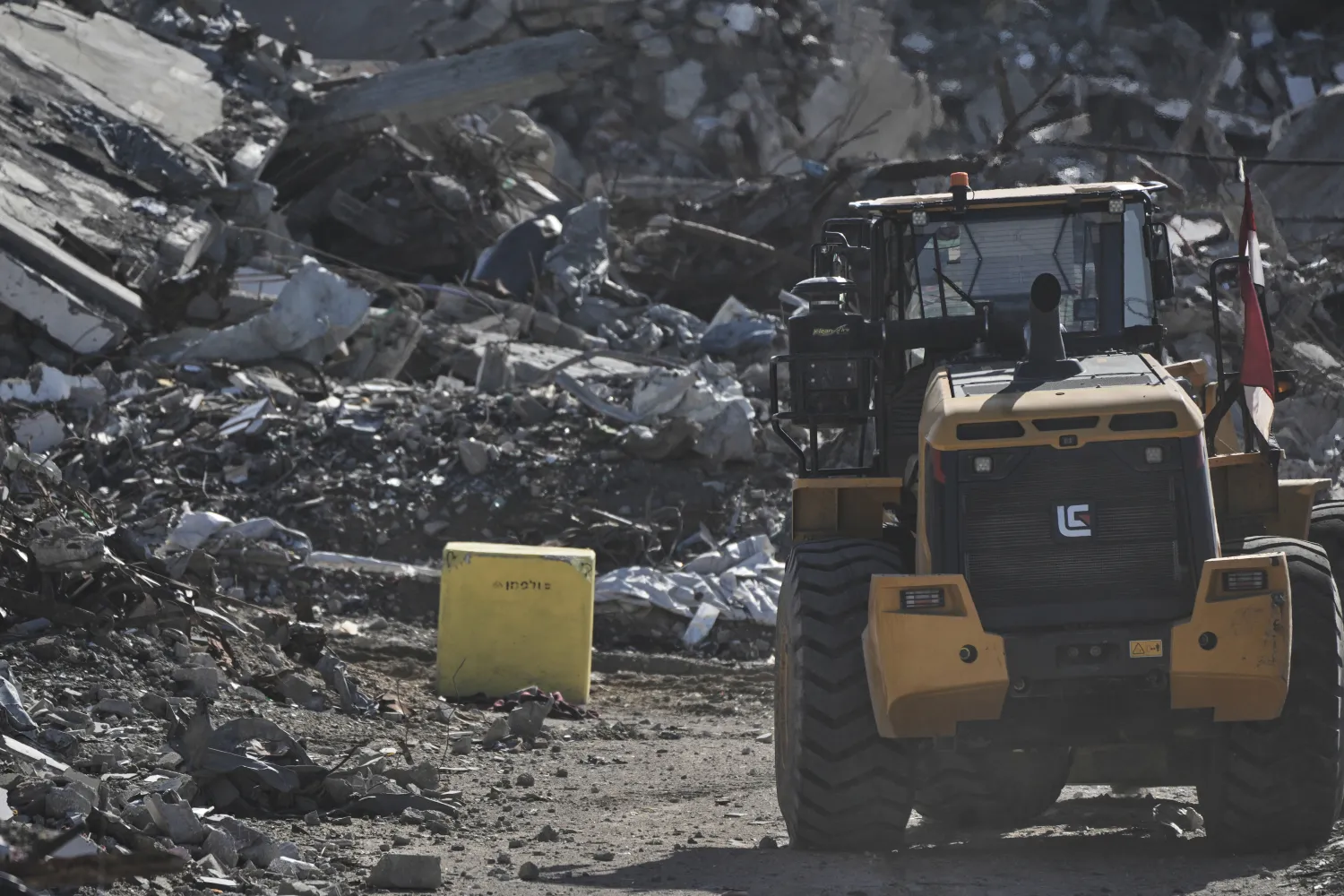
A yellow block demarcating the "Yellow Line," which has separated the Gaza Strip's Israeli-held and Palestinian zones since the October ceasefire, is visible in Jabalia, northern Gaza Strip, where Hamas militants are searching for the remains of hostages, Monday, Dec. 1, 2025. (AP Photo/Jehad Alshrafi)
TT

Israeli Troops Kill Palestinians for Crossing a Vague Ceasefire Line that's Sometimes Unmarked

A yellow block demarcating the "Yellow Line," which has separated the Gaza Strip's Israeli-held and Palestinian zones since the October ceasefire, is visible in Jabalia, northern Gaza Strip, where Hamas militants are searching for the remains of hostages, Monday, Dec. 1, 2025. (AP Photo/Jehad Alshrafi)

A dividing line, at times invisible, can mean life or death for Palestinians in Gaza.

Those sheltering near the territory's “yellow line” that the Israeli military withdrew to as part of the October ceasefire say they live in fear as Israeli soldiers direct near-daily fire at anyone who crosses or even lingers near it.

Of the 447 Palestinians killed between the ceasefire taking effect and Tuesday, at least 77 were killed by Israeli gunfire near the line, including 62 who crossed it, according to the Gaza Health Ministry. Among them were teenagers and young children, The Associated Press found.

And although the military has placed some yellow barrels and concrete barriers delineating the limits of the Palestinian zone, the line is still unmarked in certain places and in others was laid nearly half a kilometer (0.3 miles) deeper than what was agreed to in the ceasefire deal, expanding the part of Gaza that Israel controls, according to Palestinians and mapping experts.

“We stay away from the barrels. No one dares to get close” said Gaza City resident Ahmed Abu Jahal, noting that the markers are less than 100 meters (110 yards) from his house — instead of the roughly 500 meters (546 yards) outlined in a map put out by the Israeli military.

As of Tuesday, the military had acknowledged killing 57 people around the yellow line, saying most were militants. It said its troops are complying with the rules of engagement in order to counter militant groups, and are informing Palestinians of the line’s location and marking it on the ground to “reduce friction and prevent misunderstandings.”

Easy to get lost

Under the ceasefire, Israel withdrew its troops to a buffer zone that is up to 7 kilometers (4 miles) deep and includes most of Gaza's arable land, its elevated points and all of its border crossings. That hems more than 2 million Palestinians into a strip along the coastline and central Gaza.

People of all ages, some already dead, have been showing up almost daily at the emergency room of Gaza City's Al-Ahli hospital with bullet wounds from straying near the line, said hospital director Fadel Naeem.

Amid the vast destruction in Gaza, the demarcation line often isn't easy to detect, Naeem said. He recounted picking his way through undamaged paths during a recent visit to the southern city of Khan Younis. He didn't notice he was almost across the line until locals shouted at him to turn back, he said.

The Israeli military said most of the people it has killed crossing the line posed a threat to its troops. According to a military official who spoke on the condition of anonymity in line with military rules, troops issue audible warnings and then fire warning shots whenever someone crosses the line. Many civilians retreat when warning shots are fired, though some have been killed, the official acknowledged.

Killed while playing near the line

Zaher Shamia, 17, lived with his grandfather in a tent 300 meters (330 yards) from the line in northern Gaza’s Jabaliya refugee camp. On Dec. 10, he was playing with his cousin and some friends near the line, according to video he took before his death.

Suddenly, shots rang out and the video stopped. Soldiers approaching the line with an armored bulldozer had fired on the teens, hitting Zaher, said a witness.

A neighbor eventually found Zaher’s body, which had been crushed by the bulldozer, said Zaher's grandfather, Kamal al-Beih: “We only recognized him from his head."

Two doctors, Mohamed Abu Selmiya and Rami Mhanna, confirmed that the teen had been killed by gunshots and then run over by a bulldozer. The military official said he was aware that Shamia was a civilian and that the military was looking into it.

Maram Atta said that on Dec. 7, her 3-year-old daughter, Ahed al-Bayouk, was playing with siblings outside of their tent, which was near the yellow line along Gaza's southern coast. Atta was preparing lentils when she heard aircraft overhead, then shots.

A stray projectile whizzed close to her and struck Ahed, who was dead before they reached the clinic.

“I lost my daughter to what they keep calling a ‘ceasefire’” said Atta, crying. “What ceasefire are they talking about?”

A military official denied the killing.

Deadly ambiguity

The line's exact location is ambiguous, differing on maps put out by the Israeli military and the White House.

Neither matches the line troops appear to be marking on the ground, according to Palestinians and geolocation specialists.

Chris Osiek, an open source intelligence analyst and consultant, has geolocated a number of yellow blocks based on social media videos. He found at least four urban areas where troops set the blocks several hundred meters deeper into Gaza than the military map-specified yellow line.

“This is basically what you get when you simply let Trump make an image and post it on Truth Social and let the Israeli army make their own,” he said. “If it’s not a proper system, with coordinates that make it easy for people to navigate where it is, then you leave the ambiguity free for the Israeli army to interpret the yellow line how they basically want.”

The military official dismissed such criticism, saying any deviations from the map amount to just a few meters. But to Palestinians hemmed in by widespread destruction and displacement, every few meters lost is another house that can't be sheltered in — another they doubt will ever be returned.

‘The line is getting very close’

Under the ceasefire, Israeli forces are only supposed to remain at the yellow line until a fuller withdrawal, though the agreement doesn't give a timeline for that. With the next steps in the deal lagging and troops digging into positions on the Israeli side, though, Palestinians wonder if they are witnessing a permanent land takeover.

In December, Israel’s defense minister described the yellow line as “a new border line — serving as a forward defensive line for our communities and a line of operational activity.”

The military has continued leveling buildings inside the Israeli-held zone, turning already damaged neighborhoods to moonscapes. Almost all of the city of Rafah, on Gaza's border with Egypt, has been razed over the past year. The army says this is necessary to destroy tunnels and prepare the area for reconstruction.

In some places, demolitions since the ceasefire have encroached beyond the official yellow line. Since November, troops have leveled a swath of Gaza City’s Tuffah neighborhood extending some 300 meters (330 yards) outside the Israeli-held zone, according to Oct. 14 and Dec. 18 satellite photos provided by Planet Labs.

Abu Jahal moved back to his damaged house in Tuffah at the ceasefire's start. He said he frequently saw new yellow barrels appear and the military forcing out anyone living on its side of the markers.

On Jan. 7, Israeli fire hit a house near him, and the residents had to evacuate, he said. Abu Jahal said his family — including his wife, their child, and seven other relatives — may also have to leave soon.

“The line is getting very close,” he said.


A Man Detonates Explosive Belt during Arrest Attempt in Iraq, Injuring 2 Security Members

A man wearing an explosives belt blew himself up Friday while a security force was trying to arrest him in western Iraq near the Syrian border, killing himself and wounding two security members, an Iraqi security official said. (Reuters/File)
TT

A Man Detonates Explosive Belt during Arrest Attempt in Iraq, Injuring 2 Security Members

A man wearing an explosives belt blew himself up Friday while a security force was trying to arrest him in western Iraq near the Syrian border, killing himself and wounding two security members, an Iraqi security official said. (Reuters/File)

A man wearing an explosives belt blew himself up Friday while a security force was trying to arrest him in western Iraq near the Syrian border, killing himself and wounding two security members, an Iraqi security official said.

The raid was being conducted in the al-Khaseem area in Qaim district that borders Syria, said the official who spoke on condition of anonymity in line with regulations.

The official added that “preliminary information” confirms that no members of the security forces were killed, while two personnel were injured and transferred for medical treatment, The Associated Press said.

Iraq’s National Security Agency said in a statement that its members besieged a hideout of an ISIS group security official and two of his bodyguards. One bodyguard ignited his explosives belt, killing him. It gave no further details.

ISIS once controlled large parts of Syria and Iraq and declared a caliphate in 2014. The extremist group was defeated on the battlefield in Iraq in 2017 and in Syria in 2019 but its sleeper cells still carry out deadly attacks in both countries.

In December, two US service members and an American civilian were killed in an attack in Syria that the United States blamed on ISIS. The US carried out strikes on Syria days later in retaliation.

US and Iraqi authorities in January began transferring hundreds of the nearly 9,000 ISIS members held in jails run by the US-backed and Kurdish-led Syrian Democratic Forces in northeast Syria to Iraq, where Iraqi authorities plan to prosecute them.


UN Peacekeepers in Lebanon Allege Surge in Israeli Violence toward Them

United Nations Spanish UNIFIL forces arrive to inspect chalets, after the Israeli army reportedly booby-trapped and blew them up at dawn, on the outskirts of the town of al-Khiam, southern Lebanon on January 31, 2026. (Photo by Rabih DAHER / AFP)
TT

UN Peacekeepers in Lebanon Allege Surge in Israeli Violence toward Them

United Nations Spanish UNIFIL forces arrive to inspect chalets, after the Israeli army reportedly booby-trapped and blew them up at dawn, on the outskirts of the town of al-Khiam, southern Lebanon on January 31, 2026. (Photo by Rabih DAHER / AFP)

UN peacekeepers patrolling southern Lebanon have faced a dramatic surge of “aggressive behavior” by Israeli forces over the last year, including drone-dropped grenades and machine-gun fire, according to an internal report seen by The Associated Press.

The report by one of the 48 nations that together have more than 7,500 peacekeepers in southern Lebanon says the number of incidents jumped from just one in January to 27 in December. The hilly frontier zone where the UNIFIL force patrols has seen decades of cross-border violence. Israel and Lebanon's Hezbollah militants fought a full-scale war in 2024.

The targeting of peacekeepers appears aimed at undermining the international force and strengthening Israel’s military footprint along the UN-drawn border with Lebanon, known as the Blue Line, the report alleges. It was shared with AP on condition that the news organization not identify the country whose peacekeepers compiled the findings for internal use by their senior command.

Israel has long mistrusted UNIFIL, accusing it of failing to prevent Hezbollah from building up its military presence along the border in violation of ceasefire agreements going back two decades.

The growing catalog of run-ins comes as a half-century of international peacekeeping efforts along the border face an uncertain future. UNIFIL’s mission is scheduled to end this year and US President Donald Trump ’s administration regards it as a waste of money.

Israel says it tries to reduce harm

In a statement to AP, the Israeli military said it “is not conducting a deterrence campaign against UNIFIL forces" and is working within accepted frameworks to dismantle Hezbollah, largely based in southern Lebanon.

The military “takes steps to reduce harm to UNIFIL forces and other international actors operating in the area,” it said.

UNIFIL said in a statement that “the number of attacks on or near peacekeepers, as well as aggressive behavior toward peacekeepers, have increased since September 2025,” with most of those incidents attributed to the Israeli military.

“The majority of incidents do not involve physical harm to peacekeepers, but any action that interferes with our mandated activities is a matter of concern,” it said.

The UN force has reported additional incidents this year. An Israeli tank opened fire with small-caliber bullets on a UNIFIL post on Jan. 16, it said. This week, it reported that a drone dropped a stun grenade that exploded in the vicinity of a peacekeeping patrol before flying toward Israeli territory.

Report details array of incidents

The report seen by AP details multiple instances in 2025 of grenades being dropped by Israeli drones near UNIFIL patrols, including an attack in October that wounded a peacekeeper, as well as machine-gun fire near UNIFIL positions. In some cases, UNIFIL vehicles were damaged.

The last four months of 2025 also saw a surge in incidents of direct fire at all targets from Israeli positions on both sides of the Blue Line, the report says. Such incidents spiked to 77 in December, up from just two in January, it says.

UNIFIL vehicles and positions are clearly marked as belonging to the UN, and Hezbollah militants have not maintained a visible presence or fired on Israeli forces in recent months.

The report says “it cannot be excluded” that Israel is using the incidents to maintain a military presence north of the border and prevent people who have fled the zone from returning.

Israel-Hezbollah conflict

After the Oct. 7, 2023, Hamas -led attack on Israel that triggered war in Gaza, Hezbollah began firing rockets from Lebanon into Israel in support of Hamas and the Palestinians.

Israel responded with airstrikes and shelling. The low-level conflict escalated into full-scale war in September 2024, later reined in but not fully stopped by a US-brokered ceasefire two months later.

Since then, Israel has accused Hezbollah of trying to rebuild in the south, in violation of the ceasefire, and has carried out near-daily strikes in Lebanon that it says target Hezbollah militants and facilities. Israeli forces also continue to occupy five hilltop points on the Lebanese side of the border. Hezbollah has claimed one strike against Israel since the ceasefire.

Spraying of chemicals spurs an outcry

The UN and Lebanon say Israeli forces dropped herbicide on Lebanese territory on Sunday, forcing a more than nine-hour pause in peacekeeping activities, including patrols.

“The use of herbicides raises questions about the effects on local agricultural lands, and how this might impact the return of civilians to their homes and livelihoods in the long-term,” UN spokesperson Stéphane Dujarric said. There was no Israeli comment.

Dujarric added that “any activity” by the Israeli military north of the Blue Line violates a UN resolution adopted in 2006 that expanded the UNIFIL mission, in hopes of restoring peace to the area after a monthlong war between Israel and Hezbollah.

Uncertain future for border area UNIFIL was created nearly five decades ago to oversee Israel's withdrawal from southern Lebanon after its troops invaded in 1978.

The UN Security Council voted last August to terminate its mission at the end of 2026.

Israel had long sought an end to its mandate, saying UNIFIL failed to keep Hezbollah away from the border. Under the 2006 UN ceasefire, the Lebanese army was supposed to maintain security in the south with backing from UNIFIL and militants were to disarm.

Hezbollah supporters in Lebanon have frequently accused UNIFIL of collusion with Israel and have sometimes attacked its patrols.

The Lebanese government says UNIFIL serves a necessary purpose. Prime Minister Nawaf Salam said in December that Lebanon will need a follow-up force to fill the vacuum and to help Lebanese troops along the border as they expand their presence there.

In an AP interview this week, Lebanese Deputy Prime Minister Tarek Mitri said several proposals are under discussion.

One possibility is an expansion of the United Nations Truce Supervision Organization, or UNTSO, which maintains a small observer force in Lebanon. The European Union has also offered to contribute to an international observer force, he said.

Whatever the arrangement, Mitri said: “We need a neutral, internationally mandated force to observe and make sure that whatever is agreed upon in negotiations is fully respected."


France to Rally Aid for Lebanon as It Warns Truce Gains Remain Fragile

This handout photograph released by the Lebanese Presidency Press Office shows Lebanon's President Joseph Aoun (R) receiving France's Minister for Europe and Foreign Affairs Jean-Noel Barrot (L) at the Presidential Palace in Baabda, east of Beirut, on February 6, 2026. (Photo by Lebanese Presidency Press Office / AFP)
TT

France to Rally Aid for Lebanon as It Warns Truce Gains Remain Fragile

This handout photograph released by the Lebanese Presidency Press Office shows Lebanon's President Joseph Aoun (R) receiving France's Minister for Europe and Foreign Affairs Jean-Noel Barrot (L) at the Presidential Palace in Baabda, east of Beirut, on February 6, 2026. (Photo by Lebanese Presidency Press Office / AFP)

France said on Friday that Lebanon's recovery remains precarious despite positive signs following a ceasefire and government transition, and it stood ready to support the country's reconstruction if it continues with reforms.

French Minister for Europe and Foreign Affairs Jean-Noel Barrot, addressing reporters after meetings in Beirut with Lebanese President Joseph Aoun and other top officials, said France was prepared to host a dedicated conference in Paris on reconstruction, but only if reforms continue, legislation is passed ‌and decisions ‌are implemented.

While Lebanon has adopted ‌banking ⁠secrecy and ‌bank resolution laws, it must still complete restructuring, reach an IMF agreement and pass a loss-sharing law, Barrot said. He also urged swift action on Hezbollah disarmament and national reconciliation.

Barrot said Lebanon had reached a crucial juncture in implementing the November 2024 truce with Israel, as well as restoring ⁠state authority over weapons and stabilizing a shattered financial system.

France, the ‌country's former colonial power, plans ‍to mobilize international backing for ‍the Lebanese armed forces and internal security forces at ‍a separate conference scheduled for March 5 in Paris.

"Lebanon must work to restore confidence - that of its citizens, businesses, depositors, and the diaspora," Barrot said.

France's immediate focus was ensuring respect for the ceasefire, which he emphasized "implies that Israel withdraws from Lebanese territory, in accordance with its ⁠commitments, and that civilians are protected from strikes," alongside implementation by Lebanese authorities of an agreed-upon arms monopoly plan.

Lebanon has pledged to bring all arms in the country under state control, in line with the 2024 agreement that ended a devastating war between Hezbollah and Israel, and has asserted control over areas of the country closest to the border with Israel. But Hezbollah has warned the government that pressing on with efforts to disarm ‌the group throughout the country would trigger chaos and possibly civil war.
