

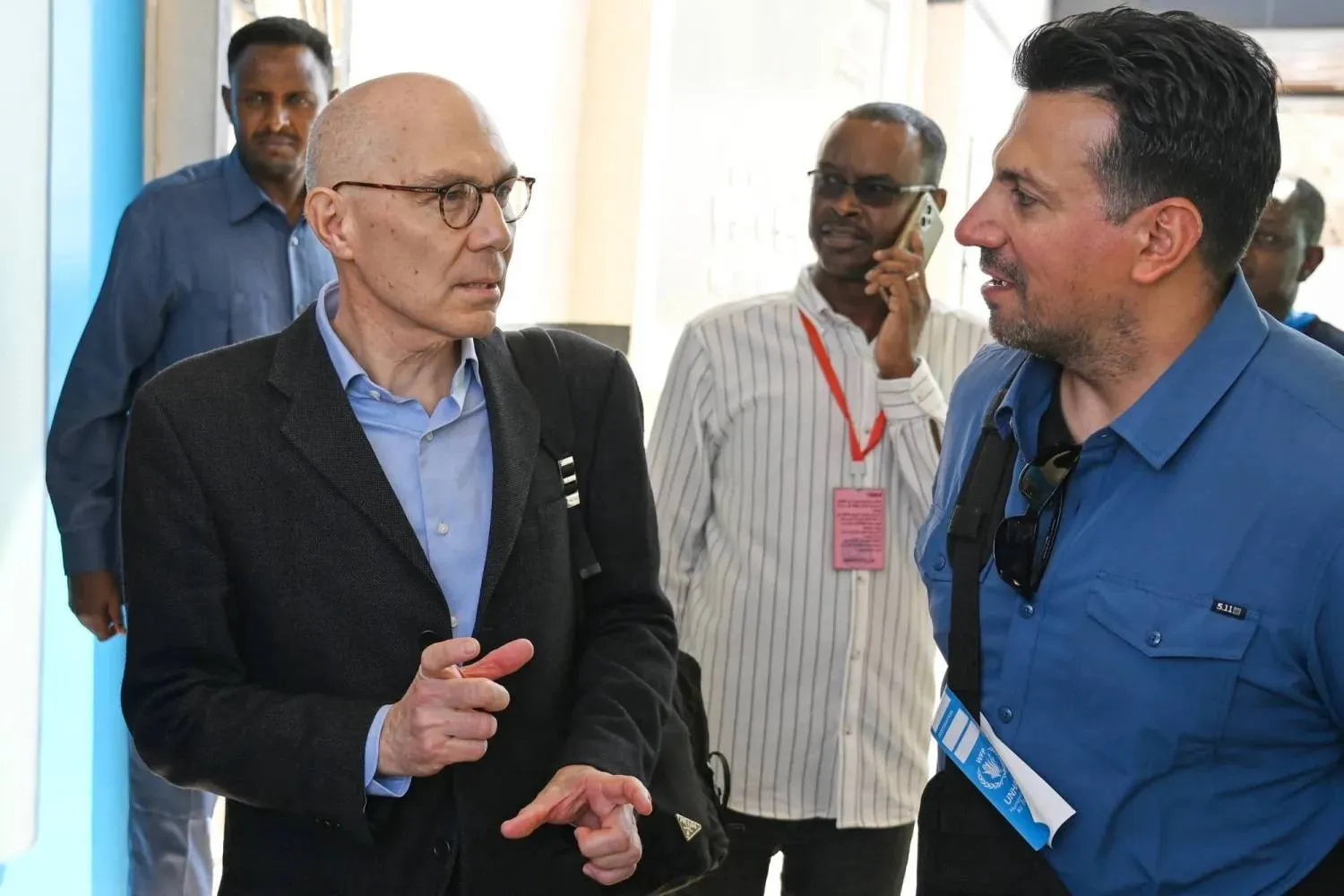

UN Human Rights Commissioner Calls for Accountability for Atrocity Crimes in Sudan

UN Human Rights commissioner Volker Turk 
TT

UN Human Rights Commissioner Calls for Accountability for Atrocity Crimes in Sudan

UN Human Rights commissioner Volker Turk 

UN Human Rights commissioner Volker Turk said on Sunday he is alarmed by the increasing militarization of society by all parties to the conflict in Sudan, also expressing his worries that the atrocity crimes committed during and after the takeover of El Fasher would be repeated in the Kordofan region.

Speaking at a press conference in Port Sudan, where the government had been operating as a temporary capital since the conflict began, the UN envoy said the proliferation of advanced military equipment, in particular drones, across Sudan has enhanced the military capabilities of both the Sudanese army (SAF) and the Rapid Support Forces (RSF), prolonging hostilities and deepening the crisis for civilians.

“I am deeply alarmed by the increasing militarization of society by all parties to the conflict, including through the arming of civilians and recruitment and use of children,” Turk noted.

The envoy said that during his visit to refugee camps in north Sudan, he heard accounts of widespread summary executions by RSF during the offensive on El Fasher, the capital of North Darfur region – for revenge, for suspected affiliation with the Sudanese Army or its allied Joint Forces.

He added, “I am very worried that the atrocity crimes committed during and after the takeover of El Fasher are at grave risk of repeating themselves in the Kordofan region, where the conflict has been rapidly escalating since late October.”

Horror and Hell

Turk also said the Sudanese population had endured “horror and hell,” especially with the expansion of the fighting in Kordofan.

“The Kordofan states are extremely volatile, with relentless military engagements, heavy shelling, drone bombardments and airstrikes causing widespread destruction and collapse of essential services,” he warned.

Since the end of October, and after taking control of El Fasher in Darfur, the RSF attacks have expanded into the neighboring Kordofan region, resulting in a continued displacement of civilians from the besieged city – all in the context of extreme food insecurity, with famine conditions confirmed in Kadugli, and risk of famine in other areas including Dilling, according to Turk.

The latest UN figures show that more than 65,000 people have been displaced since October.

At his press conference at Port Sudan airport, the envoy said that during his four-day visit to Port Sudan, Dongola, Ad Dabba and Merowe, he has met with those who have been hardest hit by brutal violence and injustice in this war.

“The terrifying experiences of these survivors must provoke action to end this conflict, and to make sure they can access what they need: medical care, psychosocial care, justice and support to pursue education and a livelihood”.

End This Madness

Turk and his UN team had visited the Al Afad site for internally displaced people (IDPs) in Ad Dabba, where they met with a large number of displaced people from the regions of Darfur and Kordofan.

“In my meetings with more than 50 local and international organizations in Dongola and Port Sudan, I heard appeals directed to those waging this war and the international community to end this madness,” he said.

“And to allow NGOs, journalists, lawyers and humanitarian actors to do their essential work without undue restrictions and reprisals,” Turk added.

He said the RSF and the Sudanese army must cease intolerable attacks against civilian objects that are indispensable to the civilian population, including markets, health facilities, schools and shelters.

“Attacks on critical civilian infrastructure are serious violations that can amount to war crimes,” Turk affirmed.

The UN envoy said the international community must ensure that the perpetrators of the horrific violations in Sudan face justice, regardless of their affiliation.

My Office, he said, is working to document and report on these violations and abuses to pave the way for accountability.

Turk described as “despicable” the fact that large sums of money are being spent on procuring increasingly advanced weaponry – funds he said that should be used to alleviate the suffering of the population.

Protection of Civilians

The envoy then called on all parties to the conflict to ensure the protection of civilians and civilian infrastructure, to guarantee safe passage for civilians to leave areas of active conflict – including Kadugli and Dilling – and for humanitarian aid to enter where it is needed.

He also repeated his call from three years ago, when he last visited Sudan, urging all those involved to set aside entrenched positions, power games, and personal interests, and to focus on the common interests of the Sudanese people.

The envoy then left Sudan with a plea that human rights be central to building confidence and bringing this war to an end, to resuming the difficult task of building a sustainable peace.

“It is difficult, but certainly not impossible, with the resilience and power of the Sudanese people,” he affirmed.



Israeli Minister Smotrich Calls for US-led Center for Gaza to Be Shuttered

US and Israeli soldiers convene at the Civil Military Coordination Center, the US-led center overseeing the implementation of President Donald Trump's plan to end the war in Gaza, in Kiryat Gat, southern Israel November 17, 2025. REUTERS/Alexander Cornwell
TT

Israeli Minister Smotrich Calls for US-led Center for Gaza to Be Shuttered

US and Israeli soldiers convene at the Civil Military Coordination Center, the US-led center overseeing the implementation of President Donald Trump's plan to end the war in Gaza, in Kiryat Gat, southern Israel November 17, 2025. REUTERS/Alexander Cornwell

Israeli Finance Minister Bezalel Smotrich urged Prime Minister Benjamin Netanyahu on Monday to shut a US-led multinational coordinating center that supports President Donald Trump’s plan to end the Gaza war.

Washington established the Civil Military Coordination Center (CMCC) last October as a center for civilian and military personnel from other countries to work alongside US and Israeli officials on post-war Gaza planning.

"The time has come to dismantle the headquarters in Kiryat Gat," said Smotrich, the far-right cabinet minister, in remarks shared by his office to media, referring to the Israeli city northeast of Gaza where the center is based.

The Israeli prime minister's office, the US State Department ‌and the US ‌military's Central Command did not immediately respond to requests ‌for ⁠comment on the ‌remarks.

Smotrich also said that Britain, Egypt and other countries that are "hostile to Israel and undermine its security" should be removed from the CMCC. The British and Egyptian foreign ministry did not immediately respond to requests for comment.

Central Command in December said that 60 countries and organizations were represented at the center. The CMCC has also been tasked with facilitating humanitarian aid entering Gaza.

The US-led CMCC was established after Trump announced his 20-point plan to end the war. Germany, ⁠France, and Canada are also among countries that have sent personnel there.

Smotrich, speaking at an event marking the ‌establishment of a new Jewish settlement in the Israeli-occupied West ‍Bank, said that Hamas should be given ‍a "very short" ultimatum to disarm and go into exile, and once that ultimatum expires, ‍the military should storm Gaza with "full force" to destroy the militant group.

"Mr. Prime Minister, it's either us or them. Either full Israeli control, the destruction of Hamas, and the continued long-term suppression of terrorism, encouragement of the enemy's emigration outward and permanent Israeli settlement," he said.

The plan, announced by Trump in September, states that members of Hamas who commit to peaceful coexistence and to decommission their weapons will be given amnesty. Those who want to leave ⁠Gaza will be given safe passage to other countries.

The White House last week announced that the president's plan to end the war was moving to the second phase, which would include the demilitarization and reconstruction of Gaza.

Under the initial phase of the plan, Israel and Hamas agreed to a ceasefire in Gaza that went into effect in October.

Hamas also released the remaining living hostages abducted from Israel during the October 2023 attack, who had been held in Gaza since then. The remains of all but one deceased hostage have been handed over as well.

Since the ceasefire started, Israel has repeatedly carried out air strikes in Gaza which it has said were responding to or fending off attacks carried out by Palestinian militants.


Israel Army Says Struck Hezbollah Sites in South Lebanon

Smoke rises from the site of an Israeli airstrike that targeted the village of Sohmor, in southern Lebanon on January 15, 2026. (AFP)
TT

Israel Army Says Struck Hezbollah Sites in South Lebanon

Smoke rises from the site of an Israeli airstrike that targeted the village of Sohmor, in southern Lebanon on January 15, 2026. (AFP)

Israel's army said it carried out several strikes against Hezbollah infrastructure in southern Lebanon on Monday, despite Lebanon this month announcing progress in disarming the party.

Israel has continued to launch regular strikes in the area even after a ceasefire was agreed with Hezbollah in November 2024 to end more than a year of hostilities.

"A short while ago, the (Israeli military) struck terror infrastructure in several areas of southern Lebanon... used by Hezbollah to conduct drills and training for terrorists" to attack Israeli forces and civilians, the military said in a statement.

It did not specify the exact locations, but Lebanon's state-run National News Agency reported "a series of Israeli strikes" on at least five villages -- Ansar, Zarariyeh, Kfar Melki, Nahr al-Shita and Buslaya.

Last week, the Lebanese army said it had completed disarming Hezbollah south of the Litani River in the first phase of a nationwide plan, though Israel described those efforts as insufficient.

The five villages mentioned by NNA lie north of the Litani, an area not included in the first phase of disarmament.

On Friday, another Israeli strike killed one person in Lebanon's south, according to the country's health ministry.


Türkiye Sees Deal between Syria, Kurdish Forces as ‘Historic Turning Point’

A group of civilians smash a statue of a Syrian Democratic Forces fighter in the city of Tabqa after the Syrian army took control of it, in Tabqa, Syria, January 18, 2026. REUTERS/Karam al-Masri TPX IMAGES OF THE DAY
TT

Türkiye Sees Deal between Syria, Kurdish Forces as ‘Historic Turning Point’

A group of civilians smash a statue of a Syrian Democratic Forces fighter in the city of Tabqa after the Syrian army took control of it, in Tabqa, Syria, January 18, 2026. REUTERS/Karam al-Masri TPX IMAGES OF THE DAY

Türkiye sees an integration deal between Syria's government and Kurdish forces there as an "historic turning point", ahead of which the Turkish intelligence agency played an intensive role to ensure restraint by parties involved, Turkish security sources said on Monday.

Türkiye, a strong supporter of Syrian President Ahmed al-Sharaa, sees the deal ‌as critical ‌to restoring state authority across ‌Syria ⁠and to ‌its own goal of eliminating terrorism at home, including advancing its long-running efforts toward securing peace with the outlawed Kurdistan Workers Party (PKK), the sources said.

Ankara is the strongest foreign backer of the administration in neighboring Damascus ⁠and had threatened its own military operation against the ‌Syrian Kurdish Democratic Forces (SDF) in the ‍north if the ‍group did not agree to come under ‍central government control, Reuters said.

On Sunday, Syria and the SDF struck a wide-ranging deal to integrate the Kurdish civilian and military authorities, ending days of fighting in which Syrian troops captured territory including key oil fields.

The Turkish security ⁠sources said the fight against ISIS group in Syria would continue uninterrupted despite the agreement.

Türkiye's intelligence agency MIT had been in dialogue with the United States - which mediated the Sunday agreement - and the Syrian government ahead of the deal, the sources said. MIT also maintained intensive contacts to ensure restraint among parties, including protecting civilians and critical infrastructure, in ‌Syria in the run-up to the deal, they added.