


Hamas Leaders Prepare for 'Safe Exit' from Gaza, Amid Doubts Over Return

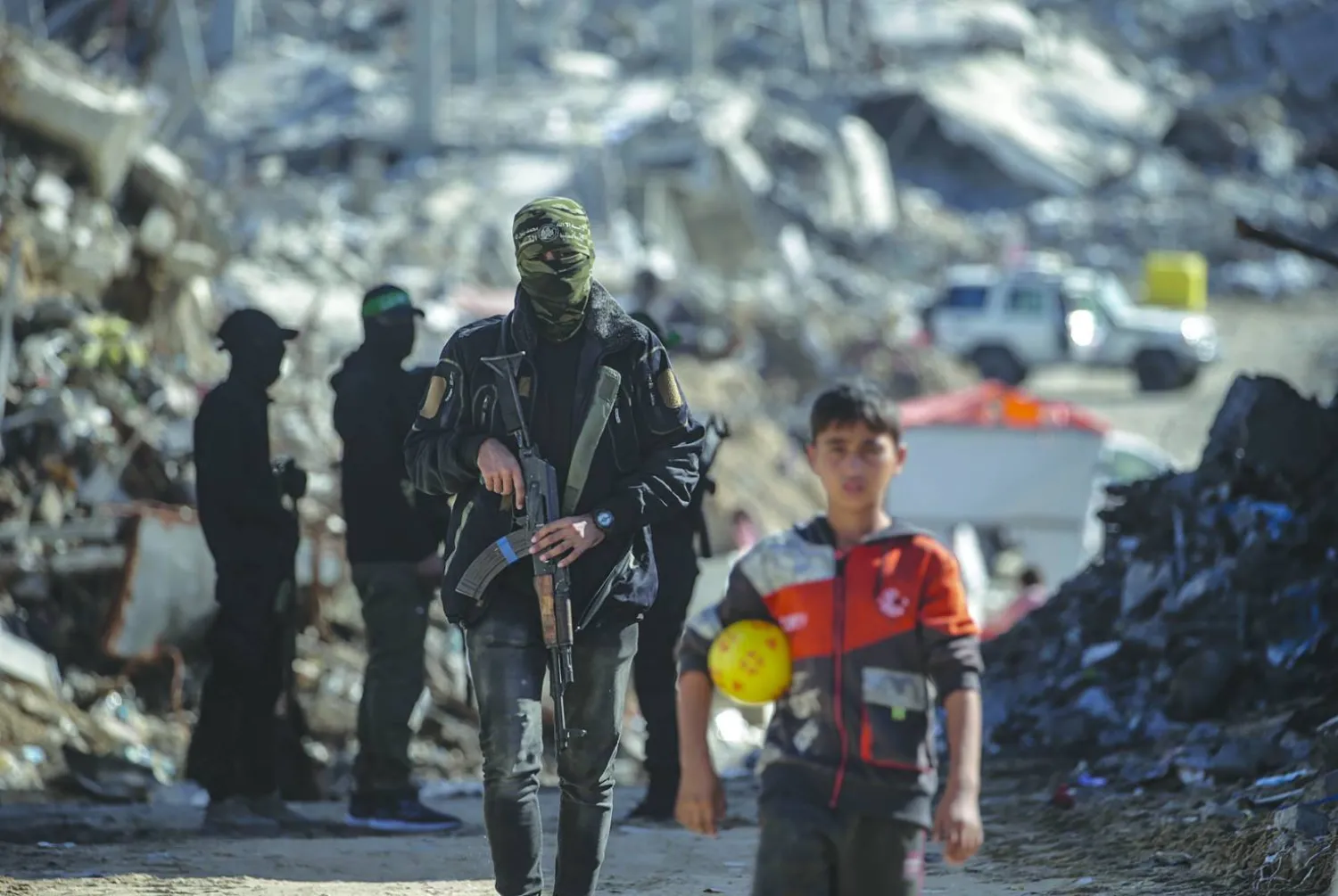
A Palestinian child is seen as fighters from Hamas’ Qassam Brigades search for the bodies of Israeli hostages in the Jabalia refugee camp in northern Gaza, last December. (EPA)
TT

Hamas Leaders Prepare for 'Safe Exit' from Gaza, Amid Doubts Over Return

A Palestinian child is seen as fighters from Hamas’ Qassam Brigades search for the bodies of Israeli hostages in the Jabalia refugee camp in northern Gaza, last December. (EPA)

Sources within Hamas in Gaza revealed that senior figures in the movement are preparing for a “safe exit” from the enclave following arrangements related to Gaza’s future under the second phase of the ceasefire agreement, which the United States announced had begun last week.

Three Hamas sources told Asharq Al-Awsat that several prominent political and military leaders who survived the war are preparing to leave the territory. One source said the departure would be voluntary and carried out under specific arrangements, with full coordination with the Hamas leadership abroad. Another source noted that other leaders, particularly military figures, categorically reject leaving Gaza under any circumstances.

Throughout nearly two years of war, Hamas officials have repeatedly stated their rejection of removing the movement’s leadership from the Strip.

The sources separately provided Asharq Al-Awsat with the names of several leaders believed likely to depart, though it is refraining from publishing them due to the inability to contact them promptly. Some of these figures were recently appointed to leadership positions in Hamas’ political bureau in Gaza as part of new organizational arrangements aimed at rebuilding and restructuring the movement.

According to the same sources, a number of former prisoners released in the 2011 exchange deal for Israeli soldier Gilad Shalit — who now oversee key portfolios within Hamas leadership — are expected to be among those traveling to Türkiye.

However, a senior Hamas leader based outside Gaza denied the reports, telling Asharq Al-Awsat that the issue of leaders leaving the Strip “has not been raised.”

Another source inside Gaza declined to comment, saying only that he had no knowledge of the matter.

Sources in Gaza said the exit would likely be “without return, at least for several years,” with those leaders likely to end up residing in several countries. Other sources said some leaders would leave temporarily to hold meetings in Egypt with security officials on critical issues related to Gaza’s governmental security forces and other key files, before returning to the Strip.

In September, Israeli Prime Minister Benjamin Netanyahu said in an interview with Fox News that Israel was considering providing safe passage for Hamas leaders to leave Gaza under certain conditions, as part of a plan being prepared by US President Donald Trump, which entered into force in October.

Israel’s public broadcaster reported that Hamas leaders would most likely head to Qatar or Türkiye if they left Gaza. Israel’s Channel 12 previously reported that Hamas officials told US officials they were prepared to accept a limited relocation of military leaders and some operatives from Gaza.

On Jan. 14, US envoy Steve Witkoff officially announced the launch of the second phase of the ceasefire, which includes Hamas relinquishing control of Gaza, establishing a Palestinian technocratic committee to administer the enclave, initiating a comprehensive disarmament process, and launching large-scale reconstruction projects.

Hamas welcomed the announcement, saying it had fulfilled all requirements for completing the first phase and moving to the second, while continuing discussions with mediators over options regarding its weapons and those of other Palestinian factions.




Russia, Egypt Discuss Means to Secure Energy, Food Supplies

Russian President Vladimir Putin receives Egyptian Foreign Minister Badr Abdelatty in Moscow on Thursday. (Egyptian Foreign Ministry)
TT

Russia, Egypt Discuss Means to Secure Energy, Food Supplies

Russian President Vladimir Putin receives Egyptian Foreign Minister Badr Abdelatty in Moscow on Thursday. (Egyptian Foreign Ministry)

Egypt stressed on Thursday its keenness on developing its bilateral ties and strategic partnership with Russia, along with coordinating over regional and international affairs, most notably the impact of the war on Iran.

Russian President Vladimir Putin received in Moscow on Thursday Egyptian Foreign Minister Badr Abdelatty, who handed him a message from President Abdel Fattah al-Sisi that tackled bilateral ties and the strategic partnership between their countries.

The FM had arrived in Moscow on Wednesday on a visit aimed at exploring means to develop bilateral cooperation and exchange views on several regional issues.

Experts said the visit aimed at “bolster balances in alliances and secure energy and food supplies.”

During his talks with Abdelatty, Putin hailed the depth of Egyptian-Russian ties and the fruitful cooperation in all fields.

He praised the role Sisi is playing in leading mediation to ease the escalation, support security and stability in the Middle East and prevent the conflict from expanding, said the Egyptian Foreign Ministry.

Abdelatty and Putin discussed the “intense diplomatic efforts aimed at de-escalation in the Middle East.” They also tackled the outcomes of the ministerial meeting that was held in Pakistan earlier this week that brought together the foreign ministers of Saudi Arabia, Egypt, and Türkiye to discuss the conflict.

Calm and diplomacy are the best choices to avoid the expansion of the conflict, they stressed.

Sisi and Putin held telephone talks on Tuesday during which the former stressed the need for de-escalation in the Middle East.

Russia, with its international standing, can use its influence to end the war, he added.


UN Resumes Operations in Sudanese Capital after 3 Years of War

Officials are seen at the reopening ceremony in Khartoum. (Asharq Al-Awsat)
TT

UN Resumes Operations in Sudanese Capital after 3 Years of War

Officials are seen at the reopening ceremony in Khartoum. (Asharq Al-Awsat)

The United Nations announced on Thursday that it was officially resuming operations in the Sudanese capital Khartoum after three years of war.

UN Resident Coordinator and Humanitarian and Development Coordinator in Sudan Denise Brown said the move was significant and allows UN agencies to reach all areas that were previously inaccessible.

Speaking at a press conference at the UN mission in central Khartoum, she added that the organization will continue its support to the state and individuals to end the war and reconstruct Sudan.

The UN quit Khartoum for Port Sudan shortly after the eruption of the war between the army and Rapid Support Forces in April 2023.

Sudanese Foreign Minister Mohi El-Din Salem said the UN’s return to Khartoum was an important message to internal partners that “we are working side by side to restore peace and stability in Sudan.”

“As we have reclaimed Khartoum from the rebel RSF, we will reclaim the regions of Darfur and Kordofan,” he told a press conference.

“We will work with the UN through the initiative proposed by Prime Minister Kamil Idris to the Security Council in December to end the war and restore peace and stability in Sudan,” he stressed.

Moreover, he said that Sudan was “open to all initiatives to reach sustainable peace,” while also rejecting any truce that allows the RSF to return to the Sudanese scene.

Sudan and the UN will work together to restore stability through intra-Sudanese dialogue, declared the FM. “Only the Sudanese people will decide the fate of their country.”


IOM Warns of 'Alarming' Risk of Long-term Mass Displacement in Lebanon

The rubble of a destroyed building, seen from inside a heavily damaged building, after an Israeli strike, amid escalating hostilities between Israel and Hezbollah, as the US-Israeli conflict with Iran continues, in Tyre, Lebanon, April 2, 2026. REUTERS/Yara Nardi
TT

IOM Warns of 'Alarming' Risk of Long-term Mass Displacement in Lebanon

The rubble of a destroyed building, seen from inside a heavily damaged building, after an Israeli strike, amid escalating hostilities between Israel and Hezbollah, as the US-Israeli conflict with Iran continues, in Tyre, Lebanon, April 2, 2026. REUTERS/Yara Nardi

International Organization for Migration chief Amy Pope told AFP on Thursday in Beirut that the prospects for prolonged mass displacement in Lebanon, where Israel and Hezbollah are at war, were "very alarming".

"I think those prospects are very alarming because you look right now at the level of destruction that's happening and... the further destruction that has been threatened," she said when asked about the possibility of prolonged mass displacement.

"There are parts of the south that are being completely flattened... even if the war ends tomorrow, that destruction remains and there needs to be a rebuilding," she said, noting that reconstruction would require funding, resources and peace.

"Unless we start to see those things come into place, that means that people will be displaced now for who knows how long," she added.

Lebanon says more than one million people have been displaced since the country was drawn into the Middle East war last month when the Tehran-backed Hezbollah launched rockets at Israel to avenge the US-Israeli attack that killed Iran's supreme leader Ali Khamenei.

Israel has responded with massive strikes across Lebanon and a ground invasion, and has issued sweeping evacuation warnings for swathes of south Lebanon and Beirut's densely populated southern suburbs.

Authorities say more than 136,000 people are staying in collective shelters including schools and stadiums, while some people are sleeping on the streets.

Israeli Defense Minister Israel Katz has said his country's military would occupy a swathe of southern Lebanon even after the war ends, and that the return of hundreds of thousands of displaced Lebanese would be "completely prevented" until northern Israel's security was ensured.

- 'Shocking' -

Pope said the current displacement crisis was "far more severe" than during the previous hostilities between Hezbollah and Israel which a 2024 ceasefire sought to end.

She noted the high number of displaced people, shelters struggling to cope and the fact that some people had been unable to return home after being displaced during the previous round of fighting.

People outside Lebanon "absolutely do not understand the scale" of the displacement crisis, which is "coming at a time where resources for humanitarian response are more limited than ever", she said.

The UN has launched a flash humanitarian appeal for more than $300 million for Lebanon, including an IOM appeal for around $19 million, Pope said, "but very, very little of that has now come in".

"We're seeing some of the most basic life-saving support really be needed," she said, including shelter and blankets.

Pope also said a strike this week on Beirut's Jnah district damaged the IOM premises nearby, shattering windows and rendering the agency's health clinic for migrants "basically unusable".

Authorities said the strike killed seven people, while Israel said it killed a senior Hezbollah commander.

Israel has also carried out several strikes on locations near where displaced people have been sheltering or on hotels or apartments reportedly rented by displaced people.

Pope said such strikes were "shocking".

"If people can't find safety, they move. And if they can't find safety at home, they move across borders," she warned.