


Iran Warns ‘Finger on Trigger’ as Trump Says Tehran Wants Talks

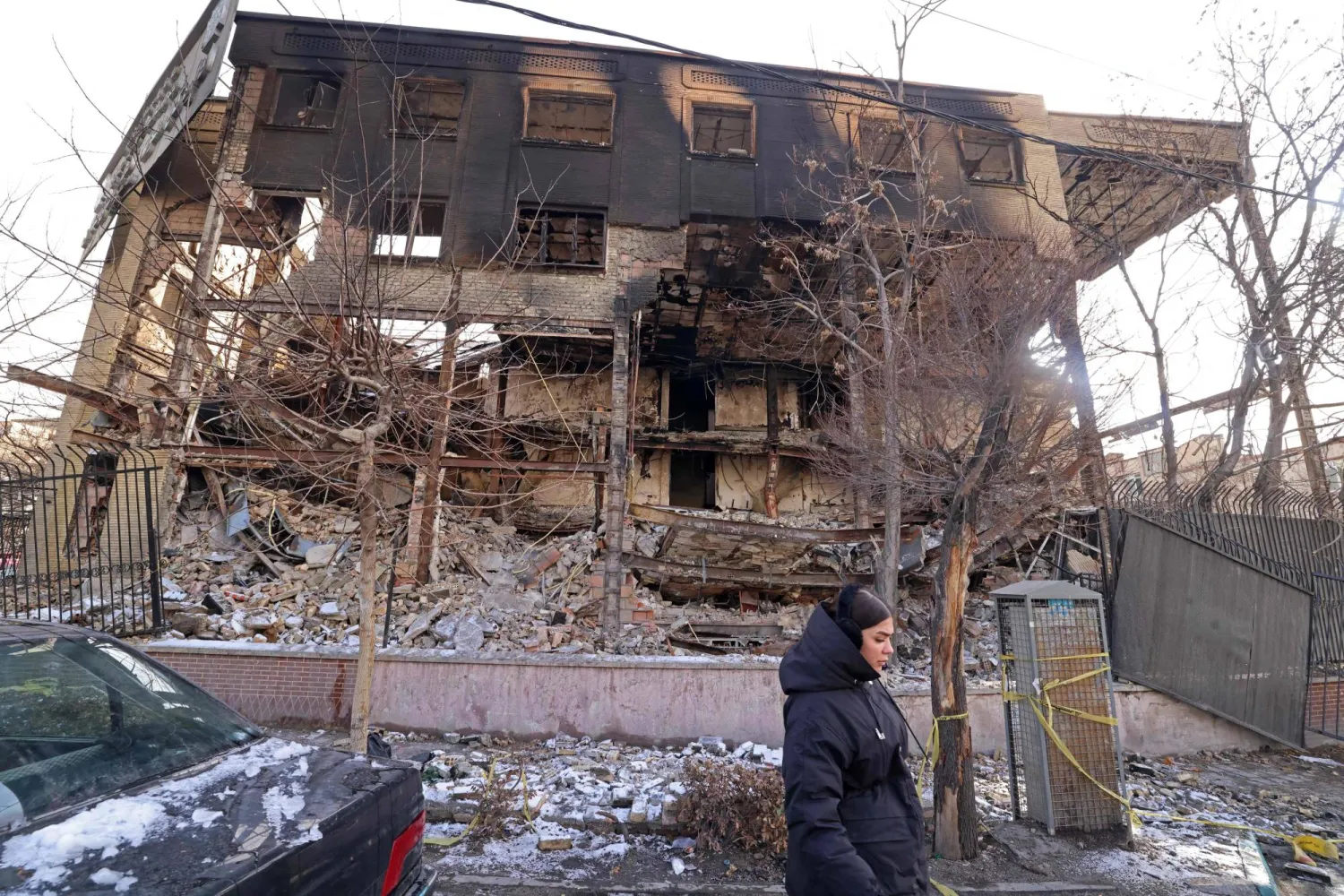
This photograph taken during a tour for foreign media shows a woman walking past a government building that was burned during recent public protests, in Tehran on January 21, 2026. (AFP)
TT

Iran Warns ‘Finger on Trigger’ as Trump Says Tehran Wants Talks

This photograph taken during a tour for foreign media shows a woman walking past a government building that was burned during recent public protests, in Tehran on January 21, 2026. (AFP)

The commander of Iran's Revolutionary Guards warned Washington Thursday that the force had its "finger on the trigger" in the wake of mass protests, as US President Donald Trump said Tehran still appeared interested in talks.

Trump has repeatedly left open the option of new military action against Iran after Washington backed and joined Israel's 12-day war in June aimed at degrading Iranian nuclear and ballistic missile programs.

Trump said Thursday a US naval "armada" was heading toward the Gulf, adding: "We're watching Iran."

A fortnight of protests starting in late December shook Iran's clerical leadership under supreme leader Ali Khamenei, but the movement has petered out in the face of a crackdown that activists say killed thousands, accompanied by an unprecedented internet blackout.

The prospect of immediate American action against Tehran appears to have receded, with both sides insisting on giving diplomacy a chance.

On his way back from the World Economic Forum in Davos, Trump told reporters on Air Force One the United States was sending a "massive fleet" toward Iran "just in case."

"I'd rather not see anything happen but we're watching them very closely," he added.

In a standoff marked by seesawing rhetoric, Trump had on Tuesday warned Iran's leaders the United States would "wipe them off the face of this Earth" if there was any attack on his life in response to a strike targeting Khamenei.

Iranian President Masoud Pezeshkian in a speech Thursday accused the United States and Israel of stoking the protests as a "cowardly revenge... for the defeat in the 12-Day War".

- 'Legitimate targets' -

Guards commander General Mohammad Pakpour warned Israel and the United States "to avoid any miscalculations, by learning from historical experiences and what they learned in the 12-day imposed war, so that they do not face a more painful and regrettable fate".

"The Revolutionary Guard Corps and dear Iran have their finger on the trigger, more prepared than ever, ready to carry out the orders and measures of the supreme commander-in-chief," he said.

Pakpour's comments came in a written statement quoted by state television marking the national day in Iran to celebrate the Guards, whose mission is to protect the 1979 revolution from internal and external threats.

Activists accuse the Guards of playing a frontline role in the deadly crackdown on protests.
The group is sanctioned as a terrorist entity by countries including Australia, Canada and the United States, and campaigners have long urged similar moves from the EU and UK.

Another senior military figure, General Ali Abdollahi Aliabadi who leads the Iranian joint command headquarters, meanwhile warned that if America attacked, "all US interests, bases and centers of influence" would be "legitimate targets" for Iran's armed forces.

- Real toll? -

Giving their first official toll from the protests, Iranian authorities on Wednesday said 3,117 people were killed.

The statement from Iran's foundation for martyrs and veterans sought to draw a distinction between "martyrs", members of security forces or innocent bystanders, and what it called US-backed "rioters".

Of its toll of 3,117, it said 2,427 people were "martyrs".

Pezeshkian said Thursday that protest "is the natural right of citizens", but a distinction had to be drawn between protesters "whose hands are stained with the blood of innocent people".

However, rights groups say the heavy toll was caused by security forces firing directly on protesters and that the actual number of dead could be far higher, even more than 20,000.

Efforts to confirm the scale of the toll have been hampered by the national internet shutdown, with monitor Netblocks saying Thursday the blackout had surpassed "two full weeks".

"All the evidence gradually emerging from inside Iran shows that the real number of people killed in the protests is far higher than the official figure," said the director of the Iran Human Rights NGO Mahmood Amiry-Moghaddam, saying the authorities' toll has "no credibility whatsoever".

Warning that their own current tolls do not reflect the true number of fatalities, IHR says it has verified at least 3,428 killings. Another NGO, US-based Human Rights Activists News Agency (HRANA), has documented 4,902 deaths.

According to HRANA, at least 26,541 people have been arrested. On Thursday alone, state TV announced over 200 more arrests in provinces including Kermanshah in the west and Isfahan in central Iran.



France PM Survives No-Confidence Vote Over Forced Budget

France's Prime Minister Sebastien Lecornu reacts after the second of the two votes on a no-confidence motion at the Assemblee Nationale, France's Parliament lower house in Paris on January 23, 2026. (AFP)
TT

France PM Survives No-Confidence Vote Over Forced Budget

France's Prime Minister Sebastien Lecornu reacts after the second of the two votes on a no-confidence motion at the Assemblee Nationale, France's Parliament lower house in Paris on January 23, 2026. (AFP)

French Prime Minister Sebastien Lecornu survived a no-confidence vote Friday following his move to force his budget through parliament, in a symbolic victory with more such challenges expected.

Lecornu on Tuesday used a constitutional power to ram part of the 2026 budget through parliament without a vote, after making concessions to gain the backing of the Socialists.

The key swing group showed their support Friday by blocking the no-confidence motion filed by the hard left from passing.

A second no-confidence motion filed by the far right was also blocked.

Lecornu will have to use the same constitutional power twice more to enact the full budget into law, exposing Lecornu to further no-confidence motions.

"Things are now at an impasse. The text can no longer be voted on. And we believe France must have a budget," the prime minister said on Tuesday.

The move marked a rowback for Lecornu who pledged last year to seek parliament's approval, in a bid to avoid the fate of his two predecessors who were ousted over budget negotiations.

But on Monday, Lecornu conceded with "a certain degree of regret and a bit of bitterness" that he had to invoke the power to push the budget through.

Ahead of Friday's vote, the Socialists signaled that the use of the measure was "the least bad solution" and the latest draft showed "progress" with concessions including an increase in a top-up benefit for the lowest-paid employees and the rollout of one-euro meals for students.

After the second part of the budget is rammed through on Friday, likely triggering another no-confidence motion, the budget text must then be reviewed by the upper-house Senate before returning to the National Assembly for final adoption.


Iran Lambasts Zelensky after Davos 'Bully' Warning

Ukrainian President Volodymyr Zelenskyy delivers a speech at the annual meeting of the World Economic Forum in Davos, Switzerland, January 22, 2026 (AP)
TT

Iran Lambasts Zelensky after Davos 'Bully' Warning

Ukrainian President Volodymyr Zelenskyy delivers a speech at the annual meeting of the World Economic Forum in Davos, Switzerland, January 22, 2026 (AP)

Iran's foreign minister on Friday launched a furious tirade against Volodymyr Zelensky after the Ukrainian president commented in Davos that the deadly crackdown on protests in Iran showed that if authorities "kill enough people" they stay in power.

Zelensky, whose country has been fighting the full-scale Russian invasion for almost four years, said in a speech at the World Economic Forum on Thursday that if Iran's clerical leadership was able to remain in power, it was a "clear signal to every bully".

Russian President Vladimir Putin is an ally of Iran’s leadership under Ali Khamenei and last week held telephone talks with President Masoud Pezeshkian, with both sides agreeing to ramp up bilateral ties.

Foreign Minister Abbas Araghchi responded to Zelensky's comments with a broadside of accusations and claims in an English-language post on X, saying the Ukrainian leader had been "rinsing American and European taxpayers to fill the pockets of his corrupt generals".

"The world has had enough of Confused Clowns, Mr Zelensky," he said, in apparent reference to the Ukrainian leader's previous career as a wildly-successful comedian and comic actor.

"Unlike your foreign-backed and mercenary-infested military, we Iranians know how to defend ourselves and have no need to beg foreigners for help," he added.

Foreigners are fighting in the Ukrainian army but make up only a tiny percentage of the armed forces.

- 'Drowned in blood' -

Kyiv and the West accuse Iran of providing drones and ballistic missiles to Russia for use in Ukraine. Tehran has repeatedly denied sending any weapons to Russia.

In his speech in Davos, Zelensky appeared to cite the response to the protests as another example of Western inaction in the face of aggression.

"There was so much talk about the protests in Iran -- but they drowned in blood. The world has not helped enough the Iranian people, it has stood aside," he said, speaking in English.

Zelensky noted that the start of the protests coincided with the Christmas and New Year holidays in Europe.

"What will Iran become after this bloodshed? If the regime survives, it sends a clear signal to every bully -- kill enough people, and you stay in power," he said.

Iranian authorities have said well over 3,000 people were killed in the protests but have blamed the violence on "rioters" backed by the United States and Israel.

Rights groups however say the toll is far higher and could be as much as 20,000, adding that confirming the numbers is hugely impeded by the now two-week shutdown of the internet in Iran.

NGOs, including Amnesty International, have accused security forces of deliberately firing on protesters to suppress the demonstrations, which have now petered out.


Iranian Prosecutor Denies Trump’s Claim 800 Prisoners Were Spared Execution

This photograph taken during a tour for foreign media shows a media representative walking past the parked buses that were burned at a depot during recent public protests, in Tehran on January 21, 2026. (AFP)
TT

Iranian Prosecutor Denies Trump’s Claim 800 Prisoners Were Spared Execution

This photograph taken during a tour for foreign media shows a media representative walking past the parked buses that were burned at a depot during recent public protests, in Tehran on January 21, 2026. (AFP)

Iran’s top prosecutor on Friday called US President Donald Trump’s repeated claims that he halted the hangings of 800 detained protesters there “completely false.” Meanwhile, the overall death toll from a bloody crackdown on nationwide demonstrations rose to at least 5,002, activists said.

Activists fear many more are dead. They struggle to confirm information as the most comprehensive internet blackout in Iran's history has crossed the two-week mark.

Tensions remain high between the United States and Iran as an American aircraft carrier group moves closer to the Middle East, something Trump likened to an “armada” in comments to journalists late Thursday.

Analysts say a military buildup could give Trump the option to carry out strikes, though so far he's avoided that despite repeated warnings to Tehran. The mass execution of prisoners had been one of his red lines for military force — the other being the killing of peaceful demonstrators.

“While President Trump now appears to have backtracked, likely under pressure from regional leaders and cognizant that airstrikes alone would be insufficient to implode the regime, military assets continue to be moved into the region, indicating kinetic action may still happen,” New York-based think tank the Soufan Center said in an analysis Friday.

Prosecutor denies Trump claim

Trump has repeatedly said Iran halted the execution of 800 people detained in the protests, without elaborating on the source of the claim. On Friday, Iran’s top prosecutor Mohammad Movahedi strongly denied that in comments carried by the judiciary’s Mizan news agency.

“This claim is completely false; no such number exists, nor has the judiciary made any such decision,” Movahedi said.

His remarks suggested that Iran’s Foreign Ministry, led by Abbas Araghchi, may have offered that figure to Trump. Araghchi has had a direct line to US envoy Steve Witkoff and conducted multiple rounds of negotiations over Iran’s nuclear program with him.

“We have a separation of powers, the responsibilities of each institution are clearly defined, and we do not, under any circumstances, take instructions from foreign powers,” Movahedi said.

Judiciary officials have called some of those being held “mohareb” — or “enemies of God.” That charge carries the death penalty. It had been used along with others to carry out mass executions in 1988 that reportedly killed at least 5,000 people.

Meanwhile, Mohammad Javad Haji Ali Akbari, the Friday prayer leader in Tehran, mocked Trump as a “yellow-faced, yellow-haired and disgraced man".

“That foolish man has resorted to threatening the nation, especially over what he said about Iran’s leader,” the cleric said in comments aired by Iranian state radio. ”If any harm were to occur, all your interests and bases in the region would become clear and precise targets of Iranian forces.”

Death toll rises 

The latest death toll was given by the US-based Human Rights Activists News Agency, which reported that 4,716 of the dead were demonstrators, 203 were government-affiliated, 43 were children and 40 were civilians not taking part in the protests. It added that more than 26,800 people had been detained in a widening arrest campaign by authorities.

The group's figures have been accurate in previous unrest in Iran and rely on a network of activists in Iran to verify deaths. That death toll exceeds that of any other round of protest or unrest in Iran in decades, and recalls the chaos surrounding Iran's 1979 revolution.

Iran’s government offered its first death toll Wednesday, saying 3,117 people were killed. It added that 2,427 of the dead in the demonstrations that began Dec. 28 were civilians and security forces, with the rest being “terrorists.” In the past, Iran’s theocracy has undercounted or not reported fatalities from unrest.

The Associated Press has been unable to independently assess the death toll, in part because of authorities cutting access to the internet and blocking international calls into the country.

US warships on the move 

The American military meanwhile has moved more military assets toward the Mideast, including the aircraft carrier USS Abraham Lincoln and associated warships traveling with it from the South China Sea.

A US Navy official, who spoke on condition of anonymity to discuss military movements, said Thursday that the Lincoln strike group is in the Indian Ocean.

Trump said Thursday aboard Air Force One that the US is moving the ships toward Iran “just in case” he wants to take action.

“We have a massive fleet heading in that direction and maybe we won’t have to use it,” Trump said.

Trump also mentioned the multiple rounds of talks that American officials had with Iran over its nuclear program prior to Israel launching a 12-day war against the country in June, which saw US warplanes bomb Iranian nuclear sites. He threatened Iran with military action that would make earlier US strikes against its uranium enrichment sites “look like peanuts.”

“They should have made a deal before we hit them,” Trump said.

The UK Defense Ministry separately said that its joint Eurofighter Typhoon fighter jet squadron with Qatar, 12 Squadron, “deployed to the Gulf for defensive purposes noting regional tensions.”

Iran shows off drones in Israel threat

Iran commemorated “the Day of the Guardian” on Friday, an annual event for its paramilitary Revolutionary Guard, which was key in putting down the nationwide protests.

To mark the day, an Iranian state television channel aired a typically religious talk show Thursday night that instead saw its cleric and prayer singers look at Iranian military drones. They fired up the engines of several of the Shahed drones, one version of which has been used extensively by Russia in its war on Ukraine.

A man identified as a member of the security forces, who wore a surgical mask and sunglasses during the telecast to hide his identity, also made a threat in mangled Hebrew toward Israel, trying to say: “We are closer to you than you think.”