


The Trends at Paris Fashion Week Are Statement Coats, Even Bigger Shoulders and Sharp Tailoring

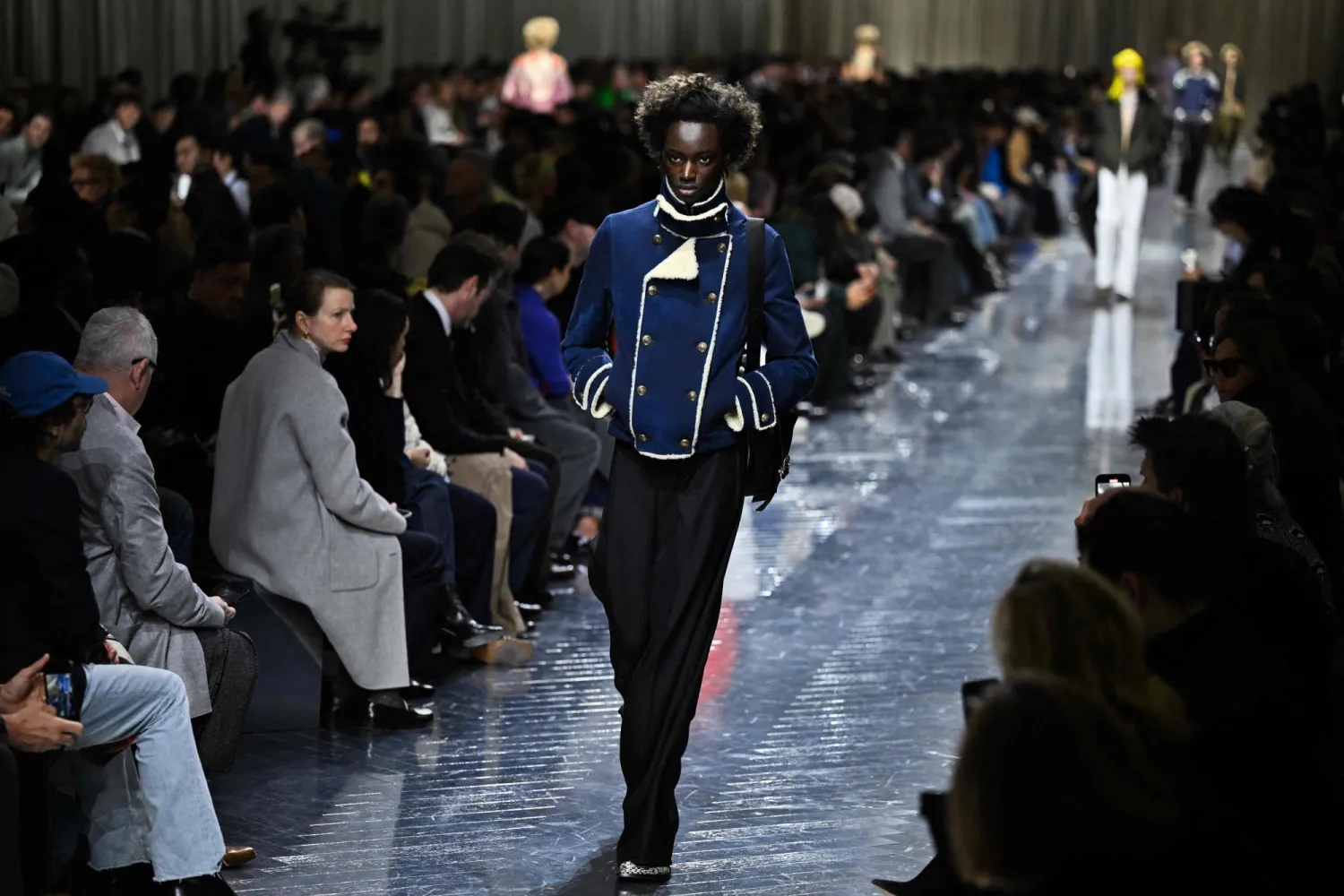
 A model presents a creation by Dior for the Menswear Ready-to-wear Fall-Winter 2026/2027 collection as part of the Men Paris Fashion Week in Paris on January 21, 2026. (AFP)
A model presents a creation by Dior for the Menswear Ready-to-wear Fall-Winter 2026/2027 collection as part of the Men Paris Fashion Week in Paris on January 21, 2026. (AFP)
TT

The Trends at Paris Fashion Week Are Statement Coats, Even Bigger Shoulders and Sharp Tailoring

 A model presents a creation by Dior for the Menswear Ready-to-wear Fall-Winter 2026/2027 collection as part of the Men Paris Fashion Week in Paris on January 21, 2026. (AFP)
A model presents a creation by Dior for the Menswear Ready-to-wear Fall-Winter 2026/2027 collection as part of the Men Paris Fashion Week in Paris on January 21, 2026. (AFP)

Paris men’s Fashion Week has been arguing for a new kind of authority this season — coat-first.

Across the runways, statement outerwear, bigger shoulders and sharp tailoring have been doing the work, turning familiar staples — trench coats, suits, denim and workwear — into clothes with a harder stance.

With the fashion week heading into its final stretch, the common thread is a push to make menswear more protective, performance-minded and built for real life, without losing the showmanship that defines Paris.

That argument landed most clearly at Dior Men, where Jonathan Anderson bent classic codes into new proportions, and Louis Vuitton, where Pharrell Williams framed luxury as practical convenience — heritage shapes upgraded with weatherproofing, reflectivity, reversibility and engineered comfort.

Other designers from Ami Paris to Rick Owens, Yohji Yamamoto and IM Men at Issey Miyake worked along the same lines: rebuild the shoulder, reshape the body, and lean into the idea of uniform, not as costume, but as modern equipment.

Celebrity presence raises the stakes

Paris menswear is also being driven by celebrity gravity, the kind that turns a runway into a global moment within minutes.

Dior’s room was packed with VIPs including Robert Pattinson, Lewis Hamilton and SZA.

Louis Vuitton delivered a front row mixing music, film and online fame — SZA, Usher, Future and Jackson Wang among them — plus a runway cameo from BamBam of GOT7.

The clothes are the product, but the frenzy is amplified by who is watching, who is posting, and who is seen.

A season built on ‘classic, but smarter’

Instead of chasing novelty for its own sake, many designers are taking familiar silhouettes and making them perform.

At Vuitton, Williams’ show was filled with recognizable pieces — double-breasted suits, blousons, polished outerwear; then the twist arrived in the materials and construction.

Tailoring carried reflective elements for night visibility.

Jackets turned into water-repellent hybrids.

Fabrics were lightened, waterproofed and sometimes embellished with crystal details that mimicked raindrops.

Accessories followed the same logic: caps designed to be crushed and returned to shape; shoes built to flex more like sneakers while still reading as traditional footwear.

The message was clear: luxury is not only a look. It is also capability.

The silhouette: shoulders, height, and controlled volume

Across brands, the silhouette focus moved upward. The shoulder became the season’s main design focus — where structure, protection and attitude all meet.

Anderson’s Dior treated tailoring history as a series of pivots.

Jackets nodded to the 1940s and early 1960s, then were cut abruptly short or shrunken to expose the hipbone.

Ordinary pieces were pushed into new scale, including a round-neck sweater extended to ankle length.

Throughout, he made the familiar feel new by changing proportion, fabric or what it was paired with.

IM Men also leaned into shoulder architecture, remixing outerwear by blending storm flaps into trench coats and amplifying volume.

Yohji Yamamoto used padding along arms and legs to give different bodies a similar shape, then controlled that bulk with buttons and adjustable details.

Even when designers disagreed on mood — sharp, romantic, severe, strange — they converged on shape: the body is being redesigned.

The mood: protection, uniform and modern armor

There has also been a clear emotional undercurrent: protection. Paris is dressing men for a world that feels harder, more uncertain, and more public.

Rick Owens described thinking about police uniforms and the impulse to mock a threat as a way of processing it.

His runway delivered skinny foundations, then added cropped jackets, tactical hybrids, leather and Kevlar-like materials, and ambiguous details that hinted at insignia without turning into costume.

His question — “sheriffs or outlaws?” — captured the season’s tension between authority and rebellion.

Yamamoto also drew from army and working clothes, but described a softer kind of protection: enveloping layers meant to endure long stretches outdoors.

IM Men’s draped, layered looks pushed a related idea, less militant than nomadic: clothing as shelter.

Paris wearability, sharpened

For all the experimentation, the week has not abandoned everyday dressing.

Ami Paris’ anniversary show was built on an idea of real Parisian style — camel coats, stripes, denim, clean tailoring — then refined through better proportion and styling.

The clothes were designed to mix easily, with small shifts that made them feel current: longer coats that sit better on the shoulder and cleaner lines.

The takeaway is that the daily wardrobe still matters, but it is being tightened and upgraded.

Dries Van Noten sharpened that idea with color and craft. Julian Klausner built the show around “coming of age" — men leaving home in hand-me-down coats, then made knitwear the engine, from structured-shoulder cardigans to patterned collar pieces on narrow coats and cloaks.

He also brought kilts and skirt-like belted layers back into the mix.

Saturated, pattern-heavy coats, including Polaroid florals and patchworked panels, showed how Paris can make a wardrobe feel new through layering, proportion and finish.

Styling as the signal

Many of the season’s strongest statements have come from styling as much as garments.

At Dior, Anderson’s “anti-normal” attitude appeared in wild wigs and ruff collars that turned what was formal and old into something sharp and slightly dangerous.

At Vuitton, the styling did the opposite — staying restrained — while letting materials and construction carry the message: classic shapes, but built for movement and weather.

While Dior and Vuitton set the tone, the rest of the schedule reinforced it in different registers — wearability with precision at Ami, confrontation and control at Owens, protection through layering at Yohji, and sculpted outerwear at IM Men.

With the week ending Sunday, the final shows will decide whether this season’s turn toward function and shape becomes a deeper shift or remains a Paris moment where luxury briefly proved it can be practical, too.

Stars Turn Out for Valentino’s Funeral in Rome

US actor Anne Hataway (C), along with her husband Adam Shulman (L), arrives to attend Valentino Garavani's funeral at the Basilica of S. Maria degli Angeli e dei Martiri in Rome, Italy, 23 January 2026. (EPA)
TT

Stars Turn Out for Valentino’s Funeral in Rome

US actor Anne Hataway (C), along with her husband Adam Shulman (L), arrives to attend Valentino Garavani's funeral at the Basilica of S. Maria degli Angeli e dei Martiri in Rome, Italy, 23 January 2026. (EPA)

Anne Hathaway and Donatella Versace were among the stars who attended the funeral Friday of legendary Italian designer Valentino Garavani, with some mourners wearing touches of his trademark red in tribute.

Rome's Basilica of Saint Mary of the Angels and of the Martyrs was decorated with wreaths of white roses while a large photo of the designer, who died on Monday aged 93, was placed in front of the altar.

Throughout a long career, Valentino dressed some of the world's most elegant women, from Elizabeth Taylor and Jackie Kennedy to Princess Diana, Julia Roberts and Gwyneth Paltrow.

Hollywood actress Hathaway, who attended the funeral with her husband Adam Shulman, this week paid tribute to a "titan of a designer" who was also a friend with whom she shared dancing and karaoke.

He "made my world so much brighter, grander and more delightful than I could have ever understood it to be", she wrote on Instagram.

"Now he rests forever surrounded by eternal beauty, a most fitting next chapter for the one true Emperor who gifted us all a legacy of unparalleled magnificence... I love you my darling, and I miss you already," she wrote.

Designers Versace, Tom Ford, Alessandro Michele -- the creative director of Valentino -- Balenciaga's Pier Paolo Piccioli, Anna Fendi and Brunello Cucinelli were also among the guests, as was fashion editor Anna Wintour.

Most of the mourners -- who also included many of Valentino's employees -- wore black. But several wore a red hat, scarf or shawl, recalling the designer's signature color.

Valentino died on Monday at his home in Rome, and his coffin was put on public display at his foundation in the city center on Wednesday and Thursday.

"We'll never find the class that Valentino had again," said one member of the public who came to pay his respects, Francesco Sangiovanni, 81.

"He conquered the world with his refinement... and he enhanced Italy, because he brought Italy to the world. The greatest people wore Valentino," he told AFP.


Paris Mourns Valentino, the Last Titan of Couture’s Golden Age

An Italian flag hangs at half-mast outside the Valentino Creative Headquarters, following the death of the fashion designer Valentino Garavani at the age of 93 on Monday, in Rome, Italy, January 20, 2026. (Reuters)
TT

Paris Mourns Valentino, the Last Titan of Couture’s Golden Age

An Italian flag hangs at half-mast outside the Valentino Creative Headquarters, following the death of the fashion designer Valentino Garavani at the age of 93 on Monday, in Rome, Italy, January 20, 2026. (Reuters)

Valentino Garavani’s death cast a long shadow over the opening day of Paris Fashion Week menswear Tuesday, with front-row guests and industry figures mourning the passing of one of the last towering names of 20th-century couture — an Italian designer whose working life was closely entwined with the Paris runways.

Valentino, 93, died at his Rome residence, the Valentino Garavani and Giancarlo Giammetti Foundation said in a statement announcing his death. While he built his house in Rome, he spent decades presenting collections in France.

He “was one of the last big couturiers who really embodied what was fashion in the 20th century,” said Pierre Groppo, fashion editor-in-chief at Vanity Fair France.

On a day meant to sell the future, many guests said they were thinking about what fashion has lost: the couturier as a living institution.

Groppo pointed to the codes that made Valentino instantly legible — “the dots, the ruffles, the knots” — and to a generation of designers who, he said, “in a way, invented what is celebrity culture.”

Valentino’s vision was built on a simple idea: make women look luminous, then make the moment unforgettable.

He dressed Jacqueline Kennedy Onassis and Elizabeth Taylor, among others, fixed his signature “Valentino red” in the public imagination, and — through his decades-long partnership with Giancarlo Giammetti — helped turn the designer himself into part of the spectacle, as recognizable as the clients in his front row.

The end of a fashion era

Prominent fashion writer Luke Leitch framed the loss in similarly outsized terms, calling Valentino “the last of the fashion ‘leviathans of that generation’,” and saying it was “absolutely” the end of a certain class of designer: figures whose names could carry a global house, and whose authority came not from viral speed but from permanence.

Trained in Paris before founding his maison in Rome, Valentino became a rare bridge figure: Italian by origin, but fluent in the rituals that made Paris couture an institution. His career moved between those two capitals of elegance, bringing Roman grandeur into a system that still treats fashion not only as commerce, but as ceremony.

Even as he aged, the house’s founder kept turning up at its couture and ready-to-wear shows, as observed by one Associated Press journalist — until he eventually retreated from public life, all the while radiating quiet grandeur from his front-row seat.

For some in Paris on Tuesday, the loss felt personal precisely because Valentino’s world was never only Italian.

Groppo recalled the designer as “very much more than a fashion brand,” adding: “It was a lifestyle.”

That lifestyle — couture polish, social glamour, and the conviction that elegance could be a form of power — remains a reference point even as fashion accelerates toward louder branding and faster cycles.

“It’s quite sad as he’s so important to the fashion industry, and he contributed a lot and I cannot forget the stunning red he created,” said Lolo Zhang, a Chinese fashion influencer attending Louis Vuitton ’s show in Paris.

“He always celebrated pure beauty, and architecture for the silhouette, and how he used color. The old era just passed by.”

Other guests described a delayed realization — the kind that arrives only when a figure who seemed permanent is suddenly gone.

YSL, Chanel and Valentino

“There are some people who want to be Yves Saint Laurent, Chanel. ... There are also people who are spontaneously Valentino,” said Guy-Claude Agboton, deputy editor of Ideat magazine. “It’s a question of identity.”

For Paris fashion observer Benedict Epinay, the grief was bound up with memory. And with the emotional charge of Valentino’s final bow.

“It was such a great moment. I was lucky enough to attend the last show he gave,” Epinay said. “It was so moving because we knew at that time it was the last show.”

Fashion observer Arfan Ghani pointed to what Valentino represented to younger designers: a “classy” standard of restraint in an era that often rewards noise.

“Because it was very classical materials," Ghani said. "It wasn’t as loud as a lot of other of these brands are with branding.”

Paris-based sculptor Ranti Bam described Valentino in the language of form: less trend than structure, less look than line.

“As a sculptor I saw Valentino as an artist,” Bam said. “He transcended fashion into sculpture.”

“He didn’t follow trends, he pursued form,” she added. “That’s why his work doesn’t date, it endures.”

The fashion house Valentino has for years continued under a new generation of leadership and design — still showcased in Paris.


Pharrell Opens Vuitton’s Monogram Anniversary Year With Cinematic Menswear Show

A model presents a creation from the Fall/Winter 2026/2027 collection by US designer Pharrell Williams for Louis Vuitton during the Paris Fashion Week, in Paris, France, 20 January 2026. (EPA)
TT

Pharrell Opens Vuitton’s Monogram Anniversary Year With Cinematic Menswear Show

A model presents a creation from the Fall/Winter 2026/2027 collection by US designer Pharrell Williams for Louis Vuitton during the Paris Fashion Week, in Paris, France, 20 January 2026. (EPA)

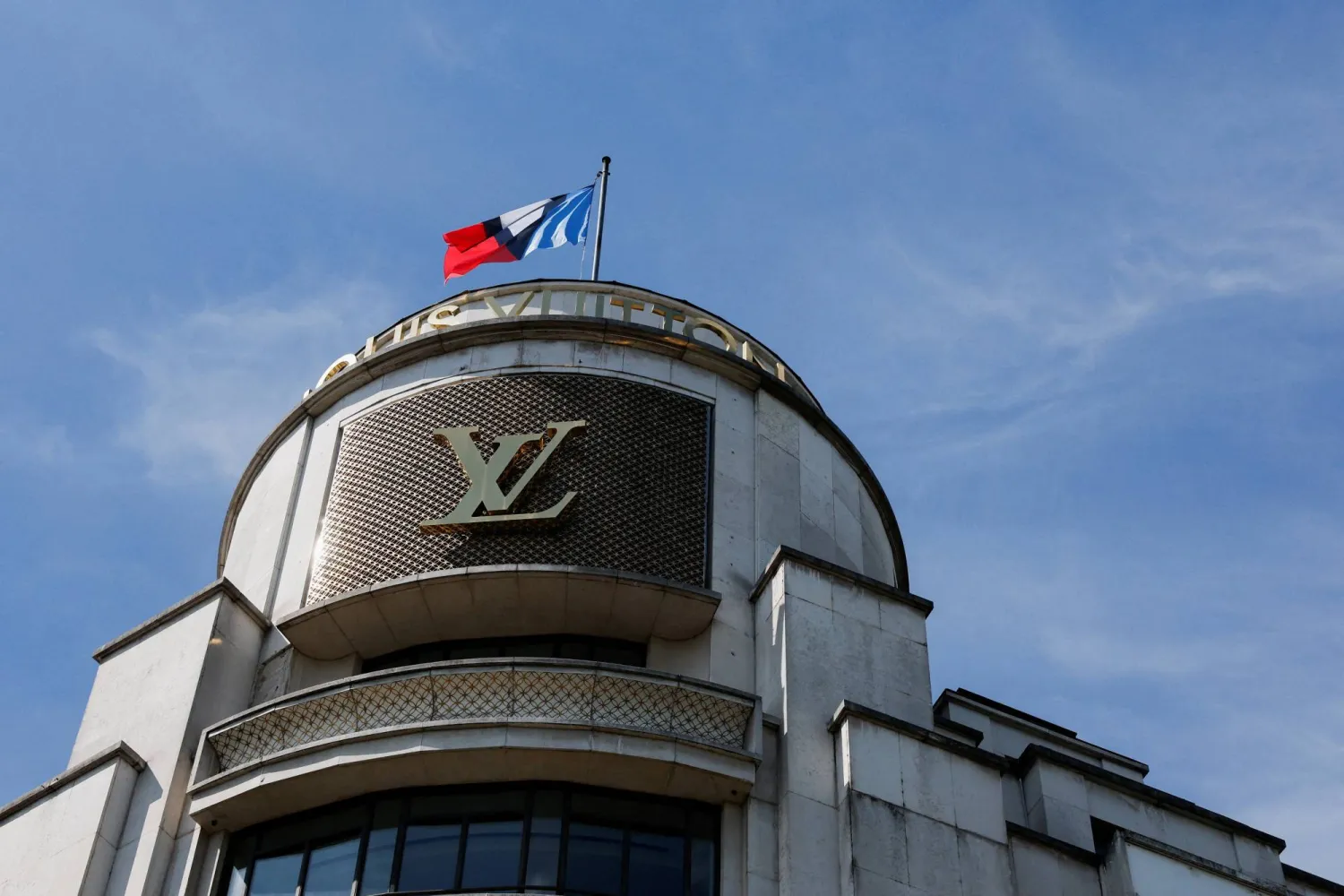
Pharrell Williams opened a celebration year for Louis Vuitton's monogram — marking the house’s 130th anniversary of its most recognizable signature — with a Fall-Winter 2026 men’s show that was equal parts brand pageant and movie set.

Inside the Louis Vuitton Foundation in Paris, the guests encircled the grassy runway. At its center sat a glass-walled, minimalist apartment — part bedroom, part display box — where models kept entering and exiting like characters crossing movie scenes.

It was also a celebrity-heavy room, with a front row mixing music, film and online fame — SZA, Usher, Future, Jackson Wang and others, plus a runway debut to seal the crossover: BamBam of Korean boy band GOT7.

The soundtrack did as much scene-setting as the set. A gospel choir and full orchestra performed live from the balconies, lifting what could have been a straightforward runway lap into something closer to a staged sequence: romantic, controlled, faintly grand.

On the clothes, Williams stayed inside his Vuitton DNA: readable from a distance, richer up close, and always tethered to the idea of travel and the house’s heritage goods.

This season’s lens was 1970s ease spiked with utility. The palette sat firmly in autumn-tonal grays, browns, black, denim, cream — then broke into jolts of bubblegum pink, baby blue and emerald green that kept the mood from turning too polite.

It was Vuitton in full brand mode: monogram year messaging, hero outerwear, high-gloss accessories, and a set built for cameras.

Silhouettes ran long and loose, with baggier trousers that swung into an A-line sweep; suits were often topped with parka coats, a high-low collision that has become one of his signatures.

The details — always his style argument — did the work.

Shirts flashed with glimmering surfaces.

Bows and jabot-style collars delivered the 70s note without going costume.

Utility came through in the hardware language: ties, toggles, belts, zippers; faux-fur collars that read both functional and decorative.

Patent Oxford shoes added a hard, glossy punctuation under the softer shapes.

A monogrammed puffer arrived as the obvious anniversary-era hero item.

Williams also pushed a slightly “undone” finish — wrinkled tops that looked intentionally lived-in rather than sloppy — while widening the fit menu beyond the season’s broader swing toward slimness: skin-tight knits, cleanly fitted suits and oversized tailored shorts.

Then came the Vuitton wink at travel as culture-object: an Art Nouveau travel case in stained glass, rolled through on a trolley — absurd, beautiful, and perfectly on-message for a house that still sells the idea of departure as luxury.