


Salam to Asharq Al-Awsat: We Refuse to Tie Lebanon’s Fate to Iran’s Interests

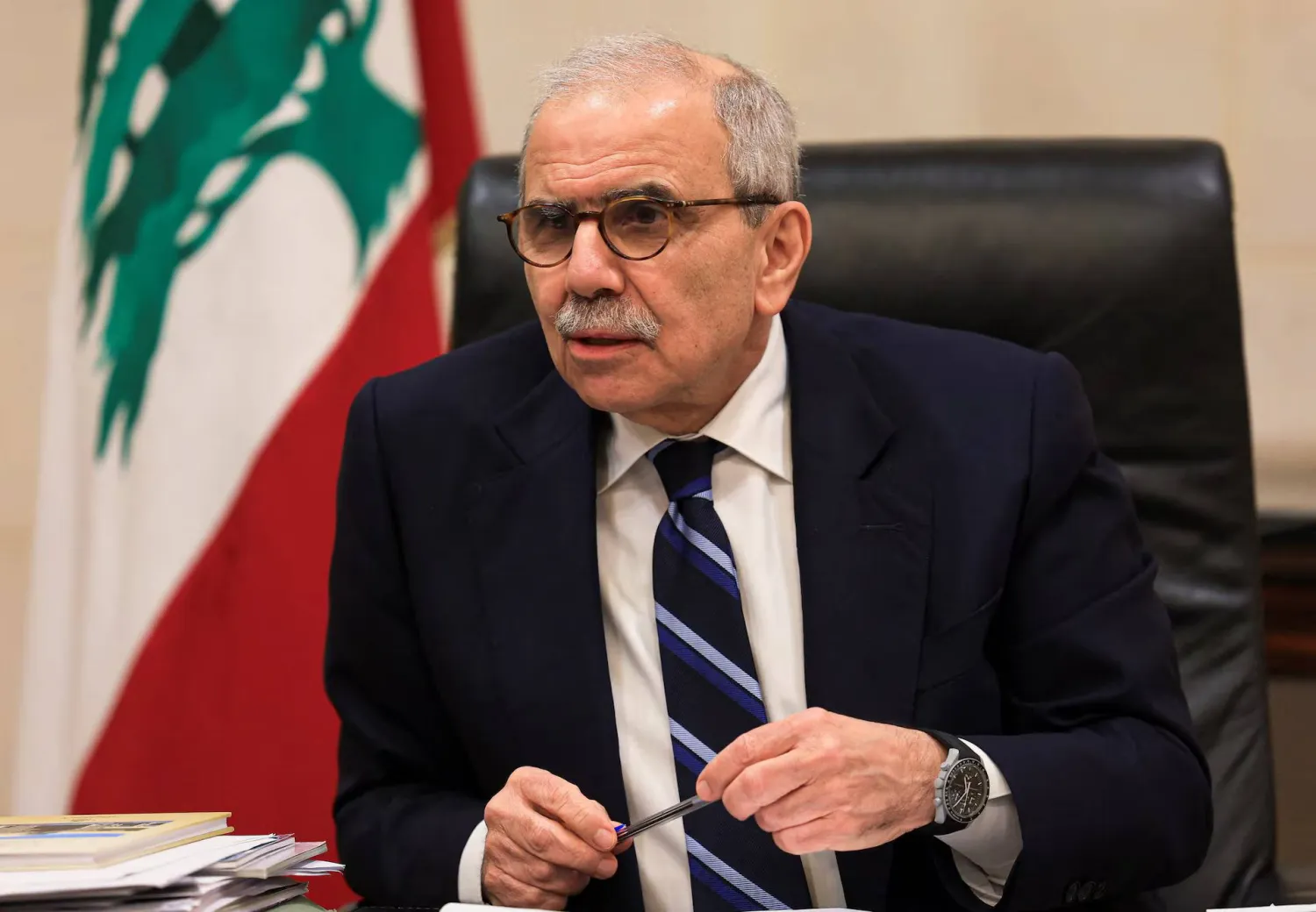
Lebanese Prime Minister Nawaf Salam speaks to reporters at the Grand Serail in Beirut, December 3, 2025. (Reuters)
TT

Salam to Asharq Al-Awsat: We Refuse to Tie Lebanon’s Fate to Iran’s Interests

Lebanese Prime Minister Nawaf Salam speaks to reporters at the Grand Serail in Beirut, December 3, 2025. (Reuters)

Lebanese Prime Minister Nawaf Salam stressed on Saturday that the state was doing everything possible on the political and diplomatic levels to end Israel’s war on Lebanon and ease its catastrophic impact on the people, especially the displaced.

He told Asharq Al-Awsat that diplomatic efforts have not reached their desired results because the situation in Lebanon is being tied to the crises and war in the region.

“We could have avoided being impacted by the conflict were it not for the strategic error committed by Hezbollah by being dragged us into it,” he added.

This been a catastrophe for Lebanon and “the environment that the party claims it wants to protect,” Salam went on to say.

The war has been imposed on all the Lebanese people, he reiterated. “It is not in their interest,” he declared, underscoring the need to end the war.

Moreover, the PM revealed that foreign efforts to end the war are being met with “an extreme hardline position by Israel” and the United States’ preoccupation with the ongoing war.

He said the war was having dangerous repercussions on the security of the Arab Gulf, condemning and questioning Iran’s attacks against countries that have extended their hands in friendship towards it and repeatedly expressed their opposition to war before it erupted.

Salam underlined his government’s determination to implement its latest decisions related to banning Hezbollah’s military and security operations.

The state’s armed forces and judiciary are carrying out their duties to that end, but the war is making implementation more difficult, he said.

On Lebanon’s decision to impose visas on visiting Iranians, the PM explained it was due to intelligence about Iranian Revolutionary Guards operations that could harm Lebanon’s national security.

Lebanon wants the best relations with Iran, state to state, Salam added, while categorically rejecting tying the Lebanese people’s interests to that of another country as has already happened.

On the displacement of the people of the South and Beirut’s southern suburbs, the PM said the government was sparing no effort to ease their suffering and meet their essential needs, such as food and medicine.

This is a major challenge given the state’s limited means, he acknowledged. He added that he was personally overseeing aid efforts.

Meanwhile, France has continued to exert efforts to resolve the crisis. President Emmanuel Macron held telephone talks with President Joseph Aoun for the third time in two days.

His efforts have yet to make any breakthrough, ministerial sources told Asharq Al-Awsat.

The situation needs more time, they revealed, expecting that mid-next week should witness renewed efforts.

Aoun also received a telephone call from Spain’s King Felipe, who expressed Madrid’s solidarity with Beirut.

Earlier on Saturday, Israel's Defense Minister Israel Katz warned the Lebanese government to disarm Hezbollah or "pay ‌a very ‌heavy price." 

"We (ISRAEL) ‌have ⁠no territorial claims ⁠against Lebanon, but we will not accept a situation ⁠where what ‌existed ‌for many ‌years — firing ‌from Lebanese territory toward the State of ‌Israel — is renewed," Katz said in ⁠a ⁠statement.  

"Therefore, we are turning and warning: act and take action before we act even more." 

The United Nations special coordinator for Lebanon urged Lebanon and Israel to enter talks to negotiate an end hostilities after the outbreak of a renewed Israel-Hezbollah war.  

"As bad as things are today, they are set to get even worse," Jeanine Hennis-Plasschaert said.  

"Talks between Lebanon and Israel can be the game changer needed to save future generations from going, time and again, through the same nightmare".  

In December, Lebanese and Israeli civilian representatives engaged in their first direct talks in decades as part of a meeting of a committee monitoring the November 2024 ceasefire between Israel and Hezbollah.  

Lebanon was engulfed by the expanding Middle East war on Monday, after Hezbollah fired missiles at Israel to avenge the death of Iranian supreme leader Ali Khamenei in US-Israeli attacks on Iran. 


Strike Kills 2 Academics at Lebanese University as Israel Bombs Central Beirut

People stand amid debris in front of damaged buildings in the aftermath of a reported Israeli strike in Zuqaq al-Blat, central Beirut, Lebanon March 12, 2026. REUTERS/Mohamed Azakir
TT

Strike Kills 2 Academics at Lebanese University as Israel Bombs Central Beirut

People stand amid debris in front of damaged buildings in the aftermath of a reported Israeli strike in Zuqaq al-Blat, central Beirut, Lebanon March 12, 2026. REUTERS/Mohamed Azakir

An Israeli strike that hit in the vicinity of Lebanon’s only public university killed the director of the faculty of sciences Hussein Bazzi and professor Mortada Srour.

The campus is in Hadath, on the outskirts of Beirut’s southern suburbs, which Israel had warned last week should be evacuated.

It was not clear whether the campus was directly targeted, but smoke could be seen rising near the building’s courtyard in the aftermath.

Lebanese President Joseph Aoun condemned the bombing, which he said targeted the campus, as a crime and a “violation of international laws and norms that prohibit attacks on educational institutions and civilians.”

Israel’s military said Thursday night it had begun another wave of strikes on Lebanon’s capital, saying it was targeting Hezbollah sites.

Israeli strikes hit two buildings in busy residential and commercial districts near central Beirut.


How Israel Crippled Gaza's Fishing

A Palestinian man stands on the door of a refrigerator that he uses as a makeshift rowing boat, as he throws his fishing basket into the sea at the port of Gaza City on March 9, 2025. (Photo by BASHAR TALEB / AFP)
TT

How Israel Crippled Gaza's Fishing

A Palestinian man stands on the door of a refrigerator that he uses as a makeshift rowing boat, as he throws his fishing basket into the sea at the port of Gaza City on March 9, 2025. (Photo by BASHAR TALEB / AFP)

Fishermen in Gaza say they are facing their toughest conditions since the start of the Israeli war, with Israeli forces preventing them from accessing the sea to earn a living and exposing them to gunfire or arrest, both during periods of truce and even after the ceasefire reached last October.

Israeli forces target Gaza fishermen with live ammunition or detain some for allegedly violating bans on fishing or even diving. Restrictions imposed on Gaza residents also leave them largely unable to swim.

Nafez Jarbou, 53, a fisherman from the Beach refugee camp west of Gaza City, told Asharq Al-Awsat that Israeli naval boats destroyed his fishing vessel during the war. He supports a family of 16, including four relatives who worked with him in fishing, all of whom lost their livelihoods.

“When the first truce began in January 2025, we tried to return to fishing using another boat belonging to neighbors whose sons, also fishermen, were killed by Israeli forces,” Jarbou said. “But we were surprised to find we were still barred from fishing.”

Hope briefly returned after the ceasefire was announced. But Jarbou said that, like thousands of other fishermen, he encountered “severe restrictions.” He later tried to resume fishing with his sons within less than one nautical mile from Gaza City’s shoreline.

Israeli naval boats continued to pursue them, opening fire or attempting to arrest them and confiscate their boats, he said.

Diving replaces fishing

With traditional fishing routes effectively closed despite the ceasefire, Gaza’s fishing activity has sharply declined. Even fishing within a one-nautical-mile range has become increasingly restricted.

Faced with these limits, fishermen have turned to diving with simple, rudimentary equipment to avoid being pursued or targeted.

But Jarbou said diving prevents them from catching most types of fish.

“All we can catch now is small sardines, which are not in high demand,” he said.

According to the Gaza Fishermen’s Union, more than 5,000 fishermen worked in the sector before the war.

At least 235 have been killed during Israeli military operations, most in airstrikes that hit their homes or the homes of relatives.

Another 40 fishermen were killed, and dozens were wounded while working at sea at extremely short distances from shore, sometimes less than 500 meters, and in some cases just 200 meters. Israeli forces have also arrested around 43 fishermen.

Mohammed al-Habil, 31, from the Beach refugee camp, was recently released after being detained off Gaza City’s coast.

“We went through a long ordeal in prison after I was arrested with two of my relatives while working at sea to make a living,” he told Asharq Al-Awsat.

Al-Habil said interrogators did not focus on his fishing work but instead sought “information about Hamas members in my area.”

He added that Israeli forces have long targeted fishermen, even before the latest war, attempting to arrest them and recruit them as informants.

“Words cannot describe our living conditions,” he said. “We have joined the large army of unemployed in Gaza.”

He questioned the role of mediators overseeing the ceasefire in ensuring safety for fishermen and allowing them to work at least within two or three nautical miles, an area he said “would not pose any security threat to Israel.”

“Starvation policy”

Zakaria Bakr, head of the Union of Workers in Gaza’s fishing sector, said Israel is “deliberately depriving fishermen of work at sea to starve them,” describing the move as part of a collective punishment policy against the enclave.

Preventing fishing, even within limited distances, despite the ceasefire shows the main goal is to destroy what remains of the fishing sector, which has already suffered heavy damage since the war began, he said.

“What is happening is the destruction of fishermen by depriving them of their livelihoods,” Bakr told Asharq Al-Awsat.

Each fisherman supports at least four family members who depend on the fish they sell, fish that are now largely unavailable under current restrictions imposed by Israel, he said.

The Gaza Center for Human Rights said Israel has imposed strict restrictions aimed at the comprehensive destruction of the fishing sector’s infrastructure and deepening a policy of starvation affecting thousands of fishermen’s families.

The group said Israeli forces destroyed trawlers and large fishing vessels, the backbone of Gaza’s fish production, inside the main Gaza port and the harbors of Khan Younis and Rafah, putting them permanently out of service.

More than 95% of small boats and more than 100 larger vessels have been destroyed, along with fishing equipment and boat-building workshops, it said.


UN: Over 200 Civilians Reported Killed in Sudan Drone Strikes Since March 4

Residents receive aid from World Food Programme (WFP) at Al-Omada neighbourhood of Omdurman, the twin city of Khartoum on March 11, 2026. (Photo by Ebrahim Hamid / AFP)
TT

UN: Over 200 Civilians Reported Killed in Sudan Drone Strikes Since March 4

Residents receive aid from World Food Programme (WFP) at Al-Omada neighbourhood of Omdurman, the twin city of Khartoum on March 11, 2026. (Photo by Ebrahim Hamid / AFP)

UN rights chief Volker Turk said Thursday he was "appalled" at reports that more than 200 civilians had been killed by drone attacks in Sudan since March 4.

"It is deeply troubling that despite multiple reminders, warnings and appeals, parties to the conflict in Sudan continue to use increasingly powerful drones to deploy explosive weapons with wide-area impacts in populated areas," Turk said in a statement.

Dozens of civilians have been killed in drone strikes across southern Sudan over the past two days, medical sources told AFP on Wednesday, as some of the heaviest fighting of the nearly three-year war grips the region.

Sudan has been riven by conflict since April 2023, when a power struggle between the regular army and the Rapid Support Forces (RSF) plunged the country into a war that has killed tens of thousands and displaced millions.

Since the war broke out, both sides have been accused of war crimes, including targeting civilians and indiscriminately shelling residential areas.
