

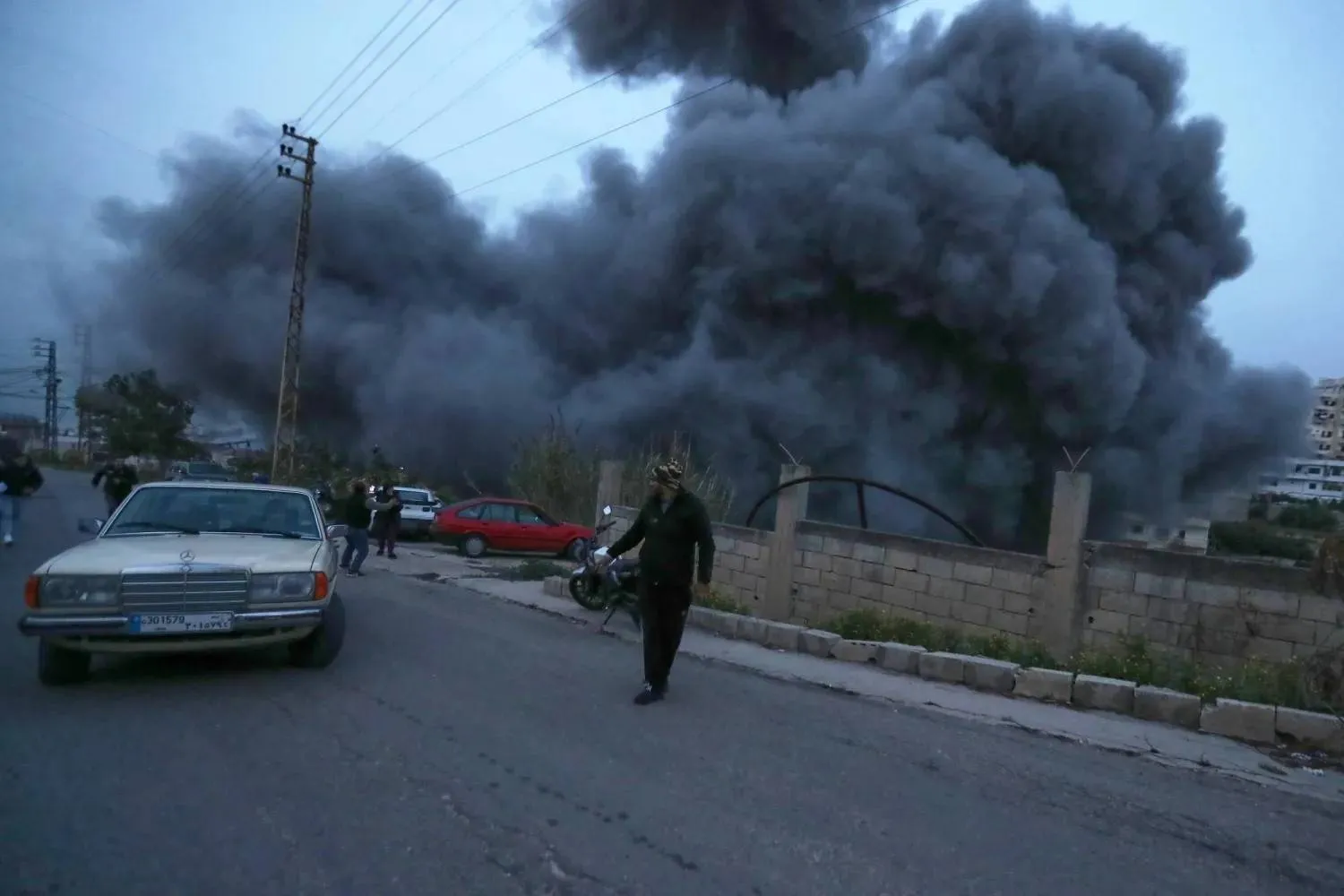

Israel Resumes Strikes on Smuggling Routes along Lebanon-Syria Border

Local residents flee into the street during an Israeli strike on the village of Qanarit in southern Lebanon on Jan. 21 (AP)
TT

Israel Resumes Strikes on Smuggling Routes along Lebanon-Syria Border

Local residents flee into the street during an Israeli strike on the village of Qanarit in southern Lebanon on Jan. 21 (AP)

The Israeli strikes that hit overnight, Wednesday to Thursday, the outskirts of the villages of Hosh al Sayyed Ali and al-Mashrafa on the Lebanese-Syrian border in northeastern Lebanon marked a new episode in a series of attacks increasingly targeting eastern Lebanon, in parallel with ongoing escalation on the southern front.

The strikes were repeated on Friday in eastern Lebanon, where an Israeli drone carried out two air strikes near the city of Baalbek. No casualties were reported.

In a statement, the Israeli army said its aircraft had struck four crossings in the Hermel area on the border between Syria and Lebanon that it said were used by Hezbollah to transport military equipment.

The strikes have refocused Israeli military planning on the eastern border, underscoring concerns over border crossings and the region’s lack of population stability.

The targeted area lies within an open geographic border strip that has been repeatedly struck, indicating a gradual transformation into a zone of indirect pressure used to convey security messages beyond the immediate tactical framework, without sliding into a full-scale confrontation.

Abandoned village and closed crossings

The mayor of Hosh al Sayyed Ali, Mohammad Nasr al-Din, told Asharq Al-Awsat that the strikes did not hit any inhabited areas, noting that the village has been deserted for a long time.

He said all crossings in the area had already been closed and unusable before the strikes, on both the Lebanese and Syrian sides, adding that there was no crossing or smuggling and that the village was completely empty of residents.

Nasr al-Din said the Syrian side and the Lebanese army prevent passage through these crossings, making the strikes puzzling.

He said the damage was limited to material losses, including roads and some nearby facilities, as well as damage to a main bridge in the area.

He added that residents of Hosh al Sayyed Ali have been displaced for some time, with most currently living in Hermel and surrounding areas, some in tents or garages, under difficult humanitarian conditions.

Preventing the rebuilding of capabilities

The strike on Hosh al Sayyed Ali and what are known as illegal crossings fall within the framework of daily Israeli escalation aimed at cutting off any potential supply lines to Hezbollah and preventing it from rebuilding its military structure, retired Brigadier General Saeed Qazzah told Asharq Al-Awsat.

He said Israel has for some time pursued a policy of systematically tracking anything it considers logistical or military support routes for Hezbollah.

Qazzah said claims of full control over borders and crossings remain theoretical, noting that smuggling cannot be completely eliminated between any two countries, even with army deployments and strict monitoring.

He said intercepting one arms shipment necessarily means others may have passed, as smuggling by nature cannot be fully prevented.

Qazzah noted that Israel says Hezbollah is smuggling weapons from Syria, while facts on the ground show Syrian security forces intercepting arms shipments heading from Syria into Lebanon.

He said Israel is pursuing all means of transporting military equipment from Syria to Hezbollah in order to prevent it from rebuilding its capabilities.

Israeli escalation

Qazzah said the developments are not limited to a narrow military signal, adding that all indicators suggest Israeli escalation is likely to be broad and extensive.

He said Israel will not allow Hezbollah to return to the period between 2006 and 2023, when it monitored the growth of the group’s military capabilities and built a target bank before deciding on confrontation.

He added that Israel was fully aware of Hezbollah’s military buildup during those years and had wagered that it would remain within the framework of internal deterrence, before shifting to the option of wide-scale strikes and the destruction of heavy weapons depots.

He stressed that Israel will not allow Hezbollah to rebuild militarily by any means, whether by pursuing known or newly discovered facilities or by targeting potential supply routes.

Qazzah said Israel could continue striking all sources of Hezbollah’s strength across all Lebanese territory without limiting targets to a specific area, adding that the actions also fall within a framework of sustained pressure on Lebanon to push it toward the next phase, namely, confining weapons north of the Litani River.


Southern Yemeni Forces Rally in Riyadh Ahead of Key Saudi-Sponsored Dialogue

Southern leaders received in Riyadh by Abdullah Bawazeer, a member of Yemen’s Presidential Leadership Council (X).
TT

Southern Yemeni Forces Rally in Riyadh Ahead of Key Saudi-Sponsored Dialogue

Southern leaders received in Riyadh by Abdullah Bawazeer, a member of Yemen’s Presidential Leadership Council (X).

Riyadh has witnessed, since the beginning of January, an unprecedented wave of political activity involving southern Yemeni leaders and factions.

These consultations and discussions among key actors and influential figures are aimed at preparing for the convening of the Southern Dialogue Conference, sponsored by Saudi Arabia at the request of Rashad al-Alimi, Chairman of Yemen’s Presidential Leadership Council.

Al-Alimi had formally requested Saudi sponsorship of the conference against the backdrop of military and political developments that followed unilateral military actions by Aidarous al-Zubaidi, head of what was formerly known as the Southern Transitional Council (STC), and the subsequent intervention of the Coalition to Support Legitimacy in Yemen to protect civilians in Hadhramaut and Al-Mahra.

As coalition-backed government forces regained control of Hadhramaut and Al-Mahra and deployed across other southern governorates, the Presidential Leadership Council decided to remove Aidarous al-Zubaidi and Faraj al-Bahsani from its membership.

Al-Zubaidi fled Aden by sea to Somalia and then by air to Abu Dhabi, which Yemeni authorities accuse of committing widespread violations in Hadhramaut before ending its military presence there in recent weeks.

Broad Political Mobilization

Amid this momentum, southern figures held a consultative meeting days ago, during which they agreed to abide by the outcomes of the upcoming dialogue, according to a statement read by Abdulrahman al-Muharrami, a member of the Presidential Leadership Council.

In the statement, participants called on the international community to support the dialogue and respect the aspirations of the southern people, stressing that Saudi Arabia guarantees the inclusion of all southern parties and encourages partnership and responsible representation.

Meanwhile, political and social figures in Hadhramaut are mobilizing to unify their vision at the dialogue conference, under the leadership of Salem al-Khanbashi, a member of the Presidential Leadership Council and Governor of Hadhramaut.

Parallel efforts are being led by Abdullah al-Alimi, another member of the Presidential Leadership Council, who has been holding meetings with various southern groups and figures, including those from Shabwa Governorate, alongside representatives from other governorates such as Al-Mahra, Abyan, and Socotra.

This intensive political activity is taking place under direct Saudi sponsorship, in preparation for the launch of the Comprehensive Southern Dialogue Conference, which is expected to constitute a cornerstone in shaping Yemen’s final transitional phase.

Saudi Arabia’s role is no longer confined to traditional mediation but has evolved into what participants describe as “engineering consensus.” Current meetings aim to bridge differences among the various southern components, particularly leaders of what was formerly known as the Southern Transitional Council prior to its dissolution, in addition to other influential southern figures.

Analysts believe that the upcoming conference will not be a mere symbolic event, but rather a defining moment in the history of the “Southern Cause” and Yemen more broadly.

Emphasis on Partnership

Against this political backdrop, converging positions have emerged from Presidential Leadership Council members Abdullah al-Alimi Bawazeer and Abdulrahman al-Muharrami, who stressed the need to entrench the principle of partnership, reject exclusion, and unify the southern front through an inclusive dialogue under Saudi sponsorship.

These positions were articulated during southern meetings held in Riyadh, with the participation of prominent political and military leaders, as part of ongoing preparations for the upcoming dialogue conference.


Lebanon PM Says IMF Wants Rescue Plan Changes as Crisis Deepens

A photograph released by the Lebanese Government Press Office on December 26, 2025, show Lebanon's Prime Minister Nawaf Salam speaking during a press conference following a cabinet session in Beirut on December 26, 2025. (Photo by Handout / Lebanese Government Press Office / AFP)
TT

Lebanon PM Says IMF Wants Rescue Plan Changes as Crisis Deepens

A photograph released by the Lebanese Government Press Office on December 26, 2025, show Lebanon's Prime Minister Nawaf Salam speaking during a press conference following a cabinet session in Beirut on December 26, 2025. (Photo by Handout / Lebanese Government Press Office / AFP)

The International Monetary Fund has demanded amendments to a draft rescue law aimed at hauling Lebanon out of its worst financial crisis on record and giving depositors access to savings frozen for six years, Prime Minister Nawaf Salam said.

The "financial gap" law is part of a series of reform measures required by the IMF in order to access its funding and aims to allocate the losses from Lebanon's 2019 crash between the state, the central bank, commercial banks and depositors.

Salam told Reuters the IMF wants clearer provisions in the hierarchy of claims, which is a core element of the draft legislation designed to determine how losses are allocated.

"We want to engage with the IMF. We want to improve. This is a draft law," ‌Salam said in ‌an interview at the World Economic Forum annual meeting ‌in ⁠the Swiss mountain ‌resort of Davos.

"They wanted the hierarchy of claims to be clearer. The talks are all positive," Salam added.

In 2022, the government put losses from the financial crisis at about $70 billion, a figure that analysts and economists forecast is now likely to be higher.

Salam stressed that Lebanon is still pushing for a long-delayed IMF program, but warned the clock is ticking as the country has already been placed on a financial 'grey list' and risks falling onto the 'black ⁠list' if reforms stall further.

"We want an IMF program and we want to continue our discussions until we get ‌there," he said, adding: "International pressure is real ... The longer we ‍delay, the more people's money will evaporate".

The ‍draft law, which was passed by Salam's government in December, is under parliamentary ‍review. It aims to give depositors a guaranteed path to recovering their funds, restart bank lending, and end a financial crisis that has left nearly a million accounts frozen and confidence in the system shattered.

The roadmap would repay depositors up to $100,000 over four years, starting with smaller accounts, while launching forensic audits to determine losses and responsibility.

Lebanon's Finance Minister Yassine Jaber, who is driving the reform push with Salam, told Reuters it was ⁠essential to salvage a hollowed-out banking system, and to stop the country from sliding deeper into its cash-only, paralyzed economy.

The aim, Jaber said, is to give depositors clarity after years of uncertainty and to end a system that has crippled Lebanon's international standing.

He framed the law as part of a broader reckoning: the first time a Lebanese government has confronted a combined collapse of the banking sector, the central bank and the state treasury.

Financial reforms have been repeatedly derailed by political and private vested interests over the last six years and Jaber said the responsibility now lies with lawmakers.

Failure to act, he said, would leave Lebanon trapped in "a deep, dark tunnel" with no way back to a functioning system.

"Lebanon ‌has become a cash economy, and the real question is whether we want to stay on the grey list, or sleepwalk into a black list," Jaber added.


Hamas Disarmament, Reconstruction Plan Hinge on Gaza Truce Understandings

A Palestinian child pulls containers filled with water at the Jabalia refugee camp in the northern Gaza Strip (AFP)
TT

Hamas Disarmament, Reconstruction Plan Hinge on Gaza Truce Understandings

A Palestinian child pulls containers filled with water at the Jabalia refugee camp in the northern Gaza Strip (AFP)

Attention is once again turning to the stalled second phase of the Gaza ceasefire agreement, as momentum builds toward its long-delayed implementation and questions mount over how its most contentious provisions will be handled, notably those concerning the disarmament of Hamas and the reconstruction of the war-ravaged enclave.

The anticipated provisions, unfolding amid ongoing Israeli obstacles and violations since the agreement took effect months ago, require further understanding to push the ceasefire forward, experts told Asharq Al-Awsat.

They estimated that Washington would exert significant pressure to complete the agreement, driven by its need to do so to support its presidency of the Peace Council, whose role remains disputed between the United States and Western countries.

Egyptian Foreign Minister Badr Abdelatty, in a phone call with his Emirati counterpart Sheikh Abdullah bin Zayed Al Nahyan, voiced support for US President Donald Trump’s initiative to launch the Peace Council and welcomed the move, according to a statement by Egypt’s Foreign Ministry on Friday.

Abdelatty stressed the importance of moving ahead with the requirements of the second phase of the US president’s plan, backing the national committee to administer Gaza, and swiftly deploying an international stabilization force to monitor the ceasefire, paving the way for early recovery and reconstruction.

Meanwhile, Israel’s i24NEWS website reported on Thursday that “understandings are taking shape between the United States and Hamas regarding disarmament in the Gaza Strip.” It said an upcoming meeting between US envoy Steve Witkoff and senior Hamas official Khalil al-Hayya would seek to bridge gaps between the two sides and examine whether a disarmament agreement could be advanced while preserving Israel’s security and reducing security threats.

Witkoff is expected to meet al-Hayya soon to discuss a draft agreement that includes, among other issues, arrangements for dismantling weapons in the enclave, including distinguishing between heavy and light arms, to sign what would be called an “understanding agreement” on firearms, rather than a weapons surrender deal.

Disarmament is not the only issue under discussion. Talk has also intensified over reconstruction, which Egypt and Arab states insist should cover the entire Gaza Strip, in line with the Egyptian plan approved by Arab leaders in March 2025.

By contrast, US President Trump’s son-in-law, Jared Kushner, said on Thursday in Davos that Washington envisions a “new Gaza,” transforming the war-ravaged territory into a luxury resort within three years.

Said Okasha, a political analyst specializing in Israeli affairs at the Al-Ahram Center for Political and Strategic Studies, said the remaining provisions of the Gaza agreement clearly require further understandings, especially on Hamas disarmament and reconstruction, given the current uncertainty over Israel’s positions.

He said Israel accepts low-intensity attacks but rejects any withdrawal or reconstruction without the complete disarmament of Hamas. Any gradual disarmament understandings may not be accepted and could obstruct the phase, pushing the parties back to new negotiations with mediators. Still, he said, there is no alternative to continuing talks at this critical time.

Palestinian political analyst Nizar Nazzal said the US understanding of Hamas’ weapons differs from Israel’s zero-tolerance approach, and that understandings may emerge from the Witkoff-al-Hayya meeting to freeze or manage the arms issue.

He expected Hamas to find common ground with Washington on the matter, bolstering implementation of the agreement.

In his speech at the Davos forum on Thursday, Kushner stressed that Hamas disarmament is one of the ceasefire provisions in force since Oct. 10, saying it would encourage companies and donors to commit to the enclave.

He outlined what he called a “new Gaza” within three years and called for at least $25 billion in investments to rebuild infrastructure and public services.

Okasha said Kushner’s plan may be the most likely to move forward, provided understandings are reached with mediators on how to implement it.

Nazzal, however, cast doubt on Kushner’s remarks, saying he presented videos depicting Gaza as a paradise, but that Washington’s track record in resolving the Israeli-Palestinian conflict does not inspire confidence, raising expectations that fighting could resume.

Amid these concerns, Israel’s public broadcaster reported on Thursday that Israel had settled the issue of operating the Rafah border crossing with Egypt, saying it would establish an additional crossing, “Rafah 2,” adjacent to the existing one and operated by Israel itself.

The broadcaster said the main crossing would be run by the European Union Border Assistance Mission, with participation from officers of the Palestinian Authority’s General Intelligence Service. In contrast, the new crossing would be subject to Shin Bet checks and Israeli remote screening procedures, including facial imaging and identity card verification.

Okasha said the new crossing would likely be built inside Palestinian territory rather than on the Egyptian border, possibly near the Karni crossing, noting that Cairo would reject any arrangement on its border with Israel.

He added that Israel does not want to take any additional steps under the agreement, but that US pressure remains decisive in implementing its provisions.

Nazzal said Israel does not want more crossings but seeks to assert its sovereignty through control over any crossing, using it to apply pressure in future solutions that advance its gains.

He stressed that the United States would not allow Israel or others to derail the “Trump plan,” predicting Israeli withdrawals, increased aid, the reopening of Rafah, and further positive developments.
