


Israel 'Not Sure' Whether US Will Strike Iran

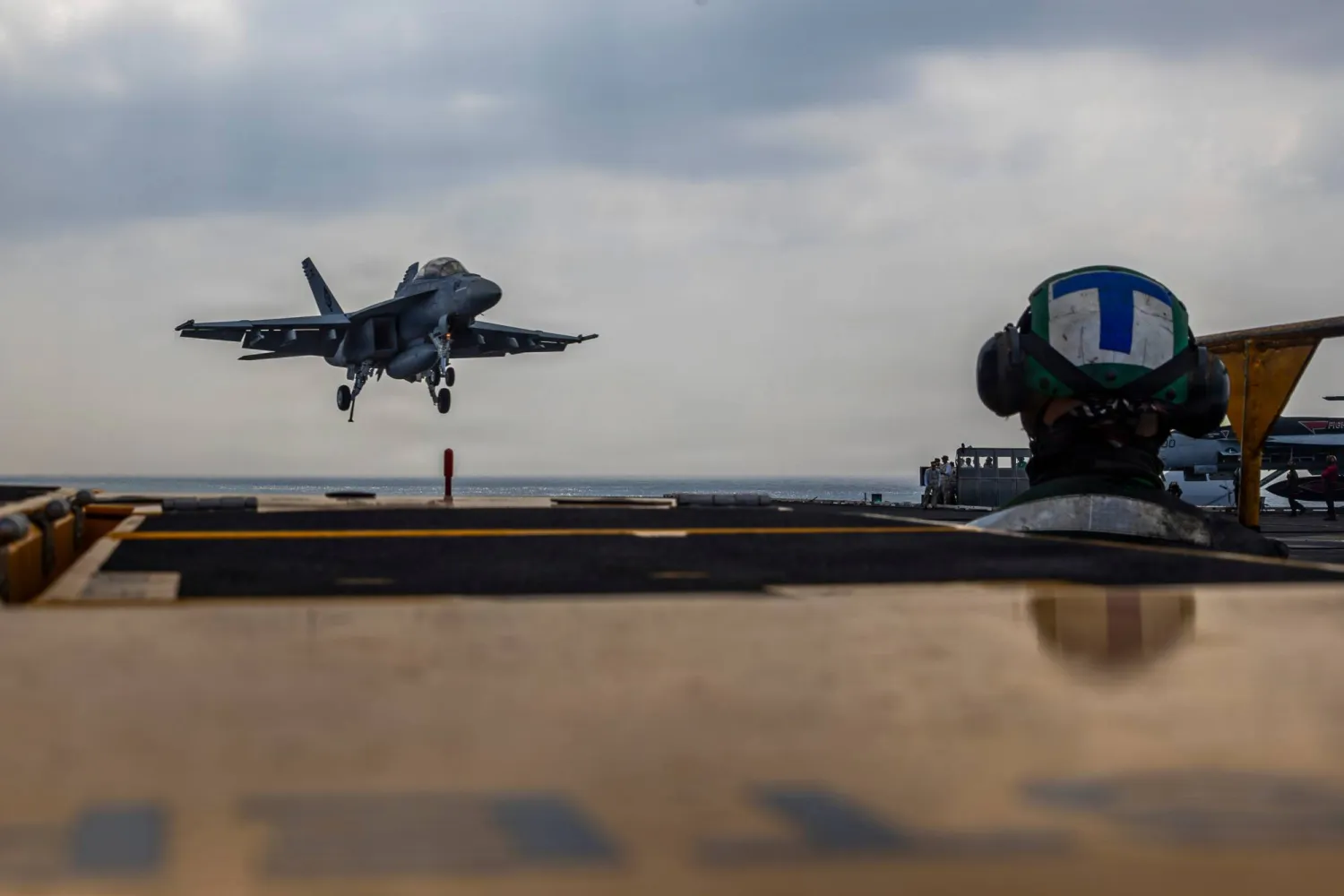
 This photo provided by the US Navy shows a Boeing F/A-18E Super Hornet landing on the Nimitz-class aircraft carrier USS Abraham Lincoln in the Indian Ocean on Jan. 22, 2026. (Mass Communication Specialist Seaman Daniel Kimmelman/US Navy via AP)
 This photo provided by the US Navy shows a Boeing F/A-18E Super Hornet landing on the Nimitz-class aircraft carrier USS Abraham Lincoln in the Indian Ocean on Jan. 22, 2026. (Mass Communication Specialist Seaman Daniel Kimmelman/US Navy via AP)
TT

Israel 'Not Sure' Whether US Will Strike Iran

 This photo provided by the US Navy shows a Boeing F/A-18E Super Hornet landing on the Nimitz-class aircraft carrier USS Abraham Lincoln in the Indian Ocean on Jan. 22, 2026. (Mass Communication Specialist Seaman Daniel Kimmelman/US Navy via AP)
 This photo provided by the US Navy shows a Boeing F/A-18E Super Hornet landing on the Nimitz-class aircraft carrier USS Abraham Lincoln in the Indian Ocean on Jan. 22, 2026. (Mass Communication Specialist Seaman Daniel Kimmelman/US Navy via AP)

Israeli observers are in agreement that the final decision on military action against Iran remains in the hands of President Donald Trump alone, Israeli media reported on Monday.

The reports came despite a strategic partnership between Tel Aviv and Washington, intensive coordination meetings at the highest levels, and the prevailing impression among Israeli officials that a US strike against Iran could be carried out soon.

“Trump is dealing with the issue of war as a businessman,” the observers said. “The President could easily back off with a certain deal that offers him clear gains,” they said, stressing that Tehran might also defuse tension with Washington through serious negotiating.

Political and military sources in Tel Aviv said Israel was surprised not to be secretly involved in the size and timing of a potential US strike on Iran.

They said Israeli Chief of Staff Eyal Zamir raised the issue with US Central Command (CENTCOM) chief Brad Cooper, who visited Israel on Saturday.

The sources said Cooper explained that even the US command is short of details on a decision to carry out a strike against Iran. The matter is limited to President Trump who ordered military readiness without offering further details, they quoted Cooper as saying.

The sources added that US and Israeli military officials discussed coordination for worst-case scenarios and on means to jointly counter them, and shared intelligence on the deployment of Iranian forces.

The Walla website said the two sides also coordinated their preparations for a possible US strike, which could lead to an Iranian attack against Israel.

In an analysis for the Yedioth Ahronoth newspaper, military expert Ron Ben-Yishai said neither the Pentagon nor US Central Command has received instructions beyond preparing a large naval and air force capable of delivering precise strikes on Iran if ordered, while simultaneously preparing to defend American troops and bases and US interests and allies in the Middle East, including Israel.

Ben-Yishai wrote that joint US-Israeli defense against Iranian missile and drone retaliation, were the main focus of discussions between Cooper and Zamir. They also coordinated how the Israeli army would assist with intelligence and other support for a possible American strike, and how the Israeli Air Force would join an offensive campaign alongside US naval and air forces if Israel were attacked.

In the absence of a presidential decision, the two generals appear to have conducted what the Israeli army calls a strategic “contingency discussion,” with details to be finalized later, he said.

He explained that the US president is probably weighing five questions before striking Iran.

The first is whether a limited but highly precise and powerful strike can bring about the collapse of the regime, or at least significantly weaken it and the security apparatus that protects it.

The second is whether there is anyone in Iran who could exploit such weakness to topple the regime completely, or at least force a fundamental change in its domestic policies toward its citizens and its external behavior on the nuclear issue, ballistic missiles and regional policies.

The third question asks whether the military threat should be stabilized and reinforced for several more weeks to allow the Iranian regime and its leader to accept the US demands set as conditions for entering negotiations on lifting sanctions and removing the military threat.

In this regard, he said it is quite possible that the Iranians, even Supreme Leader Ali Khamenei, will again conclude that their situation is so dire that it is time for a “heroic compromise.”

The fourth question is “if it becomes clear that the Iranian regime cannot be toppled through air strikes alone, should the massive American force now being assembled in the Middle East be used to deliver another blow to Iran?”

The fifth, and most critical question, the expert said, is whether the Americans have sufficient precise intelligence and whether they even have the capability to achieve any of their objectives, either regime collapse or a blow severe enough to disable Iran’s military infrastructure for many years, and above all, at what cost?

In any case, the decision is in Trump’s hands alone, and as "we have learned, even when he decides, he may change his mind at the last moment," Ben-Yishai said.

Trump does not want to pay the price in American lives or the high cost of a prolonged operation, he added.



Top Trump Iran Negotiator Says Visits US Aircraft Carrier in Middle East

US Special Envoy Steve Witkoff delivers a press conference upon the signing of the declaration on deploying post-ceasefire force in Ukraine, during the so-called "Coalition of the Willing" summit, at the Elysee Palace in Paris, France, January 6, 2026. (Reuters)
TT

Top Trump Iran Negotiator Says Visits US Aircraft Carrier in Middle East

US Special Envoy Steve Witkoff delivers a press conference upon the signing of the declaration on deploying post-ceasefire force in Ukraine, during the so-called "Coalition of the Willing" summit, at the Elysee Palace in Paris, France, January 6, 2026. (Reuters)

US President Donald Trump's lead Iran negotiator Steve Witkoff on Saturday said he visited the USS Abraham Lincoln aircraft carrier currently in the Arabian Sea, with Washington and Tehran due to hold further talks soon.

"Today, Adm. Brad Cooper, Commander of US Naval Forces Central Command, Jared Kushner, and I met with the brave sailors and Marines aboard the USS Abraham Lincoln, her strike group, and Carrier Air Wing 9 who are keeping us safe and upholding President Trump's message of peace through strength," said Witkoff in a social media post.

Iranian Foreign Minister Abbas Araghchi said on Saturday he hoped talks with the United States would resume soon, while reiterating Tehran's red lines and warning against any American attack.


Israel’s Netanyahu Expected to Meet Trump in US on Wednesday and Discuss Iran

Israeli Prime Minister Benjamin Netanyahu delivers a speech during a special session to mark the 77th anniversary of the Knesset's establishment and the 60th anniversary of the dedication of the current building at the Knesset, the Israeli parliament, in Jerusalem, 02 February 2026. (EPA)
TT

Israel’s Netanyahu Expected to Meet Trump in US on Wednesday and Discuss Iran

Israeli Prime Minister Benjamin Netanyahu delivers a speech during a special session to mark the 77th anniversary of the Knesset's establishment and the 60th anniversary of the dedication of the current building at the Knesset, the Israeli parliament, in Jerusalem, 02 February 2026. (EPA)

Israeli Prime Minister Benjamin Netanyahu is expected to meet US President Donald Trump on Wednesday in Washington, where they will discuss negotiations with Iran, Netanyahu's office said on Saturday.

Iranian and US officials held indirect nuclear ‌talks in the ‌Omani capital ‌Muscat ⁠on Friday. ‌Both sides said more talks were expected to be held again soon.

A regional diplomat briefed by Tehran on the talks told Reuters Iran insisted ⁠on its "right to enrich uranium" ‌during the negotiations with ‍the US, ‍and that Tehran's missile capabilities ‍were not raised in the discussions.

Iranian officials have ruled out putting Iran's missiles - one of the largest such arsenals in the region - up ⁠for discussion, and have said Tehran wants recognition of its right to enrich uranium.

"The Prime Minister believes that any negotiations must include limiting ballistic missiles and halting support for the Iranian axis," Netanyahu's office said in a ‌statement.


Italy FM Rules Out Joining Trump’s ‘Board of Peace’

Italy's Minister for Foreign Affairs Antonio Tajani speaks to the press during the EPP Leaders’ meeting, in Zagreb, Croatia, 30 January 2026. (EPA)
TT

Italy FM Rules Out Joining Trump’s ‘Board of Peace’

Italy's Minister for Foreign Affairs Antonio Tajani speaks to the press during the EPP Leaders’ meeting, in Zagreb, Croatia, 30 January 2026. (EPA)

Italy will not take part in US President Donald Trump's "Board of Peace", Italian Foreign Minister Antonio Tajani said Saturday, citing "insurmountable" constitutional issues.

Trump launched his "Board of Peace" at the World Economic Forum in Davos in January and some 19 countries have signed its founding charter.

But Italy's constitution bars the country from joining an organization led by a single foreign leader.

Prime Minister Giorgia Meloni, a Trump ally, last month noted "constitutional problems" with joining, but suggested Trump could perhaps reopen the framework "to meet the needs not only of Italy, but also of other European countries".

Tajani appeared Saturday to rule that out.

"We cannot participate in the Board of Peace because there is a constitutional limit," he told the ANSA news agency.

"This is insurmountable from a legal standpoint," he said, the day after meeting US Secretary of State Marco Rubio and US Vice President JD Vance at the Olympics in Milan.

Although originally meant to oversee Gaza's rebuilding, the board's charter does not limit its role to the Palestinian territory and appears to want to rival the United Nations.