

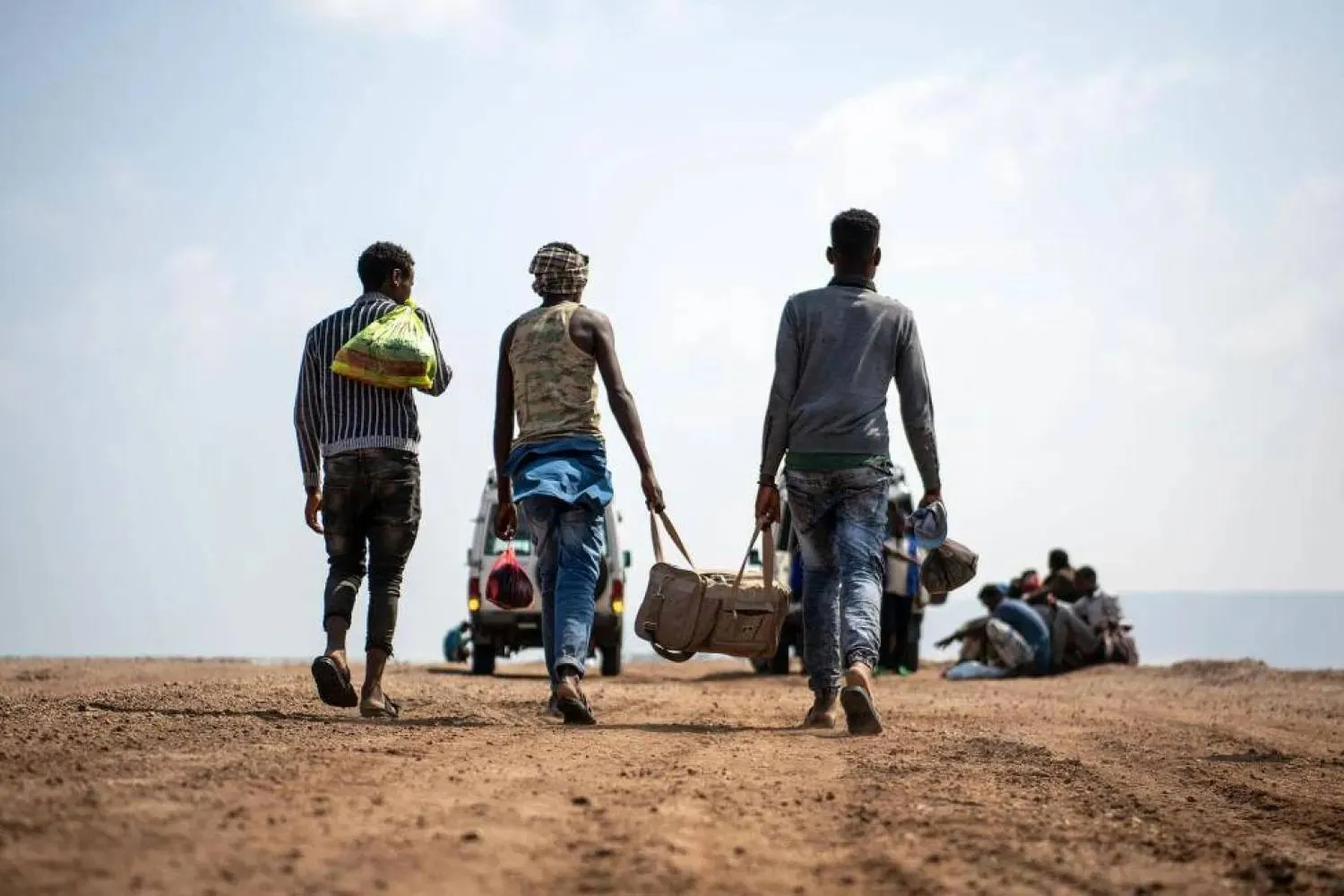

Yemen: Route for Illegal Migration

Tens of thousands of illegal migrants are reaching Yemen through dangerous routes. (UN)
TT

Yemen: Route for Illegal Migration

Tens of thousands of illegal migrants are reaching Yemen through dangerous routes. (UN)

Yemen's coastlines witnessed one of the highest waves of illegal migrants during the last three months of 2025, highlighting the country's role as the main gateway on the Eastern Route, primarily for populations originating in the Horn of Africa.

In a report summarizing findings from October 1 to December 31, 2025, the International Organization for Migration (IOM) said a total of 62,779 movements were documented, including 57,340 inflow migrants arriving in Yemen and 5,439 outflow migrants departing the country.

It said the majority of migrants were male, with men older than 18 accounting for 77% of the total.

The IOM report also showed that the majority of the migrants - 68% - came from Djibouti and landed in the Taiz, Abyan and Shabwah governorates. Somalia accounted for 22% of the remaining departure points to Yemen.

Data collected in this period showed that arrivals in Yemen always reached more than 2,000 individuals per week. The highest arrival recorded occurred in the last week of December.

The majority of migrants arriving in Yemen planned to head from there to various Gulf countries, while some 15% said Yemen was their final destination.

Migrants departing Yemen primarily aimed to travel to Djibouti before continuing their journeys to their origin countries.

Humanitarian and security challenges

The report said Yemen’s role as a crucial transit country and, at the same time, a point of forced reversal for vulnerable populations is highlighted by the continuity of this outgoing flow.

Given that the outflow includes vulnerable people like children, pregnant women, and unaccompanied minors who must make the dangerous reverse sea journey to the Horn of Africa, this dynamic indicates serious protection risks.

During the monitoring period, a total of 5,439 outgoing migrant movements were noted. These were all non-Yemeni migrants, 96% of whom started heading back towards the Horn of Africa after failing to reach intended destinations, while the rest turned to Oman.

The majority of migrants arriving in Yemen during the reporting period were Ethiopian nationals, accounting for 97% of the total, while 3% were Somali nationals, with other nationalities representing less than 1%.

Meanwhile, the Yemeni Interior Ministry said on Tuesday that security authorities in Shabwah announced the arrival of 200 illegal migrants on the coast of Kida, raising the total number of arrivals in January to 890.

All of the migrants are Ethiopian, the Ministry said.


Aoun Calls for Rationally Implementing Lebanon's Commitments as Hezbollah Eases Rhetoric

Lebanese President Joseph Aoun meets with members of the Sovereignty Front. (Lebanese Presidency)
TT

Aoun Calls for Rationally Implementing Lebanon's Commitments as Hezbollah Eases Rhetoric

Lebanese President Joseph Aoun meets with members of the Sovereignty Front. (Lebanese Presidency)

Hezbollah has softened its confrontational tone toward Lebanon’s president and government, without showing clear flexibility on the issue of the state's decision to impose monopoly over arms.

Hezbollah Secretary-General Sheikh Naim Qassem said the party is ready “to discuss how to confront the enemy [Israel] with those who believe in resistance,” while reaffirming its ability to “inflict pain on the enemy” in any potential future confrontation.

His made his remarks as Lebanese President Joseph Aoun reiterated that there will be “no turning back from extending the authority of the law and implementing monopoly over weapons,” stressing that the process would be carried out “with rationality, realism, and responsibility.”

This marks Hezbollah’s first adjustment in tone since it launched a political campaign against the government’s decision to move forward with enforcing the state’s monopoly on arms, including the second phase of the plan that covers regions north of the Litani River.

The Iran-backed party had in recent weeks intensified its criticism of Aoun and the government over the disarmament plan even as Lebanese authorities were working to mobilize international support for the army ahead of a donor conference hosted by Paris on March 5.

Meanwhile, Lebanese Army Commander General Rodolphe Haykal was in the United States where he held talks at the Pentagon with senior military officials, including Chairman of the US Joint Chiefs of Staff General Dan Caine, and Acting Assistant Secretary of Defense for International Security Affairs and Acting Director of the Defense Security Cooperation Agency Daniel Zimmerman.

The discussions focus on military assistance programs and logistical support for the Lebanese army.

Commitment to pledges

On Tuesday, Aoun reiterated his insistence on implementing the weapons monopoly plan, telling a delegation from the Sovereignty Front that the process is being carried out with realism and restraint.

He said the return of international confidence in Lebanon and renewed foreign support are a natural result of efforts to rebuild the state on firm foundations, particularly by enforcing the rule of law and restricting arms to the state.

“These are two matters from which there can be no retreat, regardless of considerations,” Aoun stated, adding that he remains committed to the pledges made in his inaugural address, which received broad domestic and international backing and placed a heavy responsibility on him to remain faithful to them.

Aoun also stressed that he continues to work with all parties to prevent Lebanon from being dragged into a new war.

The Lebanese people, he said, can no longer endure further conflicts, while international conditions require a realistic approach to safeguarding the country and its citizens. He warned that any major danger would affect all Lebanese, not just one group.

Qassem

Despite Lebanon’s insistence on enforcing monopoly over weapons, Hezbollah appeared to step back from its earlier escalation.

Qassem said Lebanon is no longer required to take any further steps under the ceasefire agreement signed in November 2024, calling on the five-member monitoring committee to pressure Israel, rather than Lebanon, to implement the deal.

In a televised address on Tuesday, he said: “We are defending our land, our rights, and our existence against an enemy that wants to eliminate us.”

“When the enemy cannot target fighters, it targets civilians, homes, and municipalities. We must say ‘no’ to the enemy and refuse to surrender.”

Turning to the Lebanese authorities, he said: "Explain to delegations that you cannot pressure the people because they have offered countless martyrs and wounded for the nation."

Qassem said that demands have been made of Hezbollah, "while nothing has been demanded of Israel."

"To those threatening us that the enemy can hurt us, we say we too can harm the enemy, but everything will happen in its own time," he warned.


Libya Opens Investigation into Killing of Seif al-Islam Gadhafi

In this Feb. 25, 2011, file photo, Seif al-Islam al-Gadhafi speaks to the media at a press conference in a hotel in Tripoli, Libya. (AP)
TT

Libya Opens Investigation into Killing of Seif al-Islam Gadhafi

In this Feb. 25, 2011, file photo, Seif al-Islam al-Gadhafi speaks to the media at a press conference in a hotel in Tripoli, Libya. (AP)

Libyan prosecutors said Wednesday they were investigating the killing of Seif al-Islam al-Gadhafi, son of slain ruler Moammar Gadhafi, in the city of Zintan.

The public prosecutor's office said forensic experts had been dispatched to Zintan in northwest Libya, where he was shot dead, adding that efforts were underway to identify suspects.

"The victim died from wounds by gunfire," the office said in a statement, adding that investigators were looking to "speak to witnesses and anyone who may be able to shed light on the incident".

A lawyer of Seif al-Islam, Marcel Ceccaldi, told AFP he was killed by an unidentified "four-man commando" who stormed his house in Zintan on Tuesday.

Libya has struggled to recover from the chaos that erupted after a NATO-backed uprising in 2011 overthrew Moammar Gadhafi.

Libya remains divided between the Government of National Unity based in Tripoli and an eastern administration.

Neither authority has commented on Seif al-Islam's death.

The only public reaction came from Moussa al-Kouni, vice president of the Presidential Council representing the Fezzan region.

"No to political assassinations, no to achieving demands by force, and no to violence as a language or a means of expression," he wrote on X.


Israeli Fire in Gaza Kills 17

Children walk past tents and makeshift shelters in the Bureij refugee camp in the central Gaza Strip on February 3, 2026. (Photo by Eyad BABA / AFP)
TT

Israeli Fire in Gaza Kills 17

Children walk past tents and makeshift shelters in the Bureij refugee camp in the central Gaza Strip on February 3, 2026. (Photo by Eyad BABA / AFP)

Israeli fire in Gaza killed at least 17 Palestinians, most of them women and children, hospital officials said Wednesday, while Israel said militant gunfire had injured an Israeli soldier.

They were the latest Palestinian deaths since a ceasefire, which has been punctuated by deadly Israeli strikes, came into effect on Oct. 10, 2025.

More than 530 Palestinians have been killed by Israeli fire since the deal took effect, according to Gaza’s health ministry.

The Israeli military said it had conducted "precision strikes" after "terrorists opened fire on troops,” seriously wounding an officer, adding that it considers the incident a violation of the ceasefire.

The military said the troops came under attack near the so-called "Yellow Line,” beyond which Israeli forces are stationed in Gaza.
