


NASA's Juno finds Jupiter is a tiny bit smaller than previously thought

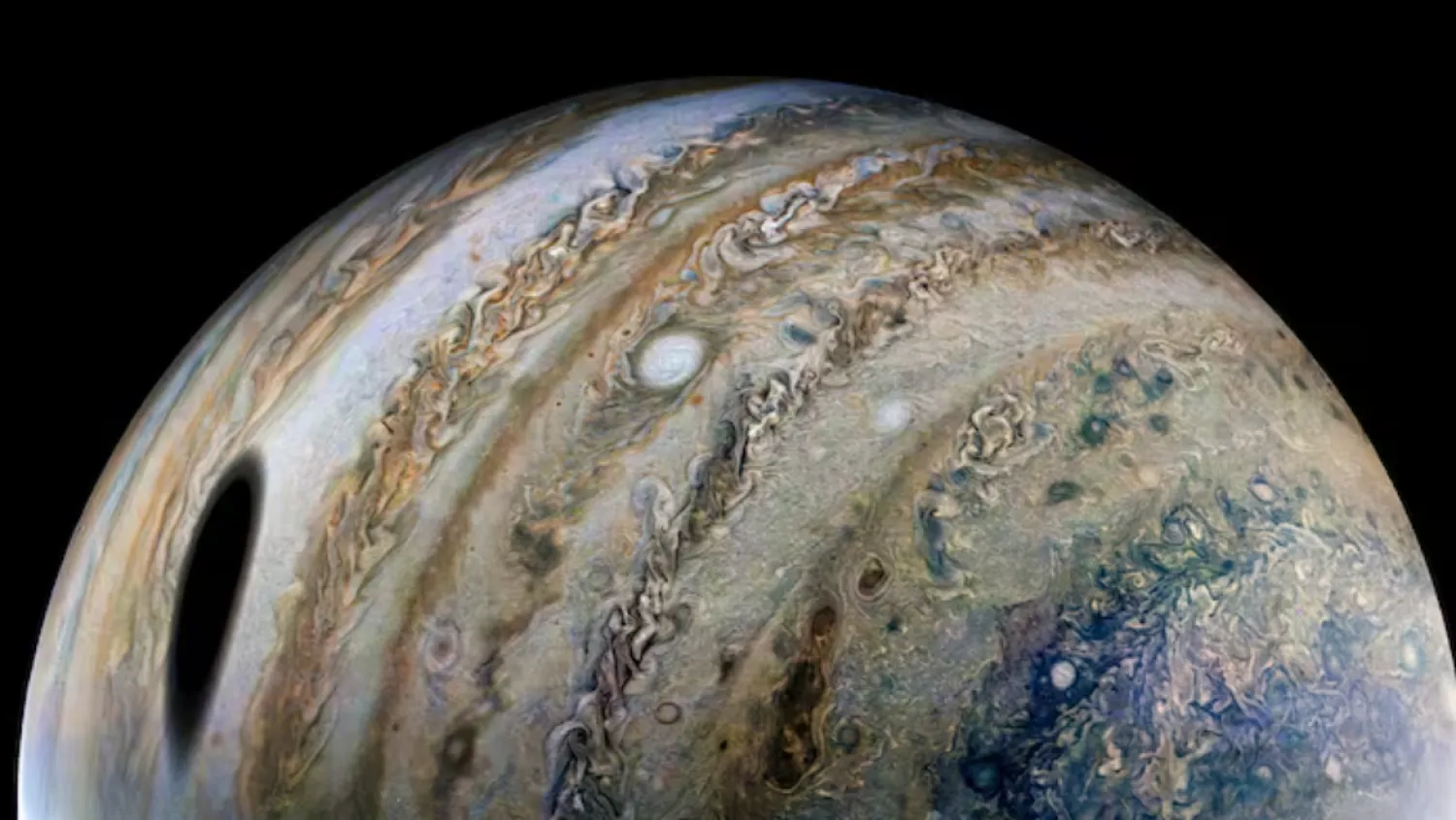
An enhanced-color image, using raw data from the JunoCam instrument aboard NASA's Juno spacecraft, shows the planet Jupiter, with a shadow of its moon Ganymede on the left, released by NASA on April 21, 2022. NASA/JPL-Caltech/SwRI/MSSS/Image processing by Thomas Thomopoulos/Handout via REUTERS
TT

NASA's Juno finds Jupiter is a tiny bit smaller than previously thought

An enhanced-color image, using raw data from the JunoCam instrument aboard NASA's Juno spacecraft, shows the planet Jupiter, with a shadow of its moon Ganymede on the left, released by NASA on April 21, 2022. NASA/JPL-Caltech/SwRI/MSSS/Image processing by Thomas Thomopoulos/Handout via REUTERS

Jupiter, without a doubt, is the biggest planet in our solar system. But it turns out that it is not quite as large - by ever so small an amount - as scientists had previously thought.

Using new data obtained by NASA's robotic Juno spacecraft, scientists have obtained the most precise measurements to date of Jupiter's size and shape. This is important information to gain a fuller understanding of this gas giant, including studying its complex interior structure.

The Juno observations showed that Jupiter has an equatorial diameter of 88,841 miles (142,976 km), which is about 5 miles (8 km) smaller than previous measurements had indicated. The observations also showed that Jupiter's diameter from north pole to south pole is 83,067 miles (133,684 km), about 15 miles (24 km) smaller than previously estimated, Reuters reported.

The planet, like our own, is not a perfect sphere, but rather a bit flattened - and, based on the new data, slightly more so than previously known. Jupiter is about 7% larger at the equator than at the poles. For comparison, Earth's equator is only 0.33% larger than its diameter at the poles.

The previous measurements of Jupiter were based on data gathered by NASA's Voyager and Pioneer robotic spacecraft in the late 1970s. Juno, launched in 2011, has been orbiting Jupiter since 2016, transmitting raw data back to Earth. NASA extended the Juno mission in 2021, giving scientists the opportunity to carry out the type of observations needed in order to fine-tune the measurements of its size and shape, including traveling behind Jupiter from Earth's point of view.

"When Juno passed behind Jupiter from Earth's perspective, its radio signal traveled through the planet's atmosphere before reaching Earth," said planetary scientist Eli Galanti of the Weizmann Institute of Science in Israel, lead author of the study published this week in the journal Nature Astronomy.

"Measuring how the signal changed due to Jupiter's atmospheric composition, density and temperature allowed us to probe the atmosphere and determine the planet's size and shape with high precision. Interestingly, this geometrical configuration did not occur during Juno's prime mission, so these experiments were not originally planned," Galanti said.

Earth, which is the third from the sun among the solar system's eight planets, is a relatively small rocky world.

Jupiter, fifth from the sun, is so immense that all the other planets could fit inside it, including more than 1,300 Earths. Jupiter is composed primarily of hydrogen and helium, with traces of other gases. Strong winds seen as stripes and a few storms dominate Jupiter's colorful outward appearance.

Juno has been collecting data about Jupiter's atmosphere, interior structure, internal magnetic field and magnetosphere, the region around the planet created by its internal magnetism.

Precise new measurements of Jupiter are helpful to scientists because its radius - a measure that is half its diameter - is a fundamental reference used in models of the planet's interior and its atmospheric structure.

"Jupiter is the largest planet in the solar system and contains most of its planetary mass, so understanding its composition and internal structure is central to understanding how the solar system formed and evolved. Jupiter likely formed early, and strongly influenced the distribution of material, the growth of other planets and the delivery of volatiles to the inner solar system, including Earth," Galanti said.

Volatiles are substances like water, carbon dioxide and ammonia that evaporate easily. The delivery of these to the inner solar system, where the four rocky planets reside, was essential because volatiles, Galanti said, "supplied Earth with water and key ingredients for its atmosphere and for life."



Saudi Arabia’s GEA, MBC Egypt Sign Strategic Agreement for Joint Media Production

The partnership covers a comprehensive package of variety and sports programs alongside several drama series (GEA)
TT

Saudi Arabia’s GEA, MBC Egypt Sign Strategic Agreement for Joint Media Production

The partnership covers a comprehensive package of variety and sports programs alongside several drama series (GEA)

Saudi Arabia’s General Entertainment Authority has signed a joint production agreement with MBC Egypt to deliver high-quality media content for the Egyptian audience.

The signing took place in Cairo under the patronage of GEA Chairman Turki Alalshikh.

The partnership covers a comprehensive package of variety and sports programs alongside several drama series, aiming to diversify MBC Egypt's programming and strengthen regional media integration.

Alalshikh is visiting Egypt to explore further strategic partnerships.


India Moves Closer to Dengue Vaccine as Final Trials Underway

Patients suffering from dengue fever receive medical treatment at Civil Hospital in Karachi, Pakistan, 05 November 2025. EPA/SHAHZAIB AKBER
TT

India Moves Closer to Dengue Vaccine as Final Trials Underway

Patients suffering from dengue fever receive medical treatment at Civil Hospital in Karachi, Pakistan, 05 November 2025. EPA/SHAHZAIB AKBER

As dengue surges globally, an Indian vaccine candidate has entered the final stage of testing, raising hopes for one of the world's first single-dose shots against the deadly mosquito-borne disease.

Dengue, which causes severe flu-like symptoms and debilitating body aches, has exploded globally, fueled by rising temperatures and densely populated cities.

The World Health Organization (WHO) says that almost half the world's population is now at risk, with 100-400 million infections every year. India alone has recorded over one million cases and at least 1,500 deaths since 2021.

Hoping to stem the global epidemic, Panacea Biotec has begun final Phase III trials of its vaccine, DengiAll, which has been pursuing for nearly 15 years.

More than 10,000 volunteers across the country are enrolled in the study, overseen by the Indian Council of Medical Research, with the vaccine on track for rollout as early as next year if the trial results are favorable.

"We will try to get this vaccine out there as soon as possible," Syed Khalid Ali, chief scientific officer of Panacea, told AFP in New Delhi.

Doctor Ekta Gupta, professor of clinical virology at the Institute of Liver and Biliary Sciences in New Delhi, said dengue was now considered hyperendemic in India, with all four virus serotypes circulating simultaneously.

"This vaccine is very much needed right now to control the occurrence of these cases, or at least prevent the severity."

- Climate change -

Monsoon outbreaks regularly push Indian hospitals to their limits, crowding urban wards and leaving rural regions grappling with late diagnoses and poor access to care.

Higher temperatures and changing rainfall patterns create ideal conditions for Aedes mosquitoes -- the vectors of dengue -- to reproduce and spread the virus.

Children are particularly vulnerable to the more severe form, called dengue hemorrhagic fever, as they are more likely to suffer low platelet counts and shock.

Participants in Phase III trials, which started in 2024, were randomly assigned to receive either the vaccine or a placebo, with the results expected later this year.

Vaccines against all four dengue serotypes have long posed a scientific challenge. Immunity to one strain does not protect against others, and secondary infections can be more severe.

Most existing candidates require multiple doses.

If approved, DengiAll would become one of the world's first single-dose dengue vaccines, following Brazil's approval of a similar shot last year.

It would also be the first such vaccine available in India, where no dengue shot is currently licensed for public use.

"We will be the second (single-dose) vaccine to come out... But in India and several lower-middle-income countries, we will be the first ones to roll out the dengue vaccine," Ali said.

The candidate is based on a tetravalent strain originally developed by the US National Institutes of Health.

- 'Hope for future' -

Panacea is the most advanced of three Indian firms licensed to use the strain, having developed its own formulation and secured a process patent.

Inside the company's research labs, doctor Priyanka Priyadarsiny, head of biological R&D, said vaccine development involves several steps, from proof-of-concept studies to regulatory checks.

"We are extremely cautious about purity, safety and adverse effects," she said. "Only after meeting regulatory specifications can a product be considered safe for public use."

At present, the WHO recommends only one dengue vaccine, Qdenga, produced by Japan's Takeda for children aged six to 16 in high-transmission settings.

Qdenga, which requires two doses administered three months apart, is not currently available in India.

Ali said DengiAll could be given to people aged one to 60 and is expected to offer long-term protection.

In India, final approval would come from the Drug Controller General of India, while WHO prequalification would be required for large-scale international use.

Experts say a successful Indian-made vaccine could be key to affordability and mass rollout in lower-income countries.

Virologist and Oxford University fellow Shahid Jameel -- who is not connected with the trial -- warned dengue incidence could rise by 50-75 percent by 2050 under current climate change trends.

Still, he cautioned that only Phase III results would determine whether a candidate meets the criteria for a safe and effective dengue vaccine.

"Phase III testing and follow-up are needed to show if the above conditions are met," he told AFP.

"Only then can we have a useful dengue vaccine. It is still early days, but there is hope for the future."


Oil Spill from Cargo Ship Washes up on Thai Tourist Islands 

People walk along Patong Beach in Phuket, Thailand, June 29, 2021. (AFP)
TT

Oil Spill from Cargo Ship Washes up on Thai Tourist Islands 

People walk along Patong Beach in Phuket, Thailand, June 29, 2021. (AFP)

An oil spill from a capsized cargo ship in the Indian Ocean is washing ashore on the pristine beaches of Thailand's most famous resort island, a lawmaker told AFP Friday.

The Panama-flagged Sealloyd Arc sank off Phuket on February 7 while sailing for Chattogram in Bangladesh, Thai authorities said, spilling around 1,700 liters of oil.

The coagulated residue has begun washing up on the island's Ya Nui Beach, as well as a smattering of smaller islands in Phuket province, local lawmaker Chalermpong Saengdee told AFP.

The oil has tainted Koh Hey's Banana Beach -- a popular destination for island-hopping tourists seeking turquoise clear waters -- and is expected to keep spreading, he said.

"It's very worrying because the incident happened two weeks ago, but the situation is not improving and it poses a threat to marine life and coastal reefs," he said.

"We are also concerned it could affect Thailand's tourism and economy."

The ship lies at a depth of about 60 meters (197 feet), making it difficult for divers to contain the leak, Chalermpong said.

Footage on public broadcaster Thai PBS showed locals combing beaches with rakes and buckets to collect globs of the oil.

While the Thai Navy has been using dispersants to treat the spillage, Chalermpong has called for government funding to salvage the wreck.

Thailand suffered 130 oil spills affecting more than 23 provinces between 2017 and 2021, according to the Department of Marine and Coastal Resources.

Environmental organizations warn oil spills cause severe and long-lasting damage to ecosystems -- coating wildlife, contaminating food sources and releasing toxic chemicals.