

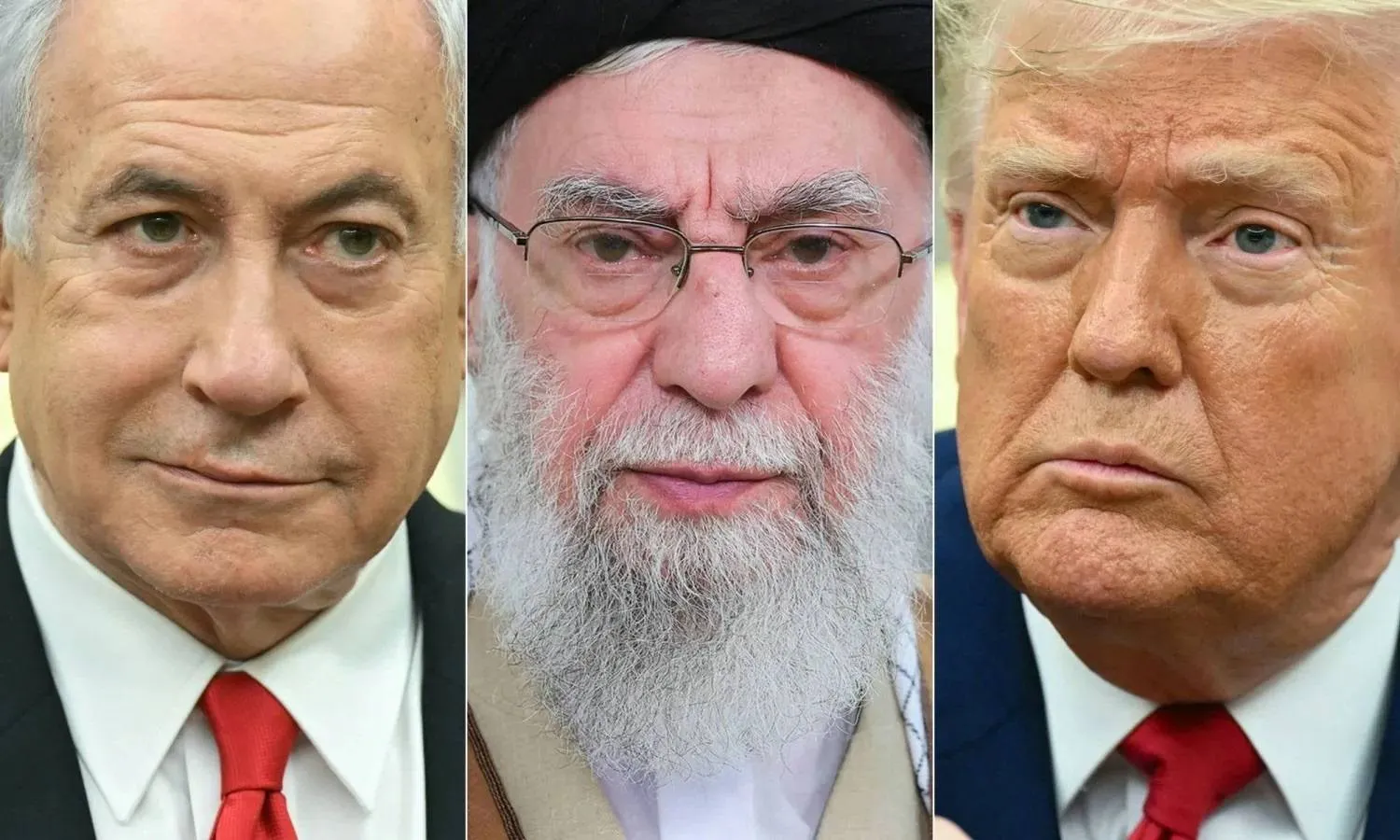

‘Surprise Strikes’ Loom If US–Iran Talks Collapse

A combined image of US President Donald Trump, Iran’s Supreme Leader Ali Khamenei, and Israeli Prime Minister Benjamin Netanyahu (AFP). 
TT

‘Surprise Strikes’ Loom If US–Iran Talks Collapse

A combined image of US President Donald Trump, Iran’s Supreme Leader Ali Khamenei, and Israeli Prime Minister Benjamin Netanyahu (AFP). 

As anticipation grows over the resumption of US–Iran negotiations in Oman, Israeli Prime Minister Benjamin Netanyahu convened an emergency meeting of Israel’s security cabinet on Thursday to assess scenarios in the event the talks fail and to consider the possibility of renewed military escalation.

Ahead of the meeting, Netanyahu briefed a confidential subcommittee of the Knesset’s Foreign Affairs and Defense Committee, stressing that the Israeli military is prepared to launch a major strike against Iran—one he said could be harsher than the so-called Twelve-Day War.

Israeli media later reported that the discussions reflected growing concern in Jerusalem over the direction of diplomacy with Tehran.

Channel 12 quoted a source familiar with the security cabinet deliberations as saying there is “full coordination with the United States” on Iran-related matters.

At the same time, The Jerusalem Post reported that Israel’s Chief of Staff, Eyal Zamir, told US officials that Israel is ready to carry out “surprise strikes” against targets inside Iran should Tehran “choose the path of war.”

According to the report, Zamir emphasized that any US concessions on Iran’s ballistic missile program would cross a red line for Israel, alongside other red lines linked to Iran’s nuclear activities.

This stance, the newspaper said, helps explain US Secretary of State Marco Rubio’s insistence that the ballistic missile program be included in the agenda of upcoming talks with Tehran. Rubio reiterated earlier this week that negotiations should address both Iran’s nuclear and missile programs.

Iran, however, has pushed back firmly. Ebrahim Rezaei, spokesman for the Iranian parliament’s National Security Committee, said both uranium enrichment and the ballistic missile program are non-negotiable “red lines” for Tehran.

Netanyahu said he does not yet know what decision US President Donald Trump will take regarding a possible military strike on Iran, but expressed confidence that Washington will adopt a tougher approach in the current round of negotiations.

Channel 12 described Israeli satisfaction with the US position as having taken on a “deep strategic dimension,” noting a recent secret visit by Zamir to Washington that Israeli officials have portrayed as significant.

Former national security adviser Tzachi Hanegbi shed further light on the background in remarks at a policy seminar in Herzliya. He said Netanyahu had previously sought to persuade former President Joe Biden to authorize a strike on Iran, but Biden rejected the idea, preferring to exhaust diplomatic options.

Netanyahu later made similar appeals during Trump’s second term, warning of an approaching “zero hour,” yet Trump initially resisted military action, opting instead for sanctions and warnings.

Hanegbi said Trump’s position shifted in June after reviewing the results of Israeli strikes on Iran ahead of the Twelve-Day War and the successful interception of two large-scale Iranian attacks with US assistance, without American casualties or disruption to shipping in the Strait of Hormuz.

He added that Trump was impressed by Israel’s military performance and eventually gave the green light for war, agreeing to join its final phase.

Meanwhile, Israeli political sources told the news site Walla that there is a growing sense in Jerusalem that Washington entered the current negotiations at a poor moment and from a weak position.

They argued that Iran today is more confident and assertive than in 2015, believing its threats of regional escalation were enough to push the United States back to diplomacy.



Iranian Hardline Clerics Seek Swift Naming of New Supreme Leader

An Iranian woman flashes the victory sign while holding a picture of late Iranian supreme leader Ali Khamenei as she arrives to attend the Friday prayer ceremony at Mosallah mosque in Tehran, Iran, 06 March 2026. (EPA)
TT

Iranian Hardline Clerics Seek Swift Naming of New Supreme Leader

An Iranian woman flashes the victory sign while holding a picture of late Iranian supreme leader Ali Khamenei as she arrives to attend the Friday prayer ceremony at Mosallah mosque in Tehran, Iran, 06 March 2026. (EPA)

Two influential and ‌hardline Iranian clerics have called for the swift selection of a new supreme leader to help guide the nation amid a new wave of US and Israeli strikes, Iranian media reported on Saturday.

The calls by the clerics suggest that at least some in the clerical establishment are uncomfortable with leaving a three-man council in charge, even temporarily under constitutional rules, after the killing of Supreme Leader Ali ‌Khamenei.

US President ‌Donald Trump has said the ‌US ⁠should have a role ⁠in choosing the new leader, a demand Iran has rejected.

Naser Makarem Shirazi said an appointment was needed swiftly to "help better organize the country’s affairs", state media reported.

Hossein Nouri Hamedani also urged members of the Assembly of Experts, ‌a clerical body charged with choosing the new leader, to accelerate the process ⁠of ⁠picking Khamenei's successor, state media reported.

Following rules laid out in Iran's constitution, a three-man council comprising the president, a senior cleric and the head of the judiciary, has taken on the supreme leader's role until the Assembly of Experts decides.

The constitution states a supreme leader should be chosen within three months, although with war raging, it is not immediately clear how quickly the 88-member Assembly of Experts can convene. Sources have said some clerics have held some consultations online.


Sri Lanka to Treat Iranian Sailors According to ‘International Law’

An ambulance enters Sri Lanka's southern naval headquarters in Galle on March 4, 2026, to pick up Iranian sailors rescued from Iranian frigate Iris Dena that was sunk off their island earlier in the day. (AFP)
TT

Sri Lanka to Treat Iranian Sailors According to ‘International Law’

An ambulance enters Sri Lanka's southern naval headquarters in Galle on March 4, 2026, to pick up Iranian sailors rescued from Iranian frigate Iris Dena that was sunk off their island earlier in the day. (AFP)

Sri Lanka will treat Iranian sailors rescued from a torpedoed frigate according to international law, a minister said Saturday, following reports Washington was pressuring Colombo to not repatriate them.

Foreign Minister Vijitha Herath told a conference in New Delhi that Sri Lanka was caring for 32 sailors from the Iranian frigate IRIS Dena under Colombo's international treaty obligations.

The frigate was sunk by a US submarine on Wednesday just off Sri Lanka's southern coast.

Sri Lanka sent its navy to rescue survivors and recover 84 bodies.

Asked if Colombo was under pressure from the US to not repatriate the Iranians, Herath did not answer directly.

"We have taken all the steps according to international laws," Herath said.

Sri Lanka also provided safe haven to a second Iranian warship, the IRIS Bushehr, and evacuated its 219 crew a day after the Dena was torpedoed.

The ship was taken to Trincomalee on Sri Lanka's northeast coast after reporting engine problems.

India, meanwhile, said Saturday it had allowed a third Iranian warship, the IRIS Lavan, to dock in one of its ports on "humane" grounds after it too reported operational problems.

The three ships were part of a multi-national fleet review held by India before the war in the Middle East started last Saturday.

"I think it was the humane thing to do and I think we were guided by that principle," Indian Foreign Minister Subrahmanyam Jaishkar said.

The Lavan docked in the southwest Indian port of Kochi on Wednesday.

"A lot of the people on board were young cadets. They have disembarked and are in a nearby facility," said Jaishkar.

Sri Lankan President Anura Kumara Dissanayake said this week that Colombo would follow the Hague Convention, which requires a neutral state to hold combatants of a warring state until hostilities end.

A senior administration official said Colombo was in talks with the International Committee of the Red Cross to deal with the survivors of the torpedoed ship.

International humanitarian law applied to the survivors from the Dena, an official said, and the wounded could be repatriated at their request.

Iranian diplomats in Colombo said they have asked for the remains of 84 sailors killed in the US attack to be taken back to Iran.


Pakistani Convicted of Plotting to Kill Trump over Death of Iran Commander

FILE PHOTO: Asif Merchant, a Pakistani man with alleged ties to Iran, appears on charges in connection with a foiled plot to assassinate a US politician or government officials, in a courtroom in New York, US, September 16, 2024 in this courtroom sketch. REUTERS/Jane Rosenberg/File Photo
TT

Pakistani Convicted of Plotting to Kill Trump over Death of Iran Commander

FILE PHOTO: Asif Merchant, a Pakistani man with alleged ties to Iran, appears on charges in connection with a foiled plot to assassinate a US politician or government officials, in a courtroom in New York, US, September 16, 2024 in this courtroom sketch. REUTERS/Jane Rosenberg/File Photo

A Pakistani ‌man was convicted on Friday of planning to kill President Donald Trump and other prominent US politicians two years ago at the behest of Iran, the Department of Justice said.

Asif Merchant was accused of trying to recruit people in the US in a plan targeting Trump and others in retaliation for Washington's killing of Iranian military commander Qassem Soleimani in 2020, when Trump was in his first term.

Targets in the 2024 plot also included then-President Joe Biden and Nikki Haley, who ran against Trump ‌that year for ‌the Republican presidential nomination, federal prosecutors said.

Merchant ‌was ⁠convicted of "murder for ⁠hire and attempting to commit an act of terrorism transcending national boundaries," directed by the Iranian authorities, the DOJ said in a statement.

The trial in the New York City borough of Brooklyn started last week, days before Trump ordered an assault on Iran, carried out with Israel, that has expanded into the region's biggest ⁠war in years.

Merchant admitted to joining the plot ‌with Iran's elite Iranian Revolutionary Guards ‌Corps but testified he did so unwillingly, to protect his family ‌in Tehran.

Merchant said he was never ordered to kill ‌a specific person but that his Iranian handler named three people in the course of conversations in the Iranian capital.

Law enforcement thwarted the plan before any attack occurred. A person Merchant contacted in April 2024 ‌to help with the plot reported his activities and became a confidential informant, the DOJ said. ⁠Merchant was ⁠arrested and pleaded not guilty that year.

The Revolutionary Guards have a central role in Iran, with a combination of military and economic power and an intelligence network. Tehran has denied accusations that it targeted Trump or other US officials.

US and Israeli attacks since Saturday have killed at least 1,332 Iranian civilians and wounded thousands, according to Iran's UN ambassador. Many top Iranian leaders, including Supreme Leader Ali Khamenei, have been killed.

The US military has said six of its service members were killed in a strike on a facility in Kuwait, while Israeli tallies show at least 10 civilians have been killed across Israel.
