


Iran Says Talks with US in Oman Were ‘Good Start’, Will Continue

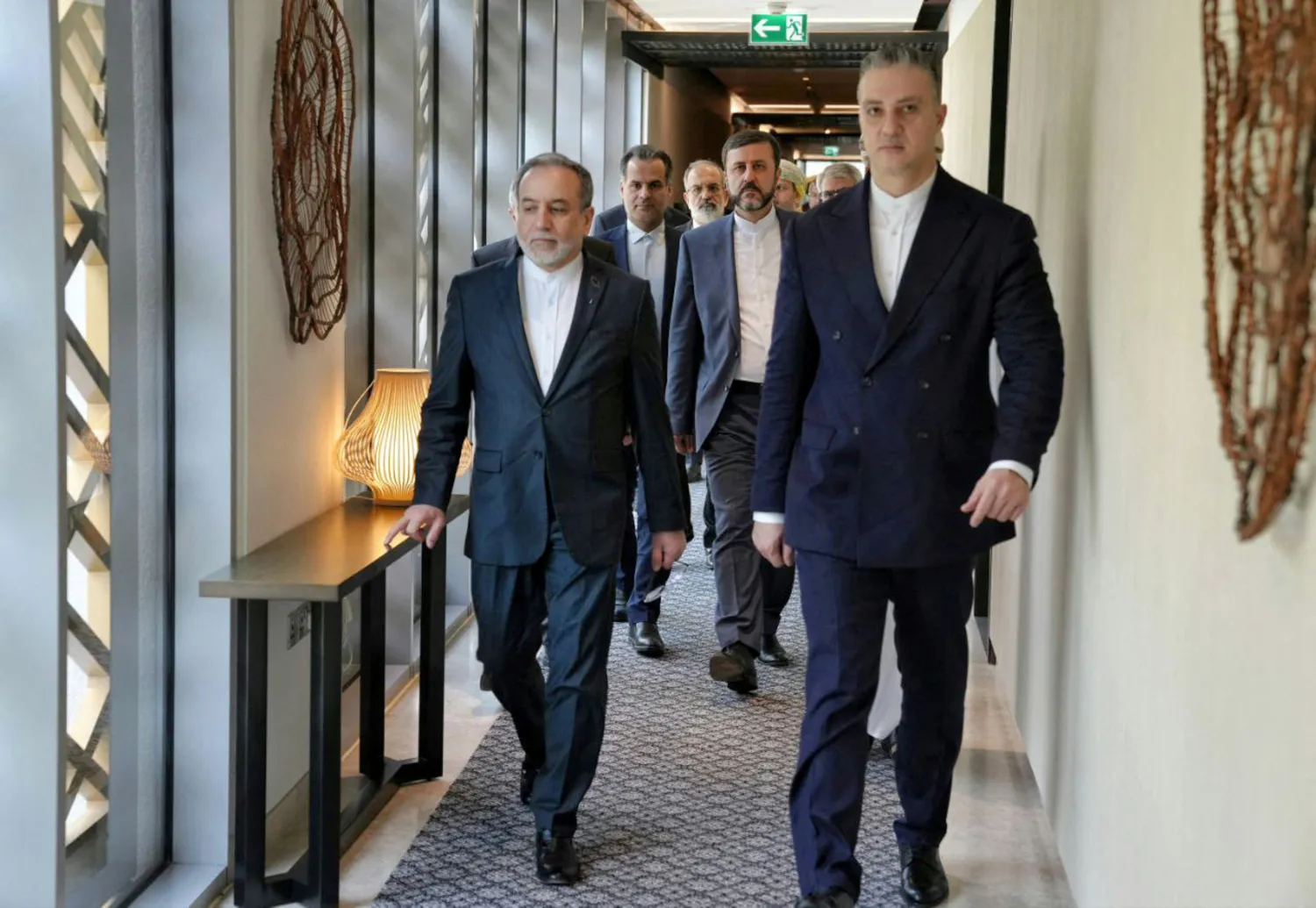
Iranian Foreign Minister Abbas Araqchi and his accompanying delegation depart for the site of the talks in Muscat, Oman, February 6, 2026. Iranian Foreign Ministry/WANA (West Asia News Agency)/ Handout via Reuters
TT

Iran Says Talks with US in Oman Were ‘Good Start’, Will Continue

Iranian Foreign Minister Abbas Araqchi and his accompanying delegation depart for the site of the talks in Muscat, Oman, February 6, 2026. Iranian Foreign Ministry/WANA (West Asia News Agency)/ Handout via Reuters

Iran’s top diplomat said on Friday that nuclear talks with the US mediated by Oman were off to a “good start” and set to continue, in remarks that could help allay concern that failure to reach a deal might nudge the Middle East closer to war. 

But Foreign Minister Abbas Araqchi said after the talks in the Omani capital Muscat that "any dialogue requires refraining from threats and pressure. (Tehran) only discusses its nuclear issue ... We do not discuss any other issue with the US." 

While both sides have indicated readiness to revive diplomacy over Tehran's long-running nuclear dispute with the West, Washington wanted to expand the talks to cover Iran's ballistic missiles, support for armed groups around the region and "treatment of their own people", US Secretary of State Marco Rubio said on Wednesday. 

Iranian officials have repeatedly ruled out putting Iran's missiles - one of the largest such arsenals in the Middle East - up for discussion, and ‌have said Tehran ‌wants recognition of its right to enrich uranium. 

For Washington, carrying out enrichment - a possible ‌pathway to ⁠nuclear bombs - inside ‌Iran is a red line. Tehran has long denied any intent to weaponize nuclear fuel production. 

"It was a good start to the negotiations. And there is an understanding on continuing the talks. Coordination on how to proceed will be decided in the capitals," Araqchi told Iranian state TV. "If this process continues, I think we will reach a good framework for an understanding." 

TALKS WERE 'VERY SERIOUS', SAYS OMAN 

Mediator Badr al-Busaidi, Oman's foreign minister, said the talks had been "very serious", with results to be considered carefully in Tehran and Washington. The goal was to reconvene in due course. 

Iran’s clerical leadership remains deeply worried that Trump may still carry out his threats to strike after a ⁠US naval buildup in seas in the region. 

"The lack of trust is a huge challenge during the talks and it should be overcome," Araqchi said. 

Last June the ‌US struck Iranian nuclear targets, joining in the final stages of a 12-day ‍Israeli bombing campaign. Tehran has since said it has halted uranium ‍enrichment activity. 

The naval buildup, which Trump has called a massive “armada”, has followed a bloody government crackdown on nationwide protests ‍in Iran last month, heightening tensions between Washington and Tehran. 

Trump has warned that "bad things" will probably happen if a deal cannot be reached, ratcheting up pressure on the country in a standoff that has led to mutual threats of air strikes. 

World powers and regional states fear a breakdown in the negotiations would ignite another conflict between the US and Iran that could spill over to the rest of the oil-rich region. 

Iran has vowed a harsh response to any strike and has cautioned regional countries that host US bases that they could be in the firing line if they were involved in an attack. 

Negotiators in Oman ⁠will have to navigate Iran's red line on discussing its missile program to reach a deal and avert future military action. Tehran has flatly ruled out talks on its "defense capabilities, including missiles and their range". 

In a show of defiance, Iranian state TV said hours before the talks that “one of the country’s most advanced long-range ballistic missiles, the Khorramshahr-4,” had been deployed at one of the Revolutionary Guards’ vast underground “missile cities”. 

However, Tehran is willing to show "flexibility" on uranium enrichment, including by handing over 400 kg of highly enriched uranium - refined closer to bomb-grade - and accepting zero enrichment under a consortium arrangement as a solution, Iranian officials told Reuters last week. 

Iran also demands the lifting of US sanctions, reimposed since 2018 when Trump, during his first term in the White House, ditched Iran's 2015 nuclear deal with six world powers. 

The United States, its European allies and Israel accuse Tehran of using its nuclear energy program as a veil for efforts to develop the capability to produce atomic bombs. Iran says its nuclear program is for peaceful purposes only. 

Israel has likened the danger of ‌Iran's missiles to its nuclear program. Prime Minister Benjamin Netanyahu said in January that Iran's "attempt to build atomic weapons" and "20,000 ballistic missiles" were like "two lumps of cancer". 


New Gallup Poll Shows How Americans’ Sympathies Have Shifted in Palestinian-Israeli Conflict 

Palestinian men carry the body of a person killed in an Israeli military strike, as they maneuver past the debris of building destroyed by the Israeli military, during their funeral in Khan Younis, in the southern Gaza Strip on February 27, 2026. (AFP)
TT

New Gallup Poll Shows How Americans’ Sympathies Have Shifted in Palestinian-Israeli Conflict 

Palestinian men carry the body of a person killed in an Israeli military strike, as they maneuver past the debris of building destroyed by the Israeli military, during their funeral in Khan Younis, in the southern Gaza Strip on February 27, 2026. (AFP)

American sympathies in the Middle East have shifted dramatically toward the Palestinians, according to new Gallup polling, after decades of overwhelming support for the Israelis.

That shift accelerated during the war in Gaza. Three years ago, 54% of Americans sympathized more with the Israelis, compared to 31% for the Palestinians.

Now, their support is about evenly balanced, with 41% saying their sympathies lie more with the Palestinians, and only 36% saying the same about the Israelis.

The numbers reflect how support for Israel has become deeply contentious in the US, with profound implications for American politics and foreign policy. The changing sentiment has been largely driven by Democrats, who are now much more likely to sympathize with Palestinians. US assistance to Israel has been a major dividing line in the party’s primaries this year.

Gallup’s data indicates that the shift was already happening before Hamas attacked Israel on Oct. 7, 2023, then increased during Israel’s subsequent military operations in Gaza. The polling has a margin of error of plus or minus 4 percentage points, meaning sentiment toward Israelis and Palestinians are roughly even.

“It’s the first time they have reached parity, which is really quite striking,” said Benedict Vigers, a senior global news writer at Gallup. “In not many years, that very significant gap in public opinion has now completely closed.”

Democrats and independents

About two-thirds of Democrats now say their concerns lie more with the Palestinians, while only about 2 in 10 sympathize more with the Israelis. As recently as 2016, the picture looked very different: About half of Democrats sympathized more with the Israelis and only about one-quarter sympathized with the Palestinians.

The shift began even before the Israel-Hamas war turned the issue into a flash point within the Democratic Party. Palestinian fighters killed around 1,200 people, mostly civilians, in the initial attack and took another 251 hostage, but the Israeli response has been widely seen as disproportionate, with Gaza health officials reporting more than 72,000 Palestinians killed, nearly half of them women and children, and wide swaths of the territory reduced to rubble.

Many progressive politicians and activists now describe Israel’s actions in the war as genocide — a charge Israel vehemently denies.

Democrats have expressed greater sympathy for the Palestinians than the Israelis since 2023 — in a Gallup poll that was conducted before the Oct. 7 attacks — but Gallup’s surveys show their support in the conflict has been tilting toward the Palestinians and away from the Israelis since around 2017.

Some of that early decline in sympathy appeared to be tied to disapproval of the right-leaning Israeli leader, Prime Minister Benjamin Netanyahu, whose favorability in the US fell nearly 15 percentage points between 2017 and 2024, according to separate Gallup polling.

Netanyahu clashed with former President Barack Obama in the last year of his administration, then forged a warmer relationship with President Donald Trump, who delivered several victories to Netanyahu in his first term, including recognizing Jerusalem as the capital of Israel and Israel’s sovereignty over the Golan Heights. Trump also persuaded three Arab countries to establish commercial and diplomatic ties with Israel. The closeness between Trump and Netanyahu has continued into Trump’s second term.

The conflict between the Israelis and Palestinians was a point of tension for Democrats during President Joe Biden’s administration, as well as during the 2024 presidential election.

An AP-NORC poll conducted toward the end of 2023, just a few months into the war in Gaza, found that Democrats were sharply divided on whether the US was too supportive of Israel, and another AP-NORC poll from 2024 found that Democratic voters were more likely to say the Israeli government held “a lot” of responsibility for the war’s escalation.

Democrats’ sympathy for the Palestinians intensified as the war progressed, Gallup’s polling shows, and independents’ views also shifted. This year, independents expressed more sympathy for the Palestinians than the Israelis for the first time in Gallup’s trend. About 4 in 10 independents are more sympathetic toward the Palestinians. That’s compared to about 3 in 10 for the Israelis, a new low.

Most Republicans continue to side with Israel — about 7 in 10 say they are more sympathetic to the Israelis — but that is a slight downtick from about 8 in 10 before the start of the war. Some figures in the Republicans’ isolationist “America First” wing are also increasingly questioning traditional US support for Israel.

Generational gaps

Younger adults — those 18 to 34 in this poll — are also increasingly sympathetic toward the Palestinians, according to the Gallup survey.

Younger Americans’ sympathies have been shifting toward the Palestinians since around 2020, and reached a new high this year. About half of 18- to 34-year-olds say they have more sympathy for the Palestinians, compared to about a quarter who say that about the Israelis.

Student protests against the Israel-Hamas war appeared on college campuses around the country during the war, asking colleges to cut investments supporting Israel.

But the shift is only “partly a generational story,” according to Vigers.

The new poll also found for the first time that middle-aged Americans, those 35 to 54, expressed more sympathy for the Palestinians than the Israelis — a reversal from last year. And while Americans over 55 are more sympathetic toward Israel, that gap is narrowing, too.

“With adults over 55, they are more sympathetic to Israelis, but it’s as low as it’s been since 2005,” Vigers said.

Palestinian state

About 6 in 10 US adults, 57%, favor the establishment of an independent Palestinian state in the West Bank and the Gaza Strip, according to the new polling. That’s not significantly different from recent years, as at least half of US adults have supported an independent Palestinian state since 2020.

Vigers notes that “party polarization is at or near its record high” on this question, even though it hasn’t been sharply increasing year over year.

In the last few years, there’s been an uptick among Democrats and independents in support for the two-state solution. Now, about three-quarters of Democrats and roughly 6 in 10 independents say they support an independent Palestinian state. Only about one-third of Republicans say the same.

The opinions of the people who would be directly affected by a two-state solution are quite different. Only about 3 in 10 Israelis living in Israel and Palestinians living in the West Bank and east Jerusalem said they supported a two-state solution in which an independent Palestinian state existed alongside Israel, according to the Gallup World Poll conducted in 2025.

“On the ground, in the region, far fewer Israelis and Palestinians tell us that they are in favor of the two-state solution than Americans when asked a very similar question,” Vigers said. “There is that interesting sort of disconnect between the region itself and Americans’ views toward it.”


Canadian PM Carney Lands in India, Say Broadcasters

Mark Carney speaks during the Liberal Party meeting to select Justin Trudeau's successor in Ottawa, March 9, 2025 (Reuters)
TT

Canadian PM Carney Lands in India, Say Broadcasters

Mark Carney speaks during the Liberal Party meeting to select Justin Trudeau's successor in Ottawa, March 9, 2025 (Reuters)

Canadian Prime Minister Mark Carney landed in India on Friday where he hopes to reset ties and double trade, offsetting the damage from his country's fracturing relations with the United States, said AFP.

Carney arrived in the country's financial hub Mumbai, Indian broadcasters reported, where he is expected to address business leaders before travelling to the capital New Delhi and meeting with Prime Minister Narendra Modi on Monday.


Ocalan Says Laws Needed in Türkiye Peace Process

FILE - Youngsters hold a photograph of Abdullah Ocalan, the jailed PKK leader in Diyarbakir, Türkiye, Feb. 27, 2025. (AP Photo/Metin Yoksu, File)
TT

Ocalan Says Laws Needed in Türkiye Peace Process

FILE - Youngsters hold a photograph of Abdullah Ocalan, the jailed PKK leader in Diyarbakir, Türkiye, Feb. 27, 2025. (AP Photo/Metin Yoksu, File)

Jailed Kurdistan Workers Party leader Abdullah Ocalan said on Friday that peace-related laws were needed for a transition to democratic integration in Türkiye, in a statement read out a year after he called on his PKK to end its decades-old insurgency and disband.

Ocalan's call could be taken to endorse a roadmap, approved last week by a Turkish parliamentary commission, that urges legal reforms to run alongside the PKK's disarmament, even though details on implementation remain hazy.

The roadmap is expected to be put before parliament next month, likely after the end of Ramadan. If it passes, it will be the first concrete step taken by Türkiye.

"The transition to ⁠democratic integration necessitates laws of peace," Ocalan said ‌in a statement read ‌out by a senior figure in the pro-Kurdish DEM Party at ‌a press conference. The democratic society solution envisions a "legal ‌framework with political, social, economic, and cultural dimensions," he added.

The leaders of DEM, which has been closely involved in the peace process, said before reading Ocalan's statement that it was time for the ‌government to take concrete measures on issues including language, cultural and religious freedoms.

The PKK declared an ⁠end to ⁠its insurgency in May last year and its militants burned some weapons in a symbolic ceremony last July. A few months later it announced its withdrawal from Türkiye, and last week a militant source welcomed the parliament move but said there was still a lack of clarity.

"The door is opening to a new political era and strategy," Ocalan said Friday in the written statement from Imrali prison island where he has been held in solitary confinement since 1999.

"We aim to close the era of violence-based politics and open a process based on democratic society and the rule of law," he said, urging all segments of Turkish society to engage with the process.

Some MPs involved in drafting the parliamentary report expressed concern the text failed to mention "the Kurdish question."

Others noted the absence of reference to the "right to hope" for Ocalan -- shorthand for a possible early release -- a key concept first raised in October 2024 when Ankara extended an olive branch to him, kicking off the process.
