

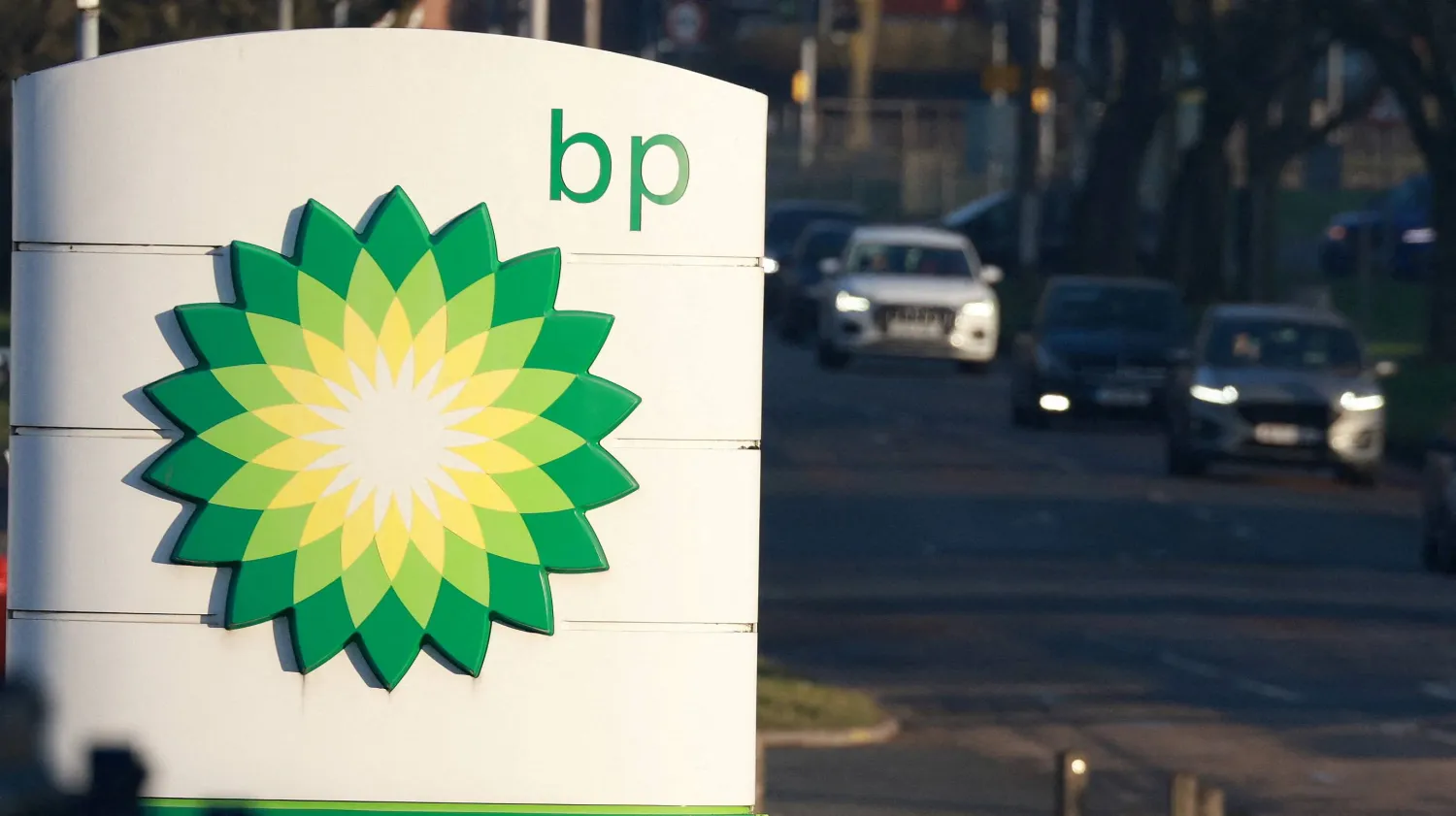

BP Announces 86% Drop in Annual Net Profit, Shocks Shareholders by Suspending Buybacks Program

FILE PHOTO: Vehicles drive past a BP (British Petroleum) petrol station in Liverpool, Britain, February 7, 2023. REUTERS/Phil Noble/File Photo
TT

BP Announces 86% Drop in Annual Net Profit, Shocks Shareholders by Suspending Buybacks Program

FILE PHOTO: Vehicles drive past a BP (British Petroleum) petrol station in Liverpool, Britain, February 7, 2023. REUTERS/Phil Noble/File Photo

British oil giant BP announced Tuesday a sharp 86% drop in annual net profit and a surprise decision to suspend the entire share buyback program to save cash and trim debts.

The financial setback comes at a sensitive time, as the company prepares to welcome its new CEO, Meg O'Neill, in April and while it hopes to strengthen the balance sheet which is hit by lower crude prices and a huge write-down linked to its green energy transition.

Profit after tax dropped to $55 million last year from $381 million a year earlier, BP said in a statement.

The company said the annual results included an impairment totaling around $4 billion linked to its “transition businesses in the gas and low carbon energy segment.”

It added that its annual performance was “delivered against a weaker oil price environment.”

Underlying earnings, which strip out some energy price movements and one-off charges, fell 16% to $7.5 billion last year, slightly below the market expectations of $7.58 billion.

Meanwhile, BP surprised shareholders by a decision to suspend its share buyback program, as the company intensifies its efforts to shore up its balance sheet.

BP said it would “fully allocate excess cash” to cutting its $22 billion debt pile, acknowledging that “urgency” was needed to revive the fortunes of one of the UK’s best-known companies.

The move sent the company’s shares down more than 5% in London, to become one of the worst performers in the pan-European STOXX 600 index.

Carol Howle, BP interim CEO, said in a statement, “We have made progress against our four primary targets - growing cash flow and returns, reducing costs, and strengthening the balance sheet - but know there is more work to be done, and we are clear on the urgency to deliver.”

Internal factors were not alone responsible for the company’s decline in net profit, as BP said its performance was driven by a weaker oil price environment that clouded 2025.

Energy prices have been under pressure on concerns that US President Donald Trump's tariffs will crimp economic growth.

The international oil price benchmark, Brent North Sea crude, was steady Tuesday at $69 per barrel.

Contrary to BP, British rival Shell last week said its net profit rose 11% last year as higher volumes and lower costs helped to offset falling oil and gas prices.

Profit after tax climbed to $17.84 billion in 2025 from $16.1 billion a year earlier.

Analysts had raised the prospect of European oil majors' buyback programs shrinking due to lower oil and gas prices. Indeed, Norway's Equinor slashed its buyback program by 70% last week.

Meg O'Neill is taking over as BP's chief executive in April, becoming the first woman to lead an oil major. Her appointment comes following Murray Auchincloss’ decision to step down late last year.

O'Neill, an American who spent 23 years working for ExxonMobil, is also the first external candidate to be appointed CEO of BP in the group's 116-year history.

She has led the Australian group Woodside Energy since April 2021.

Carole Howle, who has served as interim CEO since Auchincloss unexpectedly stepped down in December, said on Tuesday, “We look forward to Meg O'Neill joining as CEO in April as we accelerate our progress to build a simpler, stronger and more valuable BP for the future.”

“We can and will do better for our shareholders,” she added as the group suspended share buybacks.

That news hit BP's share price, which shed 5% in Tuesday’s morning trading in London.



Iraq in Talks with Gulf States on Pipeline Exports beyond Hormuz

Workers carry out maintenance on a pipeline at a gas separation station in the Zubair oil field near Basra (AP). 
TT

Iraq in Talks with Gulf States on Pipeline Exports beyond Hormuz

Workers carry out maintenance on a pipeline at a gas separation station in the Zubair oil field near Basra (AP). 

Iraq is in talks with Gulf countries to use their pipeline networks to secure alternative oil export routes beyond the Strait of Hormuz, the state oil marketer SOMO said Thursday.

The move is part of an emergency strategy by the oil ministry to tap regional infrastructure and bypass maritime chokepoints, ensuring Iraqi crude continues to reach global markets while offsetting higher transport costs linked to the current crisis.

Ali Nizar al-Shatari, head of the State Organization for Marketing of Oil (SOMO), said the ministry is prioritizing negotiations to access Gulf pipeline systems extending beyond the Strait of Hormuz and into the Arabian Sea, allowing exports to avoid areas of military tension.

“The goal is to secure stable routes that guarantee efficient flows of Iraqi oil at lower transport costs,” Shatari said, adding that Iraq generated about $2 billion in oil revenues in March, up 28 percent from February.

He said SOMO exported around 18 million barrels of crude from Basra, Kirkuk and the Kurdistan region by using all available outlets, including southern ports that operated until early March and northern routes to Türkiye’s Mediterranean port of Ceyhan.

As part of efforts to diversify export options, Shatari revealed that the first shipments of fuel oil and Basra Medium crude successfully reached Syrian ports.

He noted that Iraq had signed a deal to export 50,000 barrels per day via this route, describing cooperation with Syria as “very significant,” with storage and security provided to ensure safe delivery to the port of Baniyas.

The route has proven effective and could become a permanent option after the crisis, he added.

Shatari further noted that the oil ministry is close to completing repairs on the Iraq-Türkiye pipeline, which suffered extensive damage in previous years.

Technical teams have inspected the most difficult terrain, with about 200 kilometers (125 miles) still to be assessed in the coming days before full pumping of Kirkuk crude resumes.

In a notable logistical move, Iraq has begun pumping Basra crude northwards for export via Ceyhan.

Flows started at 170,000 barrels per day and are expected to stabilize between 200,000 and 250,000 bpd, helping offset disrupted southern exports and supply energy-hungry markets in Europe and the Americas.

Shatari said Iraq has benefited from rising global prices by selling Kirkuk crude — a medium-grade oil — at strong premiums.

He also confirmed the reactivation of an agreement with the Kurdistan region to reuse the pipeline through the region to Ceyhan, helping lift total exports to 18 million barrels in March.

This came despite a drop in production in Kurdistan fields to about 200,000 bpd due to security threats, he added.


World Food Prices Rose in March as Iran War Lifted Energy Costs, FAO Says

 A farmer carries harvested rice at a paddy field in Samahani, Aceh province on April 2, 2026. (AFP)
A farmer carries harvested rice at a paddy field in Samahani, Aceh province on April 2, 2026. (AFP)
TT

World Food Prices Rose in March as Iran War Lifted Energy Costs, FAO Says

 A farmer carries harvested rice at a paddy field in Samahani, Aceh province on April 2, 2026. (AFP)
A farmer carries harvested rice at a paddy field in Samahani, Aceh province on April 2, 2026. (AFP)

The war in the Middle East has pushed food commodity prices higher due to higher energy and fertilizer costs, the UN's food agency said Friday. 

The UN's Food and Agriculture Organization (FAO) said its Food Price Index, which measures the monthly changes in international prices of a basket of food commodities, had increased 2.4 percent in March from February. 

It was the second rise in a row, which the agency said was largely due to higher energy prices linked to conflict in the Middle East. 

Within the index, the category of vegetable oil saw the sharpest rise, of 5.1 percent over February, as palm oil prices reached their highest point since the middle of 2022, due to effects from spiking crude oil prices, FAO said. 

However, a "broadly comfortable" supply of cereal has cushioned the damaged from the conflict, FAO said. 

"Price rises since the conflict began have been modest, driven mainly by higher oil prices and cushioned by ample global cereal supplies," said FAO Chief Economist Maximo Torero in a statement. 

But he warned that if the conflict goes on beyond 40 days and the high prices on fertilizer continue, "farmers will have to choose: farm the same with fewer inputs, plant less, or switch to less intensive fertilizer crops". 

"Those choices will hit future yields and shape our food supply and commodity prices for the rest of this year and all of the next." 

Disruptions to production and supply chain routes had also introduced "additional uncertainty" into the outlook for wheat and maize, FAO found. 


Turkish Inflation Near 2% Monthly in March, Below Forecasts

A full moon rises behind Galata Tower, in Istanbul, Türkiye, Thursday, April 2, 2026. (AP)
TT

Turkish Inflation Near 2% Monthly in March, Below Forecasts

A full moon rises behind Galata Tower, in Istanbul, Türkiye, Thursday, April 2, 2026. (AP)

Turkish consumer price inflation was 1.94% month-on-month in March, while the annual figure fell to 30.87%, data from the Turkish Statistical Institute showed ‌on Friday.

In ‌a Reuters ‌poll, ⁠monthly inflation was ⁠forecast to be 2.32%, with the annual rate seen at 31.4%, driven by ⁠a rise in ‌fuel prices ‌and weather-related pressures ‌on food inflation.

In ‌February, consumer prices rose 2.96% month-on-month and 31.53% year-on-year, broadly in ‌line with estimates and reinforcing expectations that ⁠the ⁠disinflation process may be stalling.

The data also showed the domestic producer index rose 2.30% month-on-month in March for an annual increase of 28.08%.
