
Floods Wreak Havoc in Morocco Farmlands after Severe Drought

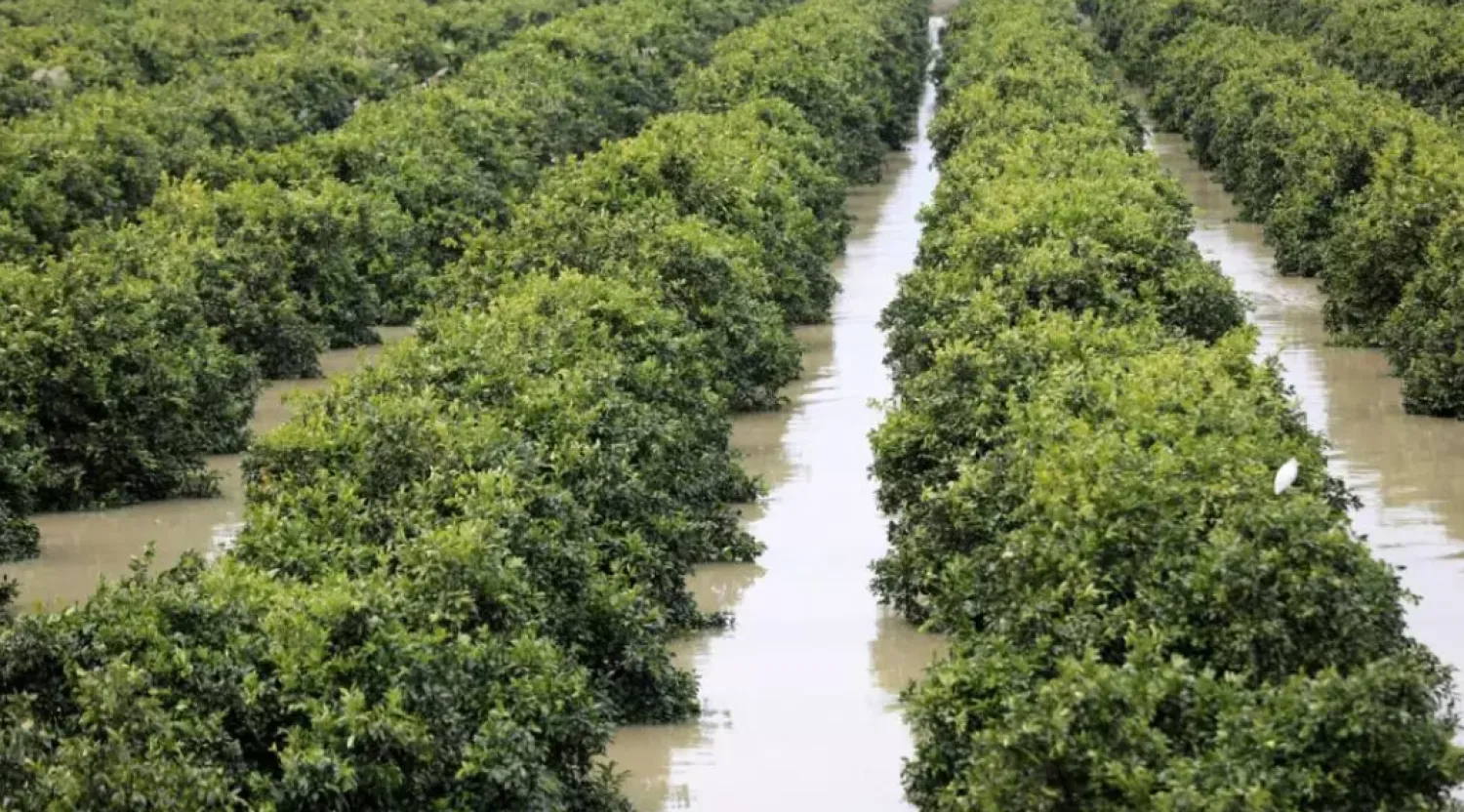
Farmers in the North African kingdom have for the past few years endured severe drought © - / AFP
TT

Floods Wreak Havoc in Morocco Farmlands after Severe Drought

Farmers in the North African kingdom have for the past few years endured severe drought © - / AFP

In the Moroccan village of Ouled Salama, 63-year-old farmer Mohamed Reouani waded through his crops, now submerged by floodwaters after days of heavy downpours.

Farmers in the North African kingdom have for the past few years endured severe drought.

But floods have now swamped more than 100,000 hectares of land, wiping out key crops and forcing farmers in the country's northwest to flee with their livestock, AFP reported.

"I have about four or five hectares" of crops, Reouani said. "All of it is gone now."

"Still, praise be to God for this blessing," he added while looking around at the water.

Morocco, where agriculture employs about a third of the working-age population, has seen seven consecutive years of drought.

As of December, its dams were only around 30 percent full on average, and farmers have largely relied on rainwater for irrigation.

Now their average filling rate stands at nearly 70 percent after they received about 8.8 billion cubic metres of water in the last month -- compared to just 9 billion over the previous two years combined.

- 'Took everything' -

Many like Reouani had at first rejoiced at the downpours.

But the rain eventually swelled into a heavy storm that displaced over 180,000 people as of Wednesday and killed four so far.

In his village, the water level climbed nearly two metres, Reouani said. Some homes still stand isolated by floodwater.

Elsewhere, residents were seen stranded on rooftops before being rescued in small boats.

Others were taken away by helicopter as roads were cut off by flooding.

Authorities have set up camps of small tents, including near the city of Kenitra, to shelter evacuees and their livestock.

"We have no grain left" to feed the animals, one evacuee, Ibrahim Bernous, 32, told AFP at a camp. "The water took everything."

Bernous, like many, now depends on animal feed distributed by the authorities, according to Mustapha Ait Bella, an official at the agriculture ministry.

At the camps, displaced families make do with little while waiting to return home.

"The problem is what happens after we return," said Chergui al-Alja, 42. "We have no grain left to feed our livestock, and they are our main source of income."

- Five percent growth -

On Thursday, the government announced a relief plan of some $330 million to provide aid to the hardest-hit regions.

A tenth of that sum was earmarked for farmers and livestock breeders.

Rachid Benali, head of the Moroccan Confederation of Agriculture and Rural Development, told AFP farming was "among the sectors most affected by the floods".

But he said "a more accurate damage assessment was pending once waters recede".

Benali added that sugar beet, citrus and vegetable farms had also been devastated by flooding.

Agriculture accounts for about 12 percent of Morocco's overall economy.

The International Monetary Fund anticipates that the massive rainfall will help the economy grow by nearly five percent.

Authorities are betting on expanded irrigation and seawater desalination to help the sector withstand increasingly volatile climate swings.

While Morocco is no stranger to extreme weather events, scientists say climate change driven by human activity has made phenomena like droughts and floods more frequent and intense.

Last December, flash floods killed 37 people in Safi, in Morocco's deadliest weather-related disaster in the past decade.

Neighbouring Algeria and Tunisia have also experienced severe weather and deadly flooding in recent weeks.

Further north, Portugal and Spain have faced fresh storms and torrential rain.


Lebanese PM Says Premature to Talk of Any High-Level Meeting with Israel

Smoke rises as a result of an Israeli strike in the south of Lebanon, as seen from the Upper Galilee in northern Israel, 06 May 2026, amid a ceasefire between Israel and Lebanon. (EPA)
TT

Lebanese PM Says Premature to Talk of Any High-Level Meeting with Israel

Smoke rises as a result of an Israeli strike in the south of Lebanon, as seen from the Upper Galilee in northern Israel, 06 May 2026, amid a ceasefire between Israel and Lebanon. (EPA)

Lebanese Prime Minister Nawaf Salam said it is premature to talk of any high-level meeting between Lebanon and Israel, comments underlining the dim chances of one being held soon as hoped for by US President Donald Trump.

Salam, in comments reported by Lebanon's National News Agency (NNA) on Wednesday, said shoring up a ceasefire would be the basis for any new round of negotiations that might be held by Lebanese and Israeli government envoys in Washington.

Hostilities between Israel and Iran-backed Hezbollah have continued to rage in southern Lebanon despite a US-mediated ceasefire between Lebanon and Israel announced on April 16.

Since ‌Hezbollah triggered the ‌war by opening fire in support of Iran on March ‌2, ⁠the Lebanese administration ⁠led by Salam and President Joseph Aoun has initiated Beirut's highest-level contacts with Israel in decades, reflecting deep divisions between the Shiite group and its Lebanese opponents.

Washington last month hosted two meetings between the Israeli and Lebanese ambassadors to the United States. Hezbollah strongly objects to the contacts.

Announcing a three-week extension of the ceasefire on April 23, Trump said he looked forward to hosting Israeli Prime Minister Benjamin Netanyahu and Aoun in the near future, and that he ⁠saw "a great chance" the countries would reach a peace deal ‌this year.

Salam said Lebanon was not seeking "normalization with Israel, but ‌rather achieving peace".

The current circumstances "are not ripe to talk about high-level meetings," he added, according to NNA.

"Our ‌minimum demand is a timetable for Israel’s withdrawal," he said, adding that the government ‌would develop its plan to restrict weapons to state control - an effort aimed at securing Hezbollah's disarmament.

Aoun said this week the timing was not right for a meeting with Netanyahu. Lebanon "must first reach a security agreement and a halt to the Israeli attacks, before we raise the issue of a meeting ‌between us," he said.

TRADING BLOWS

Israel has occupied a so-called security zone extending as deep as 10 km (6 miles) into southern ⁠Lebanon, saying it aims ⁠to protect northern Israel from Hezbollah militants embedded in civilian areas.

Hezbollah and Israel have continued to trade blows.

Lebanon's Health Ministry said on Wednesday an Israeli airstrike killed four people including two women and an elderly man in the town of Zelaya in southern Lebanon.

The Israeli military said Hezbollah had launched explosive drones and rockets towards Israeli soldiers in southern Lebanon, injuring two Israeli soldiers.

It also said the Israeli air force intercepted a hostile aircraft before it crossed into Israel, and announced strikes on Hezbollah infrastructure in several areas in Lebanon.

More than 2,700 people have been killed in the war in Lebanon since March 2, the Health Ministry says.

The Israeli military says Hezbollah has fired hundreds of rockets and drones at Israel since March 2. Israel has announced 17 soldiers have been killed in southern Lebanon, along with two civilians in northern Israel.


EU Urged to 'Act Now' on West Bank Settlement Project

The Palestinian village of Turmus Ayya (foreground) and the Israeli settlement of Shilo (background), north of Ramallah in the Israeli-occupied West Bank, are pictured on May 6, 2026. (Photo by Zain JAAFAR / AFP)
TT

EU Urged to 'Act Now' on West Bank Settlement Project

The Palestinian village of Turmus Ayya (foreground) and the Israeli settlement of Shilo (background), north of Ramallah in the Israeli-occupied West Bank, are pictured on May 6, 2026. (Photo by Zain JAAFAR / AFP)

More than 400 former diplomats, ministers, and senior officials on Wednesday urged the European Union to "act now" against Israel's "illegal" settlements in the occupied West Bank.

The open letter comes as Israel intends to move forward with E1, a new construction project covering around 12 square kilometers (4.6 square miles) with some 3,400 housing units in the occupied West Bank.

The move would further separate east Jerusalem, occupied and annexed by Israel and predominantly inhabited by Palestinians, from the West Bank.

"The EU and its member states, together with partners, must take immediate action to deter Israel from further advancing its illegal annexation of Palestinian land in the West Bank," said the letter signed by more than 440 figures, including former EU foreign policy chief Josep Borrell and former Belgian prime minister Guy Verhofstadt.

The signatories called for targeted sanctions, such as visa bans and business restrictions, on "all those engaged in illegal settlement activity", calling for measures against those promoting or implementing the E1 scheme.

The Israeli government plans to publish an initial tender on June 1 for the construction of housing for up to 15,000 "illegal settlers", AFP quoted the letter as saying, urging the EU and its member states to "act now".

The plan has been condemned by international leaders, with UN Secretary General Antonio Guterres's spokesman saying it would pose an "existential threat" to a contiguous Palestinian state.

Excluding east Jerusalem, more than 500,000 Israelis live in the occupied West Bank in settlements that are illegal under international law, among some three million Palestinians.

In 2025, the expansion of Israeli settlements reached its highest level since at least 2017, when the United Nations began tracking data, according to a UN report.

There has been a spike in deadly attacks by Israeli settlers in the occupied West Bank since the start of the Iran war on February 28, Palestinian officials and the United Nations have said.

Israel has occupied the West Bank since 1967.


Israel Army Says Striking Hezbollah Targets across Lebanon

An Israeli soldier gestures next to a tank, on the Israeli side of the border with Lebanon, May 3, 2026. REUTERS/Shir Torem
TT

Israel Army Says Striking Hezbollah Targets across Lebanon

An Israeli soldier gestures next to a tank, on the Israeli side of the border with Lebanon, May 3, 2026. REUTERS/Shir Torem

Israel's army said Wednesday it had begun striking Hezbollah infrastructure in several areas of Lebanon, despite a truce with the neighboring country intended to halt fighting with the Iran-backed militant group. 

"The IDF has begun striking Hezbollah terror infrastructure sites in several areas in Lebanon," a military statement said. 

It came shortly after the army reported "several incidents" during which drones exploded near Israeli soldiers operating in Lebanon's south.  

Lebanon's health ministry said an Israeli strike in Lebanon's eastern Bekaa valley killed four people, with local media reporting the attack took place before the Israeli army issued a warning to evacuate the area along with 11 other towns. 

"An Israeli enemy raid on the town of Zellaya in West Bekaa resulted in four martyrs, including two women and an elderly man," the ministry said. 

Lebanese state media said the attack struck the house of the town's mayor, killing him and three members of his family.