


Merz Eyes European Nuclear Shield in Call for Reset with US

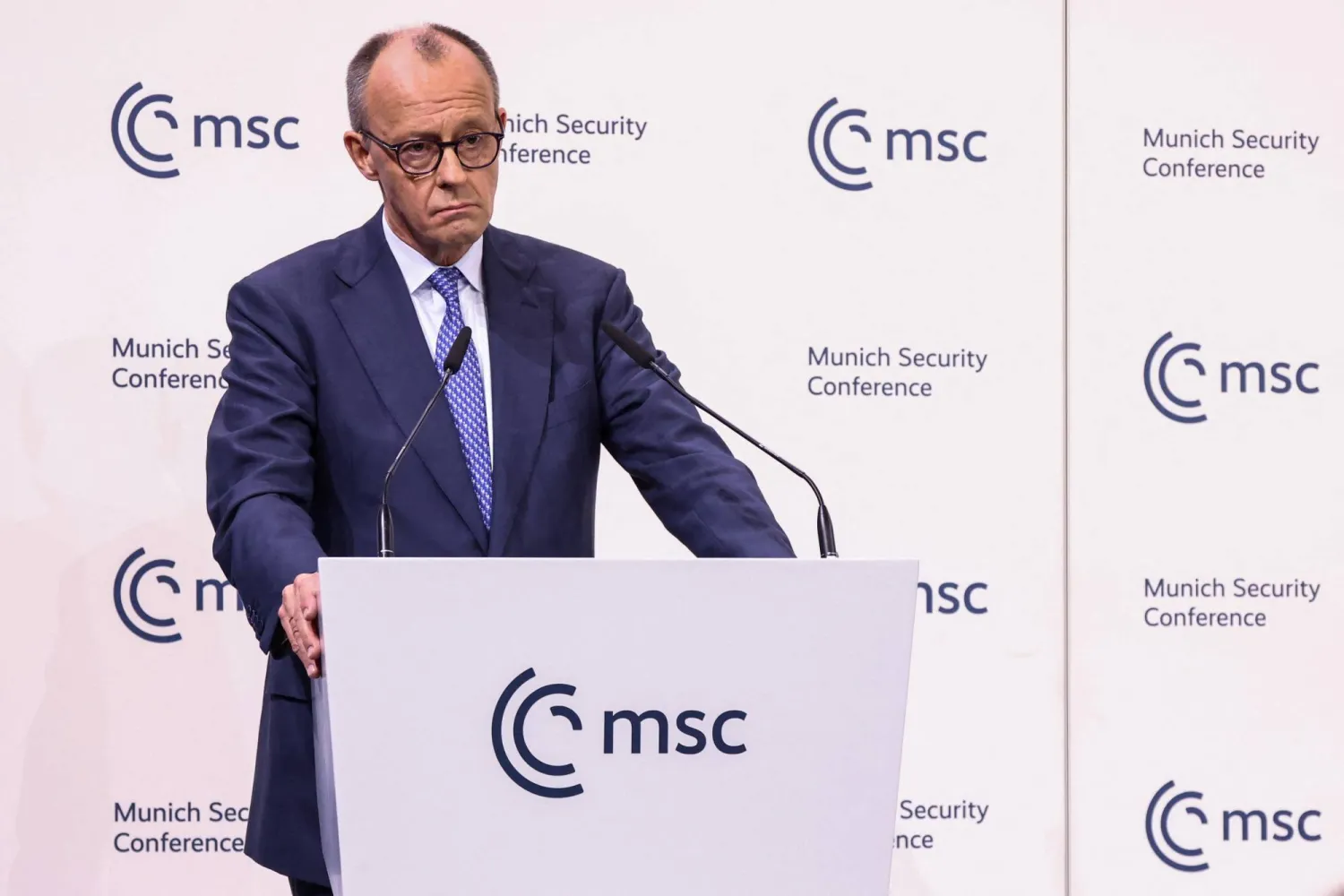
 German Chancellor Friedrich Merz speaks during the Munich Security Conference (MSC) in Munich, Germany, February 13, 2026. (Reuters)
German Chancellor Friedrich Merz speaks during the Munich Security Conference (MSC) in Munich, Germany, February 13, 2026. (Reuters)
TT

Merz Eyes European Nuclear Shield in Call for Reset with US

 German Chancellor Friedrich Merz speaks during the Munich Security Conference (MSC) in Munich, Germany, February 13, 2026. (Reuters)
German Chancellor Friedrich Merz speaks during the Munich Security Conference (MSC) in Munich, Germany, February 13, 2026. (Reuters)

German Chancellor Friedrich Merz said on Friday that Berlin had begun confidential talks with France about a European nuclear deterrent, saying the region had to become stronger in order to reset its relationship with the United States.

In a speech to open the Munich Security Conference, Merz also called on Washington to "repair and revive trust" in a dangerous new era of great power politics, warning the US could not go it alone as the old global order crumbles.

The speech underscored how European leaders are increasingly looking to carve an independent path after a year of unprecedented upheaval in transatlantic ties, while also striving to maintain their alliance with Washington.

Europe faces myriad threats from Russia's war in Ukraine to massive ructions in global trade.

"I have begun confidential talks with the French President on European nuclear deterrence," Merz said. "We Germans are adhering to our legal obligations. We see this as strictly embedded within our nuclear sharing in NATO. And we will not allow zones of ‌differing security to ‌emerge in Europe."

FRANCE IS EU'S ONLY NUCLEAR POWER

French President Emmanuel Macron is due to make ‌a ⁠speech on the nuclear ⁠deterrent later this month. Officials have remained guarded on the issue given it is the president's prerogative.

European nations have long relied heavily on the United States, including its large nuclear arsenal, for their defense but have been increasing military spending, partly in response to sharp criticism from the Trump administration.

While Germany is currently banned from developing a nuclear weapon under international agreements, France is the European Union's only nuclear power following Britain's departure from the bloc and has the world's fourth-largest stockpile.

Taking his cue from those warning that the international rules-based order was about to be destroyed, Merz said: "I fear we must put it even more bluntly: This order, however imperfect it was even at its best, no longer exists in that form."

Switching to English ⁠at the end, Merz said: "In the era of great power rivalry, even the United States will ‌not be powerful enough to go it alone. Dear friends, being a part of ‌NATO is not only Europe’s competitive advantage. It is also the United States' competitive advantage."

"So let’s repair and revive transatlantic trust together," he added.

A YEAR AFTER ‌VANCE BLAST, RUBIO STRIKES WARMER TONE

US Secretary of State Marco Rubio had also said transatlantic ties faced a "defining moment" in a ‌rapidly changing world but struck a more conciliatory tone that contrasted with remarks by Vice President JD Vance in 2025.

At the same gathering of top security officials last year, Vance had attacked European allies in a speech that marked the start of a series of confrontations.

"I think it's at a defining moment ... the world is changing very fast right in front of us," Rubio said before departing for Munich.

"(The US is) deeply tied to Europe, and our ‌futures have always been linked and will continue to be," said Rubio, who is a potential rival to Vance for the 2028 US presidential race. "So we've just got to talk about what ⁠that future looks like."

Transatlantic ties ⁠have long been central to the Munich Security Conference, which began as a Cold War forum for Western defense debate. But the unquestioned assumption of cooperation that underpinned it has been upended.

Underscoring the damage, a YouGov poll on Friday of the six largest European countries showed favorability towards the US in Europe hitting its lowest since tracking began in 2016.

The latest figures are broadly comparable to – and in some cases higher than – the perceived threat from China, Iran or North Korea, although behind Russia, YouGov said.

US President Donald Trump has toppled Venezuela’s leader, threatened other Latin American countries with similar military action, imposed tariffs on friends and foes alike and talked openly about annexing Greenland from fellow NATO member Denmark - a move that could effectively end the alliance.

Last year's speech by Vance accused European leaders of censoring free speech and failing to control immigration, which Merz explicitly rejected.

"A rift has opened up between Europe and the United States. Vice President JD Vance said this very openly here in Munich a year ago," Merz said.

"He was right. The culture war of the MAGA movement is not ours. Freedom of speech ends here with us when that speech goes against human dignity and the constitution. We do not believe in tariffs and protectionism, but in free trade," he said, drawing applause.



Italy Pledges Deeper Cooperation at Second Italy-Africa Summit

Ethiopian Prime Minister Abiy Ahmed Ali delivers a speech during the second Italy-Africa Summit in Addis Ababa on Saturday, Feb. Dec. 14, 2026. (AP Photo/Amanuel Sileshi)
TT

Italy Pledges Deeper Cooperation at Second Italy-Africa Summit

Ethiopian Prime Minister Abiy Ahmed Ali delivers a speech during the second Italy-Africa Summit in Addis Ababa on Saturday, Feb. Dec. 14, 2026. (AP Photo/Amanuel Sileshi)

Italy pledged Friday to deepen cooperation with African countries during its second Italy-Africa summit, the first on African soil, aimed at reviewing projects started in critical sectors such as energy and infrastructure during Italy’s first phase of the Mattei Plan for Africa.

The plan, launched in 2024, is aimed at promoting investment-led cooperation rather than traditional aid.

Italy’s Prime Minister Giorgia Meloni addressed dozens of African heads of state and governments in Ethiopia’s capital, Addis Ababa, and reiterated that a successful partnership would depend on Italy’s “ability to draw from African wisdom” and ensure lessons are learned, The AP news reported.

“We want to build things together,” she told African heads of state. “We want to be more consistent with the needs of the countries involved.”

Ethiopian Prime Minister Abiy Ahmed said Italy had provided Africa with a gateway to Europe through these partnerships.

“This is a moment to move from dialogue to action,” he said. “By combining Africa’s energetic and creative population with Europe’s experience, technology and capital, we can build solutions that deliver prosperity to our continents and beyond.”

After the Italy-Africa summit concludes Friday, African leaders will remain in Addis Ababa for the annual African Union Summit that begins Saturday.

Kenyan writer and political analyst Nanjala Nyabola said tangible results from such summits depend on preparations made by countries.

African governments often focus on “optics instead of actually making summits a meaningful engagement,” she said.

Instead of waiting to receive a list of demands, countries should “present the conclusions of an extended period of mapping the national needs” and engage in dialogue to see how the needs can be met.

Since it was launched two years ago, the Mattei Plan has directly involved 14 African nations and has launched or advanced around 100 projects in crucial sectors, including energy and climate transition, agriculture and food security, physical and digital infrastructure, health care, water, culture and education, training and the development of artificial intelligence, according to the Italian government.


Rubio's Speech to European Allies Takes Softer Tone but Sticks to Trump's Stance

US Secretary of State Marco Rubio speaks during the Munich Security Conference in Munich, Germany, Saturday, Feb. 14, 2026. (AP Photo/Michael Probst)
TT

Rubio's Speech to European Allies Takes Softer Tone but Sticks to Trump's Stance

US Secretary of State Marco Rubio speaks during the Munich Security Conference in Munich, Germany, Saturday, Feb. 14, 2026. (AP Photo/Michael Probst)

US Secretary of State Marco Rubio offered a reassuring message to America’s allies on Saturday, striking a less aggressive but still firm tone about the administration’s intent to reshape the trans-Atlantic alliance and push its priorities after more than a year of President Donald Trump’s often-hostile rhetoric toward traditional allies.

Reminding his audience at the annual Munich Security Conference about America’s centuries-long roots in Europe, Rubio said the United States would remain forever tied to the continent even as it pushes for changes in the relationship and the international institutions that have been the bulwark of the post-World War II world order.

Rubio addressed the conference a year after Vice President JD Vance stunned the same audience with a harsh critique of European values. A series of statements and moves from the Trump administration targeting allies followed, including Trump’s short-lived threat last month to impose new tariffs on several European countries in a bid to secure US control of Greenland, a semiautonomous territory of NATO ally Denmark.

On Friday, German Chancellor Friedrich Merz had opened this year's gathering by calling for the US and Europe to “repair and revive trans-Atlantic trust together,” saying that even the US isn’t powerful enough to go it alone in a world whose old order no longer exists. But he and other European officials made clear that they will stand by their values, including their approach to free speech, climate change and free trade.

While offering a calmer and more reassuring tone than the one often heard over the past year, Rubio made clear that the Trump administration is sticking to its guns on policy. He denounced “a climate cult” and “an unprecedented wave of mass migration that threatens the cohesion of our societies.”

Rubio argued that the “euphoria” of the Western victory in the Cold War led to a "dangerous delusion that we had entered ‘the end of history,’ that every nation would now be a liberal democracy, that the ties formed by trade and by commerce alone would now replace nationhood ... and that we would now live in a world without borders where everyone became a citizen of the world.”

“We made these mistakes together and now together we owe it to our people to face those facts and to move forward to rebuild,” Rubio said.

“This is why we Americans may sometimes come off as a little direct and urgent in our counsel," he said. "This is why President Trump demands seriousness and reciprocity from our friends here in Europe.”

Rubio said that an end of the trans-Atlantic era “is neither our goal nor our wish,” adding that "our home may be in the Western hemisphere, but we will always be a child of Europe.”

He acknowledged that "we have bled and died side-by-side on battlefields from Kapyong to Kandahar," a contrast with disparaging remarks by Trump about NATO allies’ troops in Afghanistan that drew an outcry. "And I’m here today to make it clear that America is charting the path for a new century of prosperity. and that once again, we want to do it together with you, our cherished allies and our oldest friends.”

US officials accompanying Rubio said his message was much the same as Vance’s last year but was intended to have a softer landing on the audience, which they acknowledged had recoiled at much of Trump’s rhetoric over the past year.

The president of the European Union's executive commission, Ursula von der Leyen, said Rubio's speech was “very reassuring” but noted that “in the administration, some have a harsher tone on these topics.”

In her speech to the conference, she stressed that “Europe must become more independent,” including on defense. She insisted on Europe's “digital sovereignty” — its approach to hate speech on social media.

British Prime Minister Keir Starmer said that “we shouldn’t get in the warm bath of complacency. He said the UK must re-forge closer ties with Europe to help the continent “stand on our own two feet” in its own defense, and said there needs to be investment that “moves us from overdependence to interdependence.”

Hanno Pevkur, the defense minister of EU and NATO member Estonia, said it was "quite a bold statement to say that America is ‘a child of Europe’.”

“It was a good speech, needed here today, but that doesn’t mean that we can rest on pillows now," he told The Associated Press. “So still a lot of work has to be done."

The conference pointed to tensions beyond those in the trans-Atlantic alliance.

Speaking after Rubio, Chinese Foreign Minister Wang Yi said Beijing felt “gratified” that Trump respects President Xi Jinping and China, but warned that some voices in the US are leery of China’s rise.

“We see that some forces and some people are still trying their best to suppress and contain China, and are still attacking and slandering China by any means,” Wang said.

He cautioned that “law of the jungle and unilateralism have taken hold” and said some countries “even revive the Cold War mentality.”


China Warns US 'Plotting' on Taiwan Could Lead to 'Confrontation'

China's Foreign Minister Wang Yi speaks during the Munich Security Conference (MSC) in Munich, Germany, February 14, 2026. REUTERS/Liesa Johannssen
TT

China Warns US 'Plotting' on Taiwan Could Lead to 'Confrontation'

China's Foreign Minister Wang Yi speaks during the Munich Security Conference (MSC) in Munich, Germany, February 14, 2026. REUTERS/Liesa Johannssen

Beijing's top diplomat Wang Yi warned the United States on Saturday against "plotting" on Taiwan, saying it could lead to a "confrontation" with China.

Speaking at the Munich Security Conference in Germany, Foreign Minister Wang said that any future "instigating and plotting to split China through Taiwan, crossing China's red line".

"This could very likely lead to a confrontation between China and the United States," he said.

He added that he hoped Washington would pursue a "positive and pragmatic" approach, "but we are also prepared to deal with various risks".

China claims self-ruled Taiwan as its own territory and has not ruled out the use of force to bring under its control.

The United States has long been the democratic island's most important backer and biggest arms provider, and Taiwan would be heavily reliant on US support in a potential conflict with China.