


Israel’s Barak Says He Regrets Knowing Epstein After Documents Detail Their Long Friendship

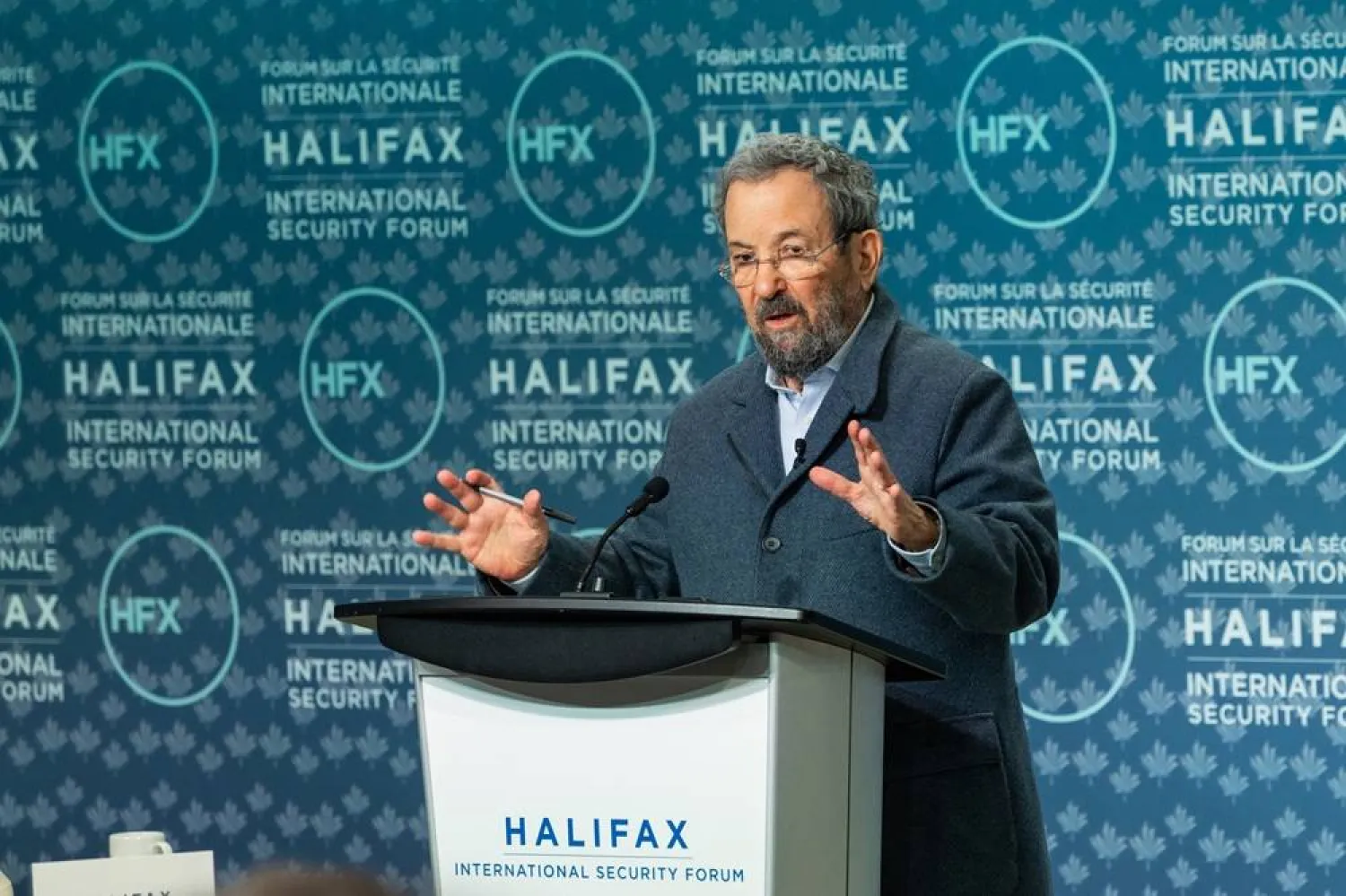
Former Israeli Prime Minister Ehud Barak speaks at the Halifax International Security Forum, Saturday, Nov. 22, 2025. (The Canadian Press via AP, File)
TT

Israel’s Barak Says He Regrets Knowing Epstein After Documents Detail Their Long Friendship

Former Israeli Prime Minister Ehud Barak speaks at the Halifax International Security Forum, Saturday, Nov. 22, 2025. (The Canadian Press via AP, File)

Former Israeli Prime Minister Ehud Barak has apologized for his yearslong friendship with convicted sex offender Jeffrey Epstein that included regular correspondence, multiple visits to the disgraced financier's Manhattan apartment and one to his private island.

The former Israeli leader has not been implicated in Epstein's sexual abuse of underage girls and faces no accusations of wrongdoing. In an exclusive interview with Israel's Channel 12 on Thursday, he said he regretted having ever known Epstein and apologized to all those "who feel deeply uncomfortable.”

“I am responsible for all my actions and decisions, and there is definitely room to ask if there wasn’t room for more in-depth judgment on my part and a more thorough examination of what the details really are, what exactly happened there,” he said.

Barak appears in several documents

Barak is among several political, business and cultural elites found to have maintained long relationships with Epstein, even after his 2008 guilty plea for soliciting prostitution from an underage girl in Florida. Epstein died by suicide in detention in 2019 while awaiting trial on federal allegations of sexually abusing and trafficking dozens of girls.

Barak, who has previously distanced himself from Epstein, gave the latest interview after millions of pages of documents were released by the US Justice Department in connection with its investigations of Epstein.

Barak and his wife, Nili, have turned up frequently in the documents, showing they stayed in regular contact with Epstein for years, including after he cut a deal with prosecutors in 2008 that resulted in an 18-month prison sentence.

Barak has acknowledged visiting Epstein numerous times, flying on his private plane and staying at his New York apartment when he was out of public office. Barak said he and his wife and some security guards paid a three-hour visit to Epstein's home in the US Virgin Islands, but saw only Epstein and some maintenance workers there.

Barak said he never observed or took part in any inappropriate behavior. He said he was aware of the earlier Epstein case but assumed he had paid his debt to society.

“Only in 2019, when a reinvestigation of the whole story begins, does the breadth and depth of the man’s heinous crimes become apparent and I cut off relations with him, and everyone cuts off relations with him,” Barak said.

A Netanyahu rival

Barak served as prime minister from 1999 to 2001, when Israel and the Palestinians held high-level peace talks before the process collapsed and a Palestinian uprising broke out. He later served as defense minister.

His ties to Epstein came to light seven years ago after Barak announced a political comeback in an unsuccessful bid to topple Israeli Prime Minister Benjamin Netanyahu.

At the time, US tax records showed Barak received some $2 million in grants for unspecified “research” the previous decade from the Wexner Foundation — a philanthropic organization that supports Jewish causes. At the time, Epstein was a trustee of the foundation.

Barak downplayed those ties when they surfaced, saying Epstein “didn't support me or pay me.”

The new batch of released documents show regular correspondence among Barak, his wife and Epstein.

Some detail plans for a 2017 stay at Epstein's New York residence, while others discuss mundane logistics for other visits, meetings and phone calls. In June 2019, Barak's wife, Nili, emailed Epstein saying they delayed their flight to New York by roughly a week. In 2013, Epstein's assistant, Lesley Groff, emailed Epstein about dinner with Barak, his wife and several business people and celebrities, including Woody Allen.

In 2019 — about a week before Epstein was arrested — an exchange about Barak between Epstein and an unknown person shows Epstein saying he was “dealing with Ehud in Israel. Making me crazy.”

The documents show that Epstein connected Barak with US President Donald Trump's former adviser, Steve Bannon, who was seeking to become more involved in Israeli politics. Emails from Epstein to his staff and others in 2018 discussed setting up dinners or meetings between Barak and Bannon.

Bannon has not been implicated in any wrongdoing related to Epstein.

In Thursday's interview, Barak said it's likely more information will emerge from the documents in the weeks ahead, but he maintained that he had done nothing illegal or improper.

“I promise you that nothing will be discovered, because there is nothing,” he said.


Zelenskiy Says US Too often Asks Ukraine, Not Russia, for Concessions

Ukrainian President Volodymyr Zelenskiy speaks during the Munich Security Conference (MSC) in Munich, Germany, February 14, 2026. REUTERS/Liesa Johannssen
TT

Zelenskiy Says US Too often Asks Ukraine, Not Russia, for Concessions

Ukrainian President Volodymyr Zelenskiy speaks during the Munich Security Conference (MSC) in Munich, Germany, February 14, 2026. REUTERS/Liesa Johannssen

Ukrainian President Volodymyr Zelenskiy voiced hope on Saturday that US-brokered peace talks next week in Geneva would be serious and substantive, but said Ukraine was being asked "too often" to make concessions in the negotiations.

Ukrainian, Russian and American delegations are due to meet in the Swiss lakeside city on Tuesday and Wednesday as US President Donald Trump seeks to push through a deal to end Europe's biggest war since 1945.

"We truly hope that the trilateral meetings next week will be serious, substantive, helpful for all us but honestly sometimes it feels like the sides are talking about completely different things," Zelenskiy said in a speech at the annual Munich Security Conference.

Ukraine and Russia, which invaded its neighbour in February 2022, have engaged in two recent rounds of talks brokered by Washington in Abu Dhabi described by the sides as constructive but achieving no major breakthroughs.

Zelenskiy called for greater action from Ukraine's allies to press Russia into making peace - both in the form of tougher sanctions and more weapons supplies.

Recalling his appeal four years ago, when he spoke at the same conference days before tens of thousands of Russian forces poured into Ukraine, Zelenskiy said there was too much talk by Western officials and not enough action.

Trump has the power to force Putin to declare a ceasefire and needed to do so, Zelenskiy said. Ukrainian officials have said a ceasefire is required to hold a referendum on any peace deal, which would be organised alongside national elections.

The Ukrainian leader, a former television entertainer, acknowledged he was feeling "a little bit" of pressure from Trump, who yesterday said Zelenskiy should not miss the "opportunity" to make peace soon and urged him "to get moving".

"The Americans often return to the topic of concessions and too often those concessions are discussed only in the context of Ukraine, not Russia," Zelenskiy said.

Instead, Zelenskiy said, he wanted instead to hear what compromises Moscow would be ready for, as Ukraine had already made many of its own.

DEADLOCK OVER TERRITORY

Land remains the major sticking point in negotiations, with Russia demanding that Ukraine cede the remaining 20% of the eastern area of Donetsk that Moscow has failed to capture - something Kyiv steadfastly refuses to do.

Zelenskiy said he was instead ready to discuss a US proposal for a free trade zone in that region, while freezing the rest of the 1,200-km (745-mile) front line.

Russia occupies about 20% of Ukraine's national territory, including Crimea and parts of the eastern Donbas region seized before the full-scale invasion in 2022.

Analysts say Moscow has gained about 1.5% of Ukrainian territory since early 2024. Its recent air strikes on Ukraine's cities and electricity infrastructure have left hundreds of thousands of Ukrainians without heating and power during the course of a bitterly cold winter.

Ukrainian officials have repeatedly expressed concern in recent weeks that US. congressional mid-term elections in November could focus the Trump administration on domestic political issues after the summer.

Zelenskiy said he hoped the US would stay involved in the negotiations, and that there would be an opportunity for Europe, which he said was currently sidelined, to play a bigger role.

'EUROPE NOT PRESENT'

"Europe is practically not present at the table. It's a big mistake to my mind," he said.

Russia said its delegation to Geneva would be led by Putin adviser Vladimir Medinsky, a change from negotiations in Abu Dhabi at which Russia's team was led by military intelligence chief Igor Kostyukov.

Ukrainian sources have criticised Medinsky's handling of previous talks, accusing him of delivering history lessons to the Ukrainian team instead of engaging in substantive negotiations.

Zelenskiy, who has long argued that the best way to achieve peace is to force Russia to the table with military and economic pressure, said he had discussed with French President Emmanuel Macron and European Commission chief Ursula von der Leyen punitive steps against tankers that export Russian oil.

Oil exports are a key revenue source for the Russian state, and in recent months some empty tankers have been targeted by Ukrainian drones.

On Saturday France's foreign minister said some G7 countries have expressed readiness to enact a maritime services ban on Russian oil and that Paris was "reasonably optimistic" it would be included in the European Union's next sanctions package.


Nobel Winner Transferred to Prison in Northern Iran

A photo provided by the Narges Mohammadi Foundation on October 2, 2023 shows Iranian human rights activist Narges Mohammadi. © AFP
TT

Nobel Winner Transferred to Prison in Northern Iran

A photo provided by the Narges Mohammadi Foundation on October 2, 2023 shows Iranian human rights activist Narges Mohammadi. © AFP

Iranian authorities have, without prior warning, transferred Nobel Peace Prize winner Narges Mohammadi to a prison in the north of the country as concern grows over her health, her husband said on Saturday.

Mohammadi, who won the peace prize in 2023 in recognition for more than two decades of campaigning, was arrested on December 12 in the eastern city of Mashhad after speaking out against the clerical authorities at a funeral ceremony, AFP reported.

She spent time on hunger strike earlier this month and had been hospitalized before being returned to prison.

The Norwegian Nobel Committee said this week it was "deeply appalled" by reports detailing "physical abuse and ongoing life-threatening mistreatment" of Mohammadi both during her arrest and in detention.

Since her arrest, Mohammadi had been held in Mashhad at the detention facility of the intelligence ministry and had only been allowed one phonecall with a brother inside Iran and another to her Iranian lawyer.

But she has now been transferred to prison in the city of Zanjan in the north of the country, said her husband Taghi Rahmani, who is based in Paris.

"This action was carried out without informing her family or her lawyer," he said on X, adding it was "intended to exile and displace Narges".

On December 7, she was handed a further six years in prison on charges of harming national security and was also given a one-and-a-half-year prison sentence for propaganda against Iran's Islamic system.

On February 2 she began a hunger strike to protest the conditions of her imprisonment and the inability to make phone calls to lawyers and family but then ended the action after a week.

Her foundation has described her physical condition as "deeply alarming", saying she was transferred to hospital in Mashhad but then returned to prison "before completing her treatment".

Mohammadi was arrested before protests erupted nationwide later in December. The movement peaked in January, with authorities launching a crackdown that activists say has left thousands dead.

Over the past quarter-century, Mohammadi, 53, who was born in Zanjan, has been repeatedly tried and jailed for her campaigning against Iran's use of capital punishment and the mandatory dress code for women.


About 200,000 Join Iran Demonstration in Munich

Protesters wave flags - with a lion and a sun against horizontal green, white and red stripes, the emblem of the monarchy overthrown in 1979- during a demonstration in Munich (Reuters).
TT

About 200,000 Join Iran Demonstration in Munich

Protesters wave flags - with a lion and a sun against horizontal green, white and red stripes, the emblem of the monarchy overthrown in 1979- during a demonstration in Munich (Reuters).

About 200,000 people joined a demonstration against the Iranian government in Munich on Saturday, police said, as world leaders gathered nearby for a security conference, AFP reported. 

The protesters rallied on Munich's Theresienwiese fairgrounds, denouncing the leadership of Iran's Islamic Republic following the deadly repression of nationwide protests in January.

Some waved flags with a lion and a sun against horizontal green, white and red stripes, the emblem of the monarchy overthrown in 1979.

Human rights groups have reported that thousands of protesters have been killed in Iran.

Rallies calling for international action against Tehran are also planned in Toronto and Los Angeles on Saturday.

The exiled son of the former shah of Iran, Reza Pahlavi, spoke at the Munich Security Conference on Saturday and called on US President Donald Trump to "help" the Iranian people.

Pahlavi, who has lived in exile since his father was overthrown in the 1979 revolution, urged an outside "humanitarian intervention to prevent more innocent lives being killed" in Iran.

The Theresienwiese, which hosts the huge annual Oktoberfest folk gathering, is located less than three kilometres (1.8 miles) from the security conference venue.

Last week, an estimated 10,000 people gathered in Berlin in response to a call from the MEK, an exiled opposition group considered "terrorist" by Tehran.
