


Rubio's Speech to European Allies Takes Softer Tone but Sticks to Trump's Stance

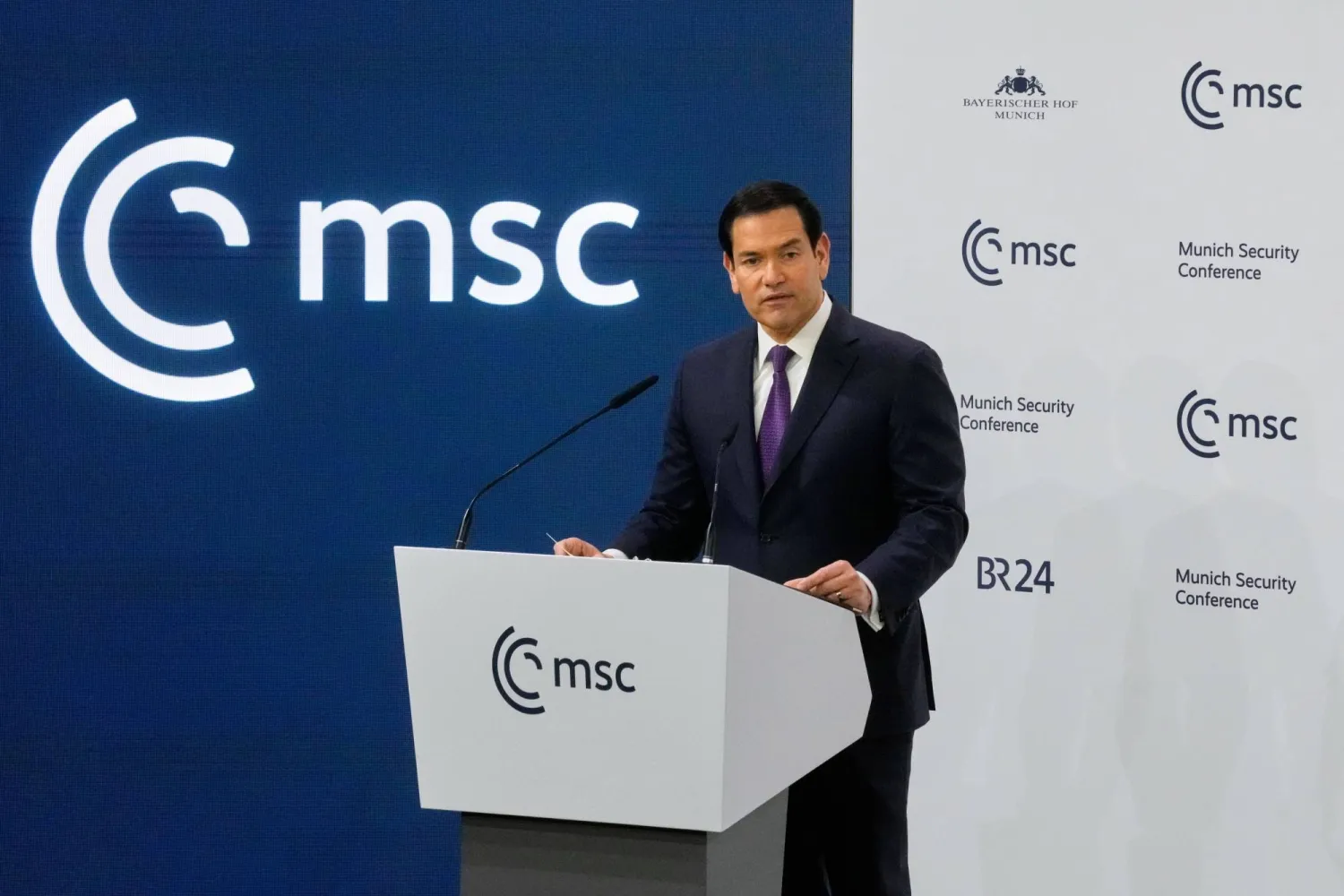
US Secretary of State Marco Rubio speaks during the Munich Security Conference in Munich, Germany, Saturday, Feb. 14, 2026. (AP Photo/Michael Probst)
TT

Rubio's Speech to European Allies Takes Softer Tone but Sticks to Trump's Stance

US Secretary of State Marco Rubio speaks during the Munich Security Conference in Munich, Germany, Saturday, Feb. 14, 2026. (AP Photo/Michael Probst)

US Secretary of State Marco Rubio offered a reassuring message to America’s allies on Saturday, striking a less aggressive but still firm tone about the administration’s intent to reshape the trans-Atlantic alliance and push its priorities after more than a year of President Donald Trump’s often-hostile rhetoric toward traditional allies.

Reminding his audience at the annual Munich Security Conference about America’s centuries-long roots in Europe, Rubio said the United States would remain forever tied to the continent even as it pushes for changes in the relationship and the international institutions that have been the bulwark of the post-World War II world order.

Rubio addressed the conference a year after Vice President JD Vance stunned the same audience with a harsh critique of European values. A series of statements and moves from the Trump administration targeting allies followed, including Trump’s short-lived threat last month to impose new tariffs on several European countries in a bid to secure US control of Greenland, a semiautonomous territory of NATO ally Denmark.

On Friday, German Chancellor Friedrich Merz had opened this year's gathering by calling for the US and Europe to “repair and revive trans-Atlantic trust together,” saying that even the US isn’t powerful enough to go it alone in a world whose old order no longer exists. But he and other European officials made clear that they will stand by their values, including their approach to free speech, climate change and free trade.

While offering a calmer and more reassuring tone than the one often heard over the past year, Rubio made clear that the Trump administration is sticking to its guns on policy. He denounced “a climate cult” and “an unprecedented wave of mass migration that threatens the cohesion of our societies.”

Rubio argued that the “euphoria” of the Western victory in the Cold War led to a "dangerous delusion that we had entered ‘the end of history,’ that every nation would now be a liberal democracy, that the ties formed by trade and by commerce alone would now replace nationhood ... and that we would now live in a world without borders where everyone became a citizen of the world.”

“We made these mistakes together and now together we owe it to our people to face those facts and to move forward to rebuild,” Rubio said.

“This is why we Americans may sometimes come off as a little direct and urgent in our counsel," he said. "This is why President Trump demands seriousness and reciprocity from our friends here in Europe.”

Rubio said that an end of the trans-Atlantic era “is neither our goal nor our wish,” adding that "our home may be in the Western hemisphere, but we will always be a child of Europe.”

He acknowledged that "we have bled and died side-by-side on battlefields from Kapyong to Kandahar," a contrast with disparaging remarks by Trump about NATO allies’ troops in Afghanistan that drew an outcry. "And I’m here today to make it clear that America is charting the path for a new century of prosperity. and that once again, we want to do it together with you, our cherished allies and our oldest friends.”

US officials accompanying Rubio said his message was much the same as Vance’s last year but was intended to have a softer landing on the audience, which they acknowledged had recoiled at much of Trump’s rhetoric over the past year.

The president of the European Union's executive commission, Ursula von der Leyen, said Rubio's speech was “very reassuring” but noted that “in the administration, some have a harsher tone on these topics.”

In her speech to the conference, she stressed that “Europe must become more independent,” including on defense. She insisted on Europe's “digital sovereignty” — its approach to hate speech on social media.

British Prime Minister Keir Starmer said that “we shouldn’t get in the warm bath of complacency. He said the UK must re-forge closer ties with Europe to help the continent “stand on our own two feet” in its own defense, and said there needs to be investment that “moves us from overdependence to interdependence.”

Hanno Pevkur, the defense minister of EU and NATO member Estonia, said it was "quite a bold statement to say that America is ‘a child of Europe’.”

“It was a good speech, needed here today, but that doesn’t mean that we can rest on pillows now," he told The Associated Press. “So still a lot of work has to be done."

The conference pointed to tensions beyond those in the trans-Atlantic alliance.

Speaking after Rubio, Chinese Foreign Minister Wang Yi said Beijing felt “gratified” that Trump respects President Xi Jinping and China, but warned that some voices in the US are leery of China’s rise.

“We see that some forces and some people are still trying their best to suppress and contain China, and are still attacking and slandering China by any means,” Wang said.

He cautioned that “law of the jungle and unilateralism have taken hold” and said some countries “even revive the Cold War mentality.”



Zelenskiy Says US Too often Asks Ukraine, Not Russia, for Concessions

Ukrainian President Volodymyr Zelenskiy speaks during the Munich Security Conference (MSC) in Munich, Germany, February 14, 2026. REUTERS/Liesa Johannssen
TT

Zelenskiy Says US Too often Asks Ukraine, Not Russia, for Concessions

Ukrainian President Volodymyr Zelenskiy speaks during the Munich Security Conference (MSC) in Munich, Germany, February 14, 2026. REUTERS/Liesa Johannssen

Ukrainian President Volodymyr Zelenskiy voiced hope on Saturday that US-brokered peace talks next week in Geneva would be serious and substantive, but said Ukraine was being asked "too often" to make concessions in the negotiations.

Ukrainian, Russian and American delegations are due to meet in the Swiss lakeside city on Tuesday and Wednesday as US President Donald Trump seeks to push through a deal to end Europe's biggest war since 1945.

"We truly hope that the trilateral meetings next week will be serious, substantive, helpful for all us but honestly sometimes it feels like the sides are talking about completely different things," Zelenskiy said in a speech at the annual Munich Security Conference.

Ukraine and Russia, which invaded its neighbour in February 2022, have engaged in two recent rounds of talks brokered by Washington in Abu Dhabi described by the sides as constructive but achieving no major breakthroughs.

Zelenskiy called for greater action from Ukraine's allies to press Russia into making peace - both in the form of tougher sanctions and more weapons supplies.

Recalling his appeal four years ago, when he spoke at the same conference days before tens of thousands of Russian forces poured into Ukraine, Zelenskiy said there was too much talk by Western officials and not enough action.

Trump has the power to force Putin to declare a ceasefire and needed to do so, Zelenskiy said. Ukrainian officials have said a ceasefire is required to hold a referendum on any peace deal, which would be organised alongside national elections.

The Ukrainian leader, a former television entertainer, acknowledged he was feeling "a little bit" of pressure from Trump, who yesterday said Zelenskiy should not miss the "opportunity" to make peace soon and urged him "to get moving".

"The Americans often return to the topic of concessions and too often those concessions are discussed only in the context of Ukraine, not Russia," Zelenskiy said.

Instead, Zelenskiy said, he wanted instead to hear what compromises Moscow would be ready for, as Ukraine had already made many of its own.

DEADLOCK OVER TERRITORY

Land remains the major sticking point in negotiations, with Russia demanding that Ukraine cede the remaining 20% of the eastern area of Donetsk that Moscow has failed to capture - something Kyiv steadfastly refuses to do.

Zelenskiy said he was instead ready to discuss a US proposal for a free trade zone in that region, while freezing the rest of the 1,200-km (745-mile) front line.

Russia occupies about 20% of Ukraine's national territory, including Crimea and parts of the eastern Donbas region seized before the full-scale invasion in 2022.

Analysts say Moscow has gained about 1.5% of Ukrainian territory since early 2024. Its recent air strikes on Ukraine's cities and electricity infrastructure have left hundreds of thousands of Ukrainians without heating and power during the course of a bitterly cold winter.

Ukrainian officials have repeatedly expressed concern in recent weeks that US. congressional mid-term elections in November could focus the Trump administration on domestic political issues after the summer.

Zelenskiy said he hoped the US would stay involved in the negotiations, and that there would be an opportunity for Europe, which he said was currently sidelined, to play a bigger role.

'EUROPE NOT PRESENT'

"Europe is practically not present at the table. It's a big mistake to my mind," he said.

Russia said its delegation to Geneva would be led by Putin adviser Vladimir Medinsky, a change from negotiations in Abu Dhabi at which Russia's team was led by military intelligence chief Igor Kostyukov.

Ukrainian sources have criticised Medinsky's handling of previous talks, accusing him of delivering history lessons to the Ukrainian team instead of engaging in substantive negotiations.

Zelenskiy, who has long argued that the best way to achieve peace is to force Russia to the table with military and economic pressure, said he had discussed with French President Emmanuel Macron and European Commission chief Ursula von der Leyen punitive steps against tankers that export Russian oil.

Oil exports are a key revenue source for the Russian state, and in recent months some empty tankers have been targeted by Ukrainian drones.

On Saturday France's foreign minister said some G7 countries have expressed readiness to enact a maritime services ban on Russian oil and that Paris was "reasonably optimistic" it would be included in the European Union's next sanctions package.


Nobel Winner Transferred to Prison in Northern Iran

A photo provided by the Narges Mohammadi Foundation on October 2, 2023 shows Iranian human rights activist Narges Mohammadi. © AFP
TT

Nobel Winner Transferred to Prison in Northern Iran

A photo provided by the Narges Mohammadi Foundation on October 2, 2023 shows Iranian human rights activist Narges Mohammadi. © AFP

Iranian authorities have, without prior warning, transferred Nobel Peace Prize winner Narges Mohammadi to a prison in the north of the country as concern grows over her health, her husband said on Saturday.

Mohammadi, who won the peace prize in 2023 in recognition for more than two decades of campaigning, was arrested on December 12 in the eastern city of Mashhad after speaking out against the clerical authorities at a funeral ceremony, AFP reported.

She spent time on hunger strike earlier this month and had been hospitalized before being returned to prison.

The Norwegian Nobel Committee said this week it was "deeply appalled" by reports detailing "physical abuse and ongoing life-threatening mistreatment" of Mohammadi both during her arrest and in detention.

Since her arrest, Mohammadi had been held in Mashhad at the detention facility of the intelligence ministry and had only been allowed one phonecall with a brother inside Iran and another to her Iranian lawyer.

But she has now been transferred to prison in the city of Zanjan in the north of the country, said her husband Taghi Rahmani, who is based in Paris.

"This action was carried out without informing her family or her lawyer," he said on X, adding it was "intended to exile and displace Narges".

On December 7, she was handed a further six years in prison on charges of harming national security and was also given a one-and-a-half-year prison sentence for propaganda against Iran's Islamic system.

On February 2 she began a hunger strike to protest the conditions of her imprisonment and the inability to make phone calls to lawyers and family but then ended the action after a week.

Her foundation has described her physical condition as "deeply alarming", saying she was transferred to hospital in Mashhad but then returned to prison "before completing her treatment".

Mohammadi was arrested before protests erupted nationwide later in December. The movement peaked in January, with authorities launching a crackdown that activists say has left thousands dead.

Over the past quarter-century, Mohammadi, 53, who was born in Zanjan, has been repeatedly tried and jailed for her campaigning against Iran's use of capital punishment and the mandatory dress code for women.


About 200,000 Join Iran Demonstration in Munich

Protesters wave flags - with a lion and a sun against horizontal green, white and red stripes, the emblem of the monarchy overthrown in 1979- during a demonstration in Munich (Reuters).
TT

About 200,000 Join Iran Demonstration in Munich

Protesters wave flags - with a lion and a sun against horizontal green, white and red stripes, the emblem of the monarchy overthrown in 1979- during a demonstration in Munich (Reuters).

About 200,000 people joined a demonstration against the Iranian government in Munich on Saturday, police said, as world leaders gathered nearby for a security conference, AFP reported. 

The protesters rallied on Munich's Theresienwiese fairgrounds, denouncing the leadership of Iran's Islamic Republic following the deadly repression of nationwide protests in January.

Some waved flags with a lion and a sun against horizontal green, white and red stripes, the emblem of the monarchy overthrown in 1979.

Human rights groups have reported that thousands of protesters have been killed in Iran.

Rallies calling for international action against Tehran are also planned in Toronto and Los Angeles on Saturday.

The exiled son of the former shah of Iran, Reza Pahlavi, spoke at the Munich Security Conference on Saturday and called on US President Donald Trump to "help" the Iranian people.

Pahlavi, who has lived in exile since his father was overthrown in the 1979 revolution, urged an outside "humanitarian intervention to prevent more innocent lives being killed" in Iran.

The Theresienwiese, which hosts the huge annual Oktoberfest folk gathering, is located less than three kilometres (1.8 miles) from the security conference venue.

Last week, an estimated 10,000 people gathered in Berlin in response to a call from the MEK, an exiled opposition group considered "terrorist" by Tehran.