


Zelenskiy Says US Too often Asks Ukraine, Not Russia, for Concessions

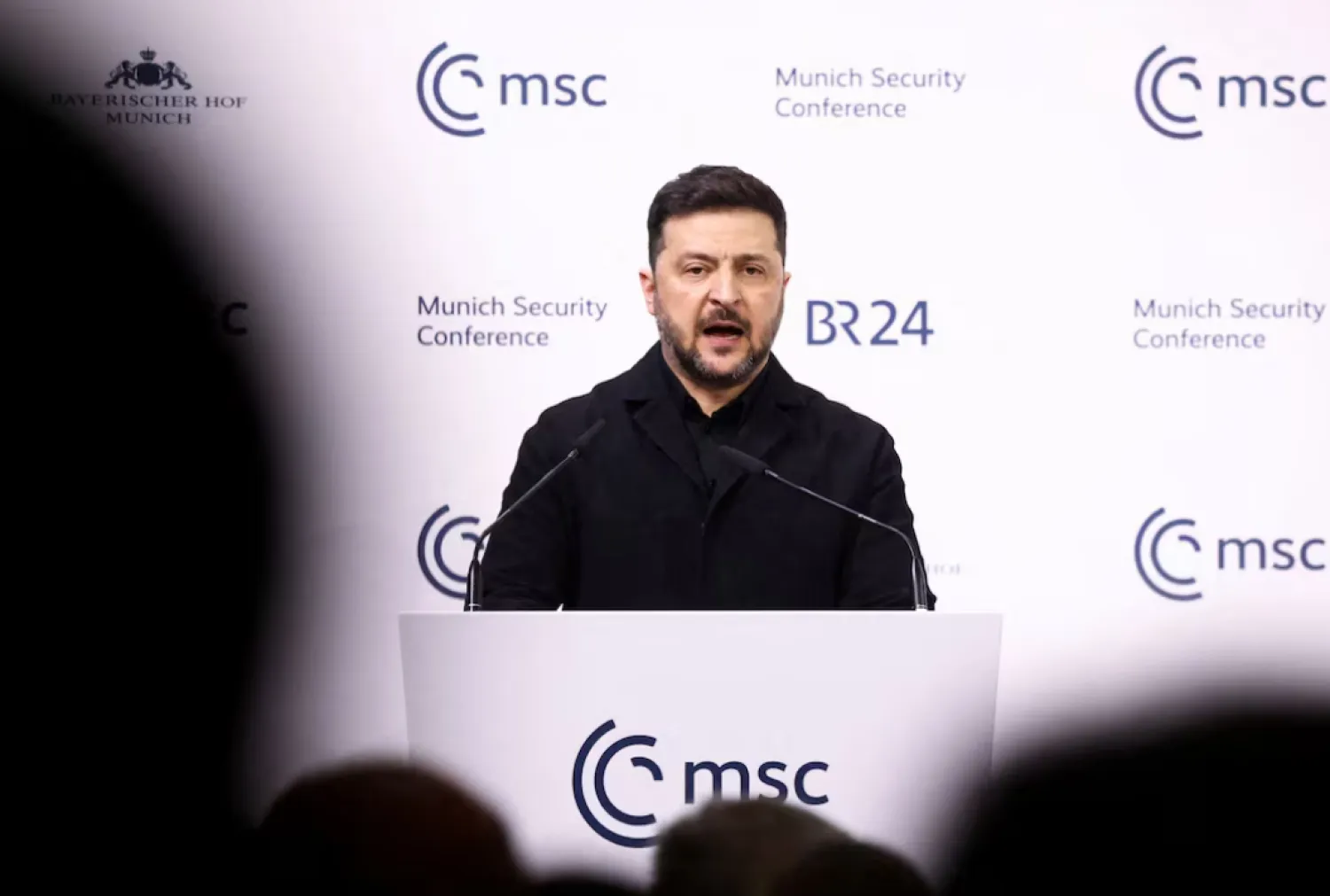
Ukrainian President Volodymyr Zelenskiy speaks during the Munich Security Conference (MSC) in Munich, Germany, February 14, 2026. REUTERS/Liesa Johannssen
TT

Zelenskiy Says US Too often Asks Ukraine, Not Russia, for Concessions

Ukrainian President Volodymyr Zelenskiy speaks during the Munich Security Conference (MSC) in Munich, Germany, February 14, 2026. REUTERS/Liesa Johannssen

Ukrainian President Volodymyr Zelenskiy voiced hope on Saturday that US-brokered peace talks next week in Geneva would be serious and substantive, but said Ukraine was being asked "too often" to make concessions in the negotiations.

Ukrainian, Russian and American delegations are due to meet in the Swiss lakeside city on Tuesday and Wednesday as US President Donald Trump seeks to push through a deal to end Europe's biggest war since 1945.

"We truly hope that the trilateral meetings next week will be serious, substantive, helpful for all us but honestly sometimes it feels like the sides are talking about completely different things," Zelenskiy said in a speech at the annual Munich Security Conference.

Ukraine and Russia, which invaded its neighbour in February 2022, have engaged in two recent rounds of talks brokered by Washington in Abu Dhabi described by the sides as constructive but achieving no major breakthroughs.

Zelenskiy called for greater action from Ukraine's allies to press Russia into making peace - both in the form of tougher sanctions and more weapons supplies.

Recalling his appeal four years ago, when he spoke at the same conference days before tens of thousands of Russian forces poured into Ukraine, Zelenskiy said there was too much talk by Western officials and not enough action.

Trump has the power to force Putin to declare a ceasefire and needed to do so, Zelenskiy said. Ukrainian officials have said a ceasefire is required to hold a referendum on any peace deal, which would be organised alongside national elections.

The Ukrainian leader, a former television entertainer, acknowledged he was feeling "a little bit" of pressure from Trump, who yesterday said Zelenskiy should not miss the "opportunity" to make peace soon and urged him "to get moving".

"The Americans often return to the topic of concessions and too often those concessions are discussed only in the context of Ukraine, not Russia," Zelenskiy said.

Instead, Zelenskiy said, he wanted instead to hear what compromises Moscow would be ready for, as Ukraine had already made many of its own.

DEADLOCK OVER TERRITORY

Land remains the major sticking point in negotiations, with Russia demanding that Ukraine cede the remaining 20% of the eastern area of Donetsk that Moscow has failed to capture - something Kyiv steadfastly refuses to do.

Zelenskiy said he was instead ready to discuss a US proposal for a free trade zone in that region, while freezing the rest of the 1,200-km (745-mile) front line.

Russia occupies about 20% of Ukraine's national territory, including Crimea and parts of the eastern Donbas region seized before the full-scale invasion in 2022.

Analysts say Moscow has gained about 1.5% of Ukrainian territory since early 2024. Its recent air strikes on Ukraine's cities and electricity infrastructure have left hundreds of thousands of Ukrainians without heating and power during the course of a bitterly cold winter.

Ukrainian officials have repeatedly expressed concern in recent weeks that US. congressional mid-term elections in November could focus the Trump administration on domestic political issues after the summer.

Zelenskiy said he hoped the US would stay involved in the negotiations, and that there would be an opportunity for Europe, which he said was currently sidelined, to play a bigger role.

'EUROPE NOT PRESENT'

"Europe is practically not present at the table. It's a big mistake to my mind," he said.

Russia said its delegation to Geneva would be led by Putin adviser Vladimir Medinsky, a change from negotiations in Abu Dhabi at which Russia's team was led by military intelligence chief Igor Kostyukov.

Ukrainian sources have criticised Medinsky's handling of previous talks, accusing him of delivering history lessons to the Ukrainian team instead of engaging in substantive negotiations.

Zelenskiy, who has long argued that the best way to achieve peace is to force Russia to the table with military and economic pressure, said he had discussed with French President Emmanuel Macron and European Commission chief Ursula von der Leyen punitive steps against tankers that export Russian oil.

Oil exports are a key revenue source for the Russian state, and in recent months some empty tankers have been targeted by Ukrainian drones.

On Saturday France's foreign minister said some G7 countries have expressed readiness to enact a maritime services ban on Russian oil and that Paris was "reasonably optimistic" it would be included in the European Union's next sanctions package.



Kremlin Accuses Ukraine of 'Reckless' Strikes on Major Gas Pipeline

File photo: Pipes at the landfall facilities of the Nord Stream 1 gas pipeline are pictured in Lubmin, Germany, March 8, 2022. (Reuters)
TT

Kremlin Accuses Ukraine of 'Reckless' Strikes on Major Gas Pipeline

File photo: Pipes at the landfall facilities of the Nord Stream 1 gas pipeline are pictured in Lubmin, Germany, March 8, 2022. (Reuters)

The Kremlin accused Ukraine on Thursday of targeting a major gas pipeline in southern Russia that leads to Türkiye with "reckless" drone strikes.

Ukraine has hit Russian energy targets throughout Moscow's four-year offensive, a war that has killed thousands and displaced millions.

"At night, there were renewed attempts to attack the Russkaya compressor station with drones," Kremlin spokesman Dmitry Peskov said, calling the pipeline an "international facility" that "ensures energy security for Türkiye".

"These are absolutely reckless actions by the Kyiv regime," Peskov said.

Russia's defense ministry said it had downed 10 Ukrainian-launched drones in the early hours of Thursday "above the gas compressor station that supplies gas to the TurkStream pipeline".

The station lies in Russia's southern Krasnodar region, which is regularly targeted by Ukrainian drone strikes.

State-owned Russian gas producer Gazprom earlier said that the Russkaya and Beregovaya stations were targeted.

It called them "critical energy infrastructure facilities ensuring the reliability of gas exports via the TurkStream and Blue Stream gas pipelines."

Russia has decimated much of Ukraine's energy infrastructure in more than four years of war.


First Passenger Train in Six Years Arrives in Pyongyang from China

A passenger train with cross-border service to North Korea's Pyongyang leaves Beijing Railway Station in Beijing, China March 12, 2026. REUTERS/Florence Lo
TT

First Passenger Train in Six Years Arrives in Pyongyang from China

A passenger train with cross-border service to North Korea's Pyongyang leaves Beijing Railway Station in Beijing, China March 12, 2026. REUTERS/Florence Lo

A passenger train that departed from the northeastern Chinese city of Dandong arrived in the North Korean capital Pyongyang on Thursday, as rail service between the neighboring countries resumed after six years.

The train arrived at a railway station in central Pyongyang, state news agency Xinhua said, after reporters from South Korea's Yonhap reported seeing a train crossing the Sino-Korean Friendship Bridge over the Yalu River.

China and ⁠North Korea are "friendly neighbours" and a cross-border passenger train service facilitates people-to-people exchanges, a foreign ministry spokesperson told reporters on Thursday.

China also backs stronger communication between both sides to ease such exchanges, the spokesperson added.

The service was suspended when the COVID-19 pandemic broke out ⁠in 2020.

North Korea is largely closed ‌to foreign tourism, with ‌few exceptions, largely for Russian tour ​groups under restricted arrangements, say ‌travel agencies organizing trips to the country.


NYT: US Says Iran Campaign Cost $11 Billion in Six Days

FILE PHOTO: A map showing the Strait of Hormuz and Iran is seen in this illustration taken June 22, 2025. REUTERS/Dado Ruvic/Illustration/File Photo
TT

NYT: US Says Iran Campaign Cost $11 Billion in Six Days

FILE PHOTO: A map showing the Strait of Hormuz and Iran is seen in this illustration taken June 22, 2025. REUTERS/Dado Ruvic/Illustration/File Photo

The opening week of the war against Iran cost the United States more than $11.3 billion, lawmakers were told in a Pentagon briefing, according to a New York Times report underscoring the pace at which the conflict is consuming weapons and resources.

The Times, citing unnamed sources familiar with Tuesday's closed-door briefing, said members of Congress were told that the figure excludes many costs connected with the buildup to the strikes -- suggesting the final tally for the first week could rise substantially.

Defense officials had previously told Congress that roughly $5.6 billion worth of munitions were expended in just the first two days of fighting, according to US media -- a burn rate far higher than earlier public estimates.

The Center for Strategic and International Studies (CSIS) independent think tank in Washington estimated that the first 100 hours of Operation Epic Fury cost $3.7 billion -- or more than $891 million per day.

Most of these costs, $3.5 billion, had not already been budgeted, the CSIS said.

The Iran War Cost Tracker website, which estimates the cost of the conflict in real time, showed a figure of more than $17 billion on its counter at around 08:00 GMT on Thursday.

According to the site, the United States is spending $1 billion per day on the war.

However, it points out the true cost of the war is likely higher, as the figures do not take into account long-term expenses such as veteran healthcare.