



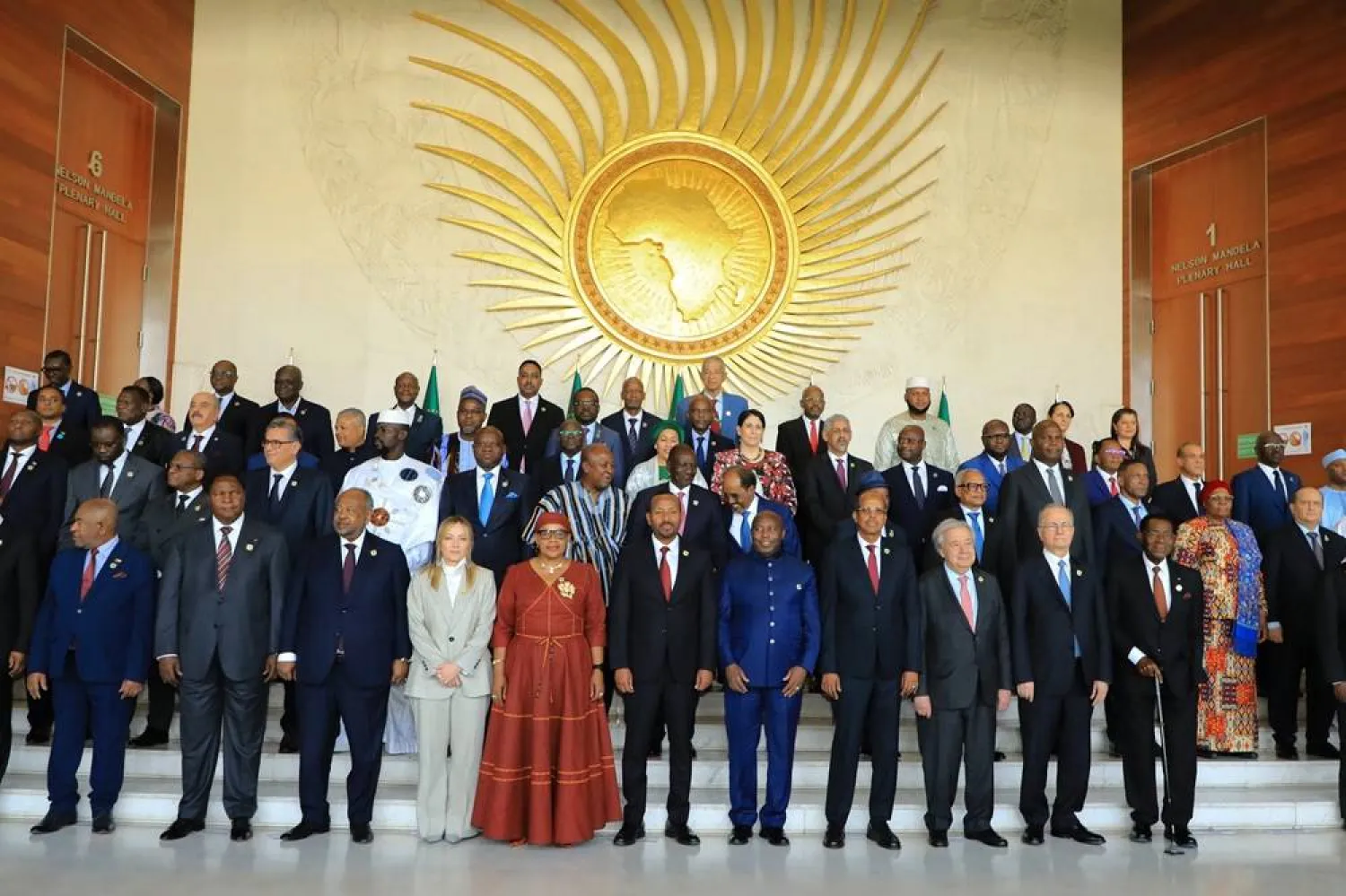

African leaders meeting in Addis Ababa at the 39th Ordinary Session of the African Union (AU) Assembly of Heads of State and Government called for unified action and African-led solutions to address the continent’s mounting challenges, particularly in the areas of peace and security and Africa’s representation on the UN Security Council.
Chairperson of the AU Commission Mahmoud Ali Youssouf stressed the importance of adhering to the principle of “African solutions to African problems,” noting that it has become a strategic necessity amid an increasingly turbulent global geopolitical environment.
He said water security and sanitation systems feature prominently on the agenda of this year’s summit, reflecting their central role in stability and sustainable development.
UN Secretary-General Antonio Guterres urged an end to Africa’s continued absence from permanent representation on the UN Security Council, describing the situation as unacceptable.
Africa must be present in all decisions related to the continent, he urged, reaffirming UN support for AU priorities, including silencing the guns, advancing the Sustainable Development Goals, and reforming the global financial architecture and the Security Council.
Ethiopian Prime Minister Abiy Ahmed said Africa is at a critical juncture, calling on member states to deepen their commitment to African-led solutions and collective responsibility in confronting shared challenges.
The summit also witnessed important institutional developments, including the election of the AU Bureau for 2026 and the handover of the rotating AU chairmanship from Angolan President Joao Lourenco to Burundian President Evariste Ndayishimiye.
Egypt, for its part, renewed calls for adopting a “comprehensive approach” to strengthening security across the continent.
Presenting the annual report of the AU Peace and Security Council, Egyptian Foreign Minister Badr Abdelatty said such an approach is essential to addressing interconnected challenges, foremost among them terrorism and foreign interference that undermine state sovereignty.
He underscored the need to boost early warning systems and activate preventive diplomacy and mediation mechanisms to address tensions at their early stages.
He underlined Egypt’s firm commitment to supporting Africa’s peace and security, highlighting its role in conflict prevention, preserving sovereignty and territorial integrity, and advancing stability and development.
He also drew attention to the African Union Support and Stabilization Mission in Somalia, noting that it continues to make progress despite funding gaps and renewed calls for sustainable and predictable financing.
African affairs analyst Ramy Zohdy said Egypt’s call for a comprehensive approach reflects a qualitative shift in understanding the nature of security threats facing the continent.
He told Asharq Al-Awsat that security in Africa can no longer be viewed solely through a military lens, but as an interconnected system encompassing political, economic, social, water, food, and information security.
Zohdy added that conflicts in the Sahel, the Horn of Africa, Central Africa, and the Great Lakes region are interlinked rather than isolated, stressing that restoring African ownership of solutions is key to reducing reliance on external interference.
A comprehensive approach could curb terrorism if it simultaneously strengthens national security institutions, disrupts illicit financing networks, and promotes development in fragile regions, he stressed.
The absence of an effective African collective security system has opened the door to external intervention, while stronger and more effective AU institutions would help narrow that space and reinforce the sovereignty of African states, he remarked.


