Madagascar Cyclone Death Toll Rises to 59 

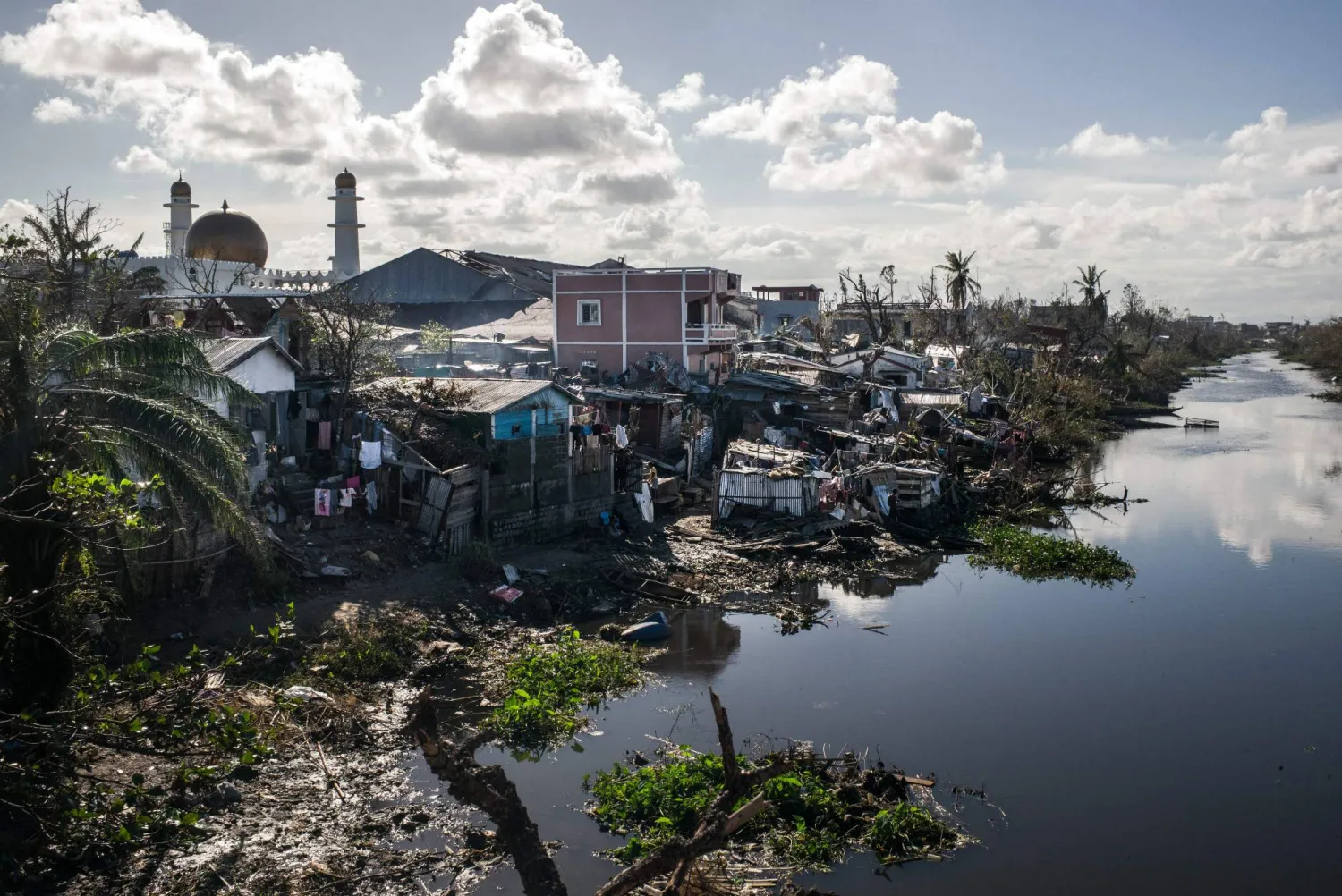
General view of the city center of Toamasina on February 14, 2026 following the passage of tropical cyclone Gezani during the night of February 10, 2026. (AFP)
TT

Madagascar Cyclone Death Toll Rises to 59 

General view of the city center of Toamasina on February 14, 2026 following the passage of tropical cyclone Gezani during the night of February 10, 2026. (AFP)

Flooding and fierce winds have pushed Madagascar's death toll from Cyclone Gezani to 59, with more than a dozen people still unaccounted for, the country's disaster agency said on Monday.

It is the latest in a string of tropical storms to batter the southern African island in recent months, underscoring its vulnerability to increasingly extreme weather fueled by climate change.

At least 59 people had been killed countrywide by the cyclone, which slammed into Madagascar on February 10, the National Office for Risk and Disaster Management (BNRGC) said, while more than 16,000 people have been displaced by storm waters.

A previous report had put the death toll at 43.

Most of the fatalities were reported in the port city of Toamasina on the east coast, formerly known as Tamatave, Madagascar's second-largest urban center with around 400,000 inhabitants.

Another 15 people remain missing nearly a week after the cyclone struck, according to BNRGC.

The damage to housing was extensive, with some 25,000 homes destroyed, 27,000 others flooded and more than 200 classrooms partially or completely wrecked, it said.

Gezani made landfall last week with winds topping around 250 kilometers (160 miles) per hour, prompting the government to declare a national emergency.

AFP images showed a trail of destruction across Toamasina, with streets in the city center still swamped by muddy floodwater and debris strewn between shuttered shops and damaged homes.

Residents queued for food at a primary school turned relief hub, while health workers screened families for malaria as the city began the slow clean-up and took stock of the cyclone's toll.

The World Food Program warned Friday that "the scale of destruction is overwhelming," with the city running on roughly five percent of its electricity and without water.

China and France have sent support for search and rescue efforts.

The storm largely spared neighboring Mozambique, skirting about 50 kilometers (30 miles) off its coast and causing far less damage, though authorities reported at least four deaths.

Pope Leo XIV on Sunday offered condolences and prayers for "the people of Madagascar, who have been struck by two cyclones in quick succession".

In early February, Madagascar's northwest was hit by Tropical Cyclone Fytia, which killed at least seven people and displaced more than 20,000.


Kremlin Rejects Claim it Poisoned Navalny with Dart Frog Toxin, Widow Says Truth is Out

A person lays flowers at the grave of Russian opposition leader Alexei Navalny while marking the first anniversary of his death at a cemetery in Moscow, Russia, February 16, 2025. REUTERS/Evgenia Novozhenina
TT

Kremlin Rejects Claim it Poisoned Navalny with Dart Frog Toxin, Widow Says Truth is Out

A person lays flowers at the grave of Russian opposition leader Alexei Navalny while marking the first anniversary of his death at a cemetery in Moscow, Russia, February 16, 2025. REUTERS/Evgenia Novozhenina

The Kremlin on Monday flatly rejected accusations from five European countries that the Russian state had killed Alexei Navalny two years ago using toxin from poison dart frogs, but his widow said the truth had finally been proven.

Navalny, President Vladimir Putin's most prominent domestic critic, died on February 16, 2024, in the "Polar Wolf" penal colony north of the Arctic Circle about 1,900 km (1,200 miles) northeast of Moscow. He was 47, Reuters reported.

His death, which the Russian state said was from natural causes, occurred a month before Putin was re-elected for a fifth term in a landslide vote which Western nations said was neither free nor fair due to censorship and a crackdown on opponents.

Britain, France, Germany, Sweden and the Netherlands said on Saturday that analyses of samples from Navalny's body had "conclusively" confirmed the presence of epibatidine, a toxin found in poison dart frogs in South America and not found naturally in Russia.

"Navalny died while held in prison, meaning Russia had the means, motive and opportunity to administer this poison to him," they said.

Kremlin spokesman Dmitry Peskov rejected the allegations.

"Naturally, we do not accept such accusations. We disagree with them. We consider them biased and not based on anything. And we strongly reject them," Peskov told reporters.

TEST RESULTS?

Maria Zakharova, a spokeswoman for the Russian Foreign Ministry, previously said Moscow would provide relevant comment if and when the countries making the allegations released and detailed their test results.

Until then, the state TASS news agency cited her as saying, the allegations were "merely propaganda aimed at diverting attention from pressing Western issues".

The British government on Saturday declined to respond to a Reuters query about how the samples from Navalny's body were obtained or where they were assessed.

The European joint statement referenced the 2018 Novichok poisoning in Salisbury, England, of former Russian agent Sergei Skripal and his daughter, suggesting that Moscow has form when it comes to using deadly poisons against its enemies.

Russia denies involvement in the Salisbury incident. It also rejects British allegations that Moscow killed dissident Alexander Litvinenko in London in 2006 by lacing his tea with radioactive polonium-210.

A group of 15 mostly European countries - but also including Australia, New Zealand and Canada - issued a fresh statement on Monday, reiterating their demands for Russia to conduct a transparent investigation into Navalny's death.

The statement, published on the German foreign ministry's website, said that Russian human rights defenders were continuing Navalny's legacy and called on Moscow to release "all political prisoners".

The dart frog toxin allegations were made at the Munich Security Conference ahead of the second anniversary of Navalny's death on Monday.

Yulia Navalnaya, his widow - who had alleged from the outset that her husband had been murdered by the Russian state - said on Monday that the findings provided the necessary proof to back her stance.

"Two years. We have attained the truth, and we will also attain justice one day," Navalnaya wrote on X above a photograph of her late husband smiling.


EU to Take Part in Trump’s ‘Board of Peace’ but Not as Member 

European Commissioner for the Mediterranean Dubravka Suica speaks during a debate on the “Situation in Northeast Syria, the violence against civilians and the need to maintain a sustainable ceasefire” as part of the European Parliament plenary session in Strasbourg, France, 10 February 2026. (EPA) 
TT

EU to Take Part in Trump’s ‘Board of Peace’ but Not as Member 

European Commissioner for the Mediterranean Dubravka Suica speaks during a debate on the “Situation in Northeast Syria, the violence against civilians and the need to maintain a sustainable ceasefire” as part of the European Parliament plenary session in Strasbourg, France, 10 February 2026. (EPA) 

The European Union will take part in this week's inaugural meeting of US President Donald Trump's "Board of Peace", but a spokesman insisted Monday that Brussels would not be joining as a member.

The European Commissioner for the Mediterranean, Dubravka Suica, will head to Washington to represent the EU at the meeting Thursday.

"She will participate in the meeting of the Board of Peace for the specific part dedicated to Gaza. Let me stress that the European Commission, it's not becoming a member to the Board of Peace," EU spokesman Guillaume Mercier said.

He added the EU executive was participating as part of its "long-standing commitment" to the implementation of the Gaza ceasefire and "to support the reconstruction and the post-recovery in Gaza", he added.

The Board of Peace, of which Trump is the chairman, was initially designed to oversee the Gaza truce and reconstruction after the war between Hamas and Israel.

But its purpose has since morphed into resolving all sorts of international conflicts, triggering fears the US president wants to create a rival to the UN.

Some EU member states have raised concerns about the board.

"We still have a number of questions regarding several elements in the Board of Peace: one concerning its scope, two concerning its governance, and three, its compatibility with the UN Charter," EU spokesman Anouar El Anouni said.


Kremlin Rejects European Assessment Navalny Died of Poisoning

People queue to visit the grave of Alexei Navalny, the late Russian opposition leader, on the second anniversary of his death, at the Borisovskoye Cemetery in Moscow, Russia, 16 February 2026. EPA/MAXIM SHIPENKOV
TT

Kremlin Rejects European Assessment Navalny Died of Poisoning

People queue to visit the grave of Alexei Navalny, the late Russian opposition leader, on the second anniversary of his death, at the Borisovskoye Cemetery in Moscow, Russia, 16 February 2026. EPA/MAXIM SHIPENKOV

The Kremlin said Monday that it "strongly rejected" an assessment by five European countries that Russian opposition leader Alexei Navalny died from poisoning two years ago, as his supporters marked the anniversary of his death in prison.

Navalny, a charismatic anti-corruption campaigner who rallied hundreds of thousands to the streets in protest at the Russian leadership, was Russian President Vladimir Putin's fiercest domestic opponent for years.

He died in an Arctic prison colony in February 2024 while serving a 19-year sentence for "extremism", a charge that he and his supporters say was punishment for his opposition work, said AFP.

Britain, Sweden, France, Germany and the Netherlands issued a joint statement on Saturday saying they believed he had been poisoned with epibatidine -- a toxin found in poison dart frogs -- and that the Russian state had the "means, motive and opportunity" to administer it.

"We naturally do not accept such accusations. We disagree with them. We consider them biased and baseless," Kremlin spokesman Dmitry Peskov told reporters, including AFP, during a daily briefing call.

"In fact, we strongly reject them," he added.

Dozens of people visited his grave in Moscow early Monday, among them foreign diplomats, according to an AFP reporter at the scene.

Some of those who attended wore masks or scarves over their faces.

Russian authorities designated Navalny and his organization "extremist" before his death, and anyone who mentions him or his exiled anti-corruption foundation are liable for prosecution.

Navalny, a Yale-educated lawyer, was the most widely known Russian opposition figure and galvanized thousands of young people to protest against Putin.

He had already survived a suspected poisoning with the Novichok nerve agent in 2020.

- Ecuadoran dart frog -

Navalny's mother Lyudmila told reporters she felt vindicated by the European statement and called for those responsible to be held accountable.

"This confirms what we knew from the very beginning. We knew that our son did not simply die in prison, he was murdered," she said outside the cemetery where he was buried in Moscow.

"I think it will take some time, but we will find out who did it. Of course, we want this to happen in our country, and we want justice to prevail," she added.

Navalny's widow, Yulia Navalnya, said on Saturday it was now "science proven" that her husband had been murdered.

She had previously said in September that laboratory analysis of smuggled biological samples found that her husband was poisoned.

Epibatidine, found in the Ecuadoran dart frog, causes muscle paralysis and eventual asphyxiation.

Experts have said the toxin can also be produced synthetically, instead of extracting it directly from the frog itself.

The European statement did not say how it was administered or by whom.

Britain's foreign office said the poison is not found naturally in Russia and that "only the Russian state had the means, motive and opportunity to deploy this lethal toxin."

Russia's prison service said he died after going for a walk and falling ill.

Since Navalny's death, Russia's opposition has remained largely exiled and fragmented.

Navalny's widow Yulia vowed to take the mantle of Russia's opposition in the wake of his death but has struggled to galvanize widespread support.

Inside Russia, Moscow has intensified a crackdown on anybody who had links with the late opposition leader.

In addition to targeting his allies and backers, photographers who covered his court hearings and lawyers who represented him at trial have been sentenced to lengthy prison terms.